

Download CBSE Class 12 Physics Useful Resources
Review targeted academic resources with the CBSE Class 12 Physics Thermal Expansion Theory and Examples. Built according to official CBSE standards for the 2026-27 term, these downloadable Class 12 Physics study materials support effective daily practice and deeper conceptual understanding for Thermal Expansion.
Access CBSE Study Guides and Summaries
Navigate directly to the advanced Physics study materials using the digital viewer below. Each resource pack includes detailed conceptual summaries and solved practice questions, allowing students to instantly reinforce their learning.
CBSE Class 12 Physics Thermal Expansion Theory and Examples. Please refer to the examination notes which you can use for preparing and revising for exams. These notes will help you to revise the concepts quickly and get good marks.
1. INTRODUCTION
Solids are made of atoms and molecules. At a given temperature, the atoms and molecules are placed at some equilibrium distance. When heat is supplied to solid, the interatomic separation increases by which there is an expansion of solids. This expansion can be in terms of length/area/volume.

2. LINEAR EXPANSION OF SOLID
(i) Almost all solids expand on heating. On increasing the temperature of a solid, its length increases. This change in length of a solid on heating is called linear expansion.
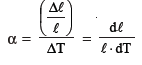
(ii) Coefficient of linear expansion is defined as fractional increase in length per ºC rise in temperature. If l is the length of the rod at T K and as the temperature is changed to T + ΔT its length becomes l+ Δl, so coefficient of linear expansion is given by
(iii) Unit of α is Per Kelvin or Per ºC. It is positive for metals except carbon. The value of α is negative for plastic because in plastic when the temperature increases, length decreases.
(iv)The numerical value of α is same in both the units i.e. in Per Kelvin or Per ºC
(v) If α is coefficient of linear expansion at t1ºC.
l1 = length of the rod at t1ºC
l2 = length of the rod at t2ºC
l2 =l1[1 + α(t2 – t1)]
t may be in any unit ºC or ºK because in the formula there is a difference of temperature which remains same for ºC or ºK.
(vi) If length of the rod is l0 at 0ºC and lt at tºC than
lt = l0 [1 + α (t – 0)]
lt = l0(1 + αt)
where α is temperature coefficient of linear expansion at 0ºC. Here t should be in ºC only because initial temperature is taken as 0ºC.
From the above tree, it is clear that the thermal expansion of solid is classified into three categories.
(1) Linear expansion of solids
(2) Superficial expansion of solids
(3) Cubical expansion of solids
Now we shall discuss these topics one by one.
3. APPLICATION OF LINEAR EXPANSION
3.1 Differential expansion of two solid rod
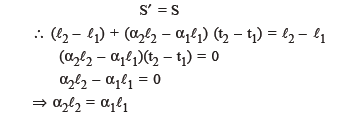
(1) Suppose there are two rods of length l1 and l2.The first rod is kept on the other such that the initial separation between the free ends of the
rod is S = l2 – l1
Both the rods are initially at a temperature of t1ºC. On heating the entire system, the temperature increases to t2 such that the length of both the rod increases. So, if the new length of the rod be

3.2 Radius of Bimetallic strip
If two strips of different metals are welded together to form a bimetallic strip, when heated uniformly it bends in the form of an arc, the metal with greater coefficient of linear expansion lies on convex side. The radius of arc thus formed by bimetal is
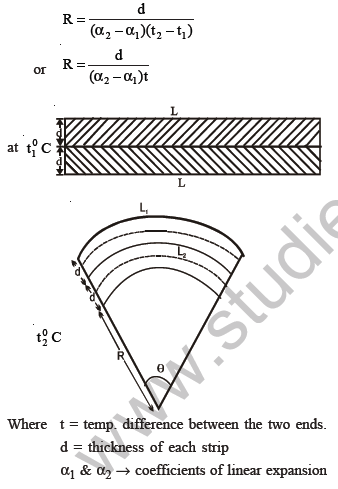
Differential expansion of two solid rods
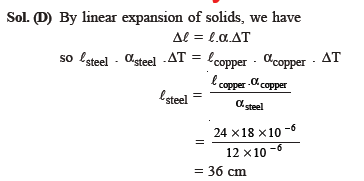
Ex. 1 The length of the steel rod which would have the same difference in length with a copper rod of length 24cm at all temperatures. (αcopper = 18 × 10–6 k–1, αsteel = 12 × 10–6 k–1)
is –
(A) 20 cm (B) 18 cm (C) 24 cm (D) 36 cm
Ex. 2 A metal sheet with a circular hole is heated. The hole
(A) Gets larger
(B) Gets smaller
(C) Remains of the same size
(D) Gets deformed
Sol. (A) When a body is heated, the distance between any two points on it increases. So due to thermal expansion of solids, the hole gets larger.
Ex. 3 Two identical rectangular strips one of copper and other of steel are riveted together to form a bimetallic strip (αcopper > αsteel). On heating this strip will
(A) Remains straight
(B) Bend with copper on convex side
(C) Bend with steel on convex side
(D) Get twisted
Sol. (B) When a bimetallic strip of different metals is heated, the strip bends due to unequal linear expansion of the two metals. The strip will bend with metal of greater α on the convex side i.e. outer side.
3.3 Thermal stress
(1) When a rod is heated or cooled, it expands or contracts. It is turned as free expansion of the rod
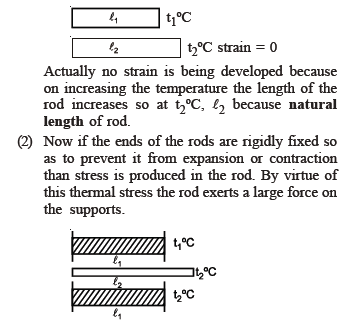
Please click on below link to download pdf file for CBSE Class 12 Physics Thermal Expansion Theory and Examples.
Free study material for Physics
Physics Class 12 Exam Resources: Thermal Expansion
Essential Notes for Class 12 Physics
Review targeted study resources for Thermal Expansion tailored for Class 12 learners. Utilizing these structured notes and quick-revision tools ensures complete alignment with current CBSE evaluation standards.
Verified Solutions for Class 12 Physics
Designed around the official curriculum, these study guides guarantee standard compliance. Reviewing step-by-step solutions clarifies complex sub-topics within Thermal Expansion and demystifies standard marking schemes for Physics evaluations.
Enhance Accuracy with Online Tests
For peak performance in upcoming evaluations, integrate official Physics sample papers directly into your study schedule. Follow up your revision by attempting online MCQ tests for Thermal Expansion to refine calculation speed and precision.
FAQs
Our advanced study package for Thermal Expansion includes detailed concepts, diagrams, Mind Maps, and explanation of complex topics to ensure Class 12 students learn as per syllabus for 2026 exams.
The Mind Maps provided for Thermal Expansion act as visual anchors which will help faster recall during high-pressure exams.
Yes, teachers use our Class 12 Physics resources for lesson planning as they are in simple language and have lot of solved examples.
Yes, You can download the complete, mobile-friendly PDF of the Physics Thermal Expansion advanced resources for free.
Yes, our subject matter experts have updated the Thermal Expansion material to align with the rationalized NCERT textbooks and have removed deleted topics and added new competency-based questions.