

Download CBSE Class 12 Physics Useful Resources
Access comprehensive study materials and useful resources for Chapter 03 Current Electricity using the CBSE Class 12 Physics Current Electricity Theory and Examples. Designed to align with the 2026-27 CBSE academic guidelines, these advanced resources help Class 12 Physics students reinforce core concepts beyond standard textbooks.
Access CBSE Study Guides and Summaries
Access the complete useful resource PDF for Class 12 Physics below. Regular practice with these targeted academic notes builds familiarity with complex topics and helps secure higher marks in final school evaluations.
CBSE Class 12 Physics Current Electricity Theory and Examples. Please refer to the examination notes which you can use for preparing and revising for exams. These notes will help you to revise the concepts quickly and get good marks.
1. ELECTRIC CURRENT
(a) When a charge flows in a conductor from one place to the other, then the rate of flow of charge is called electric current(i)
(b) The electric current in measured by 'rate of flow of charge'.or
(c) Charge flowing per second from any cross section of the conductor is called electric current,
Current i = Charge/Time= dq/dt, if flow is uniformi =q t
(d) Unit : Ampere (A) 1 ampere = 1 coulomb/second. i.e. if 1 coulomb of charge flows per second then 1 ampere of current is said to be flowing.
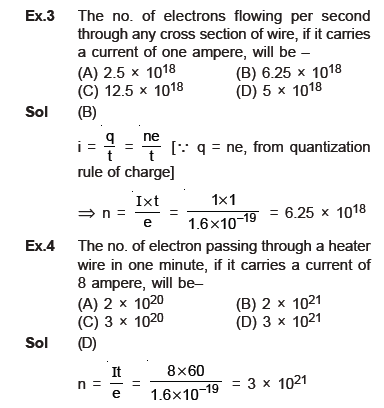
(e) Dimension : (M0L0T0A1) (f) If n electrons pass through any cross section in every t seconds then i = ne/t where e = 1.6 × 10⁻¹⁹ coulomb.
(g) 1 ampere of current means the flow of 6.25 × 10¹⁸ electrons per second through any cross section of conductor
(h) Direction of flow of current is taken to be opposite to the direction of flow of electrons.
(i) Value of the current is same throughout the conductor, irrespective of the cross section of conductor at different points.
(j) Net charge in a current carrying conductor is zero at any instant of time.
Note : A current carrying conductor cannot said to be charged, because in conductor the current is caused by electron (free electron). The no. of electron (negative charge) and proton (positive charge) in a conductor is same. Hence the net charge in a current carrying conductor is zero.
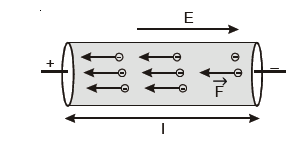
(k) Electric field outside a current carrying conductor is zero, but it is non zero inside the conductor and is given by e = –v/l
Note : The electric field inside charged conductor is zero, but it is non zero inside a current carrying conductor
(l) Electric current is a scalar quality Although in diagrams, we represent current in a wire by an arrow but the arrow simply indicate the direction of flow of positive charges in the wire.
Note : Though electric current needs direction for its representation, yet it is scalar quantity. It is because, the current can be added algebraically. Only scalar quantities can be added algabraically not the vector quantities.
Electric current
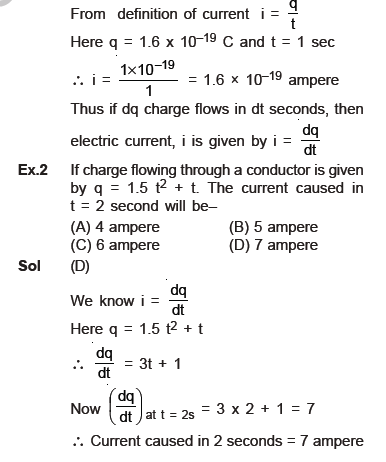
Ex.1 If a charge of 1.6 × 10⁻¹⁹ coulomb flows per second through any cross section of any conductor, the current constitute will be–
(A) 2.56 × 10⁻¹⁹ A (B) 6.25 × 10⁻¹⁹ A (C) 1.6 × 10⁻¹⁹ A (D) 3.2 × 10⁻¹⁹ A
Sol (C)
Ex.5 In hydrogen atom, the electron moves in an orbit of radius 5 × 10–11 m with a speed of 2.2 × 10⁶ m/sec. the equivalent current will be –
(A) 1.12 mA (B) 4.32 mA (C) 3.32 mA (D) 7.12 mA
Sol (A)
Time taken by the electron in 1 revolution isT =2πr/v where r is the radius of orbit and v is the speed. Therefore, the no. of revolutions in 1 second is
n =1/T= v/2π r =22 ×106 /2× 22/7×(5×10-11)
= 7 × 10¹⁵ /sec
In one revolution, 1.6 × 10⁻¹⁹ coulomb of charge flows through any point of the orbit. Hence the total charge flown in 1 sec. is q = charge in 1 revolution × no. of revolution in 1 sec. = (1.6 × 10–19) × (7.0 × 1015) = 1.12 × 10⁻³ coulomb
∴ Current I =q/t =11.2×10⁻³/1
= 1.12 × 10⁻³ amp = 1.12 mA
Ex.6 A conductor of non–uniform cross–sectional area, has cross–sectional area at three points as A1 = 2cm2, A2 = 4cm2, A3 = 6cm2. If a current of 5 ampere is passed through A1, the current will give values, when passed through A2 and A3 respectively as–
(A) 10 ampere, 15 ampere
(B) 20 ampere, 30 ampere
(C) 2.5 ampere, 1.66 ampere
(D) 5 ampere, 5 ampere
Sol Current will remain same.
Ex.7 A steady current is flowing in a cylindrical conductor. Is there any electric field within the conductor ? [IIT–82]
Sol Yes, The reason is that the current in a conductor flows only when the electric field established in the conductor applies a force on each free electron.
Ex.8 An electron moves in a circle of radius 10 cm with a constant speed of 4 × 10⁶ m/s find the electric current at a point on the circle.
Sol Consider a point A on the circle. The electron crosses this point once in every revolution. The number of revolutions made by electron in one second is –

2. CURRENT DENSITY
(a) The current density at a point in a conductor is the ratio of the current at that point in the conductor to the area of cross–section of the conductor of that point.
(b) It is denoted by j i.e. j =i/A
i = Electric current A = Area of cross section.
Note : Area 'A' is normal to current 'I'. If A is not normal to I, but makes an angle θ with the normal to current, then
Please click on below link to download pdf file for CBSE Class 12 Physics Current Electricity Theory and Examples.
Free study material for Physics
Physics Class 12 Exam Resources: Chapter 03 Current Electricity
Quick Revision Material for Chapter 03 Current Electricity
Explore essential learning tools for Class 12 Physics Chapter 03 Current Electricity. This curated collection features in-depth notes and targeted practice questions built around the active 2026 curriculum to streamline your daily revision.
Expert Notes and Solved Exam Questions
Built using official NCERT guidelines for Class 12 Physics, these materials provide reliable academic support. Integrating past examination questions and step-by-step solutions helps students understand official CBSE grading criteria.
Additional Study Resources for Class 12
Maximize your grade potential by utilizing Class 12 Physics practice papers in tandem with these structured notes. All printable assignments and interactive mock tests on our platform are updated for the 2026 session and available free of charge.
FAQs
Our advanced study package for Chapter 03 Current Electricity includes detailed concepts, diagrams, Mind Maps, and explanation of complex topics to ensure Class 12 students learn as per syllabus for 2026 exams.
The Mind Maps provided for Chapter 03 Current Electricity act as visual anchors which will help faster recall during high-pressure exams.
Yes, teachers use our Class 12 Physics resources for lesson planning as they are in simple language and have lot of solved examples.
Yes, You can download the complete, mobile-friendly PDF of the Physics Chapter 03 Current Electricity advanced resources for free.
Yes, our subject matter experts have updated the Chapter 03 Current Electricity material to align with the rationalized NCERT textbooks and have removed deleted topics and added new competency-based questions.