

Class 12 Physics Study Guide: CBSE Class 12 Physics Electrostatics Solved Examples
Explore structured advanced study materials through the CBSE Class 12 Physics Electrostatics Solved Examples. Tailored for Class 12 learners, utilizing these Physics resources ensures thorough preparation and strengthens foundational knowledge before final CBSE evaluations.
Download Chapter 02 Electrostatic Potential and Capacitance Study Material PDF
Access the complete useful resource PDF for Class 12 Physics below. Regular practice with these targeted academic notes builds familiarity with complex topics and helps secure higher marks in final school evaluations.
Question. Fg and Fe represents gravitational and electrostatic force respectively between electrons situated at a distance 10 cm. The ratio of Fg/ Fe is of the order of:
a. 1042
b. 10
c. 1
d. 43-10
Answer : D
Question. Which of the following charge is not possible?
a. 18 1.6 10-18 C
b. 1.6 10-19 C
c. 1.6 10-20 C
d. None of these
Answer : C
Question. A total charge Q is broken in two parts Q1 and Q2 and they are placed at a distance R from each other. The maximum force of repulsion between them will occur, when:
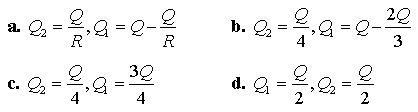
Answer : D
Question. If the radius of a solid and hollow copper spheres are same which one can hold greater charge?
a. Solid sphere
b. Hollow sphere
c. Both will hold equal charge
d. None of these
Answer : C
Question. Number of electrons in one coulomb of charge will be:
a. 5.46 × 1029
b. 6.25 ×10¹⁸
c. 1.6 ×10¹⁹
d. 9 × 10¹¹
Answer : B
Question. The force between two charges 0.06m apart is 5 N. If each charge is moved towards the other by 0.01m, then the force between them will become:
a. 7.20 N
b. 11.25 N
c. 22.50 N
d. 45.00 N
Answer : B
Question. Two point charges 1μC and 5μC are separated by a certain distance. What will be ratio of forces acting on these two?
a. 1 : 5
b. 5 :1
c. 1 : 1
d. 0
Answer : C
Question. Two point charges +3μC and +8μC repel each other with a force of 40 N. If a charge of −5μC is added to each of them, then the force between them will become:
a. −10N
b. +10N
c. +20N
d. −20N
Answer : A
Question. The ratio of electrostatic and gravitational forces acting between electron and proton separated by a distance 5 x 10-11m will be: (Charge on electron = 1.6 × 10⁻¹⁹ C, mass of electron = 9.1 × 10⁻³¹ kg, mass of proton = 1.6 10-27 kg G = 6.7 x 10⁻¹¹ Nm2/g2)
a. 2.36 × 1039
b. 2.36 × 1040
c. 2.34 × 1041
d. 2.34 × 1042
Answer : A
Question. Two charges of 40 μC and –20μC are placed at a certain distance apart. They are touched and kept at the same distance. The ratio of the initial to the final force between them is:
a. 8 :1
b. 4 :1
c. 1 : 8
d. 1 : 1
Answer : A
Question. Two particle of equal mass m and charge q are placed at a distance of 16 cm. They do not experience any force. The value of q/m is:
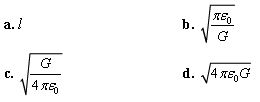
Answer : D
Question. Five balls numbered 1 to 5 balls suspended using separate threads. Pair (1,2), (2,4) and (4,1) show electrostatic attraction, while pair (2,3) and (4,5) show repulsion. Therefore ball 1 must be:
a. Positively charged
b. Negatively charged
c. Neutral
d. Made of metal
Answer : C
Question. ABC is a right angle triangle in which AB = 3 cm, BC = 4 cm and ∠ABC = π/∠ = . The three charges +15, +12 and – 20 e.s.u. are placed respectively on A, B and C. The force acting on B is:

a. 125 dynes
b. 35 dynes
c. 25 dynes
d. Zero
Answer : C
Question. A half ring of radius R has a charge of λ per unit length.
The electric field at the centre is (K = 1/4πε0)
a. Zero
b. kλ/R
c. 2kλ/R
d. kπλ/R
Answer : C
Question. The current produced in wire when 107 electron/sec are flowing in it:
a. 1.6 × 10⁻²⁶ amp
b. 1.6 × 10¹² amp
c. 1.6 × 1026 amp
d. 1.6 × 10⁻¹² amp
Answer : D
Question. The force between two charges 0.06 m apart is 5 N . If each charge is moved towards the other by 0.01m , then the force between them will become:
a. 7.20 N
b. 11.25 N
c. 22.50 N
d. 45.00 N
Answer : B
Question. The number of electrons to be put on a spherical conductor of radius 0.1m to produce an electric field of 0.036 N/C just above its surface is:
a. 2.7 ×10⁵
b. 2.6 ×10⁵
c. 2.5 ×10⁵
d. 2.4 ×10⁵
Answer : C
Question. Three particles, each having a charge of 10 μC are placed at the corners of an equilateral triangle of side 10 cm . The electrostatic potential energy of the system is: (Given 1/4πε0 = 9 x 10⁹ N - m2 / C2)
a. Zero
b. Infinite
c. 27 J
d. 100 J
Answer : C
Question. Two equal spheres are identically charged with q units of electricity separately. When they are placed at a distance 3R from centre-to-centre where R is the radius of either sphere the force of repulsion between them is:

Answer : A
Question. The insulation property of air breaks down at E = 3×10⁶ volt/metre. The maximum charge that can be given to a sphere of diameter 5 m, is approximately: (in coulombs)
a. 2 x 10⁻²
b. 2 x 10⁻³
c. 2 x 10⁻⁴
d. 2 x 10⁻⁵
Answer : B
Question. q, 2q, 3q and 4q charges are placed at the four corners A, B, C and D of a square. The field at the centre O of the square has the direction along:
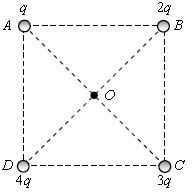
a. AB
b. CB
c. AC
d. BD
Answer : B
Question. What is the magnitude of a point charge due to which the electric field 30 cm away has the magnitude newton/coulomb 2 [1/ 4πε0 = 9×10⁹ Nm2]
a. 11 2 x 10⁻¹¹ coulomb
b. 11 3 x 10⁻¹¹ coulomb
c. 11 5 x 10⁻¹¹ coulomb
d. 11 9 x 10⁻¹¹ coulomb
Answer : A
Question. Two point charges Q and –3Q are placed at some distance apart. If the electric field at the location of Q is E, then at the locality of – 3Q, it is:
a. –E
b. E/3
c. –3E
d. - E/3
Answer : B
Question. Two charged spheres of radius R1 and R2 respectively are charged and joined by a wire. The ratio of electric field of the spheres is:
a. R1/R2
b. R2/R1
c. R12/R22
d. R22/R1
Answer : B
Question. Equal charges Q are placed at the vertices A and B of an equilateral triangle ABC of side a. The magnitude of electric field at the point A is:
a. Q/4πε0a2
b. √2Q/4πε0a2
c. √3Q/4πε0a2
d. Q/2πε0a2
Answer : C
Question. Eight charges having the valves as shown are arranged symmetrically on a circle of radius 0.4m in air. Potential at centre O will be:
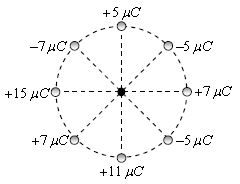
a. 63×104 volt
b. 10 63×1010 volt
c. 63×106 volt
d. Zero
Answer : A
Question. As shown in the figure, charges +q and –q are placed at the vertices B and C of an isosceles triangle. The potential at the vertex A is:
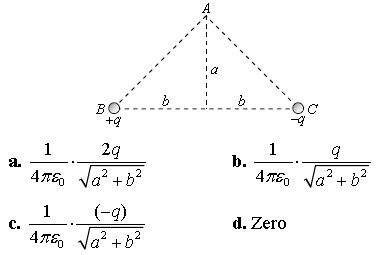
Answer : D
Question. A hollow metal sphere of radius 5cm is charged such that the potential on its surface is 10 volts. The potential at the centre of the sphere is:
a. Zero
b. 10 V
c. Same as at a point 5 cm away from the surface
d. Same as at a point 25 cm away from the surface
Answer : B
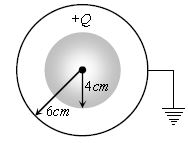
Question. A sphere of 4 cm radius is suspended within a hollow sphere of 6 cm radius. The inner sphere is charged to a potential 3 e.s.u. When the outer sphere is earthed. The charge on the inner sphere is:
a. 54 e.s.u.
b. 1/4 e.s.u.
c. 30 e.s.u.
d. 36 e.s.u.
Answer : D
Question. A charge Q is distributed over two concentric hollow spheres of radii r and (R > r) such that the surface densities are equal. The potential at the common centre is:
a. Q(R2 + r2) / 4πε0(R + r)
b. Q/R + r
c. Zero
d. Q(R + r) / 4πε0(R2 + r2)
Answer : D
Question. A solid conducting sphere having a charge Q is surrounded by an uncharged concentric conducting hollow spherical shell. Let the potential difference between the surface of the solid sphere and that of the outer surface of the hollow shell be V. If the shell is now given a charge of – 3Q, the new potential difference between the two surfaces is:
a. V
b. 2V
c. 4V
d. –2V
Answer : A
Question. An electric dipole of moment p placed in a uniform electric field E has minimum potential energy when the angle between p and E is:
a. Zero
b. π/2
c. π
d. 3π/2
Answer : C
Question. If the magnitude of intensity of electric field at a distance x on axial line and at a distance y on equatorial line on a given dipole are equal, then x : y is:
a. 1 : 1
b. 1 : 2
c. 1 : 2
d. 2 : 1
Answer : D
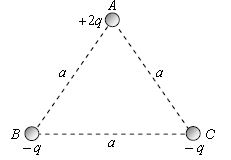
Question. Three charges of (+2q), (– q) and (– q) are placed at the corners A, B and C of an equilateral triangle of side a as shown in the adjoining figure. Then the dipole moment of this combination is:
a. qa
b. Zero
c. q a√3
d. (2/√3) qa
Answer : C
Ex.1 Two identical conducting small spheres are given charges of opposite sign. These attract each other with a force of 0.3 Newton when placed at a distance of 30 cm. These spheres are then connected by a conducting wire. When the conducting wire us removed, the spheres repel each other with a force of 0.1 Newton at the same distance of 30 cm. Find the initial charges on each sphere.
Sol.: Let the charge on the spheres be +q1 and –q2.

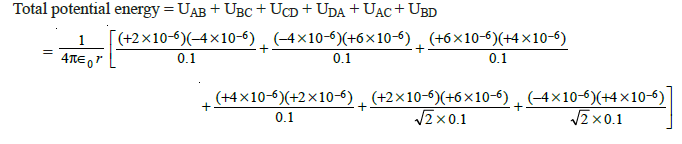
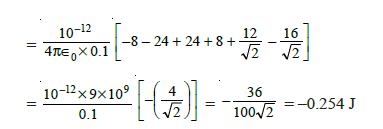
Ex.2 Four charges +2μC, –4μC, +6μC and +4μC are lying at the corners A, B, C and D respectively of a square ABCD of side 0.1 m as shown in the figure. Find the work done in assembling these charges.
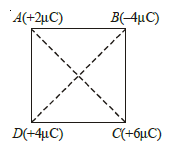
Sol.: When these four charges are lying at infinity initially, these can be brought from infinity to the respective points A, B, C and D. Thus work has to be done in assembling these
charges because of their interaction with each other. The total work done will be equal to the sum of potential energies required for each pair of particles.
Ex.3 A small sphere of mass 100 mg is given a charge of +2.5 × 10⁻¹⁰ coulomb. It hangs from an insulating and inextensible string 0.2 m long. The upper end of the string is connected to a large positively charged plane vertical conducting plate which has a surface charge density σ = 1.5 × 10⁻⁵ C.m–2. Find the angle which the string makes with the vertical direction at equilibrium.
Sol.: The electric field E due to the large conducting sheet = E =σ /∈0
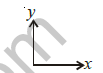
Repulsive force experienced by charge q on the sphere = F = qE =qσ/∈0

The following forces act on the sphere :
(i) Weight = mg
(ii) Electrostatic force of repulsion between sphere and metallic plate = F
(iii) Tension in the string = T
The string is deflected through angle θ to the vertical. When the sphere is in equilibrium state, resultant force

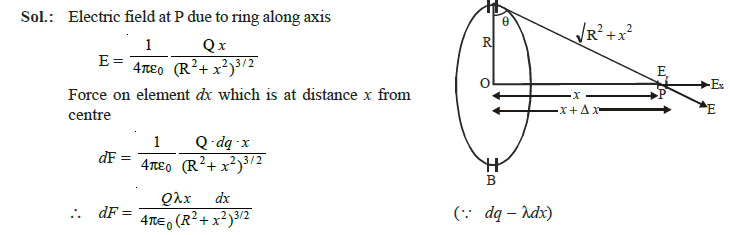
Ex.4 A thin vertical wire ring of radius R and a very long uniformly charged straight wire are so placed that one end of the wire coincides with the centre of the ring. The total charge on the ring is Q and the wire has a uniform charge per unit length equal to λ. Find the interaction force between the ring and the straight wire.
Please click on below link to download pdf file for CBSE Class 12 Physics Electrostatics Solved Examples.
Free study material for Physics
CBSE Class 12 Physics Study Material: Chapter 02 Electrostatic Potential and Capacitance
Essential Notes for Class 12 Physics
Explore essential learning tools for Class 12 Physics Chapter 02 Electrostatic Potential and Capacitance. This curated collection features in-depth notes and targeted practice questions built around the active 2026 curriculum to streamline your daily revision.
Verified Solutions for Class 12 Physics
Each resource draws directly from authorized textbooks to maintain academic accuracy. Evaluating solved examples allows Class 12 students to master the formal presentation and answer-writing standards expected in upcoming school exams.
Enhance Accuracy with Online Tests
For peak performance in upcoming evaluations, integrate official Physics sample papers directly into your study schedule. Follow up your revision by attempting online MCQ tests for Chapter 02 Electrostatic Potential and Capacitance to refine calculation speed and precision.
FAQs
Our advanced study package for Chapter 02 Electrostatic Potential and Capacitance includes detailed concepts, diagrams, Mind Maps, and explanation of complex topics to ensure Class 12 students learn as per syllabus for 2026 exams.
The Mind Maps provided for Chapter 02 Electrostatic Potential and Capacitance act as visual anchors which will help faster recall during high-pressure exams.
Yes, teachers use our Class 12 Physics resources for lesson planning as they are in simple language and have lot of solved examples.
Yes, You can download the complete, mobile-friendly PDF of the Physics Chapter 02 Electrostatic Potential and Capacitance advanced resources for free.
Yes, our subject matter experts have updated the Chapter 02 Electrostatic Potential and Capacitance material to align with the rationalized NCERT textbooks and have removed deleted topics and added new competency-based questions.