

Advanced Study Material for Class 12 Physics: Rotational Motion
Access comprehensive study materials and useful resources for Rotational Motion using the CBSE Class 12 Physics Rotational Motion Basic Problems. Designed to align with the 2026-27 CBSE academic guidelines, these advanced resources help Class 12 Physics students reinforce core concepts beyond standard textbooks.
Practice Class 12 Physics Resources: Rotational Motion
Access the complete useful resource PDF for Class 12 Physics below. Regular practice with these targeted academic notes builds familiarity with complex topics and helps secure higher marks in final school evaluations.
CBSE Class 12 Physics Rotational Motion Basic Problems. Please refer to the examination notes which you can use for preparing and revising for exams. These notes will help you to revise the concepts quickly and get good marks.
1. A small steel sphere of mass m and radius r rolls without slipping on the frictionless surface of large hemisphere of radius R whose axis of symmetry is vertical. It starts at the top from the rest.
(a) What is the kinetic energy at the bottom ?
(b) What fraction is the rotational kinetic energy of the total kinetic energy ?
(c) What fraction is the translational kinetic energy of the total kinetic energy ?
(d) Calculate the normal force that the small sphere will exert on the hemisphere at its bottom.
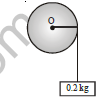
2. A wheel of radius 6 cm is mounted so as to rotate about a horizontal axis through its centre. A string of negligible mass wrapped round its circumference carries a mass of 0.2 kg attached to its free end. When let fall, the mass descends through one metre in 5 seconds. Calculate the angular acceleration of the wheel, its moment of inertia and tension in the cord.
3. On the flat surface of a disc of radius a, a small circular hole of radius b is made with its centre at a distance c from the centre of the disc. If mass of the whole uncut disc is M, calculate the moment of inertia of the holed disc about the axis of the circular hole.
4. A solid cylinder is attached to a horizontal massless spring, so that it can roll without slipping along a horizontal surface. The force constant k of the spring is 3.0 nt/metre. If the system is released from rest at a position in which the spring is stretched 0.25 metre, find the translational kinetic energy and the rotational kinetic energy of the cylinder as it passes through the equilibrium position.
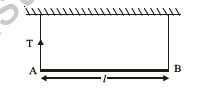
5. A uniform rod of length l and mass M is suspended on two vertical inextensible strings as shown in figure. Calculate tension T in left string at the instant, when right string snaps.
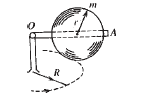
6. A uniform sphere of mass m and radius r rolls without sliding over a horizontal plane, about a horizontal axle OA as shown in figure. In the process, the centre of the sphere moves with velocity v along a circle of radius R. Find the kinetic energy of the sphere.
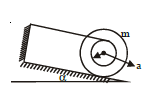
7. A spool with a thread wound on it is placed on an inclined smooth plane set at an angle α = 300 to the horizontal. The free end of the thread is attached to the wall as shown in figure. The mass of the spool is 200 gm, its moment of inertia relative to its own axis is 0.45 gm-m2, the radius of the wound thread layer is 3 cm. Find the acceleration of the spool axis.
8. A solid sphere is set into motion on a rough horizontal surface with a linear speed v in the forward direction and an angular speed v/R in the anticlockwise direction as shown in figure. Find the linear speed of the sphere
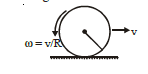
(a) when it stops rotating and
(b) when slipping finally ceases and pure rolling starts.
9. A solid sphere rolling on a rough horizontal surface with a linear speed v collides elastically with a fixed, smooth, vertical wall. Find the speed of the sphere after it has started pure rolling in the backward direction.
10. A thin spherical shell of radius R lying on a rough horizontal surface is hit sharply and horizontally by a cue. Where should it be hit so that the shell does not slip on the surface.
11. A uniform wheel of radius R is set into rotation about its axis at an angular speed ω. This rotating wheel is now placed on a rough horizontal surface with its axis horizontal. Because of friction at the contact, the wheel accelerates forward and its rotation declerates till the wheel starts pure rolling in the surface. Find the linear speed of the wheel after it starts pure rolling.
12. A thin spherical shell lying on a rough horizontal surface is hit by a cue in such a way that the line of action passes through the centre of the shell. As a result, the shell starts moving with a linear speed v without any initial angular velocity. Find the linear speed of the shell after it starts pure rolling on the surface.
13. A hollow sphere of radius R lies on a smooth horizontal surface. It is pulled by a horizontal force acting tangentially from the highest point. Find the distance travelled by the sphere during the time it makes one full rotation.
14. A solid sphere of mass 0.50 kg is kept on a horizontal surface. The coefficient of static friction between the surfaces in contact is 2/7. What maximum force can be applied at the highest point in the horizontal direction so that the sphere does not slip on the surface?
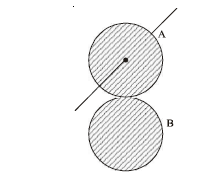
15. Two thin discs each of mass 4.0 kg and radius 0.4 m are attached as shown in the figure to form a rigid body. What in the moment of inertia of this body about an axis, perpendicular to the plane of disc B and passing through its centre?
Please click on below link to download pdf file for CBSE Class 12 Physics Rotational Motion Basic Problems.
Free study material for Physics
Useful Resources and Notes for Class 12 Physics Rotational Motion
Essential Notes for Class 12 Physics
Access comprehensive study material for Rotational Motion, including revision notes, concept maps, and high-probability questions. These resources are designed in alignment with the latest 2026 CBSE syllabus for Class 12 Physics to support effective exam preparation.
Verified Solutions for Class 12 Physics
Designed around the official curriculum, these study guides guarantee standard compliance. Reviewing step-by-step solutions clarifies complex sub-topics within Rotational Motion and demystifies standard marking schemes for Physics evaluations.
Enhance Accuracy with Online Tests
Maximize your grade potential by utilizing Class 12 Physics practice papers in tandem with these structured notes. All printable assignments and interactive mock tests on our platform are updated for the 2026 session and available free of charge.
FAQs
Our advanced study package for Rotational Motion includes detailed concepts, diagrams, Mind Maps, and explanation of complex topics to ensure Class 12 students learn as per syllabus for 2026 exams.
The Mind Maps provided for Rotational Motion act as visual anchors which will help faster recall during high-pressure exams.
Yes, teachers use our Class 12 Physics resources for lesson planning as they are in simple language and have lot of solved examples.
Yes, You can download the complete, mobile-friendly PDF of the Physics Rotational Motion advanced resources for free.
Yes, our subject matter experts have updated the Rotational Motion material to align with the rationalized NCERT textbooks and have removed deleted topics and added new competency-based questions.