

Official CBSE Study Materials for Class 12 Physics
Explore structured advanced study materials through the CBSE Class 12 Physics Rotational Motion Assignment. Tailored for Class 12 learners, utilizing these Physics resources ensures thorough preparation and strengthens foundational knowledge before final CBSE evaluations.
Advanced Resources for Physics
Navigate directly to the advanced Physics study materials using the digital viewer below. Each resource pack includes detailed conceptual summaries and solved practice questions, allowing students to instantly reinforce their learning.
Question. Inner and outer radii of a spool are r and R respectively. A thread is wound over its inner surface and spool is placed over a rough horizontal surface. Thread is pulled by a force F as shown in figure. In case of pure rolling, which of the following statements are false?

a. Thread unwinds, spool rotates anti-clock wise and friction acts leftwards
b. Thread winds, spool rotates clockwise and friction acts leftwards
c. Thread winds, spool moves to the right and friction acts rightwards
d. Thread winds, spool moves to the right and friction does not come into existence
Answer : ACD
Question. A smooth, light horizontal rod AB can rotate about a vertical axis passing through its end A. The rod is fitted with a small sleeve of mass m attached to end A by a massless spring of length l and force constant K. One person slowly sets the system to rotate with angular velocity ω and does work W1 and another person rotates the system with an angular acceleration α to set rotating with same angular velocity and does work W2 . Which of the following statements are wrong?
a. W1 = W2
b. W1 < W2
c. W1 > W2
d. W1 ≤ W2
Answer : ACD
Question. A horizontal plane support a fixed vertical cylinder of radius R and a particle is attached to the cylinder by a horizontal thread AB as shown in figure.
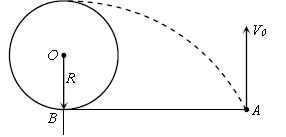
A horizontal velocity 0 υ is imparted to the particle, normal to the threading during subsequent motion. Point out false statements:
a. angular momentum of particle about O remains constant
b. angular momentum about B remains constant
c. momentum and kinetic energy both remain constant
d. kinetic energy remains constant
Answer : ABC
Question. A uniform sphere of mass m and radius r rolls without sliding over a horizontal plane, rotating about the horizontal axis OA. In the process, center of sphere moves with velocity υ along a circle of radius R. Total KE of the sphere is:

Answer : ABC
Question. In the HCl molecule, the separation between the nuclei of hydrogen and chlorine atoms is 1.27 Å. If the mass of the chlorine atom is 35.5 times that of hydrogen atom, the center of mass of the HCl molecule is at a distance of:
a. 35.5 x 1.27 / 36.5 Å from the hydrogen atom
b. 35.5 x 1.27 / 36.5 Å from the chlorine atom
c. 1.27 / 36.5 Å from the hydrogen atom
d. 1.27 / 36.5 Å form the chlorine atom
Answer : AD
Question. A stepped cylinder (shown in figure) is having a mass of 50 kg and a radius of gyration k of 0.30 m.
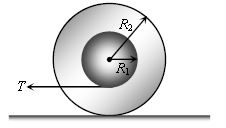
The radii R1 and R2 are respectively 0.30 m and 0.60 m. A pull T equal to 200 N is exerted on the rope attached to the inner cylinder. The coefficients of static and dynamic friction between cylinder and ground are respectively, 0.10 and 0.08. Which of the following are correct?
a. The angular acceleration is 2.67 rad/sec2
b. The force of kinetic friction is 39.2 N
c. The acceleration is – 3.2 ms–2
d. None of the above
Answer : ABC
Question. Figure shows four identical point masses, each of mass m, in the x − y plane. If Ix, Iy and iz are the moments of inertia of the system about x-axis, y-axis and z-axis respectively, then which of the following statements are correct?

a. Ix = 2ma2
b. Iy = 8ma2
c. Iz = 10ma2
d. The total moment of inertia of the system is 20 ma2
Answer : ABC
Question. A cylinder of mass M and radius R starts falling freely under gravity at t = 0 as shown in figure.

The tension in each string at any given time t is T. The instantaneous power developed by the gravitational force at time t is P. The linear acceleration of the cylinder is a.
Which of the following are correct?
a. T = (mg / 6)
b. a = (2g / 3)
c. P = (2 / 3)Mg2 t
d. None of these
Answer : ABC
Question. A solid sphere of radius R has moment of inertia I about its geometrical axis. It is melted into a disc of radius r and thickness t. If it’s moment of inertia about the tangential axis (which is perpendicular to plane of the disc), is also equal to I, then the value of r is equal to:
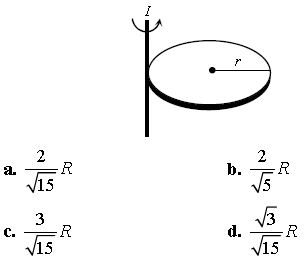
Answer : A
Question. One quarter section is cut from a uniform circular disc of radius R. This section has a mass M. It is made to rotate about a line perpendicular to its plane and passing through the centre of the original disc. Its moment of inertia about the axis of rotation is:
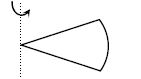
a. (1/2)MR2
b. (1/4)MR2
c. (1/8)MR2
d. √2MR2
Answer : A
Assertion and Reason
Note: Read the Assertion (A) and Reason (R) carefully to mark the correct option out of the options given below:
a. If both assertion and reason are true and the reason is the correct explanation of the assertion.
b. If both assertion and reason are true but reason is not the correct explanation of the assertion.
c. If assertion is true but reason is false.
d. If the assertion and reason both are false.
e. If assertion is false but reason is true.
Question. Assertion: The center of mass of a body may lie where there is no mass.
Reason: Centre of mass of a body is a point, where the whole mass of the body is supposed to be concentrated.
Answer : A
Question. Assertion: The common automobile speedometer is a tachometer whose readings are proportional to the instantaneous angular velocity of the drive shaft to which it is connected, and it reads the linear velocity of the drive shaft.
Reason: The linear velocity of the automobile is proportional to angular velocity of the derive shaft to which the tachometer is connected.
Answer : A
Question. Assertion: If there is no external torque on a body about its center of mass, then the velocity of the center of mass remains constant.
Reason: The linear momentum of an isolated system remains constant.
Answer : D
Question. Assertion: The center of mass of a system of n particles is the weighted average of the position vector of the n particle making up the system.
Reason: The position of the center of mass of a system is independent of coordinate system.
Answer : B
Question. Assertion: Moment of inertia of circular ring about a given axis is more than moment of inertia of the circular disc of same mass and same size about the same axis.
Reason: The circular ring is hollow so its moment of inertia is more than that of circular disc which is solid.
Answer : B
Question. Assertion: A shell at rest explodes. The center of mass of fragments moves along a straight path.
Reason: In explosion, the linear momentum of the system remains always conserved.
Answer : E
Question. Assertion: In general, to analyse the motion of a body, we cannot treat it as a point mass concentrated at its center of mass.
Reason: The radius of gyration may not be equal to separation between center of mass and axis, for a body
Answer : A
Question. Assertion: A disc A moves on a smooth horizontal plane and rebounds elastically form a smooth vertical wall (Top view is shown in figure). In this point on line XY, the angular momentum of the disc remains conserved.
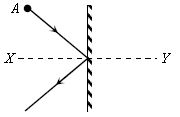
Reason: About any point in the plane, the torque experienced by disc is zero as gravity force and normal contact force balances each other.
Answer : C
Question. Assertion: A solid cylinder is performing pure rolling motion on a rough horizontal surface; such that it’s KE remains constant (Assume no external force except gravity and contact force).
Reason: Friction force is having zero value.
Answer : B
Question. Assertion: A block is kept on a rough horizontal surface, under the action of a force F as shown in the figure. The torque of normal contact force about center of mass is having zero value.
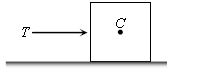
Reason: The point of application of normal contact fore may not pass through center of mass.
Answer : E
Integer
Question. Two homogeneous spheres A and B of masses m and 2 m having radii 2 a and a respectively are placed in contact. The ratio of distance of c.m. from first sphere to the distance of c.m. from second sphere is:
Answer : 2
Question. A non-uniform thin rod of length L is placed along X-axis so that one of its ends is at the origin. The linear mass density of rod is λ = λ0x ⋅ The centre of mass of rod divides the length of the rod in the ratio:
Answer : 2/1
Question. A sphere of mass 5 kg and diameter 2 m rotates about a tangent. What is its moment of inertia?
Answer : 7
Question. A uniform rod of length 1 m and mass 0.5 kg rotates at angular speed of 6 rad/sec about one of its ends. What is the KE of the rod?
Answer : 3
Question. A particle performing uniform circular motion has angular momentum L. When its angular velocity is doubled and KE is also doubled, the new angular momentum becomes x times. What is x?
Answer : 1
Comprehension-1
To start rolling, a torque about centre of the body is required, which is usually provided by friction or any other external force acting on the body. When a body rolls on the rough ground, friction does not work over it. In the given figure a ball is released from rest which rolls down on inclined surface and movesup on the other side.
First half of the track is rough enough to support rolling and the other half is smooth. Now
answer the following questions.
1. The velocity of sphere on point B is
(a) 2gh
(b) gh710
(c) gh
(d) none of these
2. The sphere reaches the other side up to point H. Where H is
(a) h
(b) 57h
(c) 75h
(d) none of these
3. In the above question, the correct statement is
(a) the ball will roll from A to B and onward.
(b) the ball will reach at point C where its K.E. is zero
(c) the ball will reach up to point C and its K.E. at highest point will not be zero.
(d) none of them is correct
Comprehension-2
As in linear motion, External force changes the linear momentum similarly in rotational motion external torque changes the angular momentum and relationship between torque and angular momentum (L)

5. Change in linear momentum of cylinder is
(a) FΔt (b) 2 FΔt (c) F/2 Δt (d) none of these
6. Change in translational kinetic energy of cylinder is
(a) F2 Δt 2 /2m (b) 1/2 mVc2 (c) m/4 V2c (d) 1/4 mr 2ω2
7. Change in angular velocity is
(a) Vc/r (b) F Δt/mr (c) 2 F Δt/ mr (d) none of these
Each of the questions given below consists of two statements, an assertion (A) and reason (R).
Select the number corresponding to the appropriate alternative as follows
(a) If both A and R are true and R is the correct explanation of A
(b) If both A and R are true but R is not the correct explanation of A
(c) If A is true but R is false
(d) If A is false but R is true
8. A: When a disc is rolling down an inclined plane without slipping, friction acts up the plane.
R: Friction always supports rolling
9. A: For a system of particles under central force field, the total angular momentum is conserved.
R: The torque acting on such a system is zero.
10. A: If a reel of thread is allowed to enroll vertically under its own weight, then its acceleration is (2/3)g.
R: a = (g sin θ)/(1 + K2/R2)
11. A. Moment of inertia is a scalar quantity
R. The value of the moment of inertia of a body about a given axis remains unchanged even though the direction of rotation about the axis is reversed.
12. A. A wheel rotating at a constant angular velocity ω, about a fixed axis, is in mechanical equilibrium.
R. Accelerations acting on particles on opposite directions are equal but in opposite directions. So, the resultant acceleration on wheel is zero.
13. A. A body moving in a circular path with fixed speed is not in equilibrium.
R. No torque acts on it, but resultant force acting on it is not zero.
14.. A. When a particle is moving uniformly in a circular path, it is in rotational equilibrium.
R. In this case, no torque acts on it.
15. A. Torque acting on a body due to centripetal force responsible for rotating body in a circular path, is zero
R. When two parallel forces, equal in magnitude but opposite in directions, act on a body, then these produce a torque.
16. A. Rotational K.E. of a diver, turning somersaults before striking water, increases.
R. Moment of inertia of the body of the diver decreases, when he pulls the parts of his body inwards to produce somersaults.
17. A. When a solid sphere of a larger radius and another solid sphere of smaller radius, both of same material, are just released from same position of the same inclined plane, both reach the bottom of the inclined plane in the same time.
R. Moment of inertia of larger sphere is larger than that of smaller one.
18. A. A cyclist always bends inwards while negotiating a curve.
R. By bending he lowers his centre of gravity.
19. A. In case of rotational motion, centre of mass and centre of gyration of a rigid body never coincide, except for a point mass.
R. Centre of gyration depends on the distribution of particles about the axis of rotation, whereas centre of mass of a rigid is fixed with respect to its geometry.
20. A. Frictional force is used for stopping rotational motion as well as for producing rotational motion of a body. So the direction of frictional force acting on a body may change, depending on its requirement.
R. Frictional force always opposes the motion of a body.
21. A. Angular momentum and mechanical energy of any particle moving under the influence of gravitational force are conserved.
R. Gravitational force is a nonconservative for
Miscellaneous Assignment
1. (b) 2. (c) 3.(c) 4. (b) 5. (a) 6. (a) 7. (c) 8. (a) 9. (a) 10. (b) 11. (b) 12. (a) 13. (a) 14. (a) 15. (b) 16. (b) 17. (b) 18. (a) 19. (c) 20. (c)
Free study material for Physics
Free CBSE Study Guides: Class 12 Physics Rotational Motion
Essential Notes for Class 12 Physics
Review targeted study resources for Rotational Motion tailored for Class 12 learners. Utilizing these structured notes and quick-revision tools ensures complete alignment with current CBSE evaluation standards.
Verified Solutions for Class 12 Physics
Designed around the official curriculum, these study guides guarantee standard compliance. Reviewing step-by-step solutions clarifies complex sub-topics within Rotational Motion and demystifies standard marking schemes for Physics evaluations.
Enhance Accuracy with Online Tests
Maximize your grade potential by utilizing Class 12 Physics practice papers in tandem with these structured notes. All printable assignments and interactive mock tests on our platform are updated for the 2026 session and available free of charge.
FAQs
Our advanced study package for Rotational Motion includes detailed concepts, diagrams, Mind Maps, and explanation of complex topics to ensure Class 12 students learn as per syllabus for 2026 exams.
The Mind Maps provided for Rotational Motion act as visual anchors which will help faster recall during high-pressure exams.
Yes, teachers use our Class 12 Physics resources for lesson planning as they are in simple language and have lot of solved examples.
Yes, You can download the complete, mobile-friendly PDF of the Physics Rotational Motion advanced resources for free.
Yes, our subject matter experts have updated the Rotational Motion material to align with the rationalized NCERT textbooks and have removed deleted topics and added new competency-based questions.