

Advanced Study Material for Class 12 Physics: Diffraction and Polarisation of light
Explore structured advanced study materials through the CBSE Class 12 Physics Diffraction and Polarisation of light Solved Examples. Tailored for Class 12 learners, utilizing these Physics resources ensures thorough preparation and strengthens foundational knowledge before final CBSE evaluations.
Practice Class 12 Physics Resources: Diffraction and Polarisation of light
Access the complete useful resource PDF for Class 12 Physics below. Regular practice with these targeted academic notes builds familiarity with complex topics and helps secure higher marks in final school evaluations.
CBSE Class 12 Physics Diffraction and Polarisation of light Solved Examples. Please refer to the examination notes which you can use for preparing and revising for exams. These notes will help you to revise the concepts quickly and get good marks.
Ex.1 The first diffraction minima due to a single slit diffraction is at θ = 300 for a light of wavelength 5000A0. The width of the slit is-
(A) 5 × 10⁻⁵ cm (B) 1.0 × 10⁻⁴ cm (C) 2.5 × 10⁻⁵ cm (D) 1.25 × 10⁻⁵ cm
Sol. The distance of first diffraction minimum from the central principal maximum x = λD/d

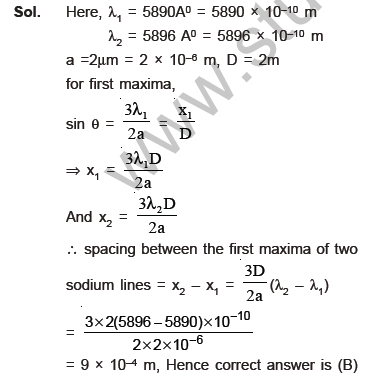
Ex.2 Two spectral line of sodium D1 & D2 have wavelengths of approximately 5890A0 and 5896A0. A sodium lamp sends incident plane wave on to a slit of width 2 micrometre. A screen is located 2m from the slit. Find the spacing between the first maxima of two sodium lines as measured on the screen.
(A) 10–4 m (B) 9 × 10⁻⁴ m (C) 9 × 10⁴ m (D) None
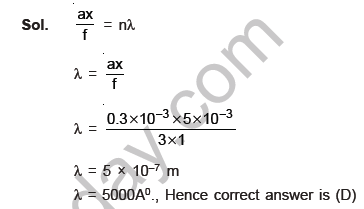
Ex. 3 Width of slit is 0.3mm. Fraunhoffer diffraction is observed at 1 m focal length in focus planed lense. If third minima is at 5 mm distance from central maxima, then wavelenght of light is-
(A) 7000Aº (B) 6500Aº (C) 6000Aº (D) 5000Aº
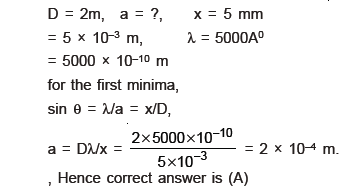
Ex.4 A screen is placed 2m away from the single narrow slit. Calculate the slit width if the first minimum lies 5mm on either side of the central maximum. Incident plane waves have a wavelenght of 5000A0.
(A) 2 × 10⁻⁴ m (B) 2 × 10⁻³ cm (C) 2 × 10⁻⁴ m (D) None
Sol. Here distance of the screen from the slit,
Ex.5 Red light of wavelength 6500A0 from a distant source falls on a slit 0.5 mm wide. What is the distance between two dark bands on each side of central bright band of diffraction pattern observed on a screen placed 1.8 m from the slit.
(A) 4.68 × 10⁻³ cm (B) 4.68 × 10⁻³ mm (C) 4.68 × 10⁻³ nm (D) 4.68 × 10⁻³ m

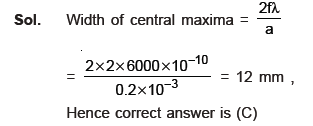
Ex.6 Fraunhoffer diffraction pattern is observed at a distance of 2m on screen, when a planewavefront
of 6000A0 is incident perpendicularly on 0.2 mm wide slit.Width of central maxima is:
(A) 10 mm (B) 6mm (C) 12 mm (D) None of these
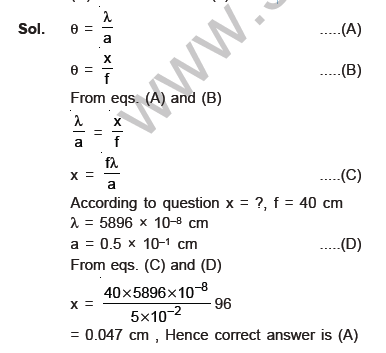
Ex.7 A diffraction pattern is produced by a single slit of width 0.5mm with the help of a convex lens of focal length 40cm. If the wave length of light used is 5896A0. then the distance of first dark fringe from the axis will be-
(A) 0.047 cm (B) 0.047 m (C) 0.047 mm (d) 47 cm
Ex.8 What should be the size of the aperture of the objective of telescope which can just resolve the two stars of angular width of 10–3 degree by light of wavelength 5000A0?
(A) 3.5 cm (B) 3.5 mm (C) 3.5 m (D) 3.5 km
Sol. dθ = 1.22λ/a or a = 1.22λ/ dθ
According to question
dθ = 10–3 degree = 10−3 × π/180
Radian,
λ – 5 × 10⁻⁵
a =1.22x 5 x10–5 x180/ 10 x3.14
a = 3.5 cm
Hence the correct answer will be (A)
Ex.9 Image of sun formed due to reflection at air water interface is found to be very highly polarised. Refractive index of water being μ = 4/3, find the angle of sun above the horizon.
Sol. Since the reflected light is very highly polarised, it implies that incident light falls at polarising angle of incidence θP. From Brewster's law,
μ = tanθp
∴ θP = tan–1 (μ) = tan–1 (4/3) = 53.1º
Since θP is the angle which the rays from sun make with the normal to the interface, angle with the interface will be
90º – 53.1º = 36.9º.
Ex.10 When light of a certain wavelength is incident on a plane surface of a material at a glancing angle 30º, the reflected light is found to be completely plane polarised. Determine
(a) refractive index of given material and (b) angle of refraction.
Sol. Angle of incident light with the surface is 30º. Hence angle of incidence = 90º – 30º = 60º. Since reflected light is completely polarised, therefore, incidence takes place at polarising angle of incidence θp.
(a) ∴ θp= 60º
Using Brewster's law
μ = tan θp = tan 60º
∴ μ = √3
Please click on below link to download pdf file for CBSE Class 12 Physics Diffraction and Polarisation of light Solved Examples.
Free study material for Physics
Physics Class 12 Exam Resources: Diffraction and Polarisation of light
Core Study Kit: Class 12 Physics Diffraction and Polarisation of light
Access comprehensive study material for Diffraction and Polarisation of light, including revision notes, concept maps, and high-probability questions. These resources are designed in alignment with the latest 2026 CBSE syllabus for Class 12 Physics to support effective exam preparation.
NCERT-Aligned Solutions for Diffraction and Polarisation of light
Each resource draws directly from authorized textbooks to maintain academic accuracy. Evaluating solved examples allows Class 12 students to master the formal presentation and answer-writing standards expected in upcoming school exams.
Next Steps in Your Exam Preparation
Wrap up your chapter revision by testing your knowledge against standard objective question formats. Explore our full library of free, up-to-date sample papers and online assessments to secure top grades in your CBSE examinations.
FAQs
Our advanced study package for Diffraction and Polarisation of light includes detailed concepts, diagrams, Mind Maps, and explanation of complex topics to ensure Class 12 students learn as per syllabus for 2026 exams.
The Mind Maps provided for Diffraction and Polarisation of light act as visual anchors which will help faster recall during high-pressure exams.
Yes, teachers use our Class 12 Physics resources for lesson planning as they are in simple language and have lot of solved examples.
Yes, You can download the complete, mobile-friendly PDF of the Physics Diffraction and Polarisation of light advanced resources for free.
Yes, our subject matter experts have updated the Diffraction and Polarisation of light material to align with the rationalized NCERT textbooks and have removed deleted topics and added new competency-based questions.