

Advanced Study Material for Class 12 Physics: Chapter 06 Electromagnetic Induction
Explore structured advanced study materials through the CBSE Class 12 Physics Electromagnetic Induction Basic Problems. Tailored for Class 12 learners, utilizing these Physics resources ensures thorough preparation and strengthens foundational knowledge before final CBSE evaluations.
Practice Class 12 Physics Resources: Chapter 06 Electromagnetic Induction
Access the complete useful resource PDF for Class 12 Physics below. Regular practice with these targeted academic notes builds familiarity with complex topics and helps secure higher marks in final school evaluations.
CBSE Class 12 Physics Electromagnetic Induction Basic Problems. Please refer to the examination notes which you can use for preparing and revising for exams. These notes will help you to revise the concepts quickly and get good marks.
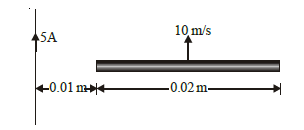
1. A copper rod of length 0.19 m is moving with a uniform velocity 10 m/s parallel to a long straight wire carrying a current of 5.0 A. The rod itself is perpendicular to the wire with its ends at distances 0.01 m and 0.2 m from it. Calculate the e.m.f. induced in the rod.
2. A long solenoid of diameter 0.1 m has 2 × 10⁴ turns per metre. At the centre of the solenoid a 100 turn coil of radius 0.01 m and resistance 10π2Ω is placed with its axis coinciding with the solenoid axis. The current in the solenoid is decreased at a constant rate from + 2 A to – 2 A in 0.05 s. Find the e.m.f. induced in the coil. Also find the total charge flowing through the coil during this time.
3. A very small circular loop of area 5 × 10⁻⁴ m2, resistance 2 Ω and negligible inductance is initially coplanar and concentric with a much larger fixed circular loop of radius 0.1 m. A constant current of 1 ampere is passed in the bigger loop and the smaller loop is rotated with angular velocity ω rad/s about a diameter. Calculate as a function of time
(a) the flux linked with the smaller loop,
(b) induced e.m.f.
(c) induced current in the smaller loop.
4. A closed coil consists of 500 turns on a a rectangular frame of area 4.0 cm2 and has a resistance of 50 Ω. The coil is kept with its plane perpendicular to a uniform magnetic field of 0.2 T. Calculate the amount of charge flowing through the coil if it is turned over (rotated through 1800). Will the answer depend on the speed with which the coil is rotated ?
5. A long solenoid having 1000 turns per cm carries an alternating current of peak value 1 ampere. A search coil having a cross-sectional area of 1 × 10⁻⁴ m2 and 20 turns is kept in the solenoid so that its plane is perpendicular to the axis of the solenoid. The search coil registers a peak voltage of 2.5 × 10⁻² volt. Find the frequency of the current in the solenoid.
6. A coil of inductance 2 H and resistance 10 Ω is connected across a battery of 100 V along with a key. At time t = 0, the key is closed. Find
(a) time constant of the circuit
(b) steady-state current in the circuit
(c) current in the circuit at t = 1 s
(d) magnetic energy stored in the coil in the steady state.
7. Two long parallel wires of zero resistance are connected to each other by a battery of 1.0 volt. The separation between the wires is 0.5 m. A metallic bar, which is perpendicular to the wires and of resistance 10Ω moves on these wires while a magnetic field of 0.02 Tesla is acting perpendicular to the plane containing the bar and the wires. Find the steady state velocity of the bar. If mass of the bar is 0.002 kg, find its velocity as a function of time.
8. The network shown in Fig. is a part of a complete circuit. What is the potential difference VB – VA, when the current I is 5 A and is decreasing at a rate of 103 (A/s).

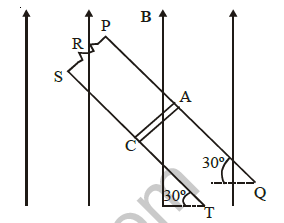
9. The figure shows a horizontal conductor AC of mass 0.1 kg and length 1 m sliding along two smooth parallel conducting rails PQ and ST, inclined at 300 to the horizontal. At the top, the rails are connected by a resistance R = 2Ω. The system is in a vertical uniform magnetic field B= 1.0 T. What is the terminal speed of the conductor AC and the current in the loop APSC when AC has achieved terminal speed? Neglect the resistance of rest of the circuit.
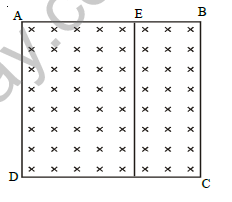
10. A rectangular frame ABCD made of a uniform metal wire has a straight connection between E and F made of the same wire, as shown in the figure. AEFD is a square of side 1 m and EB = FC = 0.5 m. The entire circuit is placed in a steadily increasing, uniform magnetic field directed into the plane of the paper and normal to it. The rate of change of magnetic field is 1 T/s. The resistance per unit length of the wire is 1 Ω/m. Find the magnitudes and directions of the currents in the segments AE, BE and EF.
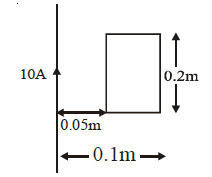
11. A current of 10 A is flowing in a long straight wire situated near a rectangular circuit whose two sides of length 0.2 m are parallel to the wire. One of them is at a distance of
0.05 m and the other is at a distance of 0.10 m from the long wire. The wire is in the plane of the rectangle. Find the magnetic flux through the rectangular circuit. If the current
decays uniformly to zero in 0.02 s, find the e.m.f induced in the circuit. 0.1m 10A 0.05m
12. A circular coil P of 100 turns and radius 2 cm is placed coaxially at the centre of another circular coil Q of 100 turns and radius 20 cm. Calculate
(a) the mutual inductance of the coils,
(b) the induced e.m.f. in coil P when the current in the coil Q decreases from 5 amp. to 3 amp.
(c) the rate of change of flux through the coil P at this instant and
(d) the charge passing through coil P if its resistance is 8 ohm.
13. A solenoid of resistance 50 Ω and inductance 80 henry are connected to a 200 volt battery. How long will it take for the current to reach 50% of its final equilibrium value ? Calculate the maximum energy stored.
14. A copper rod of length 0.19 m is moving with uniform velocity 10 m/s parallel to a long straight wire carrying a current of 5.0 ampere. The rod itself is perpendicular to the wire with its ends at distances 0.01 m and 0.2 m from it. Calculate the emf induced in the rod.
Please click on below link to download pdf file for CBSE Class 12 Physics Electromagnetic Induction Basic Problems
Free study material for Physics
Useful Resources and Notes for Class 12 Physics Chapter 06 Electromagnetic Induction
Comprehensive Study Resources for Chapter 06 Electromagnetic Induction
Explore essential learning tools for Class 12 Physics Chapter 06 Electromagnetic Induction. This curated collection features in-depth notes and targeted practice questions built around the active 2026 curriculum to streamline your daily revision.
Understanding Marking Schemes
Built using official NCERT guidelines for Class 12 Physics, these materials provide reliable academic support. Integrating past examination questions and step-by-step solutions helps students understand official CBSE grading criteria.
Complete Revision for Physics
Maximize your grade potential by utilizing Class 12 Physics practice papers in tandem with these structured notes. All printable assignments and interactive mock tests on our platform are updated for the 2026 session and available free of charge.
FAQs
Our advanced study package for Chapter 06 Electromagnetic Induction includes detailed concepts, diagrams, Mind Maps, and explanation of complex topics to ensure Class 12 students learn as per syllabus for 2026 exams.
The Mind Maps provided for Chapter 06 Electromagnetic Induction act as visual anchors which will help faster recall during high-pressure exams.
Yes, teachers use our Class 12 Physics resources for lesson planning as they are in simple language and have lot of solved examples.
Yes, You can download the complete, mobile-friendly PDF of the Physics Chapter 06 Electromagnetic Induction advanced resources for free.
Yes, our subject matter experts have updated the Chapter 06 Electromagnetic Induction material to align with the rationalized NCERT textbooks and have removed deleted topics and added new competency-based questions.