

Advanced Study Material for Class 12 Physics: Rotational Motion
Access comprehensive study materials and useful resources for Rotational Motion using the CBSE Class 12 Physics Rotational Motion Solved Examples. Designed to align with the 2026-27 CBSE academic guidelines, these advanced resources help Class 12 Physics students reinforce core concepts beyond standard textbooks.
Practice Class 12 Physics Resources: Rotational Motion
Access the complete useful resource PDF for Class 12 Physics below. Regular practice with these targeted academic notes builds familiarity with complex topics and helps secure higher marks in final school evaluations.
Question. An athlete completes one round of a circular track of radius 10 m in 40 sec. The distance covered by him in 2 min 20 sec is:
a. 70 m
b. 140 m
c. 110 m
d. 220 m
Answer : D
Question. A flywheel rotates at a constant speed of 3000 rpm. The angle described by the shaft in radian in one second is:
a. 2 π
b. 30 π
c. 100 π
d. 3000 π
Answer : C
Question. A stone is tied to one end of a spring 50 cm long is whirled in a horizontal circle with a constant speed. If the stone makes 10 revolutions in 20 s, what is the magnitude of acceleration of the stone?
a. 493 cm / sec2
b. 720 cm / sec2
c. 860 cm / sec2
d. 990 cm / sec2
Answer : A
Question. A wheel of radius 0.20m is accelerated from rest with an angular acceleration of 1 rad / s2 . After a rotation of 90º the radial acceleration of a particle on its rim will be:
a. 2 π m / s
b. 2 0.5π m/ s
c. 2 2.0π m / s
d. 2 0.2π m/ s
Answer : D
Question. The linear acceleration of a car is 10m/s2. If the wheels of the car have a diameter of 1m, the angular acceleration of the wheels will be:
a. 10 rad / sec2
b. 20 rad /sec2
c. 1 rad / sec2
d. 2 rad /sec2
Answer : B
Question. The ratio of angular velocity of rotation of minute hand of a clock with the angular velocity of rotation of the earth about its own axis is:
a. 12
b. 6
c. 24
d. None of these
Answer : C
Question. What is the value of linear velocity, if ω = 3iˆ − 4 ˆj + kˆ and r = 5iˆ −6 ˆj + 6kˆ:
a. 6iˆ + 2 ˆj −3kˆ
b. 18iˆ +13 ˆj − 2kˆ
c. 4iˆ −13ˆj + 6kˆ
d. 6iˆ − 2 ˆj +8kˆ
Answer : B
Question. Two particles of mass M and m are moving in a circle of radii R and r. If their time-periods are same, what will be the ratio of their linear velocities?
a. MR : mr
b. M : m
c. R : r
d. 1 : 1
Answer : C
Question. The road way bridge over a canal is in the form of an arc of a circle of radius 20 m. What is the minimum speed with which a car can cross the bridge without leaving contact with the ground at the highest point? (g = 9.8 m/ s2)
a. 7 m/ s
b. 14 m/ s
c. 289 m/ s
d. 5 m/ s
Answer : B
Question. A ball of mass 0.1 kg is whirled in a horizontal circle of radius 1 m by means of a string at an initial speed of 10 r.p.m. Keeping the radius constant, the tension in the string is reduced to one quarter of its initial value. The new speed is:
a. 5 r.p.m.
b. 10 r.p.m.
c. 20 r.p.m.
d. 14 r.p.m.
Answer : A
Question. A mass is supported on a frictionless horizontal surface. It is attached to a string and rotates about a fixed centre at an angular velocity ω0. If the length of the string and angular velocity are doubled, the tension in the string which was initially T0 is now:
a. T0
b. T0/2
c. 4T0
d. 8T0
Answer : D
Question. If the speed of revolution of a particle on the circumference of a circle and the speed gained in falling through a distance equal to half the radius are equal, then the centripetal acceleration will be:
a. g/2
b. g/4
c. g/3
d. g
Answer : D
Question. A particle moves along a circle with a uniform speed v. After it has made an angle of 60º its speed will be:
a. v√2
b. v/√2
c. v/√3
d. v
Answer : D
Question. A cord can bear a maximum force of 100 N without breaking. A body of mass 1 kg tied to one end of a cord of length 1 m is revolved in a horizontal plane. What is the maximum linear speed of the body so that the cord does not break?
a. 10 m/s
b. 20 m/s
c. 25 m/s
d. 30 m/s
Answer : A
Question. A motor cycle driver doubles its velocity when he is having a turn. The force exerted outwardly will be:
a. Double
b. Half
c. 4 times
d. (1/4)1 times
Answer : C
Question. When the road is dry and the coefficient of friction isμ , the maximum speed of a car in a circular path is 10 m/ s. If the road becomes wet and , μ = μ/2 what is the maximum speed permitted:
a. 5 m/ s
b. 10 m/ s
c. 10√2 m/ s
d. 5√2 m/ s
Answer : D
Question. The distance between two rails is 1.5m. The centre of gravity of the train at a height of 2m from the ground.
The maximum speed of the train on a circular path of radius 120m can be:
a. 10.5 m/ s
b. 42 m/ s
c. 21m/ s
d. 84 m/ s
Answer : C
Question. A bottle of soda water is grasped by the neck and swing briskly in a vertical circle. Near which portion of the bottle do the bubbles collect?
a. Near the bottom
b. In the middle of the bottle
c. Near the neck
d. Uniformly distributed in the bottle
Answer : C
Question. A boy on a cycle pedals around a circle of 20 metres radius at a speed of 20 metres/sec. The combined mass of the boy and the cycle is 90kg. The angle that the cycle makes with the vertical so that it may not fall is: (g = 9.8 m/ sec2)
a. 60.25º
b. 63.90º
c. 26.12º
d. 30.00º
Answer : B
Question. A car moves at a constant speed on a road as shown in the figure.
The normal force exerted by the road on the car is NA and NB when it is at the points A and B respectively:
a. NA = NB
b. NA > NB
c. NA < NB
d. All possibilities are there
Answer : C
Comprehension Based
Paragraph –I
A uniform thin cylindrical disk of mass M and radius R is attached to two identical mass less springs of spring constant k which are fixed to the wall as shown in the figure. The springs are attached to the axle of the disk diametrically on either side at a distance d from its centre. The axle is mass less and both the springs and the axle are in a horizontal plane. The unstretched length of each spring is L. The disk is initially at its equilibrium position with its centre of mass (CM) at a distance L from the wall. The disk rolls without slipping with velocity v0 = v0 iˆ The coefficient of friction is μ.
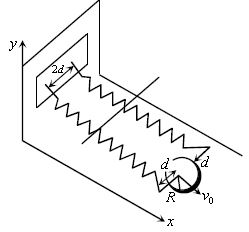
Question. The next external force acting on the disk when its centre of mass is at displacement x with respect to its equilibrium position is
a. – kx
b. – 2 kx
c. – 2kx / 3
d. – 4kx / 3
Answer : D
Question. The centre of mass of the disk undergoes simple harmonic motion with angular frequency ω equal to
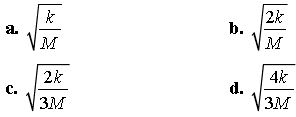
Answer : D
Question. The maximum value of v0 for which the disk will roll without slipping is
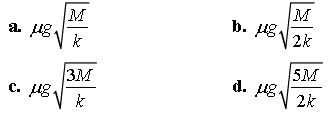
Answer : C
Paragraph – II
When a block of mass m is placed on rim of rotating disc wheel of mass M and radius R, the block will remain in contact or will not depend on the angular speed of wheel. If μ is coefficient of friction between the disc wheel and the block, then the block slips with angular speed ω of disc. To stop the slip of block we place another block of identical mass over the first block while wheel is in rotation.
Question. The new angular velocity ω′ of the rotating disc wheel is:
a. ω = ω (M + 2m / M + m)
b. ω = ω (M + 2m / M + 4m)
c. ω = ω (M + 4m / M + 2m)
d. ω = ω (M + m / M + 2m)
Answer : B
Question. The velocity of disc wheel after the original block slips and falls down:
a. ω ′= ω
b. ω = ω (1 + m / m)
c. ω = ω (1 + 2m / m)
d. ω = ω (1 - m / m)
Answer : C
Question. The minimum angular velocity at which the block slips is:
a. √μ Rg
b. √Rg /μ
c. √μ / Rg
d. √μ g / R
Answer : D
Paragraph –III
A body is rolling on a surface with acceleration a of center of mass.
Question. For a rolling body the angular velocity of a point A on the rim of rolling body about center of mass O is ω then, its angular velocity about any point B on the rim
diametrically opposite is:
a. ω
b. 2ω
c. ω / 2
d. zero
Answer : C
Question. An external force F is applied at Z on the rolling wheel. This force will cause linear acceleration a of center of mass O and linear acceleration to wheel about point of contact is α then which of the following is not possible.
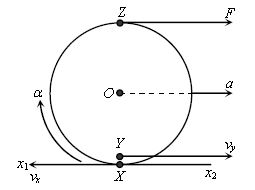
a. If a = Rα, friction f = 0
b. If a > Rα, friction will act along xx1 to provided torque to cause angular motion
c. If a < Rα, friction will act along xx2 to provide linear acceleration for wheel to rotate and move forward
d. No rolling motion is possible without friction
Answer : D
Question. Body is forced to roll by some force applied and we find many times the rolling wheels slip. The conditions of slip are governed by the force of friction between wheels and ground. The slip is related to friction in following situations which of these is not correct:
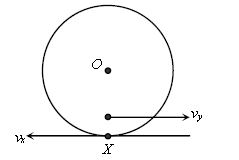
a. If υx = υy f = 0, No slip and pure rolling motion occurs
b. If υx > υy it will cause backward slip
c. If υx < υy it will cause forward slip
d. Rolling is possible with friction only
Answer : D
Ex. 1: A small sphere rolls down without slipping from the top of a track in a vertical plane. The track has an elevated section and a horizontal part. The horizontal part is 1.0 metre above the ground level and the top of the track is 2.4 m above the ground. Find the distance on the ground with respect to point B which is vertically below the end of the track below A where sphere lands. During its flight as a projectile, does the sphere continue to rotate about its centre of mass ?
Sol. : Loss of Potential Energy from C to A is given by
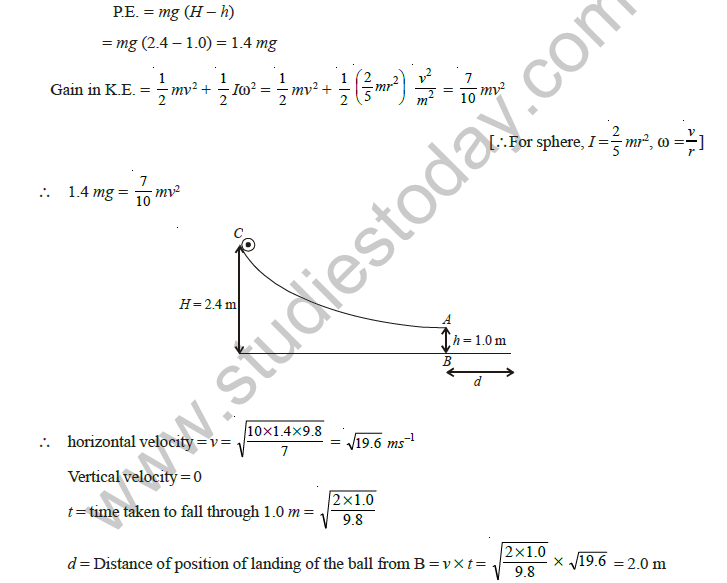
The sphere rotates about its centre of mass and the law of conservation of angular momentum
holds good during flight.
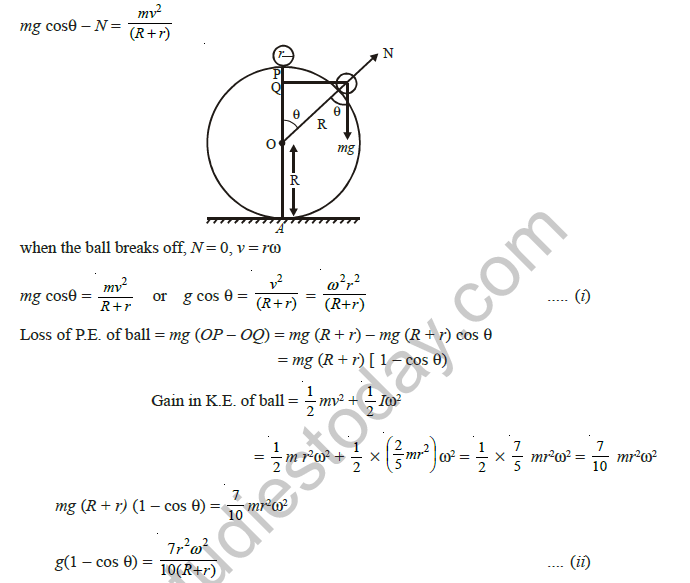
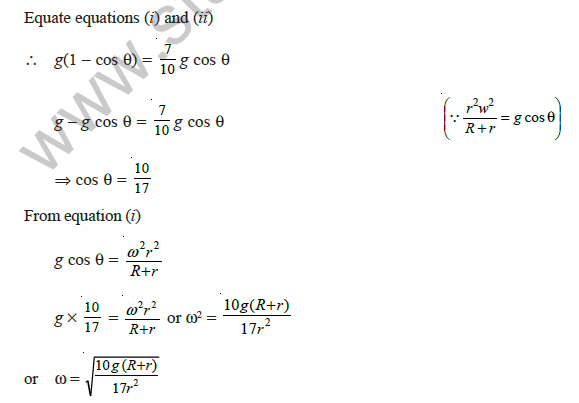
Ex.2 : A uniform ball of radius r rolls, without slipping, down from the top of a sphere of radius R. Find the angular velocity of the ball at the moment it breaks off the sphere. The initial velocity of the ball is negligible. Assume that the sphare is fixed.
Sol. : Let the ball of mass m break off the sphere when the radius vector R makes an angle θ with
vertical. If N is normal reaction,
Please click on below link to download pdf file for CBSE Class 12 Physics Rotational Motion Solved Examples.
Free study material for Physics
Free CBSE Study Guides: Class 12 Physics Rotational Motion
Essential Notes for Class 12 Physics
Access comprehensive study material for Rotational Motion, including revision notes, concept maps, and high-probability questions. These resources are designed in alignment with the latest 2026 CBSE syllabus for Class 12 Physics to support effective exam preparation.
Verified Solutions for Class 12 Physics
Built using official NCERT guidelines for Class 12 Physics, these materials provide reliable academic support. Integrating past examination questions and step-by-step solutions helps students understand official CBSE grading criteria.
Enhance Accuracy with Online Tests
Wrap up your chapter revision by testing your knowledge against standard objective question formats. Explore our full library of free, up-to-date sample papers and online assessments to secure top grades in your CBSE examinations.
FAQs
Our advanced study package for Rotational Motion includes detailed concepts, diagrams, Mind Maps, and explanation of complex topics to ensure Class 12 students learn as per syllabus for 2026 exams.
The Mind Maps provided for Rotational Motion act as visual anchors which will help faster recall during high-pressure exams.
Yes, teachers use our Class 12 Physics resources for lesson planning as they are in simple language and have lot of solved examples.
Yes, You can download the complete, mobile-friendly PDF of the Physics Rotational Motion advanced resources for free.
Yes, our subject matter experts have updated the Rotational Motion material to align with the rationalized NCERT textbooks and have removed deleted topics and added new competency-based questions.