

Download CBSE Class 12 Physics Useful Resources
Review targeted academic resources with the CBSE Class 12 Physics Magnetic Effects of Electric Current Advanced Problems. Built according to official CBSE standards for the 2026-27 term, these downloadable Class 12 Physics study materials support effective daily practice and deeper conceptual understanding for Chapter 01 Electric Charges and Fields.
Access CBSE Study Guides and Summaries
Access the complete useful resource PDF for Class 12 Physics below. Regular practice with these targeted academic notes builds familiarity with complex topics and helps secure higher marks in final school evaluations.
CBSE Class 12 Physics Magnetic Effects of Electric Current Advanced Problems. Please refer to the examination notes which you can use for preparing and revising for exams. These notes will help you to revise the concepts quickly and get good marks.
1. An α- particle is describing a circle of radius 0.45 metre in a field of magnetic induction of 1.2 weber / metre2. The mass of a-particle is 6.8 × 10⁻²⁷ kg and its charge is twice the charge of electron i.e. 3.2 × 10⁻¹⁹ coulomb.
(a) Find its speed, frequency of rotation and kinetic energy.
(b) What potential difference is required to accelerate the particle to give this much energy to it?
2. A charge of 1 Coulomb is placed at one end of a non-conducting rod of length 0.6 m. The rod is rotated in a vertical plane about a horizontal axis passing through the other end of the rod with angular frequency 104 π radian / sec. Find the magnetic field at a point on the axis of rotation at a distance of 0.8m from
the centre of the path.
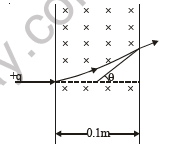
3. An α-particle is accelerated by a potential difference of 104 V. Find the change in its direction of motion, if it enter normally in a region of thickness 0.1 m having transverse
magnetic induction of 0.1 Tesla. (mass of α - particle = 6.4 × 10⁻²⁷ kg).
4. There is a constant homogeneous electric field of 100 V / m within the region x = 0 and x = 0.167 m pointing along x direction. There is a constant homogeneous magnetic field B within the region x = 1.67 m and x = 0.334 m pointing along the z-direction. A proton at rest at the origin (x = 0, y = 0) is released. Find the minimum strength of the magnetic field B, so that the proton is detected back at x = 0, y = 0.167 m. (mass of the proton = 1.67 × 10⁻²⁷ kg)
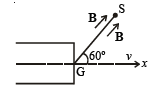
5. An electron gun G emits electrons of energy 2keV travelling in the positive x-direction. The electrons are required to hit the spot S, where GS = 0.1 m, and the line GS makes an angle of 60º with the x-axis as shown in the figure. A uniform magnetic field B parallel to GS exists in the region outside the electron gun. Find the minimum value of B needed tomake the electron hit S.
6. A particle of mass 1 × 10–26 kg and charge + 1.6 × 10⁻¹⁹ C travelling with a velocity 1.28 × 10⁶ m/s in the +x direction enters a region in which a uniform electric field E and a uniform magnetic field B are present such that Ex = Ey = 0, Ez = – 102.4 kV/m and Bx = Bz = 0, By = 8 × 10⁻² Wb /m2. The particle enters the region at the origin at time t = 0. Determine the location (x, y and z-coordinates) of the particle at t = 5 × 10⁻⁶ s. If the electric field is switched off at this instant (with magnetic field still present), what will be the position of the particle at t = 7.45 × 10⁻⁶ s?
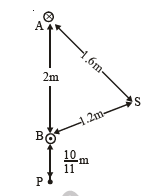
7. Two long straight parallel wires are 2 m apart, perpendicular to the plane of the paper (see figure). The wire A carries a current of 9.6 A, directed into the plane of the paper. The
wire B carries a current such that the magnetic field of induction at the point P, at a distance of 10/11 m from the wire B, is zero. Find :
(a) The magnitude and direction of the current in B.
(b) The magnitude of the magnetic field of induction at the point S. m
(c) The force per unit length on the wire B.
8. Two circular coils each of 100 turns are held such that one lies in the vertical plane and the other in the horizontal plane with their centres coinciding. The radii of the vertical and horizontal coils are respectively 20 cm and 30 cm. If the directions of the currents in them are such that the earth’s magnetic field at the centre of the coils is exactly neutralised, calculate the currents in each coil [H= 27.8 A/m angle of dip = 30º]
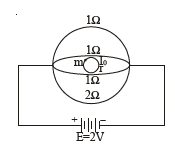
9. Two circular rings each of radius a are joined together such that their planes are perpendicular to each other as shown in the figure. The resistance of each half part of the ring is indicated. A very small loop of mass m and radius r carrying a current I0 is placed in the plane of the papers at the common centre of the rings. The loop can freely rotate about any of its diametric axes If the loop is slightly displaced, find the time period of its oscillations.
10. Consider a nonconducting plate of radius r and mass m which has a charge q distributed uniformly over it. The plate is rotated about its axis with an angular speed ω. Show that the magnetic moment μ and the angular momentum l of the plate are related as μ = .− q/2m l
11. A current i flows in a long straight wire with cross-section having the form of a thin half ring of radius R as shown in figure. Find the induction of magnetic field at the point O.

Please click on below link to download pdf file for CBSE Class 12 Physics Magnetic Effects of Electric Current Advanced Problems
Free study material for Physics
Free CBSE Study Guides: Class 12 Physics Chapter 01 Electric Charges and Fields
Quick Revision Material for Chapter 01 Electric Charges and Fields
Review targeted study resources for Chapter 01 Electric Charges and Fields tailored for Class 12 learners. Utilizing these structured notes and quick-revision tools ensures complete alignment with current CBSE evaluation standards.
Expert Notes and Solved Exam Questions
Built using official NCERT guidelines for Class 12 Physics, these materials provide reliable academic support. Integrating past examination questions and step-by-step solutions helps students understand official CBSE grading criteria.
Additional Study Resources for Class 12
Maximize your grade potential by utilizing Class 12 Physics practice papers in tandem with these structured notes. All printable assignments and interactive mock tests on our platform are updated for the 2026 session and available free of charge.
FAQs
Our advanced study package for Chapter 01 Electric Charges and Fields includes detailed concepts, diagrams, Mind Maps, and explanation of complex topics to ensure Class 12 students learn as per syllabus for 2026 exams.
The Mind Maps provided for Chapter 01 Electric Charges and Fields act as visual anchors which will help faster recall during high-pressure exams.
Yes, teachers use our Class 12 Physics resources for lesson planning as they are in simple language and have lot of solved examples.
Yes, You can download the complete, mobile-friendly PDF of the Physics Chapter 01 Electric Charges and Fields advanced resources for free.
Yes, our subject matter experts have updated the Chapter 01 Electric Charges and Fields material to align with the rationalized NCERT textbooks and have removed deleted topics and added new competency-based questions.