

Class 12 Physics Study Guide: CBSE Class 12 Physics Magnetic Effects of Electric Current Assignment
Review targeted academic resources with the CBSE Class 12 Physics Magnetic Effects of Electric Current Assignment. Built according to official CBSE standards for the 2026-27 term, these downloadable Class 12 Physics study materials support effective daily practice and deeper conceptual understanding for Chapter 01 Electric Charges and Fields.
Download Chapter 01 Electric Charges and Fields Study Material PDF
Access the complete useful resource PDF for Class 12 Physics below. Regular practice with these targeted academic notes builds familiarity with complex topics and helps secure higher marks in final school evaluations.
CBSE Class 12 Physics Magnetic Effects of Electric Current Assignment. Please refer to the examination notes which you can use for preparing and revising for exams. These notes will help you to revise the concepts quickly and get good marks.
Comprehension-1
Magnetic field intensity (B) due to current carrying conductor can be calculated by use of Biot-savart law. which is dB =μ0/4∏ Idlxr/r3, where dB is magnetic field due current element Idl at a position r from current element. For straight wire carrying current magneticfield at a distance R from wire isB=μ0/4∏ I/R(sin α + sin β) and magnetic field due to a circular arc at its centre is B =μ0I/4∏R. θ where θ angle of circular arc at centre, R is radius of circular arc.
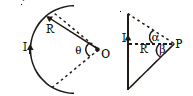
Now answer the following questions.
1. The magnetic field at C due to curved part is

2. A wire loop carrying a current I is shown in figure. The magnetic field induction at C due to straight part is
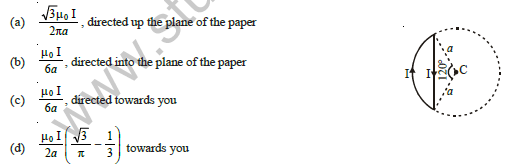
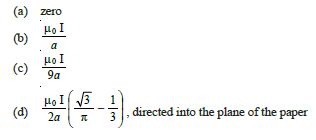
3. The net magnetic field at C due to the current carrying loop is
Comprehension-2
A current carrying coil behave like short magnet whose magnetic dipole moment M = n I A. Where direction of M is taken along the direction of magnetic field on its axis and n is no of turms A is area of coil and I is current flowing through coil. When such a coil is put in magnetic field (B) magnetic torque (τ) acts over it as τ = M × B and potential energy in of the current loop in the magnetic field is u = – M · B.
4. A current of 3 A is flowing in a plane circular coil of radius 4 cm and having 20 turns. The coil is placed in a uniform magnetic field of 0.5 Wb m–2. Then, the dipole moment of the coil is
(a) 3000 A m2 (b) 0.3 A m2 (c) 75 A m2 (d) 1.88 × 10⁻² A m2
5. A current of 3 A is flowing in a plane circular coil of radius 4 cm and having 20 turns. The coil is placed in a uniform magnetic field of 0.5 Wb m–2. Then, the P.E. of the magnetic dipole in the position of stable equilibrium is
(a) –1500 J (b) –9.4 mJ (c) +0.15 J (d) +1500 J
6. In above question, to hold the current-carrying coil with normal to its plane making an angle of 90° with the direction of magnetic induction, the necessary torque is
(a) 1500 Nm (b) 9.4 × 10⁻³ Nm (c) 15 Nm (d) 150 Nm
Each of the questions given below consists of two statements, an assertion (A) and reason (R).
Select the number corresponding to the appropriate alternative as follows
(a) If both A and R are true and R is the correct explanation of A
(b) If both A and R are true but R is not the correct explanation of A
(c) If A is true but R is false
(d) If A is false but R is true
7. A: The magnetic field interacts with a moving charge and not with a stationary charge.
R: A moving charge is a source of magnetic field.
8. A: When a charged particle moves in a magnetic field, its kinetic energy remains the same.
R: Force on a moving charged particle due to magnetic field is always perpendicular to velocity vector
9. A: The two charged particle of same mass and charge are describing circle in the same magnetic field with radii r1 and r2 (>r1), the speed of first particle is less than that of the second particle.
R: v = qBr/m i.e. v ∝ r, so the speed of the first particle is less than that of the second particle
( r2 > r1)
10. A: A current is flowing north along a power line. The direction of magnetic field above it, neglecting the earth’s field is towards east.
R: Apply Flemming’s left hand rule.
11. A: A charge can go undeviated in the combined effect of electric and magnetic field.
R: If v || E, then electric force does not change the direction of motion and when v || B, the magnetic force on the test charge is zero.
12. A: When a charged particle is fired in a magnetic field, the centripetal force on it is independent of mass of the particle.
R: The centripetal force on a test charge q0 moving with velocity v in a magnetic field B is Fm = q0v × B
13. A: Angle of dip at the equator is zero.
R: At the equator, the vertical component of earth’s magnetic field is zero.
14. A: Magnetic susceptibility has no units and no dimensions.
R: Xm = H/I, where I is the intensity of magnetisation and H is the magnetising field.
Miscellaneous Assignment
1. (a) 2. (a) 3. (d) 4. (d) 5. (b) 6. (b) 7. (a) 8. (a) 9. (a) 10. (a) 11. (b) 12. (a) 13. (a) 14. (a)
Free study material for Physics
Useful Resources and Notes for Class 12 Physics Chapter 01 Electric Charges and Fields
Quick Revision Material for Chapter 01 Electric Charges and Fields
Review targeted study resources for Chapter 01 Electric Charges and Fields tailored for Class 12 learners. Utilizing these structured notes and quick-revision tools ensures complete alignment with current CBSE evaluation standards.
Expert Notes and Solved Exam Questions
Built using official NCERT guidelines for Class 12 Physics, these materials provide reliable academic support. Integrating past examination questions and step-by-step solutions helps students understand official CBSE grading criteria.
Additional Study Resources for Class 12
For peak performance in upcoming evaluations, integrate official Physics sample papers directly into your study schedule. Follow up your revision by attempting online MCQ tests for Chapter 01 Electric Charges and Fields to refine calculation speed and precision.
FAQs
Our advanced study package for Chapter 01 Electric Charges and Fields includes detailed concepts, diagrams, Mind Maps, and explanation of complex topics to ensure Class 12 students learn as per syllabus for 2026 exams.
The Mind Maps provided for Chapter 01 Electric Charges and Fields act as visual anchors which will help faster recall during high-pressure exams.
Yes, teachers use our Class 12 Physics resources for lesson planning as they are in simple language and have lot of solved examples.
Yes, You can download the complete, mobile-friendly PDF of the Physics Chapter 01 Electric Charges and Fields advanced resources for free.
Yes, our subject matter experts have updated the Chapter 01 Electric Charges and Fields material to align with the rationalized NCERT textbooks and have removed deleted topics and added new competency-based questions.