

Download CBSE Class 12 Physics Useful Resources
Review targeted academic resources with the CBSE Class 12 Physics Electrical Instrument Theory and Examples. Built according to official CBSE standards for the 2026-27 term, these downloadable Class 12 Physics study materials support effective daily practice and deeper conceptual understanding for Chapter 01 Electric Charges and Fields.
Access CBSE Study Guides and Summaries
View or download the dedicated CBSE Class 12 Physics Electrical Instrument Theory and Examples resource below. Engaging with these advanced study guides under focused conditions ensures continuous academic progress and mastery of the 2026-27 curriculum for Chapter 01 Electric Charges and Fields.
CBSE Class 12 Physics Electrical Instrument Theory and Examples. Please refer to the examination notes which you can use for preparing and revising for exams. These notes will help you to revise the concepts quickly and get good marks.
1. MOVING–COIL METERS
1.1 GALVANOMETER
(a) The instrument used to measure strength of current, by measuring the deflection of the coil due to torque produced by a magnetic field, is known as galvanometer.
Types of galvanometer :
(I) Moving magnet type In this type of galvanometer, magnet is movable coil is stationary.
(II) Moving coil type In this type of galvanometer, the coil is movable and and magnet is stationary.
(a) Suspended coil type galvanometer

(i) In this the coil is suspended by a fine phosphor bronze fibre
(ii) In this the deflection of coil is measured by lamp and scale arrangement
(iii) Its sensitivity is high [current of order 10–9 amp. can be measured by it
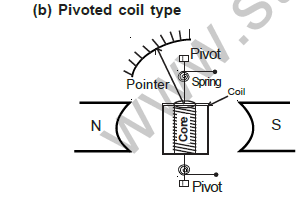
(i) In this the coil is pivoted on a pivot about which it is free to rotates.
(ii) In this the deflection of coil is determined by a pointer rotating on a circular scale.
(iii) Its sensitivity is low [current of order 10–6 amp. can be measured]
1.2 MOVING COIL TYPE GALVANOMETER
(a) Principle: When a current carrying coil is placed in magnetic field, it experiences a couple and the coil rotates.
(b) The torque of this couple is given by τ = NiAB sin α Where N – no. of turns in the coil
i – current through coil
B– intensity of magnetic field
α – angle between magnetic field and plane of the coil.
(c) For radial magnetic field α = 90º
∴τ = NiAB
(d) In the state of equilibrium of coil deflecting torque = restoring torque ⇒ NiAB = C θ Where C is restoring torque per unit deflection, (C depends on elastic properties of spring)
or i =C/NAB θ or i α θ
The current is proportional to deflection. The constant C/NAB is called galvanometer constant.
(e) Sensitivity of galvanometer–
(i) The deflection of galvanometer coil per unit current is defined as the sensitivity of galvanometer.
(ii) Si =θ/i
(iii) The deflection obtained by unit current is Si
(f) The galvanometer which gives more deflection for a small current is more sensitive. To increase sensitivity the values of N, A, B must be large and the value of C must be small.
(g) Figure of merit (K)
(i) The reciprocal of current sensitivity is defined as the figure of merit of galvanometer.
(ii) The current required for unit deflection in galvanometer is known as figure of merit(K)
(ii) Si = 1/K or K =Si
(h) Voltage sensitivity (Sv)
(i) The deflection of galvanometer coil per unit voltage is defined as voltage sensitivity of galvanometer.
(ii) Sv =Q/A= Q/iRG=NAB/CRG, where RG isresistance of galvanometer coil.
Moving-coil meters
Ex. 1 Which is more sensitive, either suspended type galvanometer or pivoted type galvanometer ?
Ans. Suspended type galvanometer. The sensitivity of suspended type galvanometer is of order 10–9 A., while that of pivoted type is of 10–6A.
Ex. 2 In your practical classes, which type of galvanometer do you use ?
Ans. Pivoted–coil (or Weston type) Galvanometer. In the suspended coil galvanometer the suspension strip is very delicate and may be broken by a small jerk. Therefore this galvanometer can not be taken from one place to another. This difficulty has been removed by westone galvanometer.

Please click on below link to download pdf file for CBSE Class 12 Physics Electrical Instrument Theory and Examples.
Free study material for Physics
Physics Class 12 Exam Resources: Chapter 01 Electric Charges and Fields
Core Study Kit: Class 12 Physics Chapter 01 Electric Charges and Fields
Review targeted study resources for Chapter 01 Electric Charges and Fields tailored for Class 12 learners. Utilizing these structured notes and quick-revision tools ensures complete alignment with current CBSE evaluation standards.
NCERT-Aligned Solutions for Chapter 01 Electric Charges and Fields
Each resource draws directly from authorized textbooks to maintain academic accuracy. Evaluating solved examples allows Class 12 students to master the formal presentation and answer-writing standards expected in upcoming school exams.
Next Steps in Your Exam Preparation
Maximize your grade potential by utilizing Class 12 Physics practice papers in tandem with these structured notes. All printable assignments and interactive mock tests on our platform are updated for the 2026 session and available free of charge.
FAQs
Our advanced study package for Chapter 01 Electric Charges and Fields includes detailed concepts, diagrams, Mind Maps, and explanation of complex topics to ensure Class 12 students learn as per syllabus for 2026 exams.
The Mind Maps provided for Chapter 01 Electric Charges and Fields act as visual anchors which will help faster recall during high-pressure exams.
Yes, teachers use our Class 12 Physics resources for lesson planning as they are in simple language and have lot of solved examples.
Yes, You can download the complete, mobile-friendly PDF of the Physics Chapter 01 Electric Charges and Fields advanced resources for free.
Yes, our subject matter experts have updated the Chapter 01 Electric Charges and Fields material to align with the rationalized NCERT textbooks and have removed deleted topics and added new competency-based questions.