

Download CBSE Class 12 Physics Useful Resources
Access comprehensive study materials and useful resources for Chapter 11 Dual Nature of Radiation and Matter using the CBSE Class 12 Physics Dual Nature Of Matter Frequently Asked Questions. Designed to align with the 2026-27 CBSE academic guidelines, these advanced resources help Class 12 Physics students reinforce core concepts beyond standard textbooks.
Access CBSE Study Guides and Summaries
Navigate directly to the advanced Physics study materials using the digital viewer below. Each resource pack includes detailed conceptual summaries and solved practice questions, allowing students to instantly reinforce their learning.
CBSE Class 12 Physics Dual Nature Of Matter Frequently Asked Questions. There are many more useful educational material which the students can download in pdf format and use them for studies. Study material like concept maps, important and sure shot question banks, quick to learn flash cards, flow charts, mind maps, teacher notes, important formulas, past examinations question bank, important concepts taught by teachers. Students can download these useful educational material free and use them to get better marks in examinations. Also refer to other worksheets for the same chapter and other subjects too. Use them for better understanding of the subjects.
DUAL NATURE OF MATTER
1. When a monochromatic yellow coloured light beam is incident on a given photosensitive surface, photoelectrons are not ejected, while the same surface gives photoelectrons when exposed to green coloured monochromatic beam. What will happen if the surface is exposed to: (i) red coloured, monochromatic beam of light? Justify your answer.
2. What is meant by work function of a metal? How does the value of work function influence the kinetic energy of electrons liberated during photoelectric emission?
3. Define the terms: (i) work function, (ii) threshold frequency & (iii) stopping potential with reference of photoelectric effect.
4. The work function of lithium is 2.3 eV. What does it mean? What is the relation between the work function ‘ωo’ and threshold wavelength ‘λo’ of a metal?
5. Red light, however bright, cannot cause emission of electrons from a clean zinc surface. But, even weak ultraviolet radiations can do so. Why?
6. An electron and a proton have same kinetic energy. Which of the two has a greater wavelength? Explain.
7. Define the term threshold frequency & work function in relation to photoelectric effect.
8. An electron and a proton are moving in the same direction and possess same kinetic energy. Find the ratio of de-Broglie wavelengths associated with these particles.
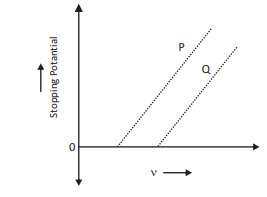
9. In the photoelectric effect experiment, the graph between the stopping potential ‘V’ and frequency ‘n’ of the incident radiation on two different metal plates P and Q are shown in the figure. (i) Which of the two metal plates, P & Q has greater value of work function? & (ii) What does the slope of the line depict?
10. What is photoelectric effect? Write Einstein’s photoelectric equation and use it to explain: (i) independence of maximum energy of emitted photoelectrons from the intensity of incident light. (ii) Existence of a threshold frequency for the emission of photoelectrons.
11. Draw the variation of maximum kinetic energy of emitted electrons with frequency of the incident radiation on a photosensitive surface. On the graph drawn, what do the following indicate: (i) slope of the graph & (ii) intercept on the energy axis.
12. Obtain Einstein’s photoelectric equation. Explain how it enables us to understand the (i) linear dependence of the maximum kinetic energy of the emitted electrons, on the
frequency of the incident radiation & (ii) existence of a threshold frequency for a given photo emitter.
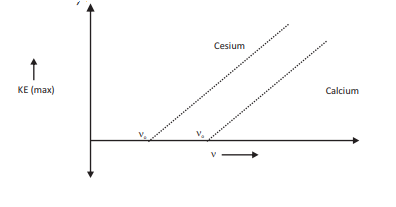
13. Given below is the graph between frequency (n) of the incident light and maximum kinetic energy (E) of emitted photoelectrons. Find the values of: (i) threshold frequency and (ii) work function from the graph.
14. Sketch a graph between frequency of incident radiations and stopping potential for a given photosensitive materials. What information can be obtained from the value of
intercept on the potential axis? A source of light of frequency greater that the threshold frequency is replaced at a distance of 1 m from the cathode of a photo cell.
The stopping potential is found to be V. If the distance of the light source from the cathode is reduced, explain giving reason, what change you will observe in the (I) photoelectric current & (ii) stopping potential.
15. Explain the laws of photoelectric emission on the basis of Einstein’s photoelectric equation. Write one feature of the photoelectric effect which cannot be explained on the basis of wave theory of light.
Please click the link below to download CBSE Class 12 Physics Dual Nature Of Matter Frequently Asked Questions.
Free study material for Physics
Free CBSE Study Guides: Class 12 Physics Chapter 11 Dual Nature of Radiation and Matter
Core Study Kit: Class 12 Physics Chapter 11 Dual Nature of Radiation and Matter
Review targeted study resources for Chapter 11 Dual Nature of Radiation and Matter tailored for Class 12 learners. Utilizing these structured notes and quick-revision tools ensures complete alignment with current CBSE evaluation standards.
NCERT-Aligned Solutions for Chapter 11 Dual Nature of Radiation and Matter
Built using official NCERT guidelines for Class 12 Physics, these materials provide reliable academic support. Integrating past examination questions and step-by-step solutions helps students understand official CBSE grading criteria.
Next Steps in Your Exam Preparation
Maximize your grade potential by utilizing Class 12 Physics practice papers in tandem with these structured notes. All printable assignments and interactive mock tests on our platform are updated for the 2026 session and available free of charge.
FAQs
Our advanced study package for Chapter 11 Dual Nature of Radiation and Matter includes detailed concepts, diagrams, Mind Maps, and explanation of complex topics to ensure Class 12 students learn as per syllabus for 2026 exams.
The Mind Maps provided for Chapter 11 Dual Nature of Radiation and Matter act as visual anchors which will help faster recall during high-pressure exams.
Yes, teachers use our Class 12 Physics resources for lesson planning as they are in simple language and have lot of solved examples.
Yes, You can download the complete, mobile-friendly PDF of the Physics Chapter 11 Dual Nature of Radiation and Matter advanced resources for free.
Yes, our subject matter experts have updated the Chapter 11 Dual Nature of Radiation and Matter material to align with the rationalized NCERT textbooks and have removed deleted topics and added new competency-based questions.