

Class 12 Physics Study Guide: CBSE Class 12 Physics Dual Nature Of Matter and Radiation chapter notes and important questions
Access comprehensive study materials and useful resources for Chapter 11 Dual Nature of Radiation and Matter using the CBSE Class 12 Physics Dual Nature Of Matter and Radiation chapter notes and important questions. Designed to align with the 2026-27 CBSE academic guidelines, these advanced resources help Class 12 Physics students reinforce core concepts beyond standard textbooks.
Download Chapter 11 Dual Nature of Radiation and Matter Study Material PDF
Access the complete useful resource PDF for Class 12 Physics below. Regular practice with these targeted academic notes builds familiarity with complex topics and helps secure higher marks in final school evaluations.
CBSE Class 12 Physics Dual Nature Of Matter & Radiation chapter notes and important questions. There are many more useful educational material which the students can download in pdf format and use them for studies. Study material like concept maps, important and sure shot question banks, quick to learn flash cards, flow charts, mind maps, teacher notes, important formulas, past examinations question bank, important concepts taught by teachers. Students can download these useful educational material free and use them to get better marks in examinations. Also refer to other worksheets for the same chapter and other subjects too. Use them for better understanding of the subjects.
DUAL NATURE OF MATTER & RADIATION
GIST
ELECTRON EMISSION
1. There are three types of electron emission, namely, Thermionic Emission, Photoelectric Emission and Field Emission.
2. The minimum energy required by an electron to escape from the metal surface is called work function.
3. Work function is conveniently expressed in electron volts ( e V )
4. One electron volt is the energy gained or lost by an electron while passing through a potential difference of one volt.
PHOTOELECTRIC EFFECT
1. The minimum energy required by an electron to come out from metal surface is called the work function of a metal.
2. Photo electric effect is the phenomenon of electrons by metals when illuminated by light of suitable frequency
3. Photo electric current depends on
i) The intensity of incident light
ii) he potential difference applied between two electrodes
iii) he nature of the emitter material
EXPERIMENTAL STUDY OF PHOTOELECTRIC EFFECT
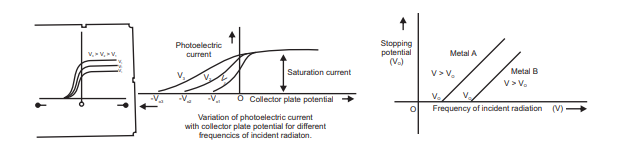
1. The minimum negative potential given to the anode plate for which the photo electric current becomes zero is called stopping potential.
2. The stopping potential Vo depends on i) The frequency of incident light and ii) the nature of emitter material. For a given frequency of incident light, the stopping potential is independent of its intensity.

3. Below a certain frequency (threshold frequency) n , characteristics of the metal , no 0 photo electric emission takes place, no matter how large the intensity may be.
EINSTEINS PHOTO ELECTRIC EQUATION: ENERGY QUANTUM OF RADIATION
1. Light is composed of discrete packets of energy called quanta or photons.
2. The energy carried by each photon is E = hν, where ν is the frequency and momentum. p= h/λ. The energy of the photon depends on the frequency γ of the incident light and not
on its intensity.
3. Photo electric emission from the metal surface occurs due to absorption of a photon by an electron
4. Einstein’s photo electric equation:

PARTICLE NATURE OF LIGHT: THE PHOTON
1. Radiation has dual nature: wave and particle. The wave nature is revealed in phenomenon like interference, diffraction and polarization. The particle nature is revealed by the phenomenon photo electric effect.
2. By symmetry, matter also should have dual nature: wave and particle. The waves associated with the moving material particle are called matter waves or De Broglie waves.
3. The De Broglie wave length (λ) associated with the moving particle is related to its moment p as: λ =h/p = h/mv
4. An equation for the De Broglie wavelength of an electron accelerated through a potential V. Consider an electron with mass ‘m’ and charge ‘e’ accelerated from rest through a potential V.
K = eV
K =1/2 mv2= 2mK
P = √2mK = √2meV
λ = h/√2meV
ONE MARK QUESTIONS
1. A proton and an electron have same kinetic energy. Which one has greater de-Broglie wavelength and why?
2. Define the term 'stopping potential' in relation to photoelectric effect.
3. The stopping potential in an experiment on photoelectric effect is 1 .5 V. What is the maximum kinetic energy of the photoelectrons itted?
4. The maximum kinetic energy of a photoelectron is 3eV.What is its stopping potential?
5. With what purpose was famous Davisson-Germer experiment with electrons performed.
6. If the intensity of incident radiation in a photoelectric experiment is doubled what, happens to kinetic energy of emitted photo electrons?
7. Calculate the frequency associated with photon of energy 3.3 x 10⁻¹⁰ J?
Ans: ν = 5 x 10 23 Hz.
8. What is the momentum of a photon of energy 1 MeV? Energy E = 1 MeV = 1.6 x 10 -13J, p = E/c= 5.33x 10⁻²² Kgm/s
9. What happens to the velocity of emitted electrons when the wave length of incident light is decreased?
10 . Which of the two photons is more energetic: red light or violet light?
11. What will be the stopping potential when a photon of 25eV is incident of metal surface of work function 6eV? Ans : 19 volt
12. Why is alkali metal surface better suited as photosensitive surface?
13. Blue light can eject electrons from a photo-sensitive surface while orange light cannot. Will violet and red light eject electrons from the same surface?
14. Matter waves associated with electrons could be verified by crystal diffraction experiments. Why?
Ans: The wave length of the matter waves associated with electrons has wavelength comparable to the spacing between the atomic planes of their crystals.
15. How do matter waves differ from light waves as regards to the velocity of the particle and the wave?
Ans: In case of matter waves, the wave velocity is different from the particle velocity. But in case of light, particle velocity and wave velocity are same.
16. An electron and an alpha particle have same kinetic energy. Which of these particles has the shortest de- Broglie wavelength Ans: Alpha particle
17. An electron, an alpha-particle and a proton have the same kinetic energy. Which one of these particles has the largest de-Broglie wave length?
Please click the link below to download CBSE Class 12 Physics Dual Nature Of Matter & Radiation chapter notes and important questions.
Free study material for Physics
Useful Resources and Notes for Class 12 Physics Chapter 11 Dual Nature of Radiation and Matter
Core Study Kit: Class 12 Physics Chapter 11 Dual Nature of Radiation and Matter
Explore essential learning tools for Class 12 Physics Chapter 11 Dual Nature of Radiation and Matter. This curated collection features in-depth notes and targeted practice questions built around the active 2026 curriculum to streamline your daily revision.
NCERT-Aligned Solutions for Chapter 11 Dual Nature of Radiation and Matter
Each resource draws directly from authorized textbooks to maintain academic accuracy. Evaluating solved examples allows Class 12 students to master the formal presentation and answer-writing standards expected in upcoming school exams.
Next Steps in Your Exam Preparation
For peak performance in upcoming evaluations, integrate official Physics sample papers directly into your study schedule. Follow up your revision by attempting online MCQ tests for Chapter 11 Dual Nature of Radiation and Matter to refine calculation speed and precision.
FAQs
Our advanced study package for Chapter 11 Dual Nature of Radiation and Matter includes detailed concepts, diagrams, Mind Maps, and explanation of complex topics to ensure Class 12 students learn as per syllabus for 2026 exams.
The Mind Maps provided for Chapter 11 Dual Nature of Radiation and Matter act as visual anchors which will help faster recall during high-pressure exams.
Yes, teachers use our Class 12 Physics resources for lesson planning as they are in simple language and have lot of solved examples.
Yes, You can download the complete, mobile-friendly PDF of the Physics Chapter 11 Dual Nature of Radiation and Matter advanced resources for free.
Yes, our subject matter experts have updated the Chapter 11 Dual Nature of Radiation and Matter material to align with the rationalized NCERT textbooks and have removed deleted topics and added new competency-based questions.