

Official CBSE Study Materials for Class 12 Physics
Explore structured advanced study materials through the CBSE Class 12 Physics Prism Deviation and Disprtion Solved Examples. Tailored for Class 12 learners, utilizing these Physics resources ensures thorough preparation and strengthens foundational knowledge before final CBSE evaluations.
Advanced Resources for Physics
Access the complete useful resource PDF for Class 12 Physics below. Regular practice with these targeted academic notes builds familiarity with complex topics and helps secure higher marks in final school evaluations.
CBSE Class 12 Physics Prism Deviation and Disprtion Solved Examples. Please refer to the examination notes which you can use for preparing and revising for exams. These notes will help you to revise the concepts quickly and get good marks.
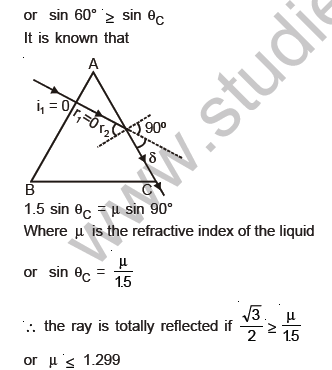
Ex.1 Light is incident on the side of a 30°– 60° – 90° prism , as shown in the figure. A thin layer of a liquid is spread over the hypotenuse of the prism. If the index of refraction of the prism is 1.5, find the maximum refractive index of the liquid in order that a ray passing normally through the 60°– base may be
totally reflected.
Sol. The angle of incidence of the hypotenuse is 60°. The ray is totally reflected if 60° ≥ θC where θC is the critical angle for the glass- liquid interface.
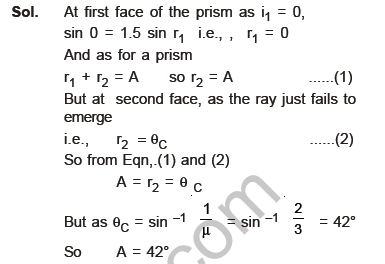
Ex.2 A ray of light fall normally on a refracting face of a prism of refractive index 1.5. Find the angle of the prism if the ray just fails to emerge from the prism.
Ex.3 The refractive indices of material of a prism for blue and red colours are 1.532 and 1.514 respectively. Calculate angular dispersion
produced by the prism if angle of prism is 8°.
Sol. Here,μb= 1.532 and μr = 1.514 A = 8° . Angular dispersion
= (μb – μr) A
= (1.532 – 1.514) x 8
= 0.018 x 8 = 0.144° .
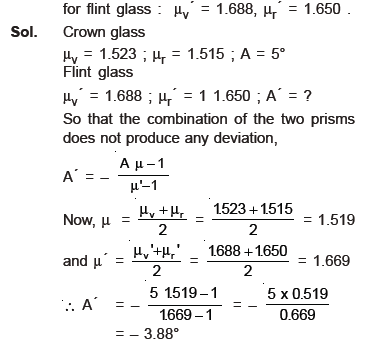
Ex.4 Determine the angle of flint glass prism, which should be combined with a crown glass prism of 5° so as to give dispersion but no deviation. Given, for crown glass :
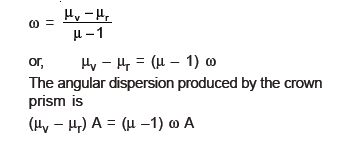
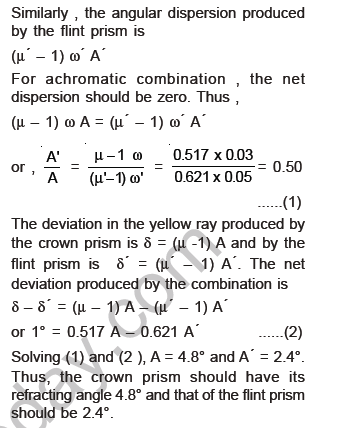
Ex.5 The dispersive powers of crown and flint glasses are 0.03 and 0.05 respectively. The refractive indices for yellow light for these glasses are 1.517 and 1.621 respectively . It is desired to form an achromatic combination of prisms of crown and flint glasses which can produce a deviation of 1° in the yellow ray. Find the refracting angles of the two prisms needed.
Sol. Suppose, the angle of the crown prism needed is A and that of the flint prism is A’. We have
Free study material for Physics
Useful Resources and Notes for Class 12 Physics Prism Deviation and Disprtion
Comprehensive Study Resources for Prism Deviation and Disprtion
Review targeted study resources for Prism Deviation and Disprtion tailored for Class 12 learners. Utilizing these structured notes and quick-revision tools ensures complete alignment with current CBSE evaluation standards.
Understanding Marking Schemes
Designed around the official curriculum, these study guides guarantee standard compliance. Reviewing step-by-step solutions clarifies complex sub-topics within Prism Deviation and Disprtion and demystifies standard marking schemes for Physics evaluations.
Complete Revision for Physics
For peak performance in upcoming evaluations, integrate official Physics sample papers directly into your study schedule. Follow up your revision by attempting online MCQ tests for Prism Deviation and Disprtion to refine calculation speed and precision.
FAQs
Our advanced study package for Prism Deviation and Disprtion includes detailed concepts, diagrams, Mind Maps, and explanation of complex topics to ensure Class 12 students learn as per syllabus for 2026 exams.
The Mind Maps provided for Prism Deviation and Disprtion act as visual anchors which will help faster recall during high-pressure exams.
Yes, teachers use our Class 12 Physics resources for lesson planning as they are in simple language and have lot of solved examples.
Yes, You can download the complete, mobile-friendly PDF of the Physics Prism Deviation and Disprtion advanced resources for free.
Yes, our subject matter experts have updated the Prism Deviation and Disprtion material to align with the rationalized NCERT textbooks and have removed deleted topics and added new competency-based questions.