

Class 12 Physics Study Guide: CBSE Class 12 Physics Prism Deviation and Disprtion Theory and Examples
Explore structured advanced study materials through the CBSE Class 12 Physics Prism Deviation and Disprtion Theory and Examples. Tailored for Class 12 learners, utilizing these Physics resources ensures thorough preparation and strengthens foundational knowledge before final CBSE evaluations.
Download Prism Deviation and Disprtion Study Material PDF
Access the complete useful resource PDF for Class 12 Physics below. Regular practice with these targeted academic notes builds familiarity with complex topics and helps secure higher marks in final school evaluations.
This Class 12 Physics page gives the theory and solved examples on refraction through a prism: terms related to a prism, deviation, condition of no emergence, critical angle of a prism, grazing emergence, maximum deviation, minimum deviation with proof, thin prisms, dispersion, angular and dispersive power, and combinations of prisms with dispersion without deviation and deviation without dispersion.
Topics Covered
1. Deviation by a prism
2. Condition of no emergence, critical angle, grazing emergence and maximum deviation
3. Minimum deviation and thin prisms
4. Solved examples on refraction by prism
5. Dispersion, angular dispersion and dispersive power
6. Combination of prisms
7. Solved examples on dispersion
1. DEVIATION
1.1 PRISM
It is a transparent medium whose refracting surfaces are not parallel but are inclined to each other.
1.2 TERMS RELATED TO PRISM
(A) Angle of Prism or Refracting Angle (A):
It is the angle between the faces on which light is incident and from which it emerges.
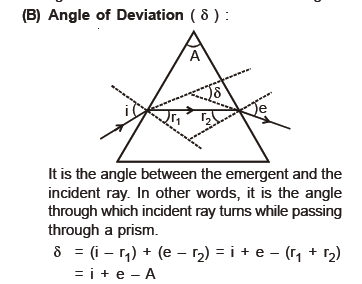
(B) Angle of Deviation (δ):
[Figure: Triangular prism with apex A. A ray enters the first face at angle of incidence i, is refracted at angle r₁ inside the prism, meets the second face at angle r₂ and emerges at angle of emergence e. The angle between the incident ray extended and the emergent ray is marked δ.]
It is the angle between the emergent and the incident ray. In other words, it is the angle through which the incident ray turns while passing through a prism.
δ = (i - r₁) + (e - r₂) = i + e - (r₁ + r₂)
= i + e - A
1.3 CONDITION OF NO EMERGENCE
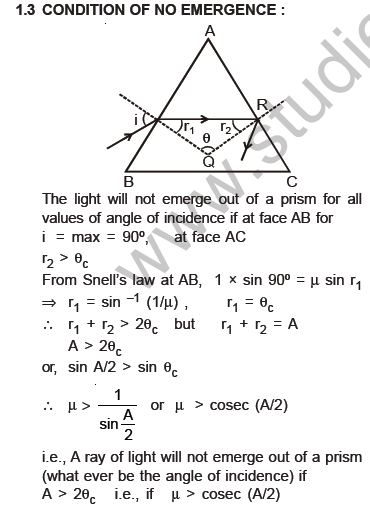
[Figure: Prism ABC with a ray incident at i on the face AB, refracted at angle r₁ at point Q, meeting the face AC at point R with angle r₂, where it is totally reflected. The angle θ is marked at Q.]
The light will not emerge out of a prism for all values of angle of incidence if at face AB for i = max = 90°, at face AC r₂ is greater than θc.
From Snell's law at AB, 1 × sin 90° = μ sin r₁
⇒ r₁ = sin⁻¹(1/μ), r₁ = θc
∴ r₁ + r₂ is greater than 2θc but r₁ + r₂ = A
A is greater than 2θc
or, sin A/2 is greater than sin θc
∴ μ is greater than \( \frac{1}{\sin\frac{A}{2}} \) or μ is greater than cosec (A/2)
i.e., a ray of light will not emerge out of a prism (whatever be the angle of incidence) if A is greater than 2θc, that is, if μ is greater than cosec (A/2).
1.4 CRITICAL ANGLE
It is the angle of prism above which incident light ray on the first surface will not emerge out from the second surface for all possible values of angle of incidence.
A = 2θC
1.5 CONDITION OF GRAZING EMERGENCE
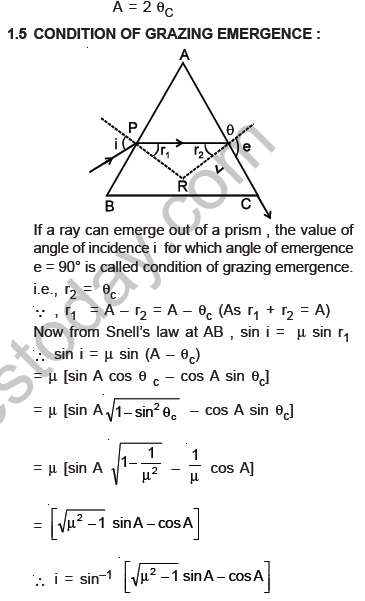
[Figure: Prism ABC with apex A. A ray enters the face AB at point P with angle of incidence i, is refracted with angles r₁ and r₂ inside the prism, meets the face AC at angle r₂ = θc and emerges along the face at e = 90°. The point R is marked on the base.]
If a ray can emerge out of a prism, the value of angle of incidence i for which angle of emergence e = 90° is called condition of grazing emergence.
i.e., r₂ = θc
∴ r₁ = A - r₂ = A - θc (as r₁ + r₂ = A)
Now from Snell's law at AB, sin i = μ sin r₁
∴ sin i = μ sin (A - θc)
= μ [sin A cos θc - cos A sin θc]
= μ [sin A \( \sqrt{1 - \sin^{2}\theta_c} \) - cos A sin θc]
= μ [sin A \( \sqrt{1 - \frac{1}{\mu^{2}}} \) - \( \frac{1}{\mu} \) cos A]
= [\( \sqrt{\mu^{2} - 1} \) sin A - cos A]
∴ i = sin⁻¹ [\( \sqrt{\mu^{2} - 1} \) sin A - cos A]
Note:
The light will emerge out of a given prism only if the angle of incidence is greater than the condition of grazing emergence.
1.6 CONDITION OF MAXIMUM DEVIATION
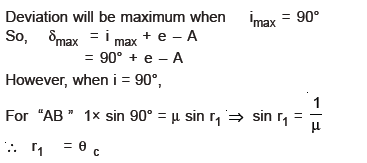
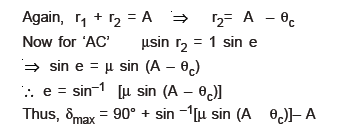
Deviation will be maximum when imax = 90°
So, δmax = imax + e - A
= 90° + e - A
However, when i = 90°,
For "AB" 1 × sin 90° = μ sin r₁ ⇒ sin r₁ = \( \frac{1}{\mu} \)
∴ r₁ = θc
Again, r₁ + r₂ = A ⇒ r₂ = A - θc
Now for "AC" μ sin r₂ = 1 sin e
⇒ sin e = μ sin (A - θc)
∴ e = sin⁻¹ [μ sin (A - θc)]
Thus, δmax = 90° + sin⁻¹ [μ sin (A - θc)] - A
Note:
This situation is reverse of grazing emergence and may also be viewed as deviation at grazing incidence.
1.7 CONDITION FOR MINIMUM DEVIATION
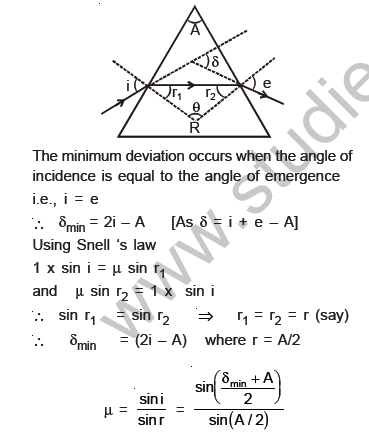
[Figure: Prism with apex A. A ray enters the first face at angle i, travels inside the prism parallel to the base with angles r₁ and r₂ equal, and emerges at angle e. The deviation δ is marked between the incident ray extended and the emergent ray. The angle θ and the point R are marked near the base.]
The minimum deviation occurs when the angle of incidence is equal to the angle of emergence, i.e., i = e
∴ δmin = 2i - A [as δ = i + e - A]
Using Snell's law
1 × sin i = μ sin r₁
and μ sin r₂ = 1 × sin i
∴ sin r₁ = sin r₂ ⇒ r₁ = r₂ = r (say)
∴ δmin = (2i - A) where r = A/2
μ = \( \frac{\sin i}{\sin r} \) = \( \frac{\sin\left(\frac{\delta_{min} + A}{2}\right)}{\sin(A/2)} \)
Note: In the condition of minimum deviation the light ray passes through the prism symmetrically, i.e., the light ray in the prism becomes parallel to its base.
PROOF
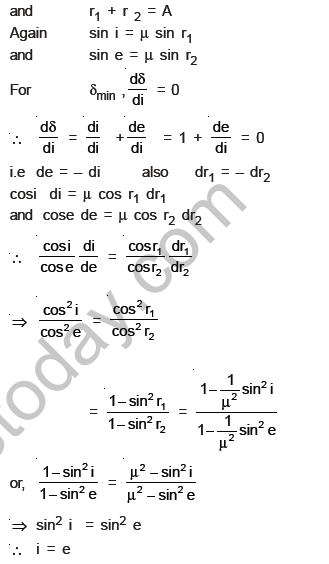
We know, δ + A = i + e
and r₁ + r₂ = A
Again sin i = μ sin r₁
and sin e = μ sin r₂
For δmin, \( \frac{d\delta}{di} \) = 0
∴ \( \frac{d\delta}{di} \) = \( \frac{di}{di} \) + \( \frac{de}{di} \) = 1 + \( \frac{de}{di} \) = 0
i.e. de = - di also dr₁ = - dr₂
cos i di = μ cos r₁ dr₁
and cos e de = μ cos r₂ dr₂
∴ \( \frac{\cos i \, di}{\cos e \, de} \) = \( \frac{\cos r_1 \, dr_1}{\cos r_2 \, dr_2} \)
⇒ \( \frac{\cos^{2} i}{\cos^{2} e} \) = \( \frac{\cos^{2} r_1}{\cos^{2} r_2} \)
= \( \frac{1 - \sin^{2} r_1}{1 - \sin^{2} r_2} \) = \( \frac{1 - \frac{1}{\mu^{2}} \sin^{2} i}{1 - \frac{1}{\mu^{2}} \sin^{2} e} \)
or, \( \frac{1 - \sin^{2} i}{1 - \sin^{2} e} \) = \( \frac{\mu^{2} - \sin^{2} i}{\mu^{2} - \sin^{2} e} \)
⇒ sin² i = sin² e
∴ i = e
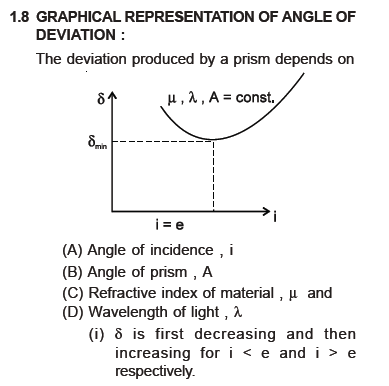
1.8 GRAPHICAL REPRESENTATION OF ANGLE OF DEVIATION
The deviation produced by a prism depends on
[Figure: Graph of δ (vertical axis) against i (horizontal axis) for constant μ, λ and A. The curve falls to a minimum value δmin at i = e (marked by dashed lines) and then rises again.]
(A) Angle of incidence, i
(B) Angle of prism, A
(C) Refractive index of material, μ and
(D) Wavelength of light, λ
(i) δ is first decreasing and then increasing for i is less than e and i is greater than e respectively.
(ii) δ ∝ A
(iii) δ ∝ (μ - 1)
(iv) δ ∝ \( \frac{1}{\lambda} \)
1.9 THIN PRISMS
In thin prism the distance between the refracting surfaces is negligible and the angle of prism (A) is very small. Since A = r₁ + r₂, therefore, r₁ and r₂ both are small and the same is true for i₁ and i₂.
According to Snell's law: sin i = μ sin r₁ ⇒ i = μr₁
sin e = μ sin r₂ ⇒ e = μ r₂
∴ deviation, δ = (i₁ - r₁) + (e - r₂)
= (r₁ + r₂)(μ - 1)
= A (μ - 1)
Note:
The deviation for a small angled prism is independent of the angle of incidence.
EXAMPLES BASED ON REFRACTION BY PRISM
Ex.1 A thin prism of angle A = 6° produces a deviation δ = 3°. Find the refractive index of the material of prism.
Answer:
1. For a thin prism, δ = A (μ - 1), so μ = 1 + \( \frac{\delta}{A} \).
2. Here A = 6° and δ = 3°, so μ = 1 + \( \frac{3}{6} \) = 1.5.
Teacher's Note:
a) Use the thin prism formula only when the angle of the prism is small.
b) Check: A(μ - 1) = 6 × 0.5 = 3°, which agrees with the given deviation.
Ex.2 A ray of light is incident at an angle of 60° on one face of a prism which has an angle of 30°. The ray emerging out of the prism makes an angle of 30° with the incident ray. Show that the emergent ray is perpendicular to the face through which it emerges and calculate the refractive index of the material of the prism.
Answer:
1. Given A = 30°, i₁ = 60° and δ = 30°.
2. From δ = (i₁ + i₂) - A: 30° = (60° + i₂) - 30°, so i₂ = 0.
3. The angle of emergence is zero, so the emergent ray is perpendicular to the face from which it emerges.
4. Now r₂ = 0, and as r₁ + r₂ = A, r₁ = A = 30°.
5. At the first face, 1 × sin 60° = μ sin 30°, so μ = \( \sqrt{3} \).
Teacher's Note:
a) A ray that leaves along the normal has e = 0, so the inner angle r₂ is also 0.
b) Here the second angle i₂ is the angle of emergence e.
c) Always check the final refractive index against the typical glass range (1.5 to 1.7); √3 = 1.73 is acceptable here.
Ex.3 The refractive index of the material of a prism is \( \sqrt{2} \) and its prism angle is 30°. One of its refracting faces is polished. The incident beam of light will return back for the angle of incidence
(A) 60°
(B) 45°
(C) 30°
(D) 0°
[Figure: Prism ABC with apex A at the top and base BC. The face AC is a polished (shaded) face. An incident ray falls on the face AB at point E with angle i; the points D and F are marked, with angles 30° and 60° shown at E and 30° at F, and the ray strikes the polished face AC at right angle at D.]
Answer:
1. The ray returns back from the polished face AC, so it falls normally on AC. Hence the angle of refraction at the face AB is r = A = 30°.
2. From Snell's law, μ = \( \frac{\sin i}{\sin r} \), so \( \sqrt{2} \) = \( \frac{\sin i}{\sin 30°} \).
3. sin i = \( \frac{\sqrt{2}}{2} \) = \( \frac{1}{\sqrt{2}} \) = sin 45°, so i = 45°.
4. Hence the correct option is (B).
Teacher's Note:
a) A ray returns on its own path only if it strikes the mirror-like face normally.
b) For a prism with A = 30° the angle inside the prism at the first face equals A when the second ray is normal.
Ex.4 A ray of light incident on a prism surface at an angle of 50° in the minimum deviation position. If the angle prism is 60° then the values of δm and μ will be respectively -
(A) 40° and 1.532
(B) 60° and 1.532
(C) 90° and 1.532
(D) 0° and 1.532
Answer:
1. A = r₁ + r₂ = 60° ... (1)
2. In the minimum deviation position r₁ = r₂ ... (2)
3. From (1) and (2), A = 2r₁ = 60°, so r₁ = 30°.
4. μ = \( \frac{\sin i}{\sin r} \) = \( \frac{\sin 50°}{\sin 30°} \) = 1.532.
5. μ = \( \frac{\sin\frac{A + \delta_m}{2}}{\sin\frac{A}{2}} \), so 1.532 = \( \frac{\sin\frac{60° + \delta_m}{2}}{\sin 30°} \).
6. sin \( \frac{60° + \delta_m}{2} \) = \( \frac{1.532}{2} \) = 0.766, so \( \frac{60° + \delta_m}{2} \) = 50° and δm = 40°.
7. Hence the correct option is (A).
Teacher's Note:
a) The printed question gives the angle of incidence as 40°, which is a misprint: only 50° gives a result in the options (with 40° the result would be μ = 1.286 and δm = 20°). The question is corrected to 50°.
b) At minimum deviation i = e, so δm = 2i - A = 100° - 60° = 40°, which is a quick check.
c) Always use r = A/2 at the minimum deviation position.
Ex.5 A glass prism of refractive index 1.5 and angle of prism 6° is put in contact with another prism of refractive index 1.6 when a ray of light is made incident on this combination normally then it emerges out undeviated. The angle of second prism will be -
(A) 6°
(B) 5°
(C) 4°
(D) 3°
Answer:
1. The deviations of the two prisms are equal and opposite for no net deviation, so δ₁ = δ₂.
2. (μ₁ - 1)A₁ = (μ₂ - 1)A₂, so (1.5 - 1) × 6° = (1.6 - 1) × A₂.
3. A₂ = \( \frac{0.5 \times 6°}{0.6} \) = 5°.
4. Hence the correct option is (B).
Teacher's Note:
a) The prisms are placed with their bases in opposite directions so that the deviations cancel.
b) The thin prism formula δ = (μ - 1)A is used because both angles are small.
2. DISPERSION
2.1 PHENOMENON
It is the phenomenon of splitting of a beam of white light into its constituent colours on passing through a prism.
[Figure: Prism ABC with a white light ray W incident on the face AB. The ray splits into coloured rays inside the prism and on emergence falls on a screen, with the red ray R at the top and the violet ray V at the bottom of the spectrum on the screen.]
2.2 CAUSE
The refractive index of a material depends on the wavelength of light, given by
CAUCHY'S FORMULA
μ = A + \( \frac{B}{\lambda^{2}} \) + \( \frac{C}{\lambda^{4}} \) + ........ where A, B, C are constants
Note:
1. As μ decreases with increase in λ, for visible light μ is maximum for violet and minimum for red.
2. Because of the different refractive indices, light of different colours bend through different angles on refraction.
2.3 ANGULAR DISPERSION
Angular dispersion produced by a prism for white light is the difference in the angles of deviation of two extreme colours i.e., violet and red colours
(δv - δr) = (μv - μr) A
DERIVATION
If δv and δr are deviation of violet and red colours respectively then,
angular dispersion = δv - δr
Now, deviation, δ through a thin prism of refracting angle A is
δ = (μ - 1) A
∴ δv = (μv - 1) A and δr = (μr - 1) A
Thus, δv - δr = (μv - 1) A - (μr - 1) A
= (μv - μr) A
2.4 DISPERSIVE POWER
The dispersive power of a prism is defined as the ratio of angular dispersion to the mean deviation produced by the prism. It is represented by ω.
i.e., ω = \( \frac{\Delta\mu}{\mu - 1} \)
DERIVATION
The mean deviation produced by the prism is δ = (μ - 1) A
Angular dispersion, δv - δr = (μv - μr) A
As dispersive power = \( \frac{\text{angular dispersion}}{\text{mean deviation}} \)
∴ ω = \( \frac{\delta_v - \delta_r}{\delta} \) = \( \frac{(\mu_v - \mu_r) A}{(\mu - 1) A} \) = \( \frac{\Delta\mu}{\mu - 1} \)
Here, δ = \( \frac{\delta_v + \delta_r}{2} \) ≈ δy
Note:
Dispersive power of a prism depends only on nature of material of the prism. However, angular dispersion and mean deviation, both depend also on the angle of prism.
2.5 COMBINATION OF PRISMS
Two prisms of refracting angles A₁ and A₂ and dispersive power ω₁ and ω₂ are placed symmetrically (as shown in the figure) for a particular ray refractive indices of the two prisms are μ₁ and μ₂ respectively.
[Figure: Two thin prisms placed in contact with their bases in opposite directions. The first prism has refracting angle A₁ and dispersive power ω₁; the second has refracting angle A₂ and dispersive power ω₂. A ray enters the first prism, is deviated by δ₁, passes through the second prism and emerges deviated by δ₂ in the opposite sense.]
Thus deviation produced by two prisms are,
δ₁ = (μ₁ - 1) A₁ and δ₂ = (μ₂ - 1) A₂
As the two deviations are opposite to each other,
Net deviation,
δ = δ₁ - δ₂
= (μ₁ - 1) A₁ - (μ₂ - 1) A₂
If white light passes through the combination then,
δv = (μ1v - 1) A₁ - (μ2v - 1) A₂
and δr = (μ1r - 1) A₁ - (μ2r - 1) A₂
Thus, the angular dispersion produced by the combination is
δv - δr = (μ1v - μ1r) A₁ - (μ2v - μ2r) A₂
The dispersive powers are
ω₁ = \( \frac{\mu_{1v} - \mu_{1r}}{\mu_{1y} - 1} \) and ω₂ = \( \frac{\mu_{2v} - \mu_{2r}}{\mu_{2y} - 1} \)
So, net angular dispersion
δv - δr = (μ1y - 1) ω₁ A₁ - (μ2y - 1) ω₂ A₂
Thus the average deviation (or net deviation for yellow ray)
δy = (μ1y - 1) A₁ - (μ2y - 1) A₂
2.5 (A) DISPERSION WITHOUT AVERAGE DEVIATION
If δy = 0
(μ1y - 1) A₁ = (μ2y - 1) A₂
∴ δv - δr = (μ1y - 1) A₁ (ω₁ - ω₂) = δ₁ (ω₁ - ω₂)
Note:
By choosing ω₁ and ω₂ different and the refracting angles we can get dispersion without average deviation.
2.5 (B) AVERAGE DEVIATION WITHOUT DISPERSION
If δv - δr = 0
(μ1y - 1) ω₁ A₁ = (μ2y - 1) ω₂ A₂
or, (μ1v - μ1r) A₁ = (μ2v - μ2r) A₂
So, net average deviation
δ = (μ1y - 1) A₁ - (μ2y - 1) A₂
= (μ1y - 1) A₁ \( \left[1 - \frac{(\mu_{2y} - 1) A_2}{(\mu_{1y} - 1) A_1}\right] \)
= (μ1y - 1) A₁ \( \left(1 - \frac{\omega_1}{\omega_2}\right) \) = δ₁ \( \left(1 - \frac{\omega_1}{\omega_2}\right) \)
EXAMPLES BASED ON DISPERSION
Ex.6 A crown glass prism of angle 5° is to be combined with a flint glass prism in such a way that the mean ray passes undeviated. Find (a) the angle of the flint glass prism needed and (b) the angular dispersion produced by the combination when white light goes through it. Refractive indices for red, yellow and violet light are 1.514, 1.517 and 1.523 respectively for crown glass and 1.613, 1.620 and 1.632 for flint glass.
Answer:
1. The deviation produced by the crown prism is δ = (μ - 1)A and by the flint prism is δ' = (μ' - 1)A'. The prisms are placed with their angles inverted, so the net deviation is D = (μ - 1)A - (μ' - 1)A'.
2. (a) For zero net deviation of the mean ray, (μ - 1)A = (μ' - 1)A', so A' = \( \frac{\mu - 1}{\mu' - 1} \) A = \( \frac{1.517 - 1}{1.620 - 1} \) × 5° = 4.2°.
3. (b) The angular dispersion of the crown prism is δv - δr = (μv - μr) A and that of the flint prism is δ'v - δ'r = (μ'v - μ'r) A'.
4. The net angular dispersion = (μv - μr) A - (μ'v - μ'r) A' = (1.523 - 1.514) × 5° - (1.632 - 1.613) × 4.2° = 0.045° - 0.0798° = -0.0348°.
5. The angular dispersion has magnitude 0.0348°.
Teacher's Note:
a) The negative sign shows that the dispersion of the flint prism is larger and in the opposite sense to that of the crown prism.
b) The flint angle is rounded to 4.2° in part (b), as in part (a).
c) Mean deviation is calculated with the refractive index of yellow light.
Ex.7 Calculate the dispersive power for crown glass from the given data μv = 1.5230, μr = 1.5145
Answer:
1. Mean refractive index μ = \( \frac{\mu_v + \mu_r}{2} \) = \( \frac{1.5230 + 1.5145}{2} \) = 1.51875.
2. ω = \( \frac{\mu_v - \mu_r}{\mu - 1} \) = \( \frac{1.5230 - 1.5145}{1.51875 - 1} \) = \( \frac{0.0085}{0.51875} \) = 0.0164.
Teacher's Note:
a) The printed solution rounds the mean index to 1.5187 and gives 0.0163; the exact value of the ratio is 0.01639, which rounds to 0.0164.
b) Dispersive power has no unit.
Ex.8 Find the angle of a prism of dispersive power 0.021 and refractive index 1.53 to form an achromatic combination with prism of angle 4.2° and dispersive power 0.045 having refractive index 1.65. Find the resultant deviation.
Answer:
1. Here ω = 0.021, μ = 1.53, ω' = 0.045, μ' = 1.65 and A' = 4.2°.
2. For no dispersion, ωδ + ω'δ' = 0, that is, ωA(μ - 1) + ω'A'(μ' - 1) = 0.
3. A = -\( \frac{\omega' A' (\mu' - 1)}{\omega (\mu - 1)} \) = -\( \frac{0.045 \times 4.2 \times (1.65 - 1)}{0.021 \times (1.53 - 1)} \) = -11.04°.
4. Net deviation δ + δ' = A(μ - 1) + A'(μ' - 1) = -11.04 × 0.53 + 4.2 × 0.65.
5. = -5.85 + 2.73 = -3.12°, that is, a resultant deviation of magnitude 3.12°.
Teacher's Note:
a) The negative sign of A means that the first prism is placed with its base opposite to that of the second prism; the angle is 11.04°.
b) The printed solution gives the resultant deviation as 3.12°; its sign is negative, which means that it is in the sense of the first (inverted) prism.
c) Check: 0.021 × 11.04 × 0.53 equals 0.045 × 4.2 × 0.65 within rounding.
Free study material for Physics
CBSE Class 12 Physics Study Material: Prism Deviation and Disprtion
Comprehensive Study Resources for Prism Deviation and Disprtion
Review targeted study resources for Prism Deviation and Disprtion tailored for Class 12 learners. Utilizing these structured notes and quick-revision tools ensures complete alignment with current CBSE evaluation standards.
Understanding Marking Schemes
Each resource draws directly from authorized textbooks to maintain academic accuracy. Evaluating solved examples allows Class 12 students to master the formal presentation and answer-writing standards expected in upcoming school exams.
Complete Revision for Physics
Wrap up your chapter revision by testing your knowledge against standard objective question formats. Explore our full library of free, up-to-date sample papers and online assessments to secure top grades in your CBSE examinations.
FAQs
Our advanced study package for Prism Deviation and Disprtion includes detailed concepts, diagrams, Mind Maps, and explanation of complex topics to ensure Class 12 students learn as per syllabus for 2026 exams.
The Mind Maps provided for Prism Deviation and Disprtion act as visual anchors which will help faster recall during high-pressure exams.
Yes, teachers use our Class 12 Physics resources for lesson planning as they are in simple language and have lot of solved examples.
Yes, You can download the complete, mobile-friendly PDF of the Physics Prism Deviation and Disprtion advanced resources for free.
Yes, our subject matter experts have updated the Prism Deviation and Disprtion material to align with the rationalized NCERT textbooks and have removed deleted topics and added new competency-based questions.