

Official CBSE Study Materials for Class 12 Physics
Review targeted academic resources with the CBSE Class 12 Physics Diffraction and Polarisation of light Theory. Built according to official CBSE standards for the 2026-27 term, these downloadable Class 12 Physics study materials support effective daily practice and deeper conceptual understanding for Diffraction and Polarisation of light.
Advanced Resources for Physics
Access the complete useful resource PDF for Class 12 Physics below. Regular practice with these targeted academic notes builds familiarity with complex topics and helps secure higher marks in final school evaluations.
CBSE Class 12 Physics Diffraction and Polarisation of light Theory. Please refer to the examination notes which you can use for preparing and revising for exams. These notes will help you to revise the concepts quickly and get good marks.
1. DIFFRACTION
1.1 Meaning of Diffraction
It is the spreading of waves round the corners of an obstacle, of the order of wave length.
1.2 Defination of Diffraction
The phenomenon of bending of light waves around the sharp edges of opaque obstacles or aperture and their encroachment in the geometrical shadow of obstacle or aperture is defined as diffraction of light.
1.3 Necessary Conditions of Diffraction of Waves
The size of the obstacle (a) must be of the order of the wavelength of the waves (λ).
a/λ > 1
Note:Greater the wave length of wave higher will be its degree of diffraction. This is the reason that diffraction of sound & radio waves is easily observed but for diffraction of light,
additional arrangement have to be arrange. λsound > λlight Wave length of sound is nearly equal to size of obstacle. If size of obstactle is a & wavelength is λ then,
S.No. a V/S λ Diffraction
(1) a << λ Not possible
(2) a >> λ Not possible
(3) a ≈ λ Possible
1.4 Interpretation of Diffraction
As a result of diffraction, maxima & minima of light intensities are found which has unequal intensities. Diffraction is the result of superposing of waves from infinite number of coherent sources on the same wavefront after the wavefront has been distorted by the obstacle.
1.5. Example of Diffraction
(a) When an intense source of light is viewed with the paritally opened eye, colours are observed in the light.
(b) Sound produced in one room can be heard in the nearby room.
(c) Appearance of a shining circle around the section of sun just before sun rise.
(d) Colored spectrum is observed if a light source at far distant is seen through a thin cloth
1.6 Two type of diffraction
Fresnel Diffraction : Fresenel diffraction which involves non-plane (spherical) wavefronts, so that the source s and the point p (where diffraction effect is to be observed )
are to be at a finite distance from the diffracting obstacle
Fraunhofer Diffraction: Fraunhofer diffraction deals with wavefronts that are plane on arrival and an effective viewing distance of infinity. If follows that fraunhofer diffraction is
an important special case of fresnel diffraction. In youngs double slit experiment, we assume the screen to be relatively distant, that we have fraunhofer conditions.
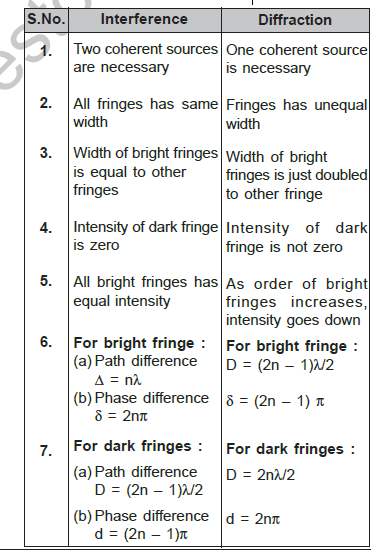
1.7 DIFFERENCE BETWEEN INTERFERENCE & DIFFRACTION OF LIGHT
1.8 RESOLVING POWER (R.P)
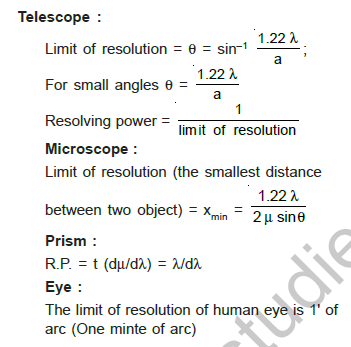
A large number of images are formed as a consequence of light diffraction from a source. If two sources are separated such that their central maxima do not overlap, their images
can be distinguished and are said to be resolved R.P. of an optical instrument is its ability to distinguish two neighbouring points. Linear R.P. = d/λD
Angular R.P. = d/λ
D = Observed distance
d = Distance between two points
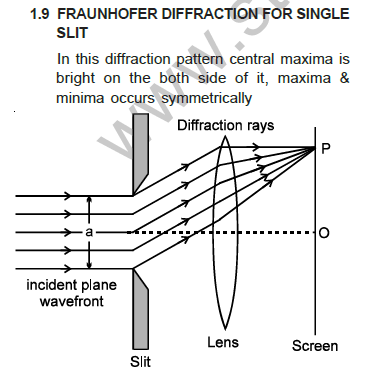
(1) For Diffraction Maxima : a sin θ = (2n – 1) λ/2
(2) For Diffraction Minima : a sin θ = nλ
(3) The maxima or minima is observed due to the superposition of waves emerging from infinite secondary sources between A & B points of slit.
(4) Fringe width : The distance between two secondary minima formed on two sides of central maximum is known as the width of central maximum

Fraunhofer diffraction for single slit
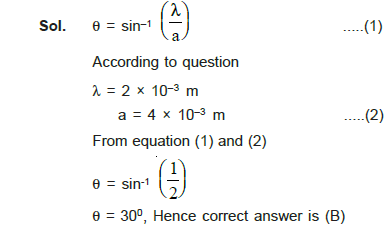
Ex.1 When wave of wavelength 0.2 cm is made inciddent normally on a slit of width 0.004m, then the semi-angular width of central maximum of diffraction pattern will be-
(1) 600 (2) 300 (3) 900 (4) 00
Please click on below link to download pdf file for CBSE Class 12 Physics Diffraction and Polarisation of light Theory.
Free study material for Physics
CBSE Class 12 Physics Study Material: Diffraction and Polarisation of light
Core Study Kit: Class 12 Physics Diffraction and Polarisation of light
Explore essential learning tools for Class 12 Physics Diffraction and Polarisation of light. This curated collection features in-depth notes and targeted practice questions built around the active 2026 curriculum to streamline your daily revision.
NCERT-Aligned Solutions for Diffraction and Polarisation of light
Built using official NCERT guidelines for Class 12 Physics, these materials provide reliable academic support. Integrating past examination questions and step-by-step solutions helps students understand official CBSE grading criteria.
Next Steps in Your Exam Preparation
Wrap up your chapter revision by testing your knowledge against standard objective question formats. Explore our full library of free, up-to-date sample papers and online assessments to secure top grades in your CBSE examinations.
FAQs
Our advanced study package for Diffraction and Polarisation of light includes detailed concepts, diagrams, Mind Maps, and explanation of complex topics to ensure Class 12 students learn as per syllabus for 2026 exams.
The Mind Maps provided for Diffraction and Polarisation of light act as visual anchors which will help faster recall during high-pressure exams.
Yes, teachers use our Class 12 Physics resources for lesson planning as they are in simple language and have lot of solved examples.
Yes, You can download the complete, mobile-friendly PDF of the Physics Diffraction and Polarisation of light advanced resources for free.
Yes, our subject matter experts have updated the Diffraction and Polarisation of light material to align with the rationalized NCERT textbooks and have removed deleted topics and added new competency-based questions.