

Class 12 Physics Study Guide: CBSE Class 12 Physics Reflection from Plane Surfaces Theory and Examples
Review targeted academic resources with the CBSE Class 12 Physics Reflection from Plane Surfaces Theory and Examples. Built according to official CBSE standards for the 2026-27 term, these downloadable Class 12 Physics study materials support effective daily practice and deeper conceptual understanding for Reflection from Plane Surfaces.
Download Reflection from Plane Surfaces Study Material PDF
View or download the dedicated CBSE Class 12 Physics Reflection from Plane Surfaces Theory and Examples resource below. Engaging with these advanced study guides under focused conditions ensures continuous academic progress and mastery of the 2026-27 curriculum for Reflection from Plane Surfaces.
CBSE Class 12 Physics Reflection from Plane Surfaces Theory and Examples. Please refer to the examination notes which you can use for preparing and revising for exams. These notes will help you to revise the concepts quickly and get good marks.
1. DEFINITION
When a light ray strikes the surface separating two media, a part of it gets reflected, i.e., returns back in the initial medium. It is known as reflection.
2. TERMS RELATED TO REFLECTION
2.1 RAY :
A ray of light is the straight line path of transfer of light energy. It is represented by a straight line with an arrow - head indicating the direction of propagation.
2.2 MIRROR :
It is a highly polished smooth surface from which most of theSmooth side incident light gets reflected. It is represented by a line with hatches in the reverse side of the smooth surface.

2.3 OBJECT :

A. Point from which incident ray actuallydiverge is called real object. Or point at which incident rays appear to converge is called virtual object.
B. object is defined on the basis of incident ray.
C. Minimum two rays are required to show the position of object
2.4 IMAGE :
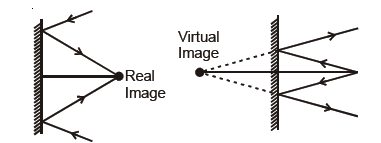
A. Point at which reflected or refracted rays actually converge is called real image. Or point from which reflected or refracted rays appear to diverge is called virtual image.
B. Minimum two reflected or refracted rays are required to determine the image position.
3. BASIC LAWS
3.1. Law Of Rectilinear Propagation Of Light states that light propagates in straight lines in homogeneous media.
3.2. Law Of Independence Of Light Rays states that rays do not disturb each other upon intersection.
3.3. Law Of Reversibility Of Light Rays states that rays retrace their path when their direction is reversed.
3.4. Laws Of Reflection :

A. The incident - ray, reflected ray and normal to the reflecting surface at the point of incidence all lie in the same plane.
B. The angle of reflection is equal to the angle of incidence, i.e. ∠i = ∠r .
Note :
1. These two laws are also valid for curved surfaces.
2. If ∠i = 0 then ∠r = 0 , i.e., if a ray is incident normally on a boundary, after reflection it retraces its path.
3. None of frequency, wavelength and speed changes. However intensity and hence amplitude usually decreases since I α A2
4. There is a phase change of π if reflection takes place from denser medium.
Laws of reflection
Ex.1 The plane of a mirror makes an angle of 30º with horizontal. If a vertical ray is incident on a mirror, then what is the angle between mirror and reflected ray ?
Sol. Angle betwen incident ray and mirror = 90º − 30º = 60º

By law of reflection ∠i = ∠r So angle of reflection ∠r = 30º, Hence angle between mirror and reflected ray = 60º
4. CHARACTERISTICS OF REFLECTION AT PLANE MIRROR
4.1. The image is always of same size and at same distance behind the mirror as the object in front of it.

4.2. When the object is real virtual image is formed and vice - versa.
4.3. The image is always erect when the object is in front of the mirror but inverted when the object is above the mirror.
4.4. The image is laterally inverted. The mirror actually reverses front and back in three dimensions (and not left to right ) i.e. only x-direction is reversed resulting in the change of left into right or vice - versa. A plane mirror changes right handed co-ordinate system to left handed one
4.5. As every part of mirror forms complete image of an extended object and due to superposition of images brightness will depend on the light reflecting area of the mirror. [It can be explained by Haygen's principle.]
4.6. Though every part of a mirror forms complete image of an object , we usually see only that part of image from which light after reflection from the mirror reaches our eye.
4.7. Deviation δ is defined as the angle between directions of incident ray and emergent ray. So if light is incident at an angle of incidence i, δ = π – ( i + r ) = π –2i
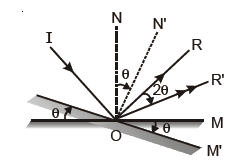
4.8. If keeping the incident ray fixed, the mirror is rotated by an angle θ , about an axis in the plane of mirror , The reflected ray is rotated through an angle 2θ.
4.9 Most of the smooth surfaces works as a good reflector when light falls at grazing incidence (∠i → 900 )
4.10 From smooth reflecting surface we get parallel beams of light which produces glare. However from rough surface we get diffused radiation.
4.11 If object moves towards the plane mirror at speed v, the image moves towards the plane mirror at speed – v. So , the image speed w.r.t object is – v – v = – 2v
4.12 If mirror is moved towards ( or away from) the object with speed v the image will move towards ( or away from ) the object with a speed 2v.
Please click on below link to download pdf file for CBSE Class 12 Physics Reflection from Plane Surfaces Theory and Examples.
Free study material for Physics
CBSE Class 12 Physics Study Material: Reflection from Plane Surfaces
Comprehensive Study Resources for Reflection from Plane Surfaces
Review targeted study resources for Reflection from Plane Surfaces tailored for Class 12 learners. Utilizing these structured notes and quick-revision tools ensures complete alignment with current CBSE evaluation standards.
Understanding Marking Schemes
Designed around the official curriculum, these study guides guarantee standard compliance. Reviewing step-by-step solutions clarifies complex sub-topics within Reflection from Plane Surfaces and demystifies standard marking schemes for Physics evaluations.
Complete Revision for Physics
Maximize your grade potential by utilizing Class 12 Physics practice papers in tandem with these structured notes. All printable assignments and interactive mock tests on our platform are updated for the 2026 session and available free of charge.
FAQs
Our advanced study package for Reflection from Plane Surfaces includes detailed concepts, diagrams, Mind Maps, and explanation of complex topics to ensure Class 12 students learn as per syllabus for 2026 exams.
The Mind Maps provided for Reflection from Plane Surfaces act as visual anchors which will help faster recall during high-pressure exams.
Yes, teachers use our Class 12 Physics resources for lesson planning as they are in simple language and have lot of solved examples.
Yes, You can download the complete, mobile-friendly PDF of the Physics Reflection from Plane Surfaces advanced resources for free.
Yes, our subject matter experts have updated the Reflection from Plane Surfaces material to align with the rationalized NCERT textbooks and have removed deleted topics and added new competency-based questions.