

Class 12 Physics Study Guide: CBSE Class 12 Physics Heat and Thermodynamics Assignment
Review targeted academic resources with the CBSE Class 12 Physics Heat and Thermodynamics Assignment. Built according to official CBSE standards for the 2026-27 term, these downloadable Class 12 Physics study materials support effective daily practice and deeper conceptual understanding for Heat and Thermodynamics.
Download Heat and Thermodynamics Study Material PDF
Navigate directly to the advanced Physics study materials using the digital viewer below. Each resource pack includes detailed conceptual summaries and solved practice questions, allowing students to instantly reinforce their learning.
CBSE Class 12 Physics Heat and Thermodynamics Assignment. Please refer to the examination notes which you can use for preparing and revising for exams. These notes will help you to revise the concepts quickly and get good marks.
MISCELLANEOUS ASSIGNMENT
CLASS 12 PHYSICS : HEAT AND THERMODYNAMICS
Comprehension-1
In fluids heat transfer takes place and molecules of the medium takes very active part. The molecules take energy from high temperature zone and move towards low temperature zone. This method is known as convection, when we require heat transfer with fast pase, we use some mechanism to make the flow of fluid on the body fast. The rate of loss of heat is proportional to velocity of fluid (v), and temperature difference (ΔT) between the body and fluid, of course more the surface area of body more the rate of loss of heat. We can write rate of loss of heat
\( \frac{dQ}{dt} \) = KAvΔT
where K is positive constant.
Now answer the following questions
1. A body is being cooled with fluid. When we increase the velocity of fluid 4 times and decrease the temperature difference 1/2 time, the rate of loss of heat increases
(a) four times
(b) two times
(c) six times
(d) no change
Answer: (b) two times
1. Rate of loss of heat dQ/dt = KAvΔT.
2. New rate = KA(4v)(ΔT/2) = 2 KAvΔT.
3. The rate becomes two times the original, so the correct option is (b).
Teacher's Note:
a) When several factors change together, multiply their individual ratios.
b) The factors here are 4 and 1/2, which give 2.
2. In the above question if mass of the body increased two times, without change in any of the other parameters, the rate of cooling
(a) decreases
(b) increases
(c) no effect of change of mass
(d) none of these
Answer: (a) decreases
1. The rate of loss of heat dQ/dt = KAvΔT does not depend on mass.
2. Rate of cooling = (dQ/dt)/(mass × specific heat), which is the fall in temperature per second.
3. With the mass doubled, the same dQ/dt gives half the fall in temperature per second, so the rate of cooling decreases.
4. Hence, the correct option is (a).
Teacher's Note:
a) Distinguish between the rate of loss of heat (unchanged) and the rate of cooling in °C per second (reduced).
b) A heavier body cools more slowly in the same surroundings.
Comprehension-2
When a body at temperature T is kept in a enclosure of temperature T0, rate of cooling is given by
- \( \frac{dT}{dt} \) = K (T - T0). This is known as Newton's law of cooling.
A block is kept in a room at temperature 25°C. Block is heated and its temperature rises at the rate of 1°C/sec when heater is switched on and falls at the rate of 0.1°C/sec just after heater is switched off. Assuming Newton's law of cooling to be valid. (Heat capacity of body is 50 J/°C)
3. Power of the heater is
(a) 100 W
(b) 50 W
(c) 40 W
(d) 80 W
Answer: (b) 50 W
1. The block starts at the room temperature of 25°C, so it loses no heat to the room at the start.
2. Power = heat capacity × rate of rise of temperature = 50 J/°C × 1 °C/s = 50 W.
3. Hence, the correct option is (b).
Teacher's Note:
a) At the room temperature there is no net loss, so the whole heater power raises the temperature.
b) Heat capacity times dT/dt gives power in watts.
4. What power radiated by block just after heater is switched off
(a) 5 J/sec
(b) 10 J/sec.
(c) 2.5 J/sec.
(d) 6 J/sec.
Answer: (a) 5 J/sec
1. Just after the heater is switched off the block cools at 0.1 °C/s.
2. Power radiated = heat capacity × rate of fall = 50 × 0.1 = 5 J/s.
3. Hence, the correct option is (a).
Teacher's Note:
a) With the heater off, all the heat lost comes from the stored energy of the block.
b) 1 W is the same as 1 J/s.
c) Use the heat capacity of the body directly, not the mass.
5. What is the power radiated by the block when temperature of block is 30° assuming its temperature was 35° when heater was switched off.
(a) 3 W
(b) 5 W
(c) 4 W
(d) 2.5 W
Answer: (d) 2.5 W
1. By Newton's law, power radiated is proportional to (T - T0), with T0 = 25°C.
2. At 35°C the excess is 10°C and the power is 5 W.
3. At 30°C the excess is 5°C, so power = 5 × 5/10 = 2.5 W.
4. Hence, the correct option is (d).
Teacher's Note:
a) Use the excess temperature over the room, not the temperature itself.
b) Halving the excess halves the power radiated.
Comprehension-3
When a thermodynamic process is shown on P-V diagram, area under curve represents work done during process. During cyclic process work done is area enclosed. The P-V graph for a thermodynamical system is shown in figure.
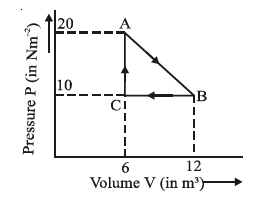
6. The work done by the system in the process A to B is
(a) 90 J
(b) 60 J
(c) 0 J
(d) 30 J
Answer: (a) 90 J
1. Work done in A to B = area under line AB, a trapezium with parallel sides 20 and 10 N/m² and width (12 - 6) = 6 m³.
2. W = (1/2)(20 + 10) × 6 = 90 J.
3. Hence, the correct option is (a).
Teacher's Note:
a) Work done by the gas is the area under the P-V curve, in joules when P is in N/m² and V in m³.
b) Expansion means positive work.
7. The work done in the process B to C is
(a) - 90 J
(b) - 60 J
(c) 0 J
(d) - 30 J
Answer: (b) - 60 J
1. B to C is at constant pressure of 10 N/m² while volume decreases from 12 m³ to 6 m³.
2. W = P ΔV = 10 × (6 - 12) = -60 J.
3. Hence, the correct option is (b).
Teacher's Note:
a) Compression gives negative work; the sign follows the change in volume.
b) The process is isobaric, so use W = PΔV.
8. The work done in the complete cycle ABCA is
(a) 90 J
(b) 60 J
(c) 0 J
(d) 30 J
Answer: (d) 30 J
1. Work done in A to B = +90 J and in B to C = -60 J.
2. C to A is at constant volume, so the work done is 0.
3. Net work = 90 - 60 + 0 = 30 J, which is the area of the triangle (1/2) × 6 × 10 = 30 J.
4. Hence, the correct option is (d).
Teacher's Note:
a) Work in a cycle equals the area enclosed by it.
b) A clockwise cycle on a P-V diagram gives positive work.
c) Check using the triangle: base 6 m³ and height 10 N/m².
Each of the questions given below consists of two statements, an assertion (A) and reason (R). Select the number corresponding to the appropriate alternative as follows
(a) If both A and R are true and R is the correct explanation of A
(b) If both A and R are true but R is not the correct explanation of A
(c) If A is true but R is false
(d) If A is false but R is true
9. A: The forces between the molecules of the liquid are gravitational forces.
R: The force between two molecules of a liquid separated by 10-10 m is of order of 10 N.
(a) If both A and R are true and R is the correct explanation of A
(b) If both A and R are true but R is not the correct explanation of A
(c) If A is true but R is false
(d) If A is false but R is true
Answer: (d) If A is false but R is true
1. The forces between molecules are electromagnetic in origin, not gravitational, so A is false.
2. Gravitational forces between molecules are extremely small compared with these forces.
3. R is taken as the statement that the intermolecular force at 10⁻¹⁰ m is large and not negligible, so it is accepted as true in this question.
4. Hence, the correct option is (d).
Teacher's Note:
a) Intermolecular forces arise from the electric charges of the particles.
b) Gravitational attraction between two molecules is negligible.
10. A: The work done in blowing a bubble of volume V is W, then work done in blowing a soap bubble to volume 2V is (2)2/3 W.
R: Work done = Surface tension × Increase in surface area.
(a) If both A and R are true and R is the correct explanation of A
(b) If both A and R are true but R is not the correct explanation of A
(c) If A is true but R is false
(d) If A is false but R is true
Answer: (a) If both A and R are true and R is the correct explanation of A
1. Work = surface tension × increase in area, so R is true.
2. Volume proportional to r³ means r proportional to V1/3, and area proportional to r² is proportional to V2/3.
3. For volume 2V the area is 22/3 times, so the work is 22/3 W; A is true and R explains it.
4. Hence, the correct option is (a).
Teacher's Note:
a) The work depends on the area, which grows as V to the power 2/3.
b) Link the assertion with the reason through W = S × ΔA.
11. A: Gas laws are not obeyed at low temperature and high pressure.
R: At low temperature and high pressure, the molecular attraction between the molecules become appreciable.
(a) If both A and R are true and R is the correct explanation of A
(b) If both A and R are true but R is not the correct explanation of A
(c) If A is true but R is false
(d) If A is false but R is true
Answer: (a) If both A and R are true and R is the correct explanation of A
1. Real gases follow the gas laws only when the molecules are far apart and the forces between them are negligible.
2. At low temperature and high pressure the molecules are close together and move slowly, so attraction becomes appreciable and the gas laws fail.
3. A and R are both true, and R explains A.
4. Hence, the correct option is (a).
Teacher's Note:
a) An ideal gas has no intermolecular forces; real gases deviate when these forces matter.
12. A: Root mean square velocity of gas molecules is greater than the most probable velocity of gas molecules.
R: vrms : vmp = \( \sqrt{\frac{3RT}{M}} \) : \( \sqrt{\frac{2RT}{M}} \)
(a) If both A and R are true and R is the correct explanation of A
(b) If both A and R are true but R is not the correct explanation of A
(c) If A is true but R is false
(d) If A is false but R is true
Answer: (a) If both A and R are true and R is the correct explanation of A
1. vrms = √(3RT/M) and vmp = √(2RT/M).
2. Since 3 is greater than 2, vrms is greater than vmp, so A is true.
3. R gives the correct ratio and explains A.
4. Hence, the correct option is (a).
Teacher's Note:
a) The order of speeds is vmp less than vav less than vrms.
b) Their ratio is √2 : √(8/π) : √3.
13. A: A beaker completely filled with water at 4°C overflows, when water is heated.
R: Water has maximum density at 4°C and hence upon heating density decreases and volume increases.
(a) If both A and R are true and R is the correct explanation of A
(b) If both A and R are true but R is not the correct explanation of A
(c) If A is true but R is false
(d) If A is false but R is true
Answer: (a) If both A and R are true and R is the correct explanation of A
1. Water has its maximum density, that is minimum volume, at 4°C.
2. On heating above 4°C its density decreases and its volume increases, so the water overflows from the full beaker.
3. Both statements are true and R explains A.
4. Hence, the correct option is (a).
Teacher's Note:
a) Water shows anomalous expansion between 0°C and 4°C.
b) The expansion of the beaker is small compared with that of water here.
14. A: The rate of loss of heat of a body at 350 K is R. At 700 K, the rate of loss becomes 16 R.
R: This is per Newton's law of cooling.
(a) If both A and R are true and R is the correct explanation of A
(b) If both A and R are true but R is not the correct explanation of A
(c) If A is true but R is false
(d) If A is false but R is true
Answer: (c) If A is true but R is false
1. Radiated heat is proportional to T⁴ by Stefan's law, so doubling T from 350 K to 700 K makes the rate 2⁴ = 16 times, 16R; A is true.
2. Newton's law of cooling says that the rate is proportional to the temperature difference, which would not give 16R, so R is false.
3. Hence, the correct option is (c).
Teacher's Note:
a) Stefan's law relates to T⁴; Newton's law relates to the difference of temperatures.
b) Match the factor 16 = 2⁴ to the fourth power.
15. A: If the temperature difference between the ends of a rod is doubled, then its thermal resistance is also doubled.
R: Thermal resistance is directly proportional to the temperature difference.
(a) If both A and R are true and R is the correct explanation of A
(b) If both A and R are true but R is not the correct explanation of A
(c) If A is true but R is false
(d) If A is false but R is true
Answer: (d) If A is false but R is true
1. Thermal resistance of a rod, R = L/(KA), depends only on its length, area and material, so A is false.
2. For a given heat current H, R = ΔT/H, which shows that resistance is directly proportional to the temperature difference, so R is taken as true.
3. Hence, the correct option is (d).
Teacher's Note:
a) The resistance of a rod does not change with the temperature difference applied across it.
b) The relation ΔT = H R is the thermal form of Ohm's law.
16. A: Two stars S1 and S2 radiate maximum energy at 240 nm and 30 nm respectively. Ratio of their absolute temperature is 5 : 4.
R: According to Wen\'s law, \( \frac{T_1}{T_2} = \frac{\lambda_2}{\lambda_1} \)
(a) If both A and R are true and R is the correct explanation of A
(b) If both A and R are true but R is not the correct explanation of A
(c) If A is true but R is false
(d) If A is false but R is true
Answer: (d) If A is false but R is true
1. By Wien's law, λm T = constant, so T1/T2 = λ2/λ1; R is true.
2. T1/T2 = 30/240 = 1/8, so the ratio is 1 : 8 and not 5 : 4; A is false.
3. Hence, the correct option is (d).
Teacher's Note:
a) The printed key gives (a), which is wrong; the correct option is (d) because the ratio of temperatures is 1 : 8.
b) A hotter star radiates its maximum at a shorter wavelength.
17. A: Two spheres of the same material have radii 2 m and 8 m and temperature 6000 K and 3000 K respectively. The energy radiated by both the spheres is same in same time.
R: \( \frac{E_1}{E_2} = \frac{A_1}{A_2} \left( \frac{T_1}{T_2} \right)^4 \)
(a) If both A and R are true and R is the correct explanation of A
(b) If both A and R are true but R is not the correct explanation of A
(c) If A is true but R is false
(d) If A is false but R is true
Answer: (a) If both A and R are true and R is the correct explanation of A
1. By Stefan's law E = σAT⁴t, so E1/E2 = (A1/A2)(T1/T2)⁴.
2. A1/A2 = (2/8)² = 1/16 and (T1/T2)⁴ = 2⁴ = 16.
3. E1/E2 = 1, so the energies are equal; R explains A.
4. Hence, the correct option is (a).
Teacher's Note:
a) Area goes as the square of the radius, and energy as the fourth power of temperature.
b) The factors 1/16 and 16 cancel exactly.
18. A: The specific heat of a gas can have values between 0 and ∞.
R: Specific heat of a gas depends on the nature of process according to which the heat is absorbed.
(a) If both A and R are true and R is the correct explanation of A
(b) If both A and R are true but R is not the correct explanation of A
(c) If A is true but R is false
(d) If A is false but R is true
Answer: (a) If both A and R are true and R is the correct explanation of A
1. The specific heat of a gas is C = Q/(mΔT) and depends on how heat is supplied.
2. It is zero for an adiabatic process (Q = 0) and infinite for an isothermal process (ΔT = 0).
3. Both statements are true and R explains A.
4. Hence, the correct option is (a).
Teacher's Note:
a) A gas has many specific heats, such as Cp and Cv, depending on the process.
19. A: The change in internal energy in any process is independent of the path followed.
R: Internal energy is a state variable.
(a) If both A and R are true and R is the correct explanation of A
(b) If both A and R are true but R is not the correct explanation of A
(c) If A is true but R is false
(d) If A is false but R is true
Answer: (a) If both A and R are true and R is the correct explanation of A
1. Internal energy depends only on the state of the system, so it is a state variable.
2. Hence the change in internal energy depends only on the initial and final states and not on the path.
3. Both are true and R explains A.
4. Hence, the correct option is (a).
Teacher's Note:
a) Work and heat are path functions, but their sum ΔU is not.
20. A: For an ideal gas, at constant temperature, the product of the pressure and volume is a constant
R: The mean square velocity of the molecules in inversely proportional to mass
(a) If both A and R are true and R is the correct explanation of A
(b) If both A and R are true but R is not the correct explanation of A
(c) If A is true but R is false
(d) If A is false but R is true
Answer: (b) If both A and R are true but R is not the correct explanation of A
1. For a fixed amount of ideal gas at constant temperature PV = constant (Boyle's law), so A is true.
2. Mean square velocity = 3kT/m, which is inversely proportional to the mass of a molecule at a given temperature, so R is true.
3. R does not explain why PV is constant.
4. Hence, the correct option is (b).
Teacher's Note:
a) Boyle's law follows from PV = (1/3)mNv², with the total kinetic energy fixed at constant T.
b) A true reason need not be the explanation.
21. A: When the absolute temperature of a black body is doubled, the wavelength λm corresponding to the maximum power radiated per unit area per unit wavelength band, gets halved.
R: Emission from a black body obeys Wien's displacement law.
(a) If both A and R are true and R is the correct explanation of A
(b) If both A and R are true but R is not the correct explanation of A
(c) If A is true but R is false
(d) If A is false but R is true
Answer: (a) If both A and R are true and R is the correct explanation of A
1. Wien's law states λm T = constant, so R is true.
2. If T is doubled, λm becomes half; A is true and follows from R.
3. Hence, the correct option is (a).
Teacher's Note:
a) λm is inversely proportional to T, not to T².
22. A: The internal energy of an ideal gas does not change during an isothermal process.
R: The decrease in volume of a gas is compensated by a corresponding increase in pressure, when its temperature is held constant.
(a) If both A and R are true and R is the correct explanation of A
(b) If both A and R are true but R is not the correct explanation of A
(c) If A is true but R is false
(d) If A is false but R is true
Answer: (b) If both A and R are true but R is not the correct explanation of A
1. The internal energy of an ideal gas depends only on temperature, so it is constant in an isothermal process; A is true.
2. At constant temperature PV is constant, so a fall in volume is balanced by a rise in pressure; R is true.
3. R describes Boyle's law and does not explain why the internal energy is constant.
4. Hence, the correct option is (b).
Teacher's Note:
a) Internal energy of an ideal gas = (f/2) nRT, with no volume term.
b) Look for the reason linking U with T.
23. A: Rate of fall of temperature is more in water than in other liquid or a solid.
R: Rate of all of temperature of a body is inversely proportional to its specific heat.
(a) If both A and R are true and R is the correct explanation of A
(b) If both A and R are true but R is not the correct explanation of A
(c) If A is true but R is false
(d) If A is false but R is true
Answer: (d) If A is false but R is true
1. Rate of fall of temperature = (heat lost per second)/(m s), so it is inversely proportional to the specific heat; R is true.
2. Water has a very high specific heat, so its temperature falls more slowly than that of most liquids and solids; A is false.
3. Hence, the correct option is (d).
Teacher's Note:
a) Water has a high specific heat, which is why it is a good coolant and heat store.
24. A: No rotational K.E. is associated with a monoatomic gas.
R: Moment of inertia of a point mass, about an axis through it, is zero.
(a) If both A and R are true and R is the correct explanation of A
(b) If both A and R are true but R is not the correct explanation of A
(c) If A is true but R is false
(d) If A is false but R is true
Answer: (a) If both A and R are true and R is the correct explanation of A
1. A monoatomic molecule is treated as a point mass, with only three translational degrees of freedom.
2. Its moment of inertia about an axis through it is zero, so the rotational kinetic energy (1/2)Iω² is zero.
3. A and R are true and R explains A.
4. Hence, the correct option is (a).
Teacher's Note:
a) A monoatomic gas has f = 3 and Cv = (3/2)R.
25. A: Adiabatic elasticity of atmospheric air is greater than its isothermal elasticity.
R: Under adiabatic conditions, "PVγ = constant" is used, whereas for isothermal conditions, "PV = constant" is used; and γ is always greater than 1 for gases.
(a) If both A and R are true and R is the correct explanation of A
(b) If both A and R are true but R is not the correct explanation of A
(c) If A is true but R is false
(d) If A is false but R is true
Answer: (a) If both A and R are true and R is the correct explanation of A
1. Isothermal elasticity Eiso = P and adiabatic elasticity Eadi = γP.
2. Since γ is greater than 1, Eadi is greater than Eiso, so A is true.
3. R states the correct conditions and explains the difference.
4. Hence, the correct option is (a).
Teacher's Note:
a) Differentiate PV = constant and PVγ = constant to get the two elasticities.
b) The ratio of the two elasticities is γ.
26. A: When a pipette filled with a liquid is emptied, some liquid is always left near its opening.
R: Atmospheric pressure of air acting from below near the opening keeps some liquid in it.
(a) If both A and R are true and R is the correct explanation of A
(b) If both A and R are true but R is not the correct explanation of A
(c) If A is true but R is false
(d) If A is false but R is true
Answer: (b) If both A and R are true but R is not the correct explanation of A
1. A small amount of liquid always remains at the narrow tip after emptying, so A is true.
2. The atmospheric pressure acts on the liquid at the opening, so the statement R is taken as true.
3. The actual reason for the retained drop is surface tension at the narrow tip, which R does not state.
4. Hence, the correct option is (b).
Teacher's Note:
a) Surface tension and adhesion hold the last drop at the tip.
b) R is true but is not the explanation.
27. A: For higher temperatures, the peak emission wavelength of a black body shifts to lower wavelengths.
R: Peak emission wavelength of a blackbody is proportional to the fourth power of temperature.
(a) If both A and R are true and R is the correct explanation of A
(b) If both A and R are true but R is not the correct explanation of A
(c) If A is true but R is false
(d) If A is false but R is true
Answer: (c) If A is true but R is false
1. By Wien's law λm T = constant, so a higher temperature gives a lower peak wavelength; A is true.
2. λm is inversely proportional to T, not proportional to T⁴; the T⁴ law belongs to total emitted energy, so R is false.
3. Hence, the correct option is (c).
Teacher's Note:
a) Do not confuse Wien's displacement law with Stefan's T⁴ law.
b) Peak wavelength falls as temperature rises.
Basic Problems
1. 57° C, 1.05 atm
Free study material for Physics
Useful Resources and Notes for Class 12 Physics Heat and Thermodynamics
Core Study Kit: Class 12 Physics Heat and Thermodynamics
Access comprehensive study material for Heat and Thermodynamics, including revision notes, concept maps, and high-probability questions. These resources are designed in alignment with the latest 2026 CBSE syllabus for Class 12 Physics to support effective exam preparation.
NCERT-Aligned Solutions for Heat and Thermodynamics
Built using official NCERT guidelines for Class 12 Physics, these materials provide reliable academic support. Integrating past examination questions and step-by-step solutions helps students understand official CBSE grading criteria.
Next Steps in Your Exam Preparation
Wrap up your chapter revision by testing your knowledge against standard objective question formats. Explore our full library of free, up-to-date sample papers and online assessments to secure top grades in your CBSE examinations.
FAQs
Our advanced study package for Heat and Thermodynamics includes detailed concepts, diagrams, Mind Maps, and explanation of complex topics to ensure Class 12 students learn as per syllabus for 2026 exams.
The Mind Maps provided for Heat and Thermodynamics act as visual anchors which will help faster recall during high-pressure exams.
Yes, teachers use our Class 12 Physics resources for lesson planning as they are in simple language and have lot of solved examples.
Yes, You can download the complete, mobile-friendly PDF of the Physics Heat and Thermodynamics advanced resources for free.
Yes, our subject matter experts have updated the Heat and Thermodynamics material to align with the rationalized NCERT textbooks and have removed deleted topics and added new competency-based questions.