

Class 12 Physics Study Guide: CBSE Class 12 Physics Rotational Motion Advanced Problems
Explore structured advanced study materials through the CBSE Class 12 Physics Rotational Motion Advanced Problems. Tailored for Class 12 learners, utilizing these Physics resources ensures thorough preparation and strengthens foundational knowledge before final CBSE evaluations.
Download Rotational Motion Study Material PDF
View or download the dedicated CBSE Class 12 Physics Rotational Motion Advanced Problems resource below. Engaging with these advanced study guides under focused conditions ensures continuous academic progress and mastery of the 2026-27 curriculum for Rotational Motion.
CBSE Class 12 Physics Rotational Motion Advanced Problems. Please refer to the examination notes which you can use for preparing and revising for exams. These notes will help you to revise the concepts quickly and get good marks.
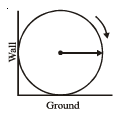
1. A uniform cylinder of radius r is rotating about its axis at the angular velocity ω0. It is now placed into a corner as shown in figure. The coefficient of friction between the wall and the cylinder as well as the ground and the cylinder is μ. Find the number of turns n, the cylinder completes before it stops.
2. A uniform solid cylinder of mass m and radius R is set in rotation about its axis with an angular velocity ω0, then lowered with its lateral surface onto a horizontal plane and released. The coefficient of friction between the cylinder and the plane is μ. Find :
(a) How long the cylinder will move with sliding ?
(b) The total work performed.
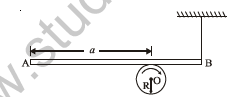
3. A wheel of radius R = 10 cm and moment of inertia I = 0.05 kg-m2 is rotating about a fixed horizontal axis O with angular velocity ω0 = 10 rad/sec. A uniform rod of mass m = 3 kg and length l = 50 cm is hinged at one end A such that it can rotate about end A in a vertical plane. End B of the rod is tied with a thread as shown in figure such that the rod is horizontal and is just in contact with the surface of rotating wheel. Horizontal distance between axis of rotation O of cylinder and A is equal to a = 30 cm. If the wheel stops rotating after one second after the thread has burnt, calculate coefficient of friction μ between the rod and the surface of wheel. g = 10 m/s2.
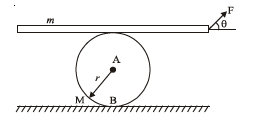
4. Consider a cylinder of mass M and radius r lying on a rough horizontal plane. It has a plank lying on its top as shown in figure. A force F is applied on the plank such that the plank moves and causes the cylinder to roll. The plank always remains horizontal. There is no slipping at any point of contact.
(a) Calculate the acceleration of the cylinder.
(b) Find the value of frictional forces at A and B.
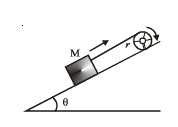
5. A wheel of radius r and moment of inertia I about its axis is fixed at the top of an inclined plane of inclination θ as shown in figure. A string is wrapped round the wheel and its free end supports a block of mass M which can slide on a plane. Initially, the wheel is rotating at a speed ω in a direction such that the block slides up the plane. How far will the block move before stopping ?
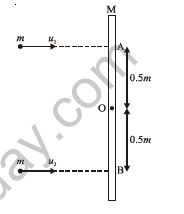
6. A thin uniform bar lies on a frictionless horizontal surface and free to move in any way on the surface. Its mass is 0.16 kg and length is √3 m. Two particles, each of mass 0.08 kg, are moving on the same surface towards the bar in a direction perpendicular to the bar, one with a velocity of 10 m/s and the other with 6 m/s as shown in the figure. The first particle strikes the bar at a point A and the other at point B. Point A and B are at a distance of 0.5 m from the centre of the bar. The particles strike the bar at the same instant and stick to it. Calculate the loss of kinetic energy of the system in the above collision process.
7. Two masses m1 = 3 kg and m2 = 2 kg are attached to the ends of a light inextensible string which passes over a fixed pulley of mass M = 2 kg. The pulley is in the form of a uniform circular disc of radius R = 10 cm. The pulley is free to rotate about its axis and the string does not slip. Find the acceleration of the masses and the tensions in the vertical sections of the string.
8. A pulley of radius r can rotate about its axis which is horizontal. The moment of inertia of the pulley about the axis is I. A light string fixed to the edge of the pulley is wound round it several times, then hangs vertically, passes under a light pulley of radius r/2 and then rises vertically, its other end being attached to the axis of the larger pulley. A particle of mass m is attached to the light pulley. Find the acceleration of the particle.
9. A light pulley is fixed at the top of a smooth inclined plane of inclination φ. A light string is wound round a solid cylinder of mass M and radius R, placed on the plane, passes over the pulley. The other end of the string is pulled by a weight such that the cylinder is just prevented from falling as the string unwinds.
Find :
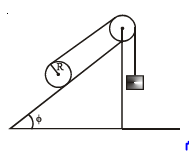
(a) the angular acceleration of the cylinder.
(b) the work done on the cylinder when it has attained and angular velocity ω.
(c) the length of the string unwound by this time.
Please click on below link to download pdf file for CBSE Class 12 Physics Rotational Motion Advanced Problems.
Free study material for Physics
Useful Resources and Notes for Class 12 Physics Rotational Motion
Quick Revision Material for Rotational Motion
Review targeted study resources for Rotational Motion tailored for Class 12 learners. Utilizing these structured notes and quick-revision tools ensures complete alignment with current CBSE evaluation standards.
Expert Notes and Solved Exam Questions
Designed around the official curriculum, these study guides guarantee standard compliance. Reviewing step-by-step solutions clarifies complex sub-topics within Rotational Motion and demystifies standard marking schemes for Physics evaluations.
Additional Study Resources for Class 12
Wrap up your chapter revision by testing your knowledge against standard objective question formats. Explore our full library of free, up-to-date sample papers and online assessments to secure top grades in your CBSE examinations.
FAQs
Our advanced study package for Rotational Motion includes detailed concepts, diagrams, Mind Maps, and explanation of complex topics to ensure Class 12 students learn as per syllabus for 2026 exams.
The Mind Maps provided for Rotational Motion act as visual anchors which will help faster recall during high-pressure exams.
Yes, teachers use our Class 12 Physics resources for lesson planning as they are in simple language and have lot of solved examples.
Yes, You can download the complete, mobile-friendly PDF of the Physics Rotational Motion advanced resources for free.
Yes, our subject matter experts have updated the Rotational Motion material to align with the rationalized NCERT textbooks and have removed deleted topics and added new competency-based questions.