

Advanced Study Material for Class 12 Physics: Chapter 06 Electromagnetic Induction
Access comprehensive study materials and useful resources for Chapter 06 Electromagnetic Induction using the CBSE Class 12 Physics Electromagnetic Induction Objective Questions. Designed to align with the 2026-27 CBSE academic guidelines, these advanced resources help Class 12 Physics students reinforce core concepts beyond standard textbooks.
Practice Class 12 Physics Resources: Chapter 06 Electromagnetic Induction
Access the complete useful resource PDF for Class 12 Physics below. Regular practice with these targeted academic notes builds familiarity with complex topics and helps secure higher marks in final school evaluations.
CBSE Class 12 Physics Electromagnetic Induction Objective Questions. Please refer to the examination notes which you can use for preparing and revising for exams. These notes will help you to revise the concepts quickly and get good marks.
CLASS 12 PHYSICS : ELECTROMAGNETIC INDUCTION
OBJECTIVE QUESTIONS
1. When the number of turns and the length of the solenoid are doubled keeping the area of cross-section same, the inductance
(a) remains the same
(b) is halved
(c) is doubled
(d) becomes four times.
Answer: (c) is doubled
1. Inductance of a solenoid, L = \( \frac{μ_0 N^{2} A}{l} \).
2. When N and l are both doubled, L becomes \( \frac{μ_0 (2N)^{2} A}{2l} \) = 2 × \( \frac{μ_0 N^{2} A}{l} \).
3. Hence, L is doubled and the correct option is (c).
Teacher's Note:
a) L is proportional to N² / l, so doubling N alone would give four times but doubling l halves that gain.
2. A coil of 10 cm × 10 cm having 50 turns is making 50 r.p.s. in a magnetic field of induction 2 tesla. The peak value of induced e.m.f. is approximately
(a) 110 volt
(b) 220 volt
(c) 314 volt
(d) 628 volt
Answer: (c) 314 volt
1. Area A = 0.1 × 0.1 = 0.01 m² and ω = 2π × 50 = 100π rad/s ≈ 314 rad/s.
2. Peak e.m.f. = NBAω = 50 × 2 × 0.01 × 314.
3. Peak e.m.f. = 314 V.
4. Hence, the correct option is (c).
Teacher's Note:
a) Convert the size to metres and r.p.s. to rad/s before substituting.
3. Two coils X and Y are placed in a circuit such that a current changes by 3 ampere in coil X and the magnetic flux changes of 1.2 weber occurs in Y. The value of mutual inductance of the coil is
(a) 0.2 H
(b) 0.4 H
(c) 0.6 H
(d) 3.6 H
Answer: (b) 0.4 H
1. Mutual inductance M = \( \frac{Δφ_Y}{ΔI_X} \).
2. M = \( \frac{1.2}{3} \) = 0.4 H.
3. Hence, the correct option is (b).
Teacher's Note:
a) Mutual inductance is flux linked with one coil per unit change of current in the other coil.
4. A coil of area 100 cm² having 50 turns is perpendicular to a magnetic field of intensity 0.02 weber/m². The resistance of the coil is 2 Ω. If it is removed in 1 sec. from the magnetic field, the induced charge produced is
(a) 5 C
(b) 0.5 C
(c) 0.05 C
(d) 0.005 C
Answer: (d) 0.005 C
1. Area = 100 cm² = 0.01 m², so the initial flux through each turn = 0.02 × 0.01 = 2 × 10⁻⁴ Wb and the final flux is 0.
2. Induced charge q = \( \frac{NΔφ}{R} \) = \( \frac{50 \times 2 \times 10^{-4}}{2} \).
3. q = 0.005 C.
4. Hence, the correct option is (d).
Teacher's Note:
a) The charge depends on the change in flux and resistance only, not on the time taken.
b) Always convert cm² to m².
5. A force of 10 N is required to move a conducting loop through a non-uniform magnetic field at 2 m/s. The rate of change of internal energy in watt in loop is
(a) 5
(b) 10
(c) 15
(d) 20
Answer: (d) 20
1. The loop moves at constant speed, so the work done by the applied force goes into heating the loop.
2. Rate of change of internal energy = power = F v = 10 × 2 = 20 W.
3. Hence, the correct option is (d).
Teacher's Note:
a) At constant velocity, the mechanical power supplied equals the electrical power dissipated as heat.
6. A coil of conducting wire of radius r has 600 turns and a self inductance of 108 mH. The self inductance of a similar coil of 500 turns will be
(a) 75 mH
(b) 108 mH
(c) 90 mH
(d) 62.5 mH
Answer: (a) 75 mH
1. For coils of the same size, L is proportional to N².
2. \( \frac{L_2}{L_1} \) = \( \frac{500^{2}}{600^{2}} \) = \( \frac{25}{36} \).
3. L2 = 108 × \( \frac{25}{36} \) = 75 mH.
4. Hence, the correct option is (a).
Teacher's Note:
a) A similar coil means the same radius and length, so only N changes.
7. Two pure inductor coils of self inductance L each are connected in series, the net inductance is
(a) L
(b) 2 L
(c) \( \frac{L}{2} \)
(d) \( \frac{L}{4} \)
Answer: (b) 2 L
1. Inductors in series add like resistors when they have no mutual coupling.
2. Lnet = L + L = 2L.
3. Hence, the correct option is (b).
Teacher's Note:
a) Series inductors add; parallel inductors combine as the reciprocals add.
8. An aeroplane is flying horizontally with a velocity of 360 km/hr. The distance between the tips of wings is 50 m. If the vertical component of earth’s magnetic field is 4 x 10⁻⁴ T, induced e.m.f. is
(a) zero
(b) 2 μV
(c) 2 mV
(d) 2 V
Answer: (d) 2 V
1. Speed v = 360 km/h = 100 m/s.
2. e.m.f. = Bv l v = 4 × 10⁻⁴ × 50 × 100.
3. e.m.f. = 2 V.
4. Hence, the correct option is (d).
Teacher's Note:
a) Only the vertical component of the earth's field is cut by the horizontal wings.
b) Convert km/h to m/s by dividing by 3.6.
9. A circular ring of diameter 20 cm has a resistance 0.01 ohm. How much charge will flow through the ring if it is rotated from position perpendicular to the uniform magnetic field of B = 2 T to a position parallel to field ?
(a) 4 C
(b) 6.28 C
(c) 3.14 C
(d) 25.12 C
Answer: (b) 6.28 C
1. Radius = 0.1 m, so area = π × (0.1)² = 0.0314 m².
2. Initial flux = BA = 2 × 0.0314 = 0.0628 Wb and final flux = 0.
3. Charge q = \( \frac{Δφ}{R} \) = \( \frac{0.0628}{0.01} \) = 6.28 C.
4. Hence, the correct option is (b).
Teacher's Note:
a) Parallel to the field means zero flux through the ring.
b) Use the radius (half the given diameter) in the area.
10. A rectangular loop with a sliding connector of length 10 cm is situated in a uniform magnetic field perpendicualr to plane of the loop. The magnetic induction is 0.1 T and resistance of connector is 1 ohm. The sides A B and C D have resistances 2 ohm and 3 ohm respectively. Find the current in the connector during its motion with constant velocity of one metre/sec.
(a) \( \frac{1}{220} \) A
(b) \( \frac{1}{110} \) A
(c) \( \frac{1}{440} \) A
(d) \( \frac{1}{55} \) A
[Figure: A rectangular loop ABCD with A at the top left, B at the bottom left, C at the bottom right and D at the top right. Side AB has a resistance of 2 Ω and side CD has a resistance of 3 Ω. A sliding connector R between the top and bottom wires moves to the right with velocity v]
Answer: (a) \( \frac{1}{220} \) A
1. e.m.f. induced in the connector = B l v = 0.1 × 0.1 × 1 = 0.01 V.
2. The 2 Ω and 3 Ω sides are in parallel: \( \frac{2 \times 3}{2 + 3} \) = 1.2 Ω.
3. Total resistance seen by the e.m.f. = 1 + 1.2 = 2.2 Ω.
4. Current in the connector = \( \frac{0.01}{2.2} \) = \( \frac{1}{220} \) A.
5. Hence, the correct option is (a).
Teacher's Note:
a) The moving connector is the source; the two side resistances act as parallel loads.
b) Convert 10 cm to 0.1 m before using B l v.
11. Two different coils have self inductances L1 = 8 mH, L2 = 2 mH. The current in one coil is increased at a constant rate. The current in the second coil is also increased at the same constant rate. At a certain instant of time, the power given to the two coils is the same. At that time, the current, the induced voltage and the energy stored in the first coil are i1, V1 and W1 respectively. Corresponding values for the second coil at the same instant are i2, V2 and W2 respectively. Then which answer is not correct
(a) \( \frac{i_1}{i_2} \) = \( \frac{1}{4} \)
(b) \( \frac{i_1}{i_2} \) = 4
(c) \( \frac{W_2}{W_1} \) = 4
(d) \( \frac{V_2}{V_1} \) = \( \frac{1}{4} \)
Answer: (b) \( \frac{i_1}{i_2} \) = 4
1. Voltage V = L \( \frac{di}{dt} \) with the same di/dt, so \( \frac{V_2}{V_1} \) = \( \frac{L_2}{L_1} \) = \( \frac{1}{4} \). So (d) is correct.
2. Equal power gives V1i1 = V2i2, so \( \frac{i_1}{i_2} \) = \( \frac{V_2}{V_1} \) = \( \frac{1}{4} \). So (a) is correct and (b) is not correct.
3. Energy W = \( \frac{1}{2} \) L i², so \( \frac{W_2}{W_1} \) = \( \frac{L_2 i_2^{2}}{L_1 i_1^{2}} \) = \( \frac{1}{4} \) × 16 = 4. So (c) is correct.
4. Hence, the option that is not correct is (b).
Teacher's Note:
a) In a question asking for the incorrect statement, test every option and mark the one that fails.
b) Equal power with unequal voltages means the currents are in the inverse ratio of the voltages.
12. The ratio of secondary to the primary turns in a transformer is 5. If the output voltage be P, the input voltage neglecting all losses, must be equal to
(a) 5 P
(b) √5 P
(c) \( \frac{P}{5} \)
(d) \( \frac{P}{\sqrt{5}} \)
Answer: (c) \( \frac{P}{5} \)
1. For a transformer, \( \frac{V_s}{V_p} \) = \( \frac{N_s}{N_p} \) = 5.
2. Vs = P, so Vp = \( \frac{P}{5} \).
3. Hence, the correct option is (c).
Teacher's Note:
a) A step-up transformer has more secondary turns, so the input voltage is smaller than the output.
13. A rectangular coil of 100 turns and size 0.1 m x 0.05 m is placed perpendicular to a magnetic field of 0.1 T. If the field drops to 0.05 T in 0.05 s, the magnitude of the e.m.f. induced in the coil is
(a) 0.5 V
(b) 0.75 V
(c) 1.0 V
(d) 1.5 V
Answer: (a) 0.5 V
1. Area A = 0.1 × 0.05 = 0.005 m² and the change in field ΔB = 0.1 - 0.05 = 0.05 T.
2. e.m.f. = \( \frac{N A ΔB}{Δt} \) = \( \frac{100 \times 0.005 \times 0.05}{0.05} \).
3. e.m.f. = 0.5 V.
4. Hence, the correct option is (a).
Teacher's Note:
a) Use the change in field (0.05 T), not the final or the initial value.
14. A coil of area 10 cm², 10 turns and resistance 20 Ω is placed in a magnetic field directed perpendicular to the plane of the coil and changing at the rate of 10⁸ gauss/second. The induced current in the coil will be
(a) 5 A
(b) 0.5 A
(c) 0.05 A
(d) 50 A
Answer: (a) 5 A
1. 1 gauss = 10⁻⁴ T, so \( \frac{dB}{dt} \) = 10⁸ × 10⁻⁴ = 10⁴ T/s.
2. Area = 10 cm² = 10⁻³ m².
3. e.m.f. = N A \( \frac{dB}{dt} \) = 10 × 10⁻³ × 10⁴ = 100 V.
4. Current = \( \frac{100}{20} \) = 5 A.
5. Hence, the correct option is (a).
Teacher's Note:
a) Convert gauss to tesla (1 G = 10⁻⁴ T) and cm² to m² before calculating.
15. A coil of cross-sectional area 400 cm² having 30 turns is making 1800 rev/min in a magnetic field of 1 T. The peak value of the induced e.m.f. is
(a) 113 V
(b) 226 V
(c) 339 V
(d) 452 V
Answer: (b) 226 V
1. Area = 400 cm² = 0.04 m² and ω = 2π × \( \frac{1800}{60} \) = 60π ≈ 188.5 rad/s.
2. Peak e.m.f. = NBAω = 30 × 1 × 0.04 × 188.5.
3. Peak e.m.f. ≈ 226 V.
4. Hence, the correct option is (b).
Teacher's Note:
a) Convert rev/min to rad/s by multiplying by 2π/60.
16. A soleniod has 2000 turns wound over a length of 0.3 m. Its cross-sectional area is 1.2 × 10⁻³ m². Around its central section a coil of 300 turns is wound. If an initial current of 2 A flowing in the solenoid is reversed in 0.25 s, the e.m.f induced in the coil will be
(a) 6.0 × 10⁻⁴ V
(b) 6.0 × 10⁻² V
(c) 4.8 × 10⁻⁴ V
(d) 4.8 × 10⁻² V
Answer: (d) 4.8 × 10⁻² V
1. Number of turns per metre of the solenoid, n = \( \frac{2000}{0.3} \) ≈ 6667 per m.
2. Initial field B = μ0 n I = 4π × 10⁻⁷ × 6667 × 2 ≈ 1.68 × 10⁻² T.
3. Reversing the current changes the field from +B to -B, so the change in flux per turn = 2BA = 2 × 1.68 × 10⁻² × 1.2 × 10⁻³ ≈ 4.0 × 10⁻⁵ Wb.
4. e.m.f. = N2 \( \frac{Δφ}{Δt} \) = \( \frac{300 \times 4.0 \times 10^{-5}}{0.25} \) ≈ 4.8 × 10⁻² V.
5. Hence, the correct option is (d).
Teacher's Note:
a) Reversal of current means the flux changes by twice its initial value.
b) The inner coil gets the flux of the solenoid, using the solenoid's cross-sectional area.
17. A square metal loop of side 20 cm and resistance 2 ohm is moved with a constant velocity partly inside a uniform magnetic field of 5 Wb/m², directed into the paper, as shown in the figure. The loop is connected to a network of five resistors each of value R. If a steady current of 0.1 A flowing in the loop, and the speed of the loop is 1 m/s, then R is equal to
(a) 2 Ω
(b) 3 Ω
(c) 8 Ω
(d) 9 Ω
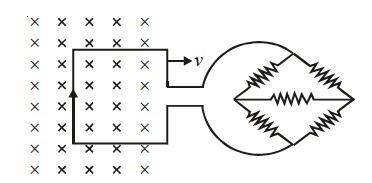
[Figure: A square loop of side 20 cm moving to the right with velocity v, partly inside a region of uniform magnetic field shown by crosses (field into the paper); the loop is connected by two wires to a network of five equal resistors R arranged as a diamond (Wheatstone bridge) with one resistor across the middle]
Answer: (c) 8 Ω
1. e.m.f. induced in the cutting side = B l v = 5 × 0.2 × 1 = 1 V.
2. Total resistance of the circuit = \( \frac{1}{0.1} \) = 10 Ω.
3. The loop has resistance 2 Ω, so the network has 10 - 2 = 8 Ω.
4. The five resistors form a balanced Wheatstone bridge, so the middle resistor carries no current and the equivalent resistance = R.
5. R = 8 Ω, so the correct option is (c).
Teacher's Note:
a) A bridge of five equal resistors is balanced, so its equivalent resistance equals R.
b) Only the side of the loop that cuts the field lines produces an e.m.f.
18. A rectangular coil of single turn, having area A, rotates in a uniform magnetic field B with an angular velocity ω about an axis perpendicular to the field. If initially the plane of the coil is perpendicular to the field, then the average induced e.m.f. when it has rotated through 90° is
(a) \( \frac{ωBA}{π} \)
(b) \( \frac{ωBA}{2π} \)
(c) \( \frac{ωBA}{4π} \)
(d) \( \frac{2ωBA}{π} \)
Answer: (d) \( \frac{2ωBA}{π} \)
1. Initial flux = BA and flux after rotating by 90° = 0, so Δφ = BA.
2. Time taken, t = \( \frac{π/2}{ω} \) = \( \frac{π}{2ω} \).
3. Average e.m.f. = \( \frac{Δφ}{t} \) = BA × \( \frac{2ω}{π} \) = \( \frac{2ωBA}{π} \).
4. Hence, the correct option is (d).
Teacher's Note:
a) The average e.m.f. over a quarter turn is 2/π times the peak value ωBA.
19. An e.m.f. of 15 V is applied in a circuit containing 5 H inductance and 10 Ω resistance. The ratio of the currents at time t = ∞ and at t = 1 s is
(a) \( \frac{e^{\frac{1}{2}}}{e^{\frac{1}{2}} - 1} \)
(b) \( \frac{e^{2}}{e^{2} - 1} \)
(c) 1-e-1
(d) e-1
Answer: (b) \( \frac{e^{2}}{e^{2} - 1} \)
1. Time constant τ = \( \frac{L}{R} \) = \( \frac{5}{10} \) = 0.5 s.
2. Current I(t) = I0(1 - e-t/τ), where I0 = \( \frac{15}{10} \) = 1.5 A is the final current.
3. At t = 1 s, I = I0(1 - e-2).
4. Ratio = \( \frac{I_0}{I_0 (1 - e^{-2})} \) = \( \frac{1}{1 - e^{-2}} \) = \( \frac{e^{2}}{e^{2} - 1} \).
5. Hence, the correct option is (b).
Teacher's Note:
a) In a growing L-R circuit the current rises as 1 - e-t/τ to its steady value V/R.
20. An ideal transformer is used to step down an alternating e.m.f. of 110 V to 4.4 V to transmit 6.6 W of power. The current rating of the secondary is
(a) 30 A
(b) 3 A
(c) 1.5 A
(d) 1 A
Answer: (c) 1.5 A
1. For an ideal transformer, the output power = 6.6 W at 4.4 V.
2. Secondary current = \( \frac{P}{V_s} \) = \( \frac{6.6}{4.4} \) = 1.5 A.
3. Hence, the correct option is (c).
Teacher's Note:
a) The secondary current is found from the output power and secondary voltage, not from the primary voltage.
21. A rectangular loop of sides 8 cm and 2 cm is lying in uniform magnetic field of magnitude 0.5 T with its plane normal to the field. The field is now gradually reduced at the rate of 0.02 T/s. If the resistance of the loop is 1.6 Ω, then the power dissipated by the loop as heat is
(a) 6.4 × 10⁻¹⁰ W
(b) 3.2 × 10⁻¹⁰ W
(c) 6.4 × 10⁻⁵ W
(d) 3.2 × 10⁻⁵ W
Answer: (a) 6.4 × 10⁻¹⁰ W
1. Area = 0.08 × 0.02 = 1.6 × 10⁻³ m².
2. e.m.f. = A \( \frac{dB}{dt} \) = 1.6 × 10⁻³ × 0.02 = 3.2 × 10⁻⁵ V.
3. Power = \( \frac{e^{2}}{R} \) = \( \frac{(3.2 \times 10^{-5})^{2}}{1.6} \) = 6.4 × 10⁻¹⁰ W.
4. Hence, the correct option is (a).
Teacher's Note:
a) Square the e.m.f. before dividing by R; the initial field value 0.5 T is not needed.
22. A current of 2 A flowing through a coil of 100 turns gives rise to a magnetic flux of 5 × 10⁻⁵ Wb per turn. The magnetic energy associated with the coil is
(a) 5 J
(b) 0.5 J
(c) 0.05 J
(d) 0.005 J
Answer: (d) 0.005 J
1. Total flux linkage Nφ = 100 × 5 × 10⁻⁵ = 5 × 10⁻³ Wb.
2. Self inductance L = \( \frac{Nφ}{I} \) = \( \frac{5 \times 10^{-3}}{2} \) = 2.5 × 10⁻³ H.
3. Energy U = \( \frac{1}{2} \) L I² = \( \frac{1}{2} \) × 2.5 × 10⁻³ × 4 = 5 × 10⁻³ J.
4. Hence, the correct option is (d).
Teacher's Note:
a) Use the flux linked with all N turns when finding L.
23. The time constant of an inductance coil is 2.0 × 10⁻³ s. When a 90 Ω resistance is joined in series, the time constant becomes 0.5 × 10⁻³ s. The inductance and resistance of the coil are
(a) 30 mH; 30 Ω
(b) 30 mH;60 Ω
(c) 60 mH;30 Ω
(d) 60 mH;60 Ω
Answer: (c) 60 mH;30 Ω
1. Let the coil have inductance L and resistance R. Then \( \frac{L}{R} \) = 2 × 10⁻³ and \( \frac{L}{R + 90} \) = 0.5 × 10⁻³.
2. Dividing, \( \frac{R + 90}{R} \) = 4, so R + 90 = 4R and R = 30 Ω.
3. L = 2 × 10⁻³ × 30 = 60 × 10⁻³ H = 60 mH.
4. Hence, the correct option is (c).
Teacher's Note:
a) Divide the two time-constant equations to remove L.
24. Two resistors of 10 Ω and 20 Ω and an ideal inductor of 10 H are connected to a 2 V battery as shown. The key K is inserted at time t = 0. The initial (at t = 0) and final (at t = ∞) currents through the battery are
(a) \( \frac{1}{15} \) A; \( \frac{1}{10} \) A
(b) \( \frac{1}{10} \) A; \( \frac{1}{15} \) A
(c) \( \frac{2}{25} \) A; \( \frac{1}{10} \) A
(d) \( \frac{1}{15} \) A; \( \frac{2}{25} \) A
[Figure: A 2 V battery and a key K in series with a 20 Ω resistor; an ideal inductor of 10 H connected in parallel with a 10 Ω resistor forms the remaining part of the loop]
Answer: (a) \( \frac{1}{15} \) A; \( \frac{1}{10} \) A
1. The 10 Ω resistor is in parallel with the ideal inductor, and this pair is in series with the 20 Ω resistor and the 2 V battery.
2. At t = 0, the inductor opposes any change and carries no current, so the current flows through the 10 Ω resistor: I = \( \frac{2}{10 + 20} \) = \( \frac{1}{15} \) A.
3. At t = ∞, the inductor behaves like a wire and short-circuits the 10 Ω resistor: I = \( \frac{2}{20} \) = \( \frac{1}{10} \) A.
4. Hence, the correct option is (a).
Teacher's Note:
a) At t = 0 an inductor acts as an open circuit and at t = ∞ as a short circuit.
25. A capacitor of 1 μF initially charged to 10 V is connected across an ideal inductor of 0.1 mH. The maximum current in the circuit is
(a) 0.6 A
(b) 1 A
(c) 1.5 A
(d) 2 A
Answer: (b) 1 A
1. The initial energy of the capacitor is converted to magnetic energy at maximum current: \( \frac{1}{2} \) C V² = \( \frac{1}{2} \) L Imax².
2. Imax = V \( \frac{\sqrt{C}}{\sqrt{L}} \) = 10 × \( \frac{\sqrt{10^{-6}}}{\sqrt{10^{-4}}} \) = 10 × 0.1.
3. Imax = 1 A.
4. Hence, the correct option is (b).
Teacher's Note:
a) In an ideal L-C circuit the total energy stays constant while it oscillates between the capacitor and the inductor.

(a) 1/220 A(b) 1/110A (c) 1/440A (d) 1/55A
Free study material for Physics
CBSE Class 12 Physics Study Material: Chapter 06 Electromagnetic Induction
Comprehensive Study Resources for Chapter 06 Electromagnetic Induction
Explore essential learning tools for Class 12 Physics Chapter 06 Electromagnetic Induction. This curated collection features in-depth notes and targeted practice questions built around the active 2026 curriculum to streamline your daily revision.
Understanding Marking Schemes
Each resource draws directly from authorized textbooks to maintain academic accuracy. Evaluating solved examples allows Class 12 students to master the formal presentation and answer-writing standards expected in upcoming school exams.
Complete Revision for Physics
Maximize your grade potential by utilizing Class 12 Physics practice papers in tandem with these structured notes. All printable assignments and interactive mock tests on our platform are updated for the 2026 session and available free of charge.
FAQs
Our advanced study package for Chapter 06 Electromagnetic Induction includes detailed concepts, diagrams, Mind Maps, and explanation of complex topics to ensure Class 12 students learn as per syllabus for 2026 exams.
The Mind Maps provided for Chapter 06 Electromagnetic Induction act as visual anchors which will help faster recall during high-pressure exams.
Yes, teachers use our Class 12 Physics resources for lesson planning as they are in simple language and have lot of solved examples.
Yes, You can download the complete, mobile-friendly PDF of the Physics Chapter 06 Electromagnetic Induction advanced resources for free.
Yes, our subject matter experts have updated the Chapter 06 Electromagnetic Induction material to align with the rationalized NCERT textbooks and have removed deleted topics and added new competency-based questions.