

Download CBSE Class 12 Physics Useful Resources
Review targeted academic resources with the CBSE Class 12 Physics Electromagnetic Induction Important Questions. Built according to official CBSE standards for the 2026-27 term, these downloadable Class 12 Physics study materials support effective daily practice and deeper conceptual understanding for Chapter 06 Electromagnetic Induction.
Access CBSE Study Guides and Summaries
View or download the dedicated CBSE Class 12 Physics Electromagnetic Induction Important Questions resource below. Engaging with these advanced study guides under focused conditions ensures continuous academic progress and mastery of the 2026-27 curriculum for Chapter 06 Electromagnetic Induction.
CBSE Class 12 Physics Electromagnetic Induction Important Questions. Please refer to the examination notes which you can use for preparing and revising for exams. These notes will help you to revise the concepts quickly and get good marks.
ASSIGNMENT
Comprehension
Inductance of a coil or a circuit can be defined as a properly by virtue of which, the coil or circuit opposes any change in the flux linked to it. Whenever one tries to change the flux, the coil or circuit produces induced current or induced e.m.f., so that it can oppose the cause of the change of flux. It is also called electromagnetic inertia, which opposes any change in its electromagnetic state. Magnetic flux is proportional to the current (I) flowing is φ = LI, where L is proportionality constant, called self inductance.
Energy in magnetic field inside inductor can be associated as U = \( \frac{1}{2} \)LI², where L is self inductance and I is the current flowing through it.
Now answer the following
1. In the shown figure a magnet is placed along the axis of a conducting coil. If magnet is pushed towards coils
(a) coil get attracted toward magnet
(b) coil get repelled away from magnet
(c) a force on magnet acts away from coil
(d) coil behaves like magnet
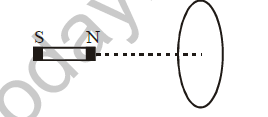
[Figure: A bar magnet with its S pole on the left and N pole on the right lies on the dotted axis of a circular coil placed on the right side of the magnet.]
Answer: (b) coil get repelled away from magnet
1. The north pole of the magnet is pushed towards the coil, so the magnetic flux linked with the coil increases.
2. By Lenz's law, the induced current in the coil opposes this increase, so the face of the coil towards the magnet becomes a north pole.
3. Two north poles repel each other, so the coil is repelled away from the magnet.
4. Hence, the correct option is (b).
Teacher's Note:
a) Lenz's law says that induced effects always oppose the cause that produces them.
b) Students often mark attraction; attraction happens only when the magnet is pulled away from the coil.
2. In the shown L-R circuit switch is thrown from (1) to (2) at time t = 0
(a) Just after closing the switch current becomes half
(b) Just after closing the switch current will not change
(c) Long time after closing the switch current in the circuit is equal to E/2R
(d) Long time after closing the switch current is 2E/R

[Figure: L-R circuit with a battery E, a resistor R and an inductor L in the main loop. A two-way switch S (positions 1 and 2) connects the main loop to a second inductor L placed in the right-hand branch.]
Answer: (b) Just after closing the switch current will not change
1. An inductor opposes any sudden change in the current flowing through it.
2. So the current in the inductor cannot change instantly at t = 0.
3. Hence, just after the switch is thrown, the current remains the same as it was before, and the correct option is (b).
Teacher's Note:
a) Inductance acts like electromagnetic inertia, so current cannot jump to a new value in zero time.
b) The printed key shows option (a), "current becomes half". A sudden halving of inductor current would need an infinite induced e.m.f., so the printed key is wrong and the correct answer is (b).
3. In the shown in the figure smooth coil having an smooth iron rod, placed as shown in the figure. Mass of rod is m and self inductance of coil L and resistance R. If force F is applied on the rod (neglecting gravity) just after the force is applied.
(a) acceleration of rod is F/m
(b) acceleration of rod is less than F/m
(c) acceleration of rod is more than F/m
(d) none of these
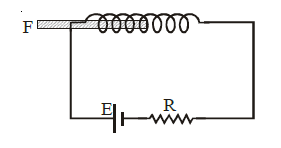
[Figure: A smooth iron rod, with a force F applied at its free left end, lies partly inside a smooth coil. The coil is connected in series with a cell E and a resistor R.]
Answer: (c) acceleration of rod is more than F/m
1. Just after the force is applied, the rod is still at rest, so the rate of change of flux linked with the coil is zero and no extra induced e.m.f. opposes the current.
2. The current in the coil cannot change instantly, so the magnetic field inside the coil is unchanged.
3. The iron rod is pulled into the coil by the magnetic force, which acts in the same direction as F.
4. So the net force on the rod is F plus this magnetic pull, and a = (F + magnetic pull) / m, which is more than F/m.
5. Hence, the correct option is (c).
Teacher's Note:
a) Iron is pulled towards the region of stronger magnetic field, which here is inside the coil.
b) Induced e.m.f. depends on the rate of change of flux, and that rate is zero at the instant the force is applied.
c) The printed key shows option (b), "less than F/m". That conflicts with the attractive magnetic pull on the iron rod, so the correct answer is (c).
Each of the questions given below consists of two statements, an assertion (A) and reason (R). Select the number corresponding to the appropriate alternative as follows
(a) If both A and R are true and R is the correct explanation of A
(b) If both A and R are true but R is not the correct explanation of A
(c) If A is true but R is false
(d) If A is false but R is true
4. A: The oscillations of a copper disc in magnetic field are damped.
R: The eddy currents produced in the copper disc always oppose its oscillatory motion.
(a) If both A and R are true and R is the correct explanation of A
(b) If both A and R are true but R is not the correct explanation of A
(c) If A is true but R is false
(d) If A is false but R is true
Answer: (a) If both A and R are true and R is the correct explanation of A
1. The copper disc oscillates through the magnetic field, so eddy currents are induced in it.
2. These eddy currents oppose the motion that produces them, so the oscillations die out.
3. Hence, R explains A, and the correct option is (a).
Teacher's Note:
a) Eddy currents are induced in any conducting body that moves through a changing or non-uniform magnetic field.
b) The damping is caused by the opposing force, so the reason directly explains the assertion.
5. A: Self inductance is the inertia of electricity.
R: The unit of self inductance is henry.
(a) If both A and R are true and R is the correct explanation of A
(b) If both A and R are true but R is not the correct explanation of A
(c) If A is true but R is false
(d) If A is false but R is true
Answer: (b) If both A and R are true but R is not the correct explanation of A
1. Self inductance opposes any change in current, and this property is called electromagnetic inertia.
2. The henry is the SI unit of self inductance, and it does not explain why self inductance behaves like inertia.
3. Hence, both statements are true but R is not the explanation of A, so the correct option is (b).
Teacher's Note:
a) A unit tells how inductance is measured, not how it behaves.
b) Self inductance is one henry when a current change of one ampere per second induces one volt.
6. A: Coefficient of mutual induction of two coils depends on their relative orientation.
R: Inductance opposes the growth of current.
(a) If both A and R are true and R is the correct explanation of A
(b) If both A and R are true but R is not the correct explanation of A
(c) If A is true but R is false
(d) If A is false but R is true
Answer: (b) If both A and R are true but R is not the correct explanation of A
1. The flux linked with one coil due to the current in the other depends on the angle and relative position of the two coils.
2. Inductance opposes the growth of current in a circuit, which is a statement about self inductance and does not explain the dependence on orientation.
3. Hence, both statements are true but R is not the explanation of A, so the correct option is (b).
Teacher's Note:
a) Mutual inductance is largest when the coils are coaxial and their flux linkage is maximum.
b) Do not confuse mutual inductance with self inductance; the reason given describes self inductance.
7. A: The energy is stored in the inductor at the expense of the energy of the source of e.m.f.
R: The energy resides in the inductor in the form of magnetic field.
(a) If both A and R are true and R is the correct explanation of A
(b) If both A and R are true but R is not the correct explanation of A
(c) If A is true but R is false
(d) If A is false but R is true
Answer: (b) If both A and R are true but R is not the correct explanation of A
1. While the current builds up, the source does work against the back e.m.f., and this work is stored in the inductor.
2. The stored energy resides in the magnetic field, given by U = \( \frac{1}{2} \)LI².
3. R describes where the energy is stored, but it does not explain how the source supplies it, so the correct option is (b).
Teacher's Note:
a) The energy of an inductor is stored in its magnetic field, not in the wire.
b) The source supplies this energy against the back e.m.f. during the growth of current.
8. A. Lenz's law violates the principle of conservation of energy.
R. Induced e.m.f. opposes always opposes magnetic flux responsible for its production.
(a) If both A and R are true and R is the correct explanation of A
(b) If both A and R are true but R is not the correct explanation of A
(c) If A is true but R is false
(d) If A is false but R is true
Answer: (d) If A is false but R is true
1. Lenz's law is consistent with the conservation of energy, because work must be done against the opposing force to produce the induced current.
2. So statement A is false.
3. The reason R is a correct description of Lenz's law, so R is true and the correct option is (d).
Teacher's Note:
a) The sign in Lenz's law is a direct result of energy conservation.
b) The word "always opposes" in R is correct for this statement of Lenz's law.
9. A. An emf is induced between the wings of the aeroplane, when it is flying horizontally.
R. An emf is induced due to vertical component of earth's magnetic filed.
(a) If both A and R are true and R is the correct explanation of A
(b) If both A and R are true but R is not the correct explanation of A
(c) If A is true but R is false
(d) If A is false but R is true
Answer: (a) If both A and R are true and R is the correct explanation of A
1. When the aeroplane flies horizontally, its wings move across the vertical component of the earth's magnetic field.
2. This motion induces an e.m.f. between the wing tips.
3. Hence, R explains A, and the correct option is (a).
Teacher's Note:
a) Only the vertical component of the earth's field cuts the wings in a horizontal flight.
b) The induced e.m.f. is the motional e.m.f. of a conductor moving in a magnetic field.
10. A. Current takes time to become zero in Inductor Resistance circuit.
R. Current takes infinite time to grow to its maximum value in the Inductor Resistance circuit.
(a) If both A and R are true and R is the correct explanation of A
(b) If both A and R are true but R is not the correct explanation of A
(c) If A is true but R is false
(d) If A is false but R is true
Answer: (b) If both A and R are true but R is not the correct explanation of A
1. In an L-R circuit, the current decays as I = I₀ e-t/τ, so it approaches zero only asymptotically.
2. The current grows towards its maximum value in the same asymptotic way, which is what statement R describes.
3. R describes the growth of current, not the decay, so it is not the explanation of A. The correct option is (b).
Teacher's Note:
a) Both the growth and the decay of current in an L-R circuit follow exponential laws.
b) The time constant τ = L/R tells how fast the current reaches a steady value.
Miscellaneous Assignment
1. (b) 2. (b) 3. (c) 4. (a) 5. (b)
6. (b) 7. (b) 8. (d) 9. (a) 10. (b)
Free study material for Physics
Free CBSE Study Guides: Class 12 Physics Chapter 06 Electromagnetic Induction
Comprehensive Study Resources for Chapter 06 Electromagnetic Induction
Review targeted study resources for Chapter 06 Electromagnetic Induction tailored for Class 12 learners. Utilizing these structured notes and quick-revision tools ensures complete alignment with current CBSE evaluation standards.
Understanding Marking Schemes
Each resource draws directly from authorized textbooks to maintain academic accuracy. Evaluating solved examples allows Class 12 students to master the formal presentation and answer-writing standards expected in upcoming school exams.
Complete Revision for Physics
Maximize your grade potential by utilizing Class 12 Physics practice papers in tandem with these structured notes. All printable assignments and interactive mock tests on our platform are updated for the 2026 session and available free of charge.
FAQs
Our advanced study package for Chapter 06 Electromagnetic Induction includes detailed concepts, diagrams, Mind Maps, and explanation of complex topics to ensure Class 12 students learn as per syllabus for 2026 exams.
The Mind Maps provided for Chapter 06 Electromagnetic Induction act as visual anchors which will help faster recall during high-pressure exams.
Yes, teachers use our Class 12 Physics resources for lesson planning as they are in simple language and have lot of solved examples.
Yes, You can download the complete, mobile-friendly PDF of the Physics Chapter 06 Electromagnetic Induction advanced resources for free.
Yes, our subject matter experts have updated the Chapter 06 Electromagnetic Induction material to align with the rationalized NCERT textbooks and have removed deleted topics and added new competency-based questions.