

Class 12 Physics Study Guide: CBSE Class 12 Physics Electromagnetic Induction Exam Notes
Explore structured advanced study materials through the CBSE Class 12 Physics Electromagnetic Induction Exam Notes. Tailored for Class 12 learners, utilizing these Physics resources ensures thorough preparation and strengthens foundational knowledge before final CBSE evaluations.
Download Chapter 06 Electromagnetic Induction Study Material PDF
View or download the dedicated CBSE Class 12 Physics Electromagnetic Induction Exam Notes resource below. Engaging with these advanced study guides under focused conditions ensures continuous academic progress and mastery of the 2026-27 curriculum for Chapter 06 Electromagnetic Induction.
CBSE Class 12 Physics Electromagnetic Induction Exam Notes. Please refer to the examination notes which you can use for preparing and revising for exams. These notes will help you to revise the concepts quickly and get good marks.
Magnetic Flux :
Magnetic flux (φ) through an area ds in magnetic field B is defined as φ = B · ds (i)
Physically it represents total lines of induction passing through a given area
Equation (i) can be written as φ = B ds cos θ (ii)ds BAθ
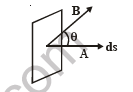
where θ is angle between B and area vector. According to equation (ii) flux can change not only due to
magnetic field and area but also due to orientation of area w.r.t. B.
Dimensional formula of flux is [ML2T–2A–1]
SI unit of magnetic flux is volt-sec. which is also known as weber.
As 1 volt = 108 emu of potential the C.G.S. unit of flux, maxwell (Mx) is related to weber through relation
1 wb = 1 V × s = 108 emu of potential × s = 108 Mx.
Electromagnetic Induction
If a magnet passes through a coil in a closed circuit containing a galvanometer, an electric current is produced in the circuit. The direction of the current so induced in the circuit is reversed when the magnet recedes away from the coil. The current so produced lasts so long as there is relative motion between the magnet and the coil. It is shown that whenever the magnetic flux linked with a closed circuit changes, an induced e.m.f. is produced in the circuit and lasts as long as the flux changes. Such currents are produced due to induced electromotive force and the phenomenon is called electromagnetic induction. The magnitude and direction of induced electromagnetic force is given by the following Faraday’s and Lenz’s laws respectively.
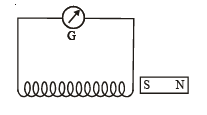
Faraday’s First Law : Whenever the magnetic flux linked with a closed circuit changes, an induced electomotive force is produced which produces an induced current in the circuit which lasts as long as the change lasts.
Faraday’s Second Law: The induced e.m.f. is equal to negative of rate of change of flux through the circuit.
e = –dt/dφ
The negative sign shows that the induced e.m.f. opposes the changes in the magnetic flux.If the coil has N number of turns, then dt e = – Ndφ/dt .
Lenz’s Law : The direction of induced electromotive force is such that it opposes the cause that produces the electromagnetic induction.
If the magnetic flux changes from φ1 to φ2 in time t, the average induced e.m.f. is given by e (avg) – N(φ2 – φ1)/t.
When the magnetic flux φ through a closed circuit of known resistance R changes, the quantity of induced charge q can be found as below:

Induction due to Motion of a Straight Rod in the Magnetic Field : Consider a straight conducting rod CD moving with velocity v towards right along a U shaped conductor in a uniform magnetic field B directed into the page. The motion of the conductor CD results in changing the area from CDEF to C′D′EF . It results in a change of area CDD′C′ in the magnetic flux producing an increase in the magnetic flux dφ as dφ = B.A If l is the length of rod CD, which moves with velocity v in time dt, change in area perpendicular to the field = CDD′C = l v dt
∴ dφ = Blvdt
The magnitude of induced e.m.f., e = dφ/dt= Blv
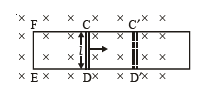
If R is the resistance of loop, the induced current is I = Bl v/R
The direction of the induced current is given by Fleming’s Right hand rule.
[Fleming’s Right Hand Rule: It states that if the thumb and the first two fingers of the right hand are stretched mutually perpendicular to each other and if the forefinger gives the direction of the magnetic field and the thumb gives the direction of motion of the conductor, then the central finger gives the direction of the induced current.]
The current in the above mentioned loop is in the anticlockwise direction. If the loop CDEF is moved towards right with velocity v, the induced current I will be flowing in the clock wise direction and this current will produce forces F1 and F2 on arms CF and DE respectively which being equal and opposite will cancel.
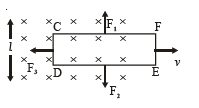
Force F3 on arm CD = BIl where CD = l
Please click on below link to download pdf file for CBSE Class 12 Physics Electromagnetic Induction Exam Notes.
Free study material for Physics
Useful Resources and Notes for Class 12 Physics Chapter 06 Electromagnetic Induction
Comprehensive Study Resources for Chapter 06 Electromagnetic Induction
Explore essential learning tools for Class 12 Physics Chapter 06 Electromagnetic Induction. This curated collection features in-depth notes and targeted practice questions built around the active 2026 curriculum to streamline your daily revision.
Understanding Marking Schemes
Built using official NCERT guidelines for Class 12 Physics, these materials provide reliable academic support. Integrating past examination questions and step-by-step solutions helps students understand official CBSE grading criteria.
Complete Revision for Physics
For peak performance in upcoming evaluations, integrate official Physics sample papers directly into your study schedule. Follow up your revision by attempting online MCQ tests for Chapter 06 Electromagnetic Induction to refine calculation speed and precision.
FAQs
Our advanced study package for Chapter 06 Electromagnetic Induction includes detailed concepts, diagrams, Mind Maps, and explanation of complex topics to ensure Class 12 students learn as per syllabus for 2026 exams.
The Mind Maps provided for Chapter 06 Electromagnetic Induction act as visual anchors which will help faster recall during high-pressure exams.
Yes, teachers use our Class 12 Physics resources for lesson planning as they are in simple language and have lot of solved examples.
Yes, You can download the complete, mobile-friendly PDF of the Physics Chapter 06 Electromagnetic Induction advanced resources for free.
Yes, our subject matter experts have updated the Chapter 06 Electromagnetic Induction material to align with the rationalized NCERT textbooks and have removed deleted topics and added new competency-based questions.