

Official CBSE Study Materials for Class 12 Physics
Explore structured advanced study materials through the CBSE Class 12 Physics Centre of Mass Solved Examples. Tailored for Class 12 learners, utilizing these Physics resources ensures thorough preparation and strengthens foundational knowledge before final CBSE evaluations.
Advanced Resources for Physics
Navigate directly to the advanced Physics study materials using the digital viewer below. Each resource pack includes detailed conceptual summaries and solved practice questions, allowing students to instantly reinforce their learning.
CBSE Class 12 Physics Centre of Mass Solved Examples. Please refer to the examination notes which you can use for preparing and revising for exams. These notes will help you to revise the concepts quickly and get good marks.

Class 12 Physics: Centre of Mass Solved Examples
Three masses \(m\), \(2m\) and \(3m\) are kept at the vertices of an equilateral triangle of side \(a\). What is the position of the centre of mass for the coordinate system shown in the figure?
Solution:
\[x_{cm}=\frac{m_1x_1+m_2x_2+m_3x_3}{m_1+m_2+m_3}=\frac{m\times0+2m\times a+3m\times\frac a2}{6m}=\frac{2am+\frac{3ma}{2}}{6m}=\frac{7a}{12}\]
\[y_{cm}=\frac{m\times0+2m\times0+3m\times\frac{\sqrt3a}{2}}{6m}=\frac{3\sqrt3a}{12}=\frac{\sqrt3a}{4}\]
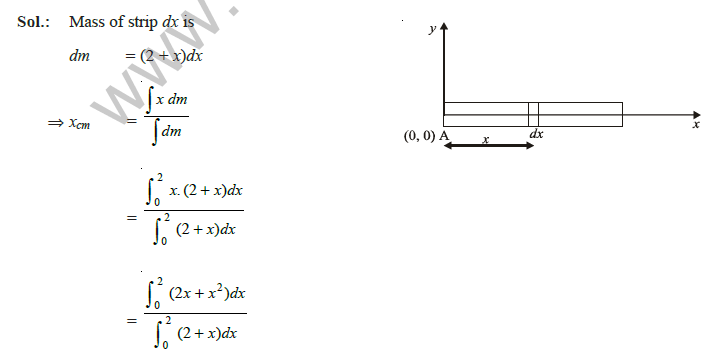
The linear mass density of a rod of length \(l=2\) m varies from A as \((2+x)\) kg/m. What is the position of the centre of mass from end A?
Solution:
Mass of the strip \(dx\) is \(dm=(2+x)\,dx\)
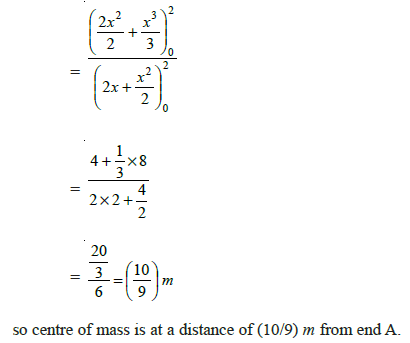
\[x_{cm}=\frac{\int x\,dm}{\int dm}=\frac{\int_0^2x(2+x)\,dx}{\int_0^2(2+x)\,dx}=\frac{\int_0^2(2x+x^2)\,dx}{\int_0^2(2+x)\,dx}=\frac{\left[x^2+\frac{x^3}{3}\right]_0^2}{\left[2x+\frac{x^2}{2}\right]_0^2}=\frac{4+\frac83}{4+2}=\frac{20/3}{6}=\frac{10}{9}\text{ m}\]
So the centre of mass is at a distance of \((10/9)\) m from end A.
One fourth of the mass of a square lamina is cut off (as shown in the figure). Where does the centre of mass of the remaining part of the square shift?
Solution:
Here \(m_1=\dfrac m4\), \(x_1=\dfrac{3a}{4}\), \(x=\dfrac a2\); A = \((a/2,\ a/2)\), B = \((3a/4,\ 3a/4)\). Using
\[x_{cm}=\frac{mx-m_1x_1}{m-m_1}=\frac{m\times\frac a2-\frac m4\times\frac{3a}{4}}{m-\frac m4}=\frac{\frac a2-\frac{3a}{16}}{\frac34}=\frac{5a}{12}\]
\[y_{cm}=\frac{m\times\frac a2-\frac m4\times\frac{3a}{4}}{m-\frac m4}=\frac{5a}{12}\]
Two blocks of masses \(m_1=2\) kg and \(m_2=5\) kg are moving in the same direction along a frictionless surface with speeds 10 m/s and 3 m/s respectively, \(m_2\) being ahead of \(m_1\). An ideal spring with \(K=1120\) N/m is attached to the back side of \(m_2\). Find the maximum compression of the spring when the blocks move after the collision.
Solution:
Let \(v\) be the final (common) velocity of the system at maximum compression. By conservation of momentum, \(m_1u_1+m_2u_2=(m_1+m_2)v\):
\[(2\times10)+(5\times3)=(2+5)v\ \Rightarrow\ v=\frac{35}{7}=5\text{ m/s}\]
Applying conservation of energy:
\[\tfrac12m_1u_1^2+\tfrac12m_2u_2^2=\tfrac12(m_1+m_2)v^2+\tfrac12Kx^2\]
\[2\times(10)^2+5\times(3)^2=[(2+5)\times(5)^2]+1120x^2\ \Rightarrow\ 200+45=175+1120x^2\]
\[x^2=\frac{70}{1120}=\frac1{16}\ \Rightarrow\ x=0.25\text{ m}\]
A body of mass \(M\) with a small disc of mass \(m\) placed on it rests on a smooth horizontal plane as shown in the figure. The disc is set in motion in the horizontal direction with velocity \(v\). To what height relative to the initial level will the disc rise after breaking off the body \(M\)? The friction is assumed to be absent.
Solution:
If \(m\) rises to a height \(h\), the law of conservation of energy gives
\[\tfrac12mv^2=mgh+\tfrac12(m+M)v_1^2\qquad \ldots\text{(i)}\]
where \(v_1\) is the velocity of the combined system. Applying the law of conservation of momentum,
\[mv=(m+M)v_1\qquad \ldots\text{(ii)}\]
Substituting \(v_1\) from (ii) in (i), we get
\[\tfrac12mv^2=mgh+\tfrac12(m+M)\left(\frac{mv}{m+M}\right)^2\]
\[\tfrac12mv^2-\tfrac12\frac{(mv)^2}{m+M}=mgh\ \Rightarrow\ mv^2\left[1-\frac{m}{m+M}\right]=2mgh\ \Rightarrow\ h=\frac{Mv^2}{2(m+M)g}\]
A flat car of mass \(m_0\) starts moving to the right due to a constant horizontal force \(\vec F\). Sand spills on the flat car from a stationary hopper. The velocity of loading is constant and equal to \(\mu\) kg/s. Find the time dependence of the velocity and the acceleration of the flat car in the process of loading. The friction is negligibly small.
Solution:
The rate of increase of mass of the flat car \(=\mu\) kg/s. The equation of motion is given by
\[m\frac{dv}{dt}=F-\frac{dm}{dt}v=F-\mu v\]
At the instant \(t\), \(m=m_0+\mu t\), therefore
\[\frac{dv}{F-\mu v}=\frac{dt}{m_0+\mu t}\ \Rightarrow\ \int_0^v\frac{dv}{F-\mu v}=\int_0^t\frac{dt}{m_0+\mu t}\]
\[-\frac1\mu\log_e\frac{F-\mu v}{F}=\frac1\mu\log_e\frac{m_0+\mu t}{m_0}\ \Rightarrow\ \log_e\frac{F}{F-\mu v}=\log_e\frac{m_0+\mu t}{m_0}\ \Rightarrow\ v=\frac{Ft}{m_0\left(1+\frac{\mu t}{m_0}\right)}\]
The acceleration \(a\) is given by
\[a=\frac{dv}{dt}=\frac{F}{m_0\left(1+\frac{\mu t}{m_0}\right)^2}\]
A 20 g bullet pierces through a plate of mass \(M_1=1\) kg and then comes to rest inside a second plate of mass \(M_2=2.98\) kg as shown in the figure. It is found that the two plates, initially at rest, now move with equal velocities. Find the percentage loss in the initial velocity of the bullet when it is between \(M_1\) and \(M_2\). Neglect any loss of material of the plates due to the action of the bullet.
Solution:
Let \(v_1\) m/s be the initial velocity of the bullet and \(v_2\) m/s be the velocity with which each plate moves. The initial momentum of the bullet is equal to the sum of the final momentum of plate \(M_1\) plus the momentum of plate \(M_2\) including the bullet.
\[mv_1=M_1v_2+(M_2+m)v_2\ \Rightarrow\ 0.02v_1=1\times v_2+(2.98+0.02)v_2\ \Rightarrow\ v_1=200v_2\qquad \ldots\text{(i)}\]
Let the velocity of the bullet when it comes out of plate \(M_1\) be \(v_3\). The momentum of the bullet between the plates equals the momentum of plate \(M_2\) together with the bullet:
\[0.02v_3=(0.02+2.98)v_2\ \Rightarrow\ v_3=150v_2\qquad \ldots\text{(ii)}\]
\[\%\text{ loss}=\frac{v_1-v_3}{v_1}\times100=\frac{200v_2-150v_2}{200v_2}\times100=25\%\]
A body of mass \(m\) moving with a velocity \(v_1\) in the X-direction collides with another body of mass \(M\) moving in the Y-direction with a velocity \(v_2\). They coalesce into one body during collision. Calculate: (a) the direction and magnitude of the momentum of the final body, (b) the fraction of the initial kinetic energy transformed into other forms such as heat during the collision.
Solution:
(a) The collision is shown in the figure, where \(v^{\prime}\) is the final velocity of both masses. Momentum, being a vector, is conserved in every direction.
Equating the total initial and final momentum along each axis, we get
\[mv_1+0=(M+m)v^{\prime}\cos\theta\qquad \ldots\text{(i)}\]
\[0+Mv_2=(M+m)v^{\prime}\sin\theta\qquad \ldots\text{(ii)}\]
Squaring and adding (i) and (ii),
\[(mv_1)^2+(Mv_2)^2=(M+m)^2{v^{\prime}}^2\qquad \ldots\text{(iii)}\]
The final momentum is \((M+m)v^{\prime}=\sqrt{(mv_1)^2+(Mv_2)^2}\) [from (iii)]. Dividing (ii) by (i),
\[\tan\theta=\frac{Mv_2}{mv_1}\ \text{ or }\ \theta=\tan^{-1}\left(\frac{Mv_2}{mv_1}\right)\]
(b) The initial kinetic energy \(=\tfrac12mv_1^2+\tfrac12Mv_2^2\). The final kinetic energy \(=\tfrac12(M+m){v^{\prime}}^2=\tfrac12\cdot\dfrac{1}{M+m}\left[(mv_1)^2+(Mv_2)^2\right]\). The decrease in total kinetic energy is
\[\Delta E=\left(\tfrac12mv_1^2+\tfrac12Mv_2^2\right)-\tfrac12\cdot\frac{1}{M+m}\left[(mv_1)^2+(Mv_2)^2\right]=\tfrac12\frac{Mm}{M+m}\left(v_1^2+v_2^2\right)\]
Fraction of kinetic energy transformed into heat:
\[\frac{\Delta E}{\frac12mv_1^2+\frac12Mv_2^2}=\left(\frac{Mm}{M+m}\right)\left(\frac{v_1^2+v_2^2}{mv_1^2+Mv_2^2}\right)\]
Two bodies A and B of masses \(m\) and \(2m\) respectively are placed on a smooth floor. They are connected by a spring. A third body C of mass \(m\) moves with a velocity \(v_0\) along the line joining A and B and collides elastically with A, as shown in the figure. At a certain time \(t_0\), it is found that the instantaneous velocities of A and B are the same. Further, at this instant the compression of the spring is found to be \(x_0\). Find: (a) the common velocity of A and B at the time \(t_0\), (b) the spring constant.
Solution:
(a) The body C collides elastically with body A; it comes to rest and transfers its momentum \(mv_0\) and kinetic energy \(\tfrac12mv_0^2\) to body A. Now B is stationary and the spring is in the unstretched state. Thus the instantaneous momentum of the system is \(mv_0\) and its kinetic energy is \(\tfrac12mv_0^2\). Now the spring is compressed. Let the instantaneous velocity of A and B be \(v\) and the compression of the spring \(x_0\). As there are no external forces on the system, the law of conservation of momentum gives
\[mv_0=mv+(2m)v\qquad \ldots\text{(i)}\]
Applying conservation of energy,
\[\tfrac12mv_0^2=\tfrac12mv^2+\tfrac12(2m)v^2+\tfrac12Kx_0^2\qquad \ldots\text{(ii)}\]
From (i), \(v=\tfrac13v_0\). Substituting in (ii):
\[\tfrac12mv_0^2=\tfrac12m\left(\frac{v_0}{3}\right)^2+\tfrac12\times2m\left(\frac{v_0}{3}\right)^2+\tfrac12Kx_0^2\]
Solving, we get
\[K=\frac{2mv_0^2}{3x_0^2}\]
(b) The spring constant is \(K=\dfrac{2mv_0^2}{3x_0^2}\), and (a) the common velocity is \(v_0/3\).
A block of mass \(M\) with a semicircular track of radius \(R\) rests on a horizontal frictionless surface. A uniform cylinder of radius \(r\) and mass \(m\) is released from rest at the point A as shown in the figure. The cylinder slips on the semicircular frictionless track. (a) How far has the block moved when the cylinder reaches the bottom point B of the track? (b) How fast is the block moving when the cylinder reaches the bottom of the track?
Solution:
(a) Let \(CD=x_1\). The sum of moments about D \(=Mg(R+x_1)+mg[x_1+(2R-r)]\). When the cylinder reaches the point B, let the end D be shifted through a distance \(x_2\) to a position E. The sum of moments about E is \((m+M)g(x_1+x_2+R)\). In the absence of external forces, the two moments should be equal:
\[Mg(R+x_1)+mg[x_1+(2R-r)]=(m+M)g(x_1+x_2+R)\]
Solving for \(x_2\), we get
\[x_2=\frac{m(R-r)}{m+M}\]
(b) Let \(v_1\) be the velocity of the block and \(v_2\) the velocity of the cylinder when the cylinder reaches point B. Applying conservation of momentum, \(Mv_1=mv_2\). Applying the law of conservation of energy,
\[\tfrac12Mv_1^2+\tfrac12mv_2^2=mg(R-r)\ \Rightarrow\ \tfrac12Mv_1^2+\tfrac12m\left(\frac Mm\right)^2v_1^2=mg(R-r)\]
\[\Rightarrow\ v_1=m\left[\frac{2g(R-r)}{M(m+M)}\right]^{1/2}\]
A rectangular plate (\(a\times b\)) of mass 3 kg and length \(a=2\) m is hinged at one end so that it can rotate freely about the horizontal axis AB. 100 balls of mass 0.01 kg each hit the plate at the shaded portion per second from below. (Assuming the collision is elastic and the balls hit the shaded portion uniformly.) What is the velocity of the balls so that the plate is in equilibrium? [IIT-JEE 2006]
Solution:
The number of balls striking a strip of width \(dx\) parallel to the axis is \(dn=\left(\dfrac{n}{a/2}\right)dx\), assuming the balls hit the shaded portion uniformly. The torque due to the impulsive forces is
\[\tau=\int_{a/2}^{a}\left(2m_0v\cdot x\cdot\frac{n}{a/2}\,dx\right)=\tfrac32m_0vna\]
For equilibrium, \(mg\dfrac a2=\tfrac32m_0vna\), so
\[v=\frac{mg}{3m_0n}=10\text{ m/s}\qquad(\text{putting }m=3\text{ kg},\ m_0=0.01\text{ kg},\ n=100)\]
Free study material for Physics
Physics Class 12 Exam Resources: Centre of Mass
Essential Notes for Class 12 Physics
Review targeted study resources for Centre of Mass tailored for Class 12 learners. Utilizing these structured notes and quick-revision tools ensures complete alignment with current CBSE evaluation standards.
Verified Solutions for Class 12 Physics
Designed around the official curriculum, these study guides guarantee standard compliance. Reviewing step-by-step solutions clarifies complex sub-topics within Centre of Mass and demystifies standard marking schemes for Physics evaluations.
Enhance Accuracy with Online Tests
Wrap up your chapter revision by testing your knowledge against standard objective question formats. Explore our full library of free, up-to-date sample papers and online assessments to secure top grades in your CBSE examinations.
FAQs
Our advanced study package for Centre of Mass includes detailed concepts, diagrams, Mind Maps, and explanation of complex topics to ensure Class 12 students learn as per syllabus for 2026 exams.
The Mind Maps provided for Centre of Mass act as visual anchors which will help faster recall during high-pressure exams.
Yes, teachers use our Class 12 Physics resources for lesson planning as they are in simple language and have lot of solved examples.
Yes, You can download the complete, mobile-friendly PDF of the Physics Centre of Mass advanced resources for free.
Yes, our subject matter experts have updated the Centre of Mass material to align with the rationalized NCERT textbooks and have removed deleted topics and added new competency-based questions.