

Advanced Study Material for Class 12 Physics: Centre of Mass
Access comprehensive study materials and useful resources for Centre of Mass using the CBSE Class 12 Physics Centre of Mass Objective Questions. Designed to align with the 2026-27 CBSE academic guidelines, these advanced resources help Class 12 Physics students reinforce core concepts beyond standard textbooks.
Practice Class 12 Physics Resources: Centre of Mass
View or download the dedicated CBSE Class 12 Physics Centre of Mass Objective Questions resource below. Engaging with these advanced study guides under focused conditions ensures continuous academic progress and mastery of the 2026-27 curriculum for Centre of Mass.
CBSE Class 12 Physics Centre of Mass Objective Questions. Please refer to the examination notes which you can use for preparing and revising for exams. These notes will help you to revise the concepts quickly and get good marks.
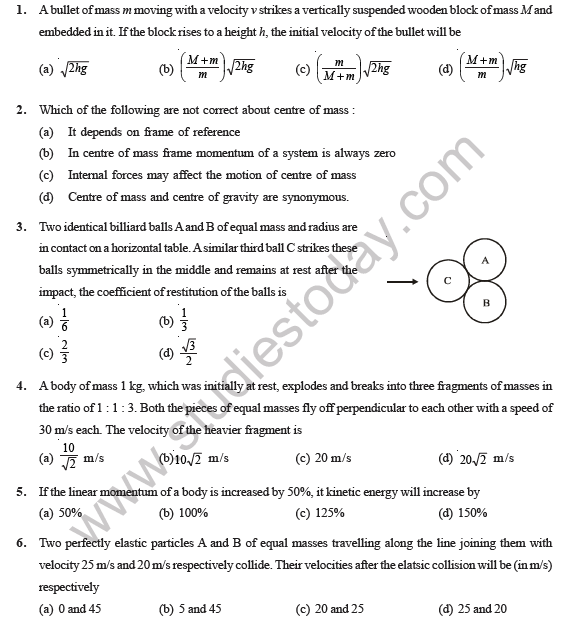
OBJECTIVES
1. A bullet of mass m moving with a velocity v strikes a vertically suspended wooden block of mass M and embedded in it. If the block rises to a height h, the initial velocity of the bullet will be
(a) √(2hg)
(b) \( \left(\frac{M+m}{m}\right) \sqrt{2hg} \)
(c) \( \left(\frac{m}{M+m}\right) \sqrt{2hg} \)
(d) \( \left(\frac{M+m}{m}\right) \sqrt{hg} \)
Answer: (b) \( \left(\frac{M+m}{m}\right) \sqrt{2hg} \)
1. After the bullet embeds, the combined mass (M + m) rises to height h, so by energy conservation V = √(2gh).
2. By conservation of momentum, mv = (M + m)V.
3. v = \( \frac{M+m}{m} \) V = \( \left(\frac{M+m}{m}\right) \sqrt{2hg} \)
4. Hence, the correct option is (b).
Teacher's Note:
a) Momentum is conserved in the collision; energy is conserved only after it, during the rise.
b) Do not apply energy conservation across the collision, because it is inelastic.
2. Which of the following are not correct about centre of mass :
(a) It depends on frame of reference
(b) In centre of mass frame momentum of a system is always zero
(c) Internal forces may affect the motion of centre of mass
(d) Centre of mass and centre of gravity are synonymous.
Answer: (a), (c) and (d)
1. Statement (b) is correct: the total momentum of a system is zero in its centre of mass frame.
2. Statement (a) is not correct as the key reads it: the centre of mass is a fixed point of the system, and changing the frame changes only its coordinates, not its position within the system.
3. Statement (c) is not correct: internal forces cancel in pairs and cannot change the motion of the centre of mass.
4. Statement (d) is not correct: the two coincide only in a uniform gravitational field, so they are not synonymous.
5. Hence, the statements that are not correct are (a), (c) and (d).
Teacher's Note:
a) Only an external force can accelerate the centre of mass.
b) A very large body, such as a tall mountain, can have its centre of gravity slightly below its centre of mass.
3. Two identical billiard balls A and B of equal mass and radius are in contact on a horizontal table. A similar third ball C strikes these balls symmetrically in the middle and remains at rest after the impact, the coefficient of restitution of the balls is
(a) \( \frac{1}{6} \)
(b) \( \frac{1}{3} \)
(c) \( \frac{2}{3} \)
(d) \( \frac{\sqrt{3}}{2} \)
Answer: (c) \( \frac{2}{3} \)
1. The centres of A, B and C form an equilateral triangle, so the line joining C to A (or B) makes 30° with the direction of motion of C.
2. Let C have speed u before impact. A and B each move along their line of centres with speed v. Momentum along the motion: mu = 2mv cos 30°, so v = \( \frac{u}{\sqrt{3}} \).
3. Speed of approach along the line of centres = u cos 30° = \( \frac{\sqrt{3}}{2} \) u.
4. Speed of separation = v - 0 = \( \frac{u}{\sqrt{3}} \), since C is at rest after the impact.
5. e = \( \frac{u/\sqrt{3}}{(\sqrt{3}/2)u} \) = \( \frac{2}{3} \)
6. Hence, the correct option is (c).
Teacher's Note:
a) The impulse on A and B acts along the line joining the centres, not along the motion of C.
b) Always resolve both approach and separation speeds along the line of impact.
4. A body of mass 1 kg, which was initially at rest, explodes and breaks into three fragments of masses in the ratio of 1 : 1 : 3. Both the pieces of equal masses fly off perpendicular to each other with a speed of 30 m/s each. The velocity of the heavier fragment is
(a) \( \frac{10}{\sqrt{2}} \) m/s
(b) 10√2 m/s
(c) 20 m/s
(d) 20√2 m/s
Answer: (b) 10√2 m/s
1. The masses are 0.2 kg, 0.2 kg and 0.6 kg.
2. Momentum of each small piece = 0.2 × 30 = 6 kg m/s, and the two are perpendicular.
3. Resultant momentum of the two small pieces = √(6² + 6²) = 6√2 kg m/s.
4. The initial momentum is zero, so the heavy fragment has momentum 6√2 kg m/s in the opposite direction.
5. Velocity of heavy fragment = 6√2 / 0.6 = 10√2 m/s
6. Hence, the correct option is (b).
Teacher's Note:
a) Perpendicular momenta add by Pythagoras, not by simple addition.
b) Divide by the heavy mass 0.6 kg, not by 1 kg.
5. If the linear momentum of a body is increased by 50%, it kinetic energy will increase by
(a) 50%
(b) 100%
(c) 125%
(d) 150%
Answer: (c) 125%
1. Kinetic energy K = \( \frac{p^2}{2m} \), so K is proportional to p².
2. New momentum p' = 1.5p, so K' = (1.5)² K = 2.25 K.
3. Increase = 2.25K - K = 1.25K, which is 125%.
4. Hence, the correct option is (c).
Teacher's Note:
a) The answer is the increase, 125%, not the new value 225%.
b) K = p²/2m links momentum and energy for a fixed mass.
6. Two perfectly elastic particles A and B of equal masses travelling along the line joining them with velocity 25 m/s and 20 m/s respectively collide. Their velocities after the elatsic collision will be (in m/s) respectively
(a) 0 and 45
(b) 5 and 45
(c) 20 and 25
(d) 25 and 20
Answer: (c) 20 and 25
1. For a head-on elastic collision between equal masses, the particles exchange their velocities.
2. Before: vA = 25 m/s and vB = 20 m/s in the same direction, so A overtakes B.
3. After: vA = 20 m/s and vB = 25 m/s.
4. Check momentum: 25 + 20 = 20 + 25, and kinetic energy is also unchanged.
5. Hence, the correct option is (c).
Teacher's Note:
a) The printed key gives (d) 25 and 20, which is the situation before the collision; after the exchange A has 20 and B has 25.
b) Equal masses with e = 1 means a simple exchange of velocities.
7. A sphere of mass m moving with a constant velocity u hits another stationary sphere of the same mass. If e is the coefficient of restitution, then the ratio of velocities of the two spheres after collision will be
(a) \( \left(\frac{1-e}{1+e}\right) \)
(b) \( \left(\frac{1+e}{1-e}\right) \)
(c) \( \left(\frac{e+1}{e-1}\right) \)
(d) \( \left(\frac{e-1}{e+1}\right) \)
Answer: (a) \( \left(\frac{1-e}{1+e}\right) \)
1. Momentum: mu = mv1 + mv2, so v1 + v2 = u.
2. Restitution: v2 - v1 = eu.
3. Adding and subtracting, v1 = \( \frac{u(1-e)}{2} \) and v2 = \( \frac{u(1+e)}{2} \).
4. Ratio v1 : v2 = \( \frac{1-e}{1+e} \)
5. Hence, the correct option is (a).
Teacher's Note:
a) The ratio is first sphere to second sphere; flipping it gives option (b).
b) For e = 1 the ratio is 0, meaning the first sphere stops.
8. A canon ball is fired with a velocity of 200 m/s at an angle of 60º with the horizontal. At the highest point it explodes into three equal fragments. One goes vertically upwards with a velocity of 100 m/s, the second one falls vertically downwards with a velocity of 100 m/s. The third one moves with a velocity of
(a) 100 m/s horizontally
(b) 300 m/s horizontally
(c) 200 m/s at 60º with the horizontal
(d) 300 m/s at 60º with the horizontal
Answer: (b) 300 m/s horizontally
1. At the highest point the velocity is purely horizontal: v = 200 cos 60° = 100 m/s.
2. Total momentum just before the explosion = 3m × 100 = 300m, horizontal.
3. The upward and downward fragments have equal and opposite vertical momenta, which cancel.
4. So the third fragment carries all the horizontal momentum: m v3 = 300m, giving v3 = 300 m/s horizontally.
5. Hence, the correct option is (b).
Teacher's Note:
a) The printed key gives (d), but the third fragment has no vertical component, so 300 m/s at 60° is not possible.
b) At the top of the path only the horizontal component of velocity remains.
9. A body of mass 2.9 kg is suspended from a string of length 2.5 m and is at rest. A bullet of mass 100 g, moving horizontally with a speed of 150 m/s, strikes and sticks to it. What is the maximum angle made by the string with the vertical after the impact ? (g = 10 m/s²)
(a) 30º
(b) 45º
(c) 60º
(d) 90º
Answer: (c) 60º
1. Mass of bullet = 0.1 kg. By momentum conservation, 0.1 × 150 = (2.9 + 0.1) V, so V = 15 / 3 = 5 m/s.
2. Height gained h = \( \frac{V^2}{2g} \) = \( \frac{25}{20} \) = 1.25 m
3. h = L(1 - cos θ), so 1 - cos θ = 1.25 / 2.5 = 0.5
4. cos θ = 0.5, so θ = 60°.
5. Hence, the correct option is (c).
Teacher's Note:
a) Convert 100 g to 0.1 kg before using momentum.
b) Height is measured vertically, and equals L(1 - cos θ), not L sin θ.
10. A bullet of mass 0.01 kg, travelling at a speed of 500 m/s, strikes a block of mass 2 kg, which is suspended by a string of length 5 m, and emerges out. The block rises bya vertical distance of 0.1 m. The speed of the bullet after it emerges from the block is
(a) 55 m/s
(b) 110 m/s
(c) 220 m/s
(d) 440 m/s
Answer: (c) 220 m/s
1. Speed of the block just after impact: V = √(2gh) = √(2 × 10 × 0.1) = √2 ≈ 1.4 m/s.
2. Momentum conservation: 0.01 × 500 = 0.01 × v + 2 × 1.4
3. 5 = 0.01v + 2.8, so 0.01v = 2.2
4. v = 220 m/s
5. Hence, the correct option is (c).
Teacher's Note:
a) The bullet passes through, so its mass and the block's mass stay separate in the momentum equation.
b) Use √2 ≈ 1.4 (g close to 9.8) to get 220 m/s exactly.
11. A 1 kg ball, moving at 12 m/s, collides head-on with a 2 kg ball moving in the opposite direction at 24 m/s. If the coefficient of restitution is 2/3, then the energy lost in the collision is
(a) 60 J
(b) 120 J
(c) 240 J
(d) 480 J
Answer: (c) 240 J
1. Take the direction of the 1 kg ball as positive: u1 = 12 m/s, u2 = -24 m/s.
2. Initial K.E. = \( \frac{1}{2} \)(1)(12)² + \( \frac{1}{2} \)(2)(24)² = 72 + 576 = 648 J
3. Momentum: v1 + 2v2 = 12 - 48 = -36, and restitution: v2 - v1 = \( \frac{2}{3} \) × 36 = 24.
4. Solving, v2 = -4 m/s and v1 = -28 m/s.
5. Final K.E. = \( \frac{1}{2} \)(1)(28)² + \( \frac{1}{2} \)(2)(4)² = 392 + 16 = 408 J
6. Energy lost = 648 - 408 = 240 J
7. Hence, the correct option is (c).
Teacher's Note:
a) Give the opposite direction a negative sign.
b) Check: the loss is also \( \frac{1}{2} \) × reduced mass × (1 - e²) × (relative speed)², which gives 240 J.
12. An isolated particle of mass m is moving in a horizontal plane (x-y), along the x-axis, at a certain height above the ground. It suddenly explodes into two fragments of masses m/4 and 3m/4. An instant later, the smaller fragment is at y = +15 cm. The larger fragment at this instant is at
(a) y = -5 cm
(b) y = +20 cm
(c) y = +5 cm
(d) y = -20 cm
Answer: (a) y = -5 cm
1. The explosion is caused by internal forces, so the centre of mass keeps moving along the x-axis, that is ycm = 0.
2. \( \frac{m}{4} \)(15) + \( \frac{3m}{4} \) y = 0
3. 3.75 + 0.75y = 0, so y = -5 cm
4. Hence, the correct option is (a).
Teacher's Note:
a) The centre of mass path is not changed by an internal explosion.
b) The larger fragment lies on the opposite side and closer to the axis, in the ratio of masses 1 : 3.
13. A body of mass m1 and speed v1 makes a head-on, elastic collision with a body of mass m2, initially at rest. The velocity of m1 after the collision is
(a) \( \frac{m_1+m_2}{m_1 m_2} v_1 \)
(b) \( \frac{m_1-m_2}{m_1+m_2} v_1 \)
(c) \( \frac{2 m_1 v_1}{m_1+m_2} \)
(d) \( \frac{2 m_2 v_1}{m_1+m_2} \)
Answer: (b) \( \frac{m_1-m_2}{m_1+m_2} v_1 \)
1. Momentum: m1v1 = m1v1' + m2v2'
2. Elastic collision: v2' - v1' = v1
3. Solving, v1' = \( \frac{m_1-m_2}{m_1+m_2} \) v1
4. Hence, the correct option is (b).
Teacher's Note:
a) If m1 is less than m2 the first body rebounds, shown by a negative sign.
14. In the above example, the velocity of mass m2 after the collision is
(a) \( \frac{m_1+m_2}{m_1 m_2} v_1 \)
(b) \( \frac{m_1-m_2}{m_1+m_2} v_1 \)
(c) \( \frac{2 m_1 v_1}{m_1+m_2} \)
(d) \( \frac{2 m_2 v_1}{m_1+m_2} \)
Answer: (c) \( \frac{2 m_1 v_1}{m_1+m_2} \)
1. From the previous question, v1' = \( \frac{m_1-m_2}{m_1+m_2} \) v1.
2. v2' = v1 + v1' = v1 \( \left[1 + \frac{m_1-m_2}{m_1+m_2}\right] \)
3. v2' = \( \frac{2 m_1 v_1}{m_1+m_2} \)
4. Hence, the correct option is (c).
Teacher's Note:
a) The numerator has m1, the mass of the moving body, not m2.
b) Check: for m1 = m2 this gives v2' = v1, the velocity exchange.
15. A ball of mass m approaches a moving wall of infinite mass with speed v along the normal to the wall. The speed of the wall is u towards the ball. The speed of the ball after an elastic collision with the wall is
(a) u + v away from the wall
(b) 2u + v away from the wall
(c) u - v away from the wall
(d) v - 2u away from the wall.
Answer: (b) 2u + v away from the wall
1. In the frame of the wall, the ball approaches with speed v + u.
2. In an elastic collision with an infinitely heavy wall, the ball leaves with the same relative speed v + u, away from the wall.
3. The wall itself moves towards the ball with speed u, so in the ground frame the ball moves away with speed (v + u) + u.
4. Speed of the ball = 2u + v away from the wall.
5. Hence, the correct option is (b).
Teacher's Note:
a) Relative speed of separation equals relative speed of approach for e = 1.
b) Convert from the wall frame back to the ground frame by adding the wall's speed.
16. A neutron is moving with velocity u. It collides head on and elastically with an atom of mass number A. If the initial K.E. of the neutron is E, how much K.E. is retained by neutron after collision ?
(a) [A/(A + 1)]² E
(b) [A/(A + 1)²] E
(c) [(1 - A)/(A + 1)²] E
(d) [(A - 1)/(A + 1)²] E
Answer: (c) [(1 - A)/(A + 1)²] E
1. Mass of neutron = 1 unit and mass of atom = A units, with the atom at rest.
2. Velocity of the neutron after the collision: v = \( \frac{1-A}{1+A} \) u
3. Kinetic energy retained = \( \frac{1}{2} \)(1)v² = \( \left(\frac{1-A}{1+A}\right)^2 \) E
4. Option (c) is printed as [(1 - A)/(A + 1)²] E, with the square lost in typesetting; it stands for the squared ratio [(1 - A)/(A + 1)]² E, since the retained energy cannot be negative.
5. Hence, the answer is option (c), as in the key.
Teacher's Note:
a) The retained fraction is the square of the velocity ratio, because K.E. depends on v².
b) For A = 1 (equal masses) the retained energy is zero, as expected.
17. A ball collides elastically with another ball of the same mass. The collision is oblique and initially one of the ball was at rest. After the collision, the two balls move with same speeds. What will be the angle between the velocity of the balls after the collision ?
(a) 30º
(b) 45º
(c) 60º
(d) 90º
Answer: (d) 90º
1. In an elastic collision of two equal masses, one initially at rest, the two velocities after collision are perpendicular to each other.
2. Proof: momentum gives u = v1 + v2 (vectors), and energy gives u² = v1² + v2².
3. So v1 · v2 = 0, which means the angle between them is 90°.
4. Hence, the correct option is (d).
Teacher's Note:
a) This result holds only for equal masses, elastic, oblique collisions with one body at rest.
b) The equal-speed condition means each ball moves at 45° to the original line.
18. Which one of the following statements does not hold good when two balls of masses m1 and m2 undergo elastic collision ?
(a) when m1 < m2 and m2 at rest, there will be maximum transfer of momentum
(b) when m1 > m2 and m2 at rest, after collision the ball of mass m2 moves with four times the velocity of m1
(c) when m1 = m2 and m2 at rest, there will be maximum transfer of K.E.
(d) when collision is oblique and m2 at rest with m1 = m2, after collision the ball moves in opposite directions
Answer: (d) when collision is oblique and m2 at rest with m1 = m2, after collision the ball moves in opposite directions
1. For m1 = m2 with m2 at rest, the whole kinetic energy is transferred in a head-on collision, so statement (c) holds.
2. For an oblique elastic collision of equal masses with one at rest, the balls move at right angles to each other, not in opposite directions. Statement (d) does not hold.
3. Statement (b) is true only in the special case m1 = 2m2, which the question treats as a stated condition, and statement (a) describes the near-maximum momentum transfer for a light ball hitting a heavy one.
4. Hence, the statement that does not hold good is (d).
Teacher's Note:
a) Statement (b) gives v2 = 4v1 only when m1 = 2m2; the clearly false statement is (d).
b) After an oblique equal-mass elastic collision the angle between the velocities is always 90°.
19. A ball is dropped from a height h on the ground. If the coefficient of restitution is e, the height to which the ball goes up after it rebounds for the nth time is
(a) h e² n
(b) h en
(c) \( \frac{e^2 n}{h} \)
(d) \( \frac{h}{e^{2n}} \)
Answer: (a) h e² n
1. Speed on reaching the ground: v0 = √(2gh). After the first rebound, speed = e v0.
2. Height after the first rebound: h1 = \( \frac{e^2 v_0^2}{2g} \) = e²h
3. Each rebound multiplies the height by e², so after n rebounds hn = h e2n.
4. Option (a) is this result, printed as h e² n with the power 2n typed beside the symbol e.
5. Hence, the correct option is (a).
Teacher's Note:
a) Height depends on the square of the speed, so each rebound gives a factor e², not e.
b) Option (a) is printed as h e² n and stands for h e2n; do not read it as h × e² × n.
20. Two equal spheres A and B lie on a smooth horizontal circular groove at opposite ends of diameter. A is projected along the groove and at the end of time t impinges on B. If e is coefficient of restitution, the second impact will occur after a time
(a) \( \frac{2t}{e} \)
(b) \( \frac{t}{e} \)
(c) \( \frac{\pi t}{e} \)
(d) \( \frac{2\pi t}{e} \)
Answer: (a) \( \frac{2t}{e} \)
1. Let the speed of A be v and the radius of the groove be r. Half the circumference is covered in time t, so πr = vt.
2. After impact (equal masses): vA = \( \frac{v(1-e)}{2} \) and vB = \( \frac{v(1+e)}{2} \)
3. The relative speed of B with respect to A is vB - vA = ev.
4. The second impact occurs when B has gained one full circumference 2πr on A: time = \( \frac{2\pi r}{ev} \) = \( \frac{2t}{e} \)
5. Hence, the correct option is (a).
Teacher's Note:
a) A and B are on a closed groove, so the next impact needs a relative gain of a full circle, 2πr.
b) For e = 1 the spheres exchange velocities and the next impact comes after 2t.
21. A body of mass 2 kg moving with a velocity of 3 m/s collides head-on with a body of mass 1 kg moving with a velocity of 4 m/s. After collision the two bodies stick together and move with a common velocity which in the units m/s is equal to
(a) 1/4
(b) 1/3
(c) 2/3
(d) 3/4
Answer: (c) 2/3
1. The bodies move in opposite directions (head-on); take the 2 kg body's direction as positive.
2. Momentum before = 2 × 3 + 1 × (-4) = 6 - 4 = 2 kg m/s
3. Momentum after = (2 + 1) V = 3V
4. V = 2/3 m/s
5. Hence, the correct option is (c).
Teacher's Note:
a) Head-on means opposite directions, so the momenta subtract.
b) The common velocity points along the direction of the heavier momentum.
22. The centre of mass of triangle shown in the figure has co-ordinates.
(a) x = \( \frac{h}{2} \); y = \( \frac{b}{2} \)
(b) x = \( \frac{b}{2} \); y = \( \frac{h}{2} \)
(c) x = \( \frac{b}{3} \); y = \( \frac{h}{3} \)
(d) x = \( \frac{h}{3} \); y = \( \frac{b}{3} \)
Answer: (c) x = \( \frac{b}{3} \); y = \( \frac{h}{3} \)
1. The triangle is right-angled with the right angle at the origin, base b along the x-axis and height h along the y-axis.
2. The centre of mass of a triangle lies at the centroid, one third of the way from each side.
3. xcm = \( \frac{0 + b + 0}{3} \) = \( \frac{b}{3} \) and ycm = \( \frac{0 + 0 + h}{3} \) = \( \frac{h}{3} \)
4. Hence, the correct option is (c).
Teacher's Note:
a) The x-coordinate goes with the base b and the y-coordinate with the height h; option (d) swaps them.
b) The centroid of a triangle is the average of the three vertex coordinates.
23. A cart of mass M is tied to one end of a massless rope of length 10 m. The other end of the rope is in the hands of a man of mass M, the entire system is on a smooth horizontal surface. The man is at x = 0 and the cart at x = 10 m. If the man pulls the cart by a roop, the man and the cart will meet at the point :
(a) x = 0
(b) x = 5 m
(c) x = 10 m
(d) They will never meet.
Answer: (b) x = 5 m
1. The surface is smooth, so there is no external horizontal force on the man-cart system.
2. The centre of mass therefore stays at rest at xcm = \( \frac{M(0) + M(10)}{2M} \) = 5 m.
3. When they meet, both are at the centre of mass, x = 5 m.
4. Hence, the correct option is (b).
Teacher's Note:
a) Pulling the rope is an internal force, so the centre of mass cannot move.
b) With equal masses they meet midway; unequal masses would meet nearer the heavier one.
24. Two particles of masses M and 2 M are at a distance D apart. Under the mutual gravitational force they start moving towards each other. The acceleraion of their centre of mass when they are D/2 apart is :
(a) 2 GM/D²
(b) 4 GM/D²
(c) 8 GM/D²
(d) Zero.
Answer: (d) Zero.
1. The only forces acting are the mutual gravitational forces between the two particles.
2. These are internal forces, equal and opposite, so the net external force is zero.
3. Acceleration of the centre of mass = net external force / total mass = 0.
4. Hence, the correct option is (d).
Teacher's Note:
a) The separation D/2 is a distraction; the answer is zero at every separation.
b) The centre of mass starts at rest and stays at rest.
25. The position coordinates (x, y) of the cm of the T-shaped plate with reference to the frame shown in the figure are
(a) x = 0, y = 8 cm
(b) y = 0, x = \( \frac{20}{3} \) cm
(c) y = 0, x = \( \frac{20}{3} \) cm
(d) x = 0, y = \( \frac{20}{3} \) cm
[Figure: picture not clear in the PDF - add image]
Answer: (a) x = 0, y = 8 cm
1. The figure with the dimensions of the T-shaped plate is not available in the PDF, so the calculation cannot be reproduced here.
2. The plate is symmetrical about the y-axis, so x = 0 for the centre of mass, which agrees with options (a) and (d).
3. Using the printed answer key, the centre of mass lies on the axis of symmetry at y = 8 cm.
4. Hence, the answer is option (a), as given in the key.
Teacher's Note:
a) For a symmetric plate the centre of mass lies on the line of symmetry.
b) Split the T into two rectangles and take the area-weighted mean of their centres to find y.
Please click on below link to download pdf file for CBSE Class 12 Physics Centre of Mass Objective Questions.
Free study material for Physics
CBSE Class 12 Physics Study Material: Centre of Mass
Essential Notes for Class 12 Physics
Explore essential learning tools for Class 12 Physics Centre of Mass. This curated collection features in-depth notes and targeted practice questions built around the active 2026 curriculum to streamline your daily revision.
Verified Solutions for Class 12 Physics
Designed around the official curriculum, these study guides guarantee standard compliance. Reviewing step-by-step solutions clarifies complex sub-topics within Centre of Mass and demystifies standard marking schemes for Physics evaluations.
Enhance Accuracy with Online Tests
For peak performance in upcoming evaluations, integrate official Physics sample papers directly into your study schedule. Follow up your revision by attempting online MCQ tests for Centre of Mass to refine calculation speed and precision.
FAQs
Our advanced study package for Centre of Mass includes detailed concepts, diagrams, Mind Maps, and explanation of complex topics to ensure Class 12 students learn as per syllabus for 2026 exams.
The Mind Maps provided for Centre of Mass act as visual anchors which will help faster recall during high-pressure exams.
Yes, teachers use our Class 12 Physics resources for lesson planning as they are in simple language and have lot of solved examples.
Yes, You can download the complete, mobile-friendly PDF of the Physics Centre of Mass advanced resources for free.
Yes, our subject matter experts have updated the Centre of Mass material to align with the rationalized NCERT textbooks and have removed deleted topics and added new competency-based questions.