

Download CBSE Class 12 Physics Useful Resources
Explore structured advanced study materials through the CBSE Class 12 Physics Centre of Mass Exam Notes. Tailored for Class 12 learners, utilizing these Physics resources ensures thorough preparation and strengthens foundational knowledge before final CBSE evaluations.
Access CBSE Study Guides and Summaries
Navigate directly to the advanced Physics study materials using the digital viewer below. Each resource pack includes detailed conceptual summaries and solved practice questions, allowing students to instantly reinforce their learning.
CBSE Class 12 Physics Centre of Mass Exam Notes. Please refer to the examination notes which you can use for preparing and revising for exams. These notes will help you to revise the concepts quickly and get good marks.
Centre of Mass, Conservation of Momentum, Impulse, Collision
INTRODUCTION
In the earlier chapter we dealt with the motion of point masses. If there is an extended body it contains millions of particles. All particles may have different velocities and accelerations. For example, a spinning cricket ball has different accelerations and velocities for different particles of the ball. Centre of mass plays an important role in studying the motion of such bodies and also the system which has a number of constituents.
CENTRE OF MASS OF A SYSTEM OF PARTICLES
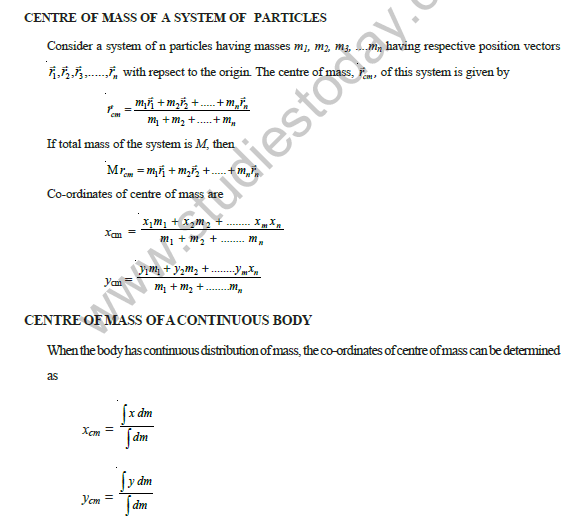
Consider a system of n particles having masses \(m_1,m_2,m_3,\ldots,m_n\) having respective position vectors \(\vec r_1,\vec r_2,\vec r_3,\ldots,\vec r_n\) with respect to the origin. The centre of mass, \(\vec r_{cm}\), of this system is given by
\[\vec r_{cm}=\frac{m_1\vec r_1+m_2\vec r_2+\cdots+m_n\vec r_n}{m_1+m_2+\cdots+m_n}\]
If total mass of the system is M, then
\[M\vec r_{cm}=m_1\vec r_1+m_2\vec r_2+\cdots+m_n\vec r_n\]
Co-ordinates of centre of mass are
\[x_{cm}=\frac{x_1m_1+x_2m_2+\cdots+x_nm_n}{m_1+m_2+\cdots+m_n}\]
\[y_{cm}=\frac{y_1m_1+y_2m_2+\cdots+y_nm_n}{m_1+m_2+\cdots+m_n}\]
CENTRE OF MASS OF A CONTINUOUS BODY
When the body has continuous distribution of mass, the co-ordinates of centre of mass can be determined as
\[x_{cm}=\frac{\int x\,dm}{\int dm}\]
\[y_{cm}=\frac{\int y\,dm}{\int dm}\]
CENTRE OF MASS OF THE BODY WHEN A PORTION OF THE BODY IS TAKEN OUT
Let there be a body of mass m and a mass \(m_1\) is taken out from this body. The coordinates of centre of mass can be written as
\[x_{cm}=\frac{mx-m_1x_1}{m-m_1}\]
\[y_{cm}=\frac{my-m_1y_1}{m-m_1}\]
where \(x,\ y\) are coordinates of centre of mass of whole (original) body and \(x_1,\ y_1\) are coordinates of centre of mass of portion to be taken out.
LAW OF CONSERVATION OF MOMENTUM
It states that if the resultant force on a system of particles is zero, then its total momentum remains conserved.
If an external force, \(\vec F_{ext}\), acts on a body, Newton’s second law of motion shows that this force is equal to the rate of change of momentum, \(\dfrac{d\vec p}{dt}\).
∴ \(\vec F_{ext}=\dfrac{d\vec p}{dt}\)
If \(\vec F_{ext}=0,\ \dfrac{d\vec p}{dt}=0\) or \(\vec p\) is a constant quantity.
Thus momenta of individual particles may change in collision of the particles, but the sum of momentum of particles remains unchanged if the external force is equal to zero.
SYSTEM OF VARIABLE MASS
Newton’s second law in the form \(\vec F=m\vec a\) is applicable to a system whose mass is constant. If mass of the system is not constant, the form \(F=\dfrac{dp}{dt}\) is still applicable and can be written as
\[\begin{aligned}\vec F&=\frac{d}{dt}(mu)\\&=m\frac{du}{dt}+u\left(\frac{dm}{dt}\right)\\ M\frac{dV}{dt}&=F_{ext}+u\frac{dm}{dt}\end{aligned}\]
Where u is velocity of adding or leaving mass w.r.t. the body and V is velocity of the body at any instant w.r.t. to inertial frame of reference. The term \(\dfrac{dm}{dt}\) can be positive or negative depending upon whether mass is added to the system or mass is leaving the system.
ROCKET PROPULSION
The propulsion of rocket is based on the law of conservation of momentum. In the combustion chamber of a rocket, the fuel is burnt in the presence of an oxidizing agent due to which a jet of gases emerges from the tail of the rocket. This action due to emission of gases in the backward direction produces a reaction force in the forward direction due to which the rocket moves forward.
If the initial velocity of the rocket is zero and \(m_0\) is the initial mass of the rocket (with its fuel) and u is the speed of exhaust of the gases such that m is the mass of the rocket at time t, the velocity v of rocket is given by
\[v=u\log_e\!\left(\frac{m_0}{m}\right)\]
The thrust F on the rocket is given by
\[F=u\frac{dm}{dt}\]
The thrust on the rocket is thus equal to the product of exhaust speed of the burnt gases and the rate of combustion of fuel at that time. The acceleration a of the rocket at time t is given by
\[a=\frac{dv}{dt}=\left[\frac{dm}{dt}\right]\frac{u}{m}=\left[\frac{dm}{dt}\right]\left[\frac{u}{m_0-(dm/dt)\,t}\right]\]
Here m is instantaneous mass of the body and \(m=m_0-\left(\dfrac{dm}{dt}\right)t\).
It is an example of the acceleration of a body whose mass changes continuously as the gases due to burning of fuel escape from the rocket.
COLLISIONS
The interaction between two or more bodies in a short time is called a collision. If no net external force is acting on the bodies, then according to the law of conservation of momentum, the total momentum of the system before and after the collision is equal.
CLASSIFICATION OF COLLISIONS:
These are classified according to whether the kinetic energy is conserved or not in the collision and these collisions are of the following types:
- Elastic Collisions: If the kinetic energy of the colliding particles is equal before and after collision, the collision is said to be an elastic collision. If \(m_1\) is mass of a body moving with velocity \(u_1\), which when collides with a body of mass \(m_2\) moving with velocity \(u_2\), so that the final velocities are \(v_1\) and \(v_2\) in perfectly elastic collision, then\[\tfrac12m_1u_1^2+\tfrac12m_2u_2^2=\tfrac12m_1v_1^2+\tfrac12m_2v_2^2\]
- Inelastic Collision: If the kinetic energy is not conserved, the collision is said to be inelastic. The kinetic energy is partially converted into the form of heat, sound, deformation energy etc.
- Perfectly Inelastic Collision: The collision is said to be perfectly inelastic if the two bodies stick together after collision and move with the same velocity.
COEFFICIENT OF RESTITUTION :
The elasticity of collision is measured in terms of a constant called as the coefficient of restitution. It is defined as the ratio of relative velocity after collision to the relative velocity before collision and the ratio is negative.
If \(u_1\) and \(u_2\) are the respective velocities of the two bodies before collision and \(v_1\) and \(v_2\) are the corresponding velocities of the two bodies after the collision, then
\[\frac{v_1-v_2}{u_1-u_2}=-e\]
The coefficient of restitution, e can also be expressed as the ratio of velocity of separation after collision to the velocity of approach before collision.
\[e=\frac{v_2-v_1}{u_1-u_2}\]
For the perfectly elastic collision, \(e=1\)
For the perfectly inelastic collision, \(e=0\)
For inelastic collision, \(0<e<1\)
In both elastic and inelastic collisions, momentum is conserved whereas in inelastic collisions, kinetic energy is not conserved. When the two bodies collide obliquely, their relative velocity resolved along their common normal bears a constant ratio to their relative velocity before collision resolved in the same direction and is of opposite sign.
ELASTIC COLLISION
Consider two small smooth spheres of masses \(m_1\) and \(m_2\) moving along the line joining their centres with velocities \(u_1\) and \(u_2\) respectively. Let their respective velocities become \(v_1\) and \(v_2\) after the elastic collision as shown in the figure.
Since momentum is conserved,
\[m_1u_1+m_2u_2=m_1v_1+m_2v_2\]
\[m_1(u_1-v_1)=m_2(v_2-u_2)\qquad\ldots(i)\]
Since kinetic energy is also conserved,
\[\tfrac12m_1u_1^2+\tfrac12m_2u_2^2=\tfrac12m_1v_1^2+\tfrac12m_2v_2^2\]
\[m_1(u_1^2-v_1^2)=m_2(v_2^2-u_2^2)\qquad\ldots(ii)\]
Dividing (ii) by (i)
\[u_1+v_1=v_2+u_2\]
or \(v_1-v_2=u_2-u_1\qquad\ldots(iii)\)
As \(v_1=-u_1+u_2+v_2\)
Substitute \(v_1\) in equation (i)
\[m_1(u_1+u_1-u_2-v_2)=m_2v_2-m_2u_2\]
\[2m_1u_1+(m_2-m_1)u_2=(m_1+m_2)v_2\]
\[v_2=\left[\frac{2m_1}{m_1+m_2}\right]u_1+\left[\frac{m_2-m_1}{m_1+m_2}\right]u_2\qquad\ldots(iv)\]
Similarly,
\[v_1=\left[\frac{m_1-m_2}{m_1+m_2}\right]u_1+\left[\frac{2m_2}{m_1+m_2}\right]u_2\qquad\ldots(v)\]
Special Cases:
(i) When \(m_1=m_2\),
From equation (i), \(u_1-v_1=v_2-u_2\), so \(v_1+v_2=u_1+u_2\).
Equation (iii) gives \(v_1-v_2=u_2-u_1\).
∴ \(v_1=u_2\) and \(v_2=u_1\)
∴ In one dimensional elastic collision of two bodies of equal masses, the bodies exchange velocities due to collision.
(ii) When \(m_2\) is at rest i.e. \(u_2=0\).
\[v_2=\frac{2m_1u_1}{m_1+m_2}+\left(\frac{m_2-m_1}{m_2+m_1}\right)u_2\ \Rightarrow\ v_2=\frac{2m_1u_1}{m_1+m_2}\]
The velocities after the collision are given as follows for the three cases :
- If \(m_1=m_2=m\)\[v_2=\frac{2mu_1}{2m}=u_1,\qquad v_1=0.\]Both the momentum and the kinetic energy of the first body are completely transferred to the second body. As \(v_1=0\), the first body is stopped.
- If \(m_2\gg m_1,\ v_1\approx-u_1,\ v_2\approx0\)
Thus when a light body collides with a much heavier stationary body, the velocity of light body is reversed and heavier body almost remains at rest. - If \(m_2\ll m_1,\ v_1\approx u_1\) and \(v_2\approx2u_1\)
Thus when a heavy body collides with a much lighter body that is at rest, the velocity of heavier body remains almost unchanged. The light body moves forward with approximately twice the velocity of the heavier body.
Inelastic Collision:
Consider two bodies of masses \(m_1\) and \(m_2\) moving along the line joining their centres, with velocities \(u_1\) and \(u_2\) respectively. Let their respective velocities after collision be \(v_1\) and \(v_2\).
\(m_1u_1+m_2u_2=m_1v_1+m_2v_2\) (As momentum is conserved)
\(v_1-v_2=-e(u_1-u_2)\) (by definition of e)
There is a loss of kinetic energy during collision when the bodies stick to each other after the collision as their kinetic energy is not conserved.
In an imperfectly elastic collision lying between perfectly elastic and inelastic collision, the loss in kinetic energy, \(\Delta E\), is given by
\[\Delta E=\frac12\left(\frac{m_1m_2}{m_1+m_2}\right)(1-e^{2})(u_1-u_2)^2\]
Putting e = 0 in the above equation, it is clear that the loss of kinetic energy is maximum in case of perfectly inelastic collision.
Free study material for Physics
Free CBSE Study Guides: Class 12 Physics Centre of Mass
Essential Notes for Class 12 Physics
Explore essential learning tools for Class 12 Physics Centre of Mass. This curated collection features in-depth notes and targeted practice questions built around the active 2026 curriculum to streamline your daily revision.
Verified Solutions for Class 12 Physics
Each resource draws directly from authorized textbooks to maintain academic accuracy. Evaluating solved examples allows Class 12 students to master the formal presentation and answer-writing standards expected in upcoming school exams.
Enhance Accuracy with Online Tests
For peak performance in upcoming evaluations, integrate official Physics sample papers directly into your study schedule. Follow up your revision by attempting online MCQ tests for Centre of Mass to refine calculation speed and precision.
FAQs
Our advanced study package for Centre of Mass includes detailed concepts, diagrams, Mind Maps, and explanation of complex topics to ensure Class 12 students learn as per syllabus for 2026 exams.
The Mind Maps provided for Centre of Mass act as visual anchors which will help faster recall during high-pressure exams.
Yes, teachers use our Class 12 Physics resources for lesson planning as they are in simple language and have lot of solved examples.
Yes, You can download the complete, mobile-friendly PDF of the Physics Centre of Mass advanced resources for free.
Yes, our subject matter experts have updated the Centre of Mass material to align with the rationalized NCERT textbooks and have removed deleted topics and added new competency-based questions.