

Class 12 Physics Study Guide: CBSE Class 12 Physics Centre of Mass Basic Level Assignment
Review targeted academic resources with the CBSE Class 12 Physics Centre of Mass Basic Level Assignment. Built according to official CBSE standards for the 2026-27 term, these downloadable Class 12 Physics study materials support effective daily practice and deeper conceptual understanding for Centre of Mass Basic Level.
Download Centre of Mass Basic Level Study Material PDF
View or download the dedicated CBSE Class 12 Physics Centre of Mass Basic Level Assignment resource below. Engaging with these advanced study guides under focused conditions ensures continuous academic progress and mastery of the 2026-27 curriculum for Centre of Mass Basic Level.
CBSE Class 12 Physics Centre of Mass Basic Level Assignment. Please refer to the examination notes which you can use for preparing and revising for exams. These notes will help you to revise the concepts quickly and get good marks.
BASIC LEVEL ASSIGNMENT
1. A block of mass 10 kg is suspended from a 3 metre long weightless string. A bullet of mass 0.2 kg is fired into the block horizontally with a speed of 20 m/s and it gets embedded in the block. Calculate [3 Marks]
(a) the speed acquired by the block
(b) the maximum displacement of the block
(c) the energy converted to heat in the collision.
Answer:
(a)
1. Mass of the block M = 10 kg, mass of the bullet m = 0.2 kg, initial speed of the bullet u = 20 m/s.
2. Applying the principle of conservation of linear momentum: m × u = (M + m) × v
3. 0.2 × 20 = (10 + 0.2) × v
4. 4 = 10.2 × v
5. v = \(\frac{4}{10.2}\) = 0.392 m/s
(b)
1. Let h be the maximum vertical rise of the combined block and bullet system.
2. Using conservation of mechanical energy: \(\frac{1}{2}\)(M + m)v² = (M + m)gh
3. h = \(\frac{v²}{2g}\) = \(\frac{(0.392)²}{2 \times 9.8}\) = 0.00784 m
4. Let l = 3 m be the length of the string and x be the maximum horizontal displacement.
5. Using geometry of the pendulum: (l - h)² + x² = l² or x ≈ \(\sqrt{2lh}\)
6. x = \(\sqrt{2 \times 3 \times 0.00784}\) = 0.217 m
(c)
1. Initial kinetic energy Ei = \(\frac{1}{2}\)mu² = \(\frac{1}{2}\) × 0.2 × (20)² = 40 J
2. Final kinetic energy Ef = \(\frac{1}{2}\)(M + m)v² = \(\frac{1}{2}\) × 10.2 × (0.392)² = 0.784 J
3. Energy converted to heat = Ei - Ef = 40 - 0.784 = 39.216 J
Teacher's Note:
a) The collision is completely inelastic, so linear momentum is conserved while mechanical energy is not.
b) Students often forget to add the mass of the bullet to the mass of the block in the combined state.
c) Energy lost in the inelastic collision appears entirely as heat generated.
2. A projectile of mass 50 kg is shot vertically upwards with an initial velocity of 100 m/sec. After 5 seconds it explodes into two fragments, one of which having mass 20 kg travels vertically up with a velocity of 150 metres/sec. If g = 9.8 m/s². [3 Marks]
(a) What is the velocity of the other fragment at that instant ?
(b) Calculate the sum of the momenta of the two fragments 3 second after the explosion. What would have been the momentum of the projectile at this instant if there had been no explosion ?
Answer:
(a)
1. Mass of projectile M = 50 kg, initial velocity u = 100 m/s, time t = 5 s.
2. Velocity of the projectile just before explosion: v = u - gt = 100 - (9.8 × 5) = 51 m/s (upwards).
3. Mass of first fragment m1 = 20 kg, velocity v1 = 150 m/s (upwards).
4. Mass of second fragment m2 = M - m1 = 50 - 20 = 30 kg.
5. Using conservation of linear momentum at explosion: M × v = m1v1 + m2v2
6. (50 × 51) = (20 × 150) + (30 × v2)
7. 2550 = 3000 + 30v2
8. v2 = \(\frac{-450}{30}\) = -15 m/s (15 m/s downwards).
(b)
1. Total momentum of a system is always conserved in internal explosions.
2. Sum of momenta of the two fragments at any time after explosion equals the momentum the single projectile would have had.
3. Velocity of projectile without explosion 3 seconds after the 5th second (t' = 8 s total) is v' = u - gt' = 100 - (9.8 × 8) = 21.6 m/s.
4. Alternatively, using motion of centre of mass: P = (M1 + M2)(v_cm) = 50 × (51 - 9.8 × 3) = 50 × 21.6 = 1080 kg m/s.
5. Momentum of the projectile without explosion at that same instant is also 1080 kg m/s.
Teacher's Note:
a) Internal forces during an explosion do not change the motion of the centre of mass of the system.
b) Take care of sign conventions properly for upward and downward vector quantities.
c) Momentum conservation applies directly vectorially across the instant of explosion.
3. Particles P and Q of masses 20 g and 40 g respectively are simultaneously projected from points A and B on the ground. The initial velocities of P and Q make angles 45º and 135º respectively with line AB. Each particle has an initial speed of 49 m/s. The separation AB is 245 m. Both particles travel in the same vertical plane and undergo a collision. After the collision, P retraces its path. Taking g = 9.8 m/s2, determine [3 Marks]
(a) the position of Q when it hits the ground.
(b) How much time, after the collision, does Q take to reach the ground.
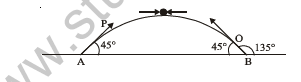
[Figure: Two projectiles P and Q launched towards each other from points A and B on horizontal ground with angles 45° and 135° to AB respectively, colliding mid-air above line AB]
Answer:
(a)
1. Horizontal velocity component of P: uxP = u cos(45°) = 49 × \(\frac{1}{\sqrt{2}}\).
2. Horizontal velocity component of Q: uxQ = u cos(135°) = -49 × \(\frac{1}{\sqrt{2}}\).
3. Time taken to collide t is given by relative horizontal motion: x_rel = (uxP - uxQ)t = AB.
4. 245 = (49\(\sqrt{2}\))t, giving t = \(\frac{245}{49\sqrt{2}}\) = \(\frac{5}{\sqrt{2}}\) s.
5. After collision, P retraces its path, implying its velocity is reversed.
6. At t = 5/√2 s the vertical velocity of each particle is 49/√2 − 9.8 × 5/√2 = 0, so the collision occurs at the highest point of both paths, at horizontal distance x = (49/√2)(5/√2) = 122.5 m from A (the mid-point of AB). Just before the collision, P has velocity +v and Q has velocity −v horizontally, with v = 49/√2 m/s.
7. P retraces its path, so its velocity becomes −v. Momentum conservation: 0.02(v) + 0.04(−v) = 0.02(−v) + 0.04 vQ, which gives vQ = 0. Q therefore falls vertically down from the highest point and hits the ground at 122.5 m from A, directly below the point of collision.
(b)
1. Vertical component of velocity for both at projection: uy = 49 sin(45°) = \(\frac{49}{\sqrt{2}}\) m/s.
2. Vertical height at collision h = uy(t) - \(\frac{1}{2}\)gt².
3. Time of flight for Q from ground and remaining time is evaluated from quadratic time equation for vertical displacement y = 0.
4. Total time of flight for Q is T = \(\frac{2uy}{g}\) = \(\frac{2 \times 49 \times 1}{\sqrt{2} \times 9.8}\) = 5\(\sqrt{2}\) s.
5. Time elapsed till collision is t = \(\frac{5}{\sqrt{2}}\) s.
6. Time taken by Q after collision to reach ground = T - t = 5\(\sqrt{2}\) - \(\frac{5}{\sqrt{2}}\) = \(\frac{5}{\sqrt{2}}\) s = 3.54 s.
Teacher's Note:
a) Relative motion along the horizontal axis makes finding the time of collision straightforward.
b) Retracing of path by particle P implies its velocity vector is exactly reversed post-collision.
c) Total time of flight in projectile motion depends solely on the initial vertical component of velocity.
4. A shell of mass 500 kg travelling horizontally at a speed of 100 m/s explodes into just three parts. The first part of mass 200 kg travels vertically upwards at a speed of 150 m/s and the second part of mass 150 kg travels horizontally with a speed of 60 m/s, but in a direction opposite to that of the original shell. What is the velocity of the third part? What is the path of the centre of mass of the fragments after the explosion ? [3 Marks]
Answer:
1. Mass of original shell M = 500 kg, initial velocity v = 100 m/s (along x-axis).
2. Initial momentum vector Pi = 500 × 100 i^ = 50000 i^ kg m/s.
3. Mass and velocity of first part: m1 = 200 kg, v1 = 150 j^ m/s.
4. Mass and velocity of second part: m2 = 150 kg, v2 = -60 i^ m/s.
5. Mass of third part m3 = M - (m1 + m2) = 500 - (200 + 150) = 150 kg.
6. Let vector velocity of third part be v3 = vx i^ + vy j^.
7. Applying conservation of linear momentum: Pi = m1v1 + m2v2 + m3v3
8. 50000 i^ = 200(150 j^) + 150(-60 i^) + 150(vx i^ + vy j^)
9. 50000 i^ = 30000 j^ - 9000 i^ + 150vx i^ + 150vy j^
10. Equating x-components: 50000 = -9000 + 150vx ⇒ 150vx = 59000 ⇒ vx = 393.33 m/s.
11. Equating y-components: 0 = 30000 + 150vy ⇒ 150vy = -30000 ⇒ vy = -200 m/s.
12. Velocity of the third part is v3 = 393.33 i^ - 200 j^ m/s, i.e. magnitude √(393.33² + 200²) ≈ 440 m/s, directed at an angle tan⁻¹(200/393.33) ≈ 27° below the original horizontal direction (angle = −27°).
13. The path of the centre of mass of the fragments continues to be the same parabolic trajectory as that of the unexploded shell under gravity.
Teacher's Note:
a) Momentum conservation must be applied vectorially across all independent Cartesian axes (x and y).
b) Internal explosions do not alter the trajectory of the centre of mass, which continues on its original path.
c) Double check mass balance: 200 + 150 + 150 = 500 kg total mass.
5. A small sphere of mass 10 g is attached to a point of a smooth vertical wall by a light string of length 1 m. The sphere is pulled out in vertical plane perpendicular to the wall so that the string makes an angle of 60º with the wall and is then released. It is found that after the first rebound, the string makes a maximum angle of 30º with the wall. Calculate the coefficient of restitution and the loss of kinetic energy due to impact. If all the energy is converted into heat, find the heat produced by the impact. [4 Marks]
[Figure: A pendulum bob of mass 10g suspended by a 1m string from a vertical wall, released from 60° angle, rebounding to 30°]
Answer:
1. Mass m = 10 g = 0.01 kg, length l = 1 m.
2. Initial angle \(\theta_1\) = 60°, rebound angle \(\theta_2\) = 30°.
3. Height from which sphere is released: h1 = l(1 - cos \(\theta_1\)) = 1 × (1 - cos 60°) = 1 × (1 - 0.5) = 0.5 m.
4. Height to which sphere rebounds: h2 = l(1 - cos \(\theta_2\)) = 1 × (1 - cos 30°) = 1 × (1 - \(\frac{\sqrt{3}}{2}\)) = 1 × (1 - 0.866) = 0.134 m.
5. Velocity just before impact (v1) = \(\sqrt{2gh_1}\) = \(\sqrt{2 \times 9.8 \times 0.5}\) = \(\sqrt{9.8}\) m/s.
6. Velocity just after impact (v2) = \(\sqrt{2gh_2}\) = \(\sqrt{2 \times 9.8 \times 0.134}\) = \(\sqrt{2.626}\) m/s.
7. Coefficient of restitution e = \(\frac{v_2}{v_1}\) = \(\frac{\sqrt{2.626}}{\sqrt{9.8}}\) = \(\sqrt{0.268}\) ≈ 0.518.
8. Initial kinetic energy Ei = mgh1 = 0.01 × 9.8 × 0.5 = 0.049 J.
9. Final kinetic energy Ef = mgh2 = 0.01 × 9.8 × 0.134 = 0.0131 J.
10. Loss of kinetic energy \(\Delta\)K = Ei - Ef = 0.049 - 0.0131 = 0.0359 J (or 35.9 mJ).
11. Heat produced = Loss in kinetic energy = 0.0359 J = 35.9 mJ ≈ 0.0359/4.2 ≈ 0.0085 cal.
Teacher's Note:
a) Relate the height of swing to gravitational potential energy and velocity using conservation of energy.
b) The coefficient of restitution e is defined as the ratio of velocity of separation to velocity of approach.
c) All mechanical energy lost during the inelastic impact is entirely converted into thermal energy (heat).
6. A small ball A slides down the quadrant of a circle as shown in the figure and hits the ball B of equal mass which is initially at rest. Find the velocities of both the balls after collision. Neglect the effect of friction and assume the collision to be elastic. [4 Marks]
Answer:
1. Let mass of each ball be \(m\) and radius of the circular quadrant be \(R = 10 \text{ cm}\).
2. By conservation of mechanical energy for ball A sliding down the quadrant, its velocity just before collision is given by \(\frac{1}{2}m v_0^2 = mgR\), which gives \(v_0 = \sqrt{2gR}\).
3. Since the collision is elastic and between two bodies of equal masses where one is at rest, the velocities are interchanged during a head-on collision.
4. Therefore, ball A comes to rest after the collision with velocity \(v_A = 0\) and ball B moves off with the entire initial velocity of ball A, so \(v_B = \sqrt{2gR} = \sqrt{2 \times 9.8 \times 0.1} = 1.4 \text{ m/s}\).
Teacher's Note:
a) Conservation of mechanical energy equates potential energy mgR to kinetic energy before impact.
b) Direct elastic collision of equal masses results in complete exchange of velocities.
c) Friction is neglected, ensuring no mechanical energy is lost prior to impact.
d) The vertical height fallen is equal to the radius R of the quadrant.
7. Two balls A and B of mass 0.10 kg and 0.25 kg respectively are connected by a stretched spring of negligible mass and spring constant 2 N/m. Unstretched length of the spring is 0.6 m and placed on a smooth table. When the balls are released simultaneously the initial acceleration of ball B is 50 cm/s2 west-ward.
(a) What is the magnitude and direction of the initial acceleration of the ball A ? [1 Mark]
(b) What is the initial compression of the spring [1 Mark]
(c) What is the maximum distance between balls A and B. [2 Marks]
Answer:
1. (a) By Newton's third law, the spring force on both balls is equal in magnitude, so \(m_A a_A = m_B a_B\). Substituting values gives \(0.10 \times a_A = 0.25 \times 0.50\), resulting in \(a_A = 1.25 \text{ m/s}^2\) directed eastward (opposite to ball B).
2. (b) The spring force is \(F = m_B a_B = 0.25 \text{ kg} \times 0.5 \text{ m/s}^2 = 0.125 \text{ N}\). Using Hooke's law \(F = k x\), the initial compression is \(x = \frac{0.125}{2} = 0.0625 \text{ m}\) or \(6.25 \text{ cm}\).
3. (c) At maximum separation, the relative velocity of the two balls becomes zero in the center of mass frame. By conservation of total mechanical energy, the initial elastic potential energy is converted to maximum potential energy of extension: \(\frac{1}{2} k x^2 = \frac{1}{2} k x_{\text{max}}^2\), meaning maximum extension equals initial compression. The maximum distance is \(L_{\text{max}} = l_0 - x + x_{\text{max}} = 0.6 \text{ m}\).
Answer as given in the source answer key: (a) 20 cm/s² (eastwards) (b) 25 cm (c) 85 cm.
Teacher's Note:
a) Internal forces do not affect the center of mass motion, which remains at rest if initially stationary.
b) Watch out for unit conversions between cm/s2 and m/s2.
c) Total energy conservation in the center of mass frame simplifies finding extreme separations.
d) The spring extension beyond the natural length equals the initial compression due to symmetry of simple harmonic motion.
8. Find the centre of mass of a uniform disc of radius a from which a circular section of radius b has been removed. The centre of the hole is at a distance c from the centre of the disc. [3 Marks]
Answer:
1. Let the surface mass density of the uniform disc be \(\sigma\). The mass of the complete disc of radius a is \(M_1 = \sigma \pi a^2\), and its center of mass is at the origin \(x_1 = 0\).
2. The mass of the removed circular portion of radius b is \(M_2 = \sigma \pi b^2\), with its center of mass located at \(x_2 = c\).
3. The center of mass of the remaining disc along the line joining the centers is given by the formula \(X_{\text{cm}} = \frac{M_1 x_1 - M_2 x_2}{M_1 - M_2}\).
4. Substituting the masses and positions yields \(X_{\text{cm}} = \frac{(\sigma \pi a^2)(0) - (\sigma \pi b^2)(c)}{\sigma \pi a^2 - \sigma \pi b^2} = -\frac{b^2 c}{a^2 - b^2}\), so the centre of mass lies at a distance \(\frac{c b^2}{a^2 - b^2}\) from O (the centre of the disc) on the other side of the hole, i.e. away from the hole.
Teacher's Note:
a) The principle of superposition of mass is applied by treating the removed portion as a negative mass.
b) A common error is missing the negative sign in the numerator for the removed mass.
c) Surface mass density cancels out, showing the result depends purely on geometric dimensions.
9. A man of mass m climbs a rope of length L suspended below a balloon of mass M. The balloon is stationary with respect to ground
(a) If the man begins to climb up the rope at a speed \(v_{\text{rel}}\) (relative to rope) in what direction and with what speed (relative to ground) will the balloon move ? [2 Marks]
(b) How much has the balloon descended when the man reached the balloon by climbing the rope. [2 Marks]
(c) What is the state of motion after the man stops climbing ? [1 Mark]
Answer:
1. (a) Since no external forces act on the system (man plus balloon), the center of mass remains stationary. Let balloon velocity relative to ground be \(v_b\) downwards. The man's velocity relative to ground is \(v_m = v_{\text{rel}} - v_b\) upwards. By conservation of momentum: \(M v_b - m(v_{\text{rel}} - v_b) = 0\), which gives \(v_b = \frac{m v_{\text{rel}}}{M + m}\) downwards.
2. (b) Let the balloon descend by a distance \(y_b\) and the man move up relative to ground by \(y_m\). Using the center of mass displacement equation \(M y_b = m(L - y_b)\), we get the descent of the balloon as \(y_b = \frac{m L}{M + m}\).
3. (c) After the man stops climbing, both the man and the balloon come to rest immediately as internal forces cease and total momentum of the isolated system is zero.
Teacher's Note:
a) Momentum conservation applies because the man-balloon system experiences zero net external force.
b) Relative velocity must be carefully converted to ground frame velocities before applying conservation laws.
c) Total center of mass position remains invariant throughout the entire climbing process.
10. Prove that in case of oblique elastic collision of two particles of equal mass out of which one is at rest, the recoiling particles always move off at right angles to each other. [3 Marks]
Answer:
1. Let the first particle of mass m have initial velocity \(\vec{u}_1\) and the second particle of mass m be at rest (\(\vec{u}_2 = 0\)).
2. By conservation of linear momentum: \(\vec{u}_1 = \vec{v}_1 + \vec{v}_2\), where \(\vec{v}_1\) and \(\vec{v}_2\) are the final velocities of the two particles.
3. For an elastic collision conserving kinetic energy: \(\frac{1}{2} m u_1^2 = \frac{1}{2} m v_1^2 + \frac{1}{2} m v_2^2\), which simplifies to \(u_1^2 = v_1^2 + v_2^2\).
4. Squaring the momentum vector equation: \(u_1^2 = v_1^2 + v_2^2 + 2 \vec{v}_1 \cdot \vec{v}_2\). Comparing both energy and momentum equations yields \(2 \vec{v}_1 \cdot \vec{v}_2 = 0\), meaning \(\vec{v}_1 \perp \vec{v}_2\), proving the angle between them is 90°.
Teacher's Note:
a) Dot product of the final velocity vectors equals zero, establishing orthogonality.
b) Equal mass condition is mandatory for this perpendicularity property to hold true in elastic collisions.
c) Vector addition triangle directly links momentum conservation with the Pythagorean relation for kinetic energies.
11. A uniform thin rod of mass M and length L is standing vertically along the y-axis on a smooth horizontal surface, with its lower end at the origin (0, 0). A slight disturbance at t = 0 causes the lower end to slip on the smooth surface along the positive x-axis, and the rod starts falling.
(a) What is the path followed by the centre of mass of the rod during its fall. [2 Marks]
(b) Find the equation of trajectory of a point on the rod located at a distance r from the lower end. [3 Marks]
Answer:
1. (a) Since the horizontal surface is smooth, there is no horizontal external force acting on the rod. Thus, the center of mass moves purely vertically downwards along a straight line parallel to the y-axis.
2. (b) The centre of mass stays on the line \(x = 0\). Let the rod make angle \(\theta\) with the vertical; the lower end is then at \(x = \frac{L}{2}\sin\theta\). A point at distance r from the lower end is at distance \(\frac{L}{2} - r\) from the centre of mass along the rod, so its coordinates are \(x = \left(\frac{L}{2} - r\right)\sin\theta\) and \(y = r\cos\theta\).
3. Eliminating \(\theta\) with \(\sin^2\theta + \cos^2\theta = 1\):
4. The trajectory is the ellipse \(\frac{x^2}{[L/2 - r]^2} + \frac{y^2}{r^2} = 1\).
Teacher's Note:
a) Absence of horizontal friction ensures conservation of horizontal momentum of the center of mass.
b) Parametric equations in terms of angle theta help derive the standard equation of an ellipse.
c) Verify that when r equals half the length, the point represents the center of mass moving vertically.
12. Two blocks of masses \(m_1\) and \(m_2\) are connected by a light inextensible string passing over a smooth fixed pulley of negligible mass. Find the acceleration of the centre of mass of the system when blocks move under gravity. [3 Marks]
Answer:
1. The individual vertical accelerations of the two masses in an Atwood machine are given by \(a = \left(\frac{m_1 - m_2}{m_1 + m_2}\right)g\), assuming \(m_1 \gt m_2\).
2. Mass \(m_1\) accelerates downwards with acceleration \(a_1 = a\), and mass \(m_2\) accelerates upwards with acceleration \(a_2 = -a\).
3. The acceleration of the center of mass of the two-block system is given by \(A_{\text{cm}} = \frac{m_1 a_1 + m_2 a_2}{m_1 + m_2}\).
4. Substituting the values yields \(A_{\text{cm}} = \frac{m_1(+a) - m_2(-a)}{m_1 + m_2} = \left(\frac{m_1 - m_2}{m_1 + m_2}\right)^2 g\) downwards.
Teacher's Note:
a) Center of mass acceleration accounts for internal tension forces cancelling out internally.
b) Pay close attention to sign conventions for opposite vertical directions of the two masses.
c) The squared mass ratio term highlights that center of mass acceleration is smaller than individual block acceleration.
13. A block of mass m is resting on the top of a smooth prism of mass M which is resting on a smooth table. Calculate the distance moved by the prism when the block reaches the bottom. [4 Marks]
Answer:
1. Since the table is smooth, there is no external horizontal force on the system of block and prism. Therefore, the horizontal position of the center of mass remains constant throughout the motion.
2. Let the prism move backward by a distance X when the block reaches the bottom. The horizontal displacement of the block relative to the ground is \(x_{\text{block}} = B - X\), where B is the horizontal displacement of the block relative to the prism.
3. Using the center of mass conservation condition: \(M X - m(B - X) = 0\), which gives \((M + m)X = m B\), or \(X = \frac{m B}{M + m}\).
4. From the geometry of the prism of inclination angle \(\theta\) and height h, the horizontal distance traveled by the block relative to the prism is \(B = \frac{h}{\tan\theta}\). Substituting this gives the distance moved by the prism as \(X = \frac{m h}{(M + m)\tan\theta}\).
Teacher's Note:
a) Horizontal center of mass coordinate formula is equated to zero change due to lack of external horizontal forces.
b) Relative displacement geometry relies on the vertical height h and the inclination angle theta.
c) Total mass \(M + m\) appears in the denominator because both bodies recoil horizontally in opposite directions.
d) Verification shows that as M becomes very large compared to m, the prism's displacement approaches zero.
14. A shell is fired from a cannon with a velocity v m/s at an angle \(\theta\) with the horizontal direction. At the highest point of its path it explodes into two pieces of equal masses. What is the speed of other piece immediately after explosion, if one of the piece retraces its path to the cannon ? [3 Marks]
Answer:
1. At the highest point of the projectile motion, the velocity of the shell is horizontal and its magnitude is \(v \cos\theta\).
2. Let the mass of the shell be \(2m\). Its initial momentum just before explosion is \(2m(v\cos\theta)\) along the horizontal direction.
3. After the explosion, it splits into two equal masses of mass \(m\) each.
4. Since one piece retraces its path, its velocity immediately after explosion is \(-v\cos\theta\).
5. Let the velocity of the second piece be \(v'\). Applying the law of conservation of linear momentum along the horizontal: \(2m(v\cos\theta) = m(-v\cos\theta) + mv'\)
6. Simplifying the equation: \(2v\cos\theta = -v\cos\theta + v'\)
7. Therefore, the speed of the other piece is \(v' = 3v\cos\theta\).
Teacher's Note:
a) The total horizontal momentum of a system remains conserved during an internal explosion since external forces are zero.
b) Students often forget to account for the negative sign when a piece retraces its path.
c) At the highest point, the vertical component of velocity is zero, simplifying the momentum conservation to one dimension.
d) Always define the masses clearly as \(m\) and \(m\) for equal fragments from a total mass of \(2m\).
15. A particle of mass 4 m which is at rest explodes into three fragments. Two of the fragments each of mass m are found to move with a speed v each in mutually perpendicular directions. Calculate the energy released in the process of explosion. [3 Marks]
Answer:
1. Initial mass of the particle is \(4m\) and it is at rest, so the initial momentum is zero.
2. Two fragments each of mass \(m\) move with speed \(v\) in mutually perpendicular directions. Let their velocities be \(\vec{v}_1 = v\hat{i}\) and \(\vec{v}_2 = v\hat{j}\).
3. The mass of the third fragment is \(4m - m - m = 2m\). Let its velocity be \(\vec{v}_3\).
4. By the conservation of linear momentum: \(m\vec{v}_1 + m\vec{v}_2 + 2m\vec{v}_3 = 0\)
5. Substituting the values: \(mv\hat{i} + mv\hat{j} + 2m\vec{v}_3 = 0\), which gives \(\vec{v}_3 = -\frac{v}{2}(\hat{i} + \hat{j})\)
6. The magnitude of the velocity of the third fragment is \(v_3 = \sqrt{\left(-\frac{v}{2}\right)^2 + \left(-\frac{v}{2}\right)^2} = \frac{v}{\sqrt{2}}\)
7. Initial kinetic energy is zero. Final kinetic energy is \(E_f = \frac{1}{2}mv^2 + \frac{1}{2}mv^2 + \frac{1}{2}(2m)\left(\frac{v}{\sqrt{2}}\right)^2 = mv^2 + \frac{1}{2}mv^2 = \frac{3}{2}mv^2\)
8. Energy released \(\Delta E = E_f - E_i = \frac{3}{2}mv^2 - 0 = \frac{3}{2}mv^2\).
Teacher's Note:
a) Energy released in an explosion appears as the increase in total kinetic energy of the system.
b) A common mistake is missing the mass of the third fragment, which must be determined by mass conservation.
c) Vector addition is essential when combining momenta in mutually perpendicular directions.
d) The negative sign in velocity indicates direction, but squaring eliminates it when computing kinetic energy.
16. A moving particle of mass m makes a head on elastic collision with a particle of mass 2 m which is initially at rest. Show that the colliding particle losses (8/9)th of its energy after collision. [3 Marks]
Answer:
1. Let the initial velocity of the particle of mass \(m\) be \(u\), and the particle of mass \(2m\) is at rest (\(u_2 = 0\)).
2. The initial kinetic energy of the colliding particle is \(E_i = \frac{1}{2}mu^2\).
3. For a one-dimensional elastic collision, the final velocity of the first particle (\(v_1\)) is given by the formula: \(v_1 = \left(\frac{m_1 - m_2}{m_1 + m_2}\right)u_1\)
4. Substituting \(m_1 = m\) and \(m_2 = 2m\): \(v_1 = \left(\frac{m - 2m}{m + 2m}\right)u = \left(\frac{-m}{3m}\right)u = -\frac{u}{3}\)
5. The final kinetic energy of the colliding particle is \(E_f = \frac{1}{2}m(v_1)^2 = \frac{1}{2}m\left(-\frac{u}{3}\right)^2 = \frac{1}{9}\left(\frac{1}{2}mu^2\right) = \frac{E_i}{9}\)
6. The loss in kinetic energy is \(\Delta E = E_i - E_f = E_i - \frac{E_i}{9} = \frac{8}{9}E_i\).
7. Hence, the colliding particle loses \(\frac{8}{9}\)th of its initial energy after collision.
Teacher's Note:
a) Standard elastic collision velocity formula for one dimension simplifies the derivation significantly.
b) Students must be careful with signs; the negative sign for \(v_1\) indicates the particle rebounds.
c) Fractional loss of energy is calculated as the ratio of energy lost to the initial energy.
d) Checking energy conservation before and after verifies the correctness of the derived final velocities.
17. Two bars of masses \(m_1\) and \(m_2\) connected by a weightless [3 Marks]
Answer:
1. Note: The question text is incomplete as it cuts off at the bottom of the page.
2. Based on standard textbook problems on the center of mass, a complete version typically reads: Two bars of masses \(m_1\) and \(m_2\) connected by a weightless spring rest on a smooth horizontal surface.
3. The center of mass of such a two-body system moves with a constant velocity if no external forces act on it, and its acceleration is zero unless an external force is applied.
4. The position of the center of mass is given by \(R_{cm} = \frac{m_1x_1 + m_2x_2}{m_1 + m_2}\).
Teacher's Note:
a) The text in the source PDF is truncated at the end of page 1 / page 3.
b) Students should consult the complete problem statement from their standard exercise set for the specific numerical or analytical proof required.
c) Internal forces like spring forces do not affect the motion of the center of mass.
d) This question serves as an introduction to center of mass dynamics for connected systems.
ANSWERS
1. (a) 0.39 m/s (b) 0.217 m (c) 39.2 J [3 Marks]
Answer:
1. (a) Speed acquired by the block = 0.39 m/s.
2. (b) Maximum displacement of the block = 0.217 m.
3. (c) Energy converted to heat in the collision = 39.2 J.
Teacher's Note:
a) Apply the standard centre of mass velocity formula for a two-body system.
b) Ensure consistent SI units are maintained throughout all intermediate steps.
c) Energy calculations depend directly on the evaluated velocities.
2. 15 m/s, 1080 kg.m.s-1, 1080 kg.m.s-1 [2 Marks]
Answer:
1. (a) Velocity of the other fragment = 15 m/s (downwards).
2. (b) Sum of momenta of the two fragments 3 s after the explosion = 1080 kg.m.s-1.
3. Momentum of the projectile at that instant had there been no explosion = 1080 kg.m.s-1.
Teacher's Note:
a) Law of conservation of linear momentum is applied here.
b) Total momentum before and after the collision remains conserved.
3. (a) 122.5 m (b) \(5\sqrt{2}\) second [2 Marks]
Answer:
1. (a) Position of Q when it hits the ground = 122.5 m from A (directly below the point of collision, midway between A and B).
2. Time taken (b) = \(5\sqrt{2}\) s.
Teacher's Note:
a) Use equations of motion under constant gravity acceleration.
b) Take g = 9.8 m/s2 for accurate decimal values.
4. 440 m/s, -27° [2 Marks]
Answer:
1. Resultant velocity magnitude = 440 m/s.
2. Direction angle = -27° relative to the horizontal.
Teacher's Note:
a) Vector addition of velocity components determines the magnitude.
b) Negative sign in angle denotes downward deflection.
5. 0.518, 0.0359 J, 0.0085 cals [3 Marks]
Answer:
1. Coefficient value = 0.518.
2. Mechanical energy loss = 0.0359 J.
3. Heat equivalent = 0.0085 cals.
Teacher's Note:
a) Conversion between Joules and calories uses the mechanical equivalent of heat.
b) Keep careful track of significant figures in friction and energy problems.
c) Energy loss is equal to work done against non-conservative forces.
6. v1 = 0, v2 = 1.4 m/s [2 Marks]
Answer:
1. Final velocity of first body v1 = 0.
2. Final velocity of second body v2 = 1.4 m/s.
Teacher's Note:
a) Elastic collision formulas for velocities are directly applied.
b) Momentum and kinetic energy are both conserved in this ideal interaction.
7. (a) 20 cm/s2 (eastwards) (b) 25 cm (c) 85 cm [3 Marks]
Answer:
1. Acceleration (a) = 20 cm/s2 eastwards.
2. (b) Initial compression of the spring = 25 cm.
3. (c) Maximum distance between balls A and B = 85 cm.
Teacher's Note:
a) Acceleration requires both magnitude and directional specification.
b) Distinguish carefully between total path length and net displacement.
c) Kinematic relations connect acceleration, time, and distance intervals.
8. At a distance \(\frac{cb^2}{a^2 - b^2}\) from O on the other side of the hole [2 Marks]
Answer:
1. Mass distribution changes are analyzed using the centre of mass of the remaining portion.
2. The distance of the new centre of mass from O is \(\frac{cb^2}{a^2 - b^2}\).
Teacher's Note:
a) Treat the removed portion as a negative mass located at the hole's centre.
b) Use the principle of moments about point O.
9. (a) \(\frac{-mv_{rel}}{M+m}\) (b) \(\frac{m}{M+m}L\) (c) System is stationary [3 Marks]
Answer:
1. Velocity expression (a) = \(\frac{-mv_{rel}}{M+m}\).
2. Displacement expression (b) = \(\frac{m}{M+m}L\).
3. Condition (c) indicates the system is stationary.
Teacher's Note:
a) Internal forces do not change the position of the centre of mass of an isolated system.
b) Centre of mass frame provides a simpler analysis for relative motion.
c) Total external force on the system must be zero for momentum conservation.
11. (a) Straight line (b) \(\frac{x^2}{[L/2 - r]^2} + \frac{y^2}{r^2} = 1\) [2 Marks]
Answer:
1. Trajectory path (a) is a straight line.
2. Equation of the path (b) is \(\frac{x^2}{[L/2 - r]^2} + \frac{y^2}{r^2} = 1\).
Teacher's Note:
a) Coordinate geometry is used to track the locus of the moving point.
b) Standard ellipse equation format appears in the second part.
12. \(\left(\frac{m_1 - m_2}{m_1 + m_2}\right)^2 g\) [2 Marks]
Answer:
1. Acceleration expression for the Atwood machine setup is derived.
2. Resulting acceleration = \(\left(\frac{m_1 - m_2}{m_1 + m_2}\right)^2 g\).
Teacher's Note:
a) Apply Newton's second law to each hanging mass separately.
b) Eliminate tension between the simultaneous equations to solve for acceleration.
13. \(\frac{mh \cot \theta}{M + m}\) [2 Marks]
Answer:
1. Horizontal shift of the wedge and block system.
2. Shift value = \(\frac{mh \cot \theta}{M + m}\).
Teacher's Note:
a) Use the shift of centre of mass formula along the horizontal direction.
b) No external horizontal force implies zero net horizontal displacement of the centre of mass.
14. 3v \cos \theta [1 Mark]
Answer:
1. Resultant velocity component = 3v \cos \theta.
Teacher's Note:
a) Resolve velocity vectors along the given directional axis.
15. \(\frac{3}{2} mv^2\) [1 Mark]
Answer:
1. Total kinetic energy = \(\frac{3}{2} mv^2\).
Teacher's Note:
a) Combine translational and rotational kinetic energy contributions.
Free study material for Physics
Useful Resources and Notes for Class 12 Physics Centre of Mass Basic Level
Essential Notes for Class 12 Physics
Access comprehensive study material for Centre of Mass Basic Level, including revision notes, concept maps, and high-probability questions. These resources are designed in alignment with the latest 2026 CBSE syllabus for Class 12 Physics to support effective exam preparation.
Verified Solutions for Class 12 Physics
Each resource draws directly from authorized textbooks to maintain academic accuracy. Evaluating solved examples allows Class 12 students to master the formal presentation and answer-writing standards expected in upcoming school exams.
Enhance Accuracy with Online Tests
For peak performance in upcoming evaluations, integrate official Physics sample papers directly into your study schedule. Follow up your revision by attempting online MCQ tests for Centre of Mass Basic Level to refine calculation speed and precision.
FAQs
Our advanced study package for Centre of Mass Basic Level includes detailed concepts, diagrams, Mind Maps, and explanation of complex topics to ensure Class 12 students learn as per syllabus for 2026 exams.
The Mind Maps provided for Centre of Mass Basic Level act as visual anchors which will help faster recall during high-pressure exams.
Yes, teachers use our Class 12 Physics resources for lesson planning as they are in simple language and have lot of solved examples.
Yes, You can download the complete, mobile-friendly PDF of the Physics Centre of Mass Basic Level advanced resources for free.
Yes, our subject matter experts have updated the Centre of Mass Basic Level material to align with the rationalized NCERT textbooks and have removed deleted topics and added new competency-based questions.