

Class 12 Physics Study Guide: CBSE Class 12 Physics Doppler Effect Theory and Examples
Explore structured advanced study materials through the CBSE Class 12 Physics Doppler Effect Theory and Examples. Tailored for Class 12 learners, utilizing these Physics resources ensures thorough preparation and strengthens foundational knowledge before final CBSE evaluations.
Download Doppler Effect Study Material PDF
Access the complete useful resource PDF for Class 12 Physics below. Regular practice with these targeted academic notes builds familiarity with complex topics and helps secure higher marks in final school evaluations.
CBSE Class 12 Physics Doppler Effect Theory and Examples. Please refer to the examination notes which you can use for preparing and revising for exams. These notes will help you to revise the concepts quickly and get good marks.
Class 12 Physics: Doppler Effect (Theory and Examples)
1. Introduction
The apparent change in frequency or wavelength observed by the observer when there is a relative motion between the source and the observer is known as the Doppler effect.
The Doppler effect takes place both in sound and light. In sound it depends on whether the source or the observer or both are in motion, while in light it depends only on whether the distance between the source and the observer is decreasing or increasing.
2. Conditions when the Doppler effect is observed for sound waves
- When the source of sound is in motion and the observer is at rest.
- When the observer is in motion and the source is at rest.
- When the source and the observer are moving with unequal velocities.
- When the source, the observer and the intervening medium are in motion.
3. Limitations of the Doppler effect in sound
- The velocity of the source of sound must be less than that of sound, i.e. \(v_s<v\).
- The velocity of the observer must be less than the velocity of sound, i.e. \(v_0<v\).
- If the velocity of the sound source is greater than that of sound, then due to shock waves the wavefront gets distorted; consequently the change in frequency will not be observed by the observer.
4. Conditions when the Doppler effect is not observed for sound waves
- When the source of sound and the observer both are at rest, the Doppler effect in sound is not observed.
- When the source and the observer both are moving with the same velocity in the same direction.
- When the source and the observer are moving mutually in perpendicular directions.
- When the medium only is moving.
- When the distance between the source and the observer is constant.
5. Apparent frequency of sound heard by the observer when the source is in motion and the observer is at rest
When the source is in motion and the observer is at rest, the cause of the apparent change in frequency is that the waves either contract or expand. (The apparent wavelength below is taken as \( \lambda'=v/n' \), as in the source.)
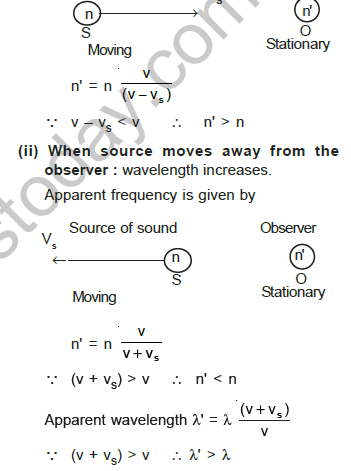
\[ n'=n\,\frac{v}{v-v_s} \]
Since \( v-v_s<v \), \( n'>n \). The apparent wavelength is \( \lambda'=\lambda\,\dfrac{v-v_s}{v}<\lambda \).
(ii) When the source moves away from the observer: the wavelength increases. The apparent frequency is given by\[ n'=n\,\frac{v}{v+v_s} \]
Since \( v+v_s>v \), \( n'<n \). The apparent wavelength is
\[ \lambda'=\lambda\,\frac{v+v_s}{v}>\lambda \]
Examples
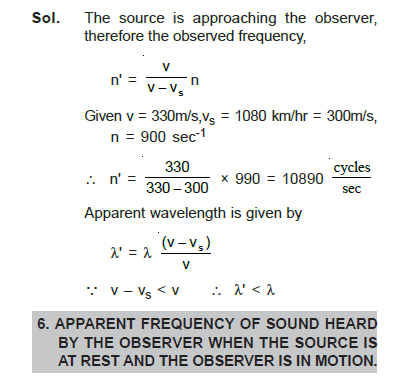
A jet plane emits sound with a frequency of 990 cycles/s and carries on board a source of light emitting radiation of wavelength 4500 Å. If the jet plane approaches the airport with a velocity of 1080 km/hr, find (i) the frequency of sound heard by the observer at the airport. (Velocity of sound \(v=330\) m/s, velocity of light \(c=3\times10^8\) m/s)

- 10890 cycles/s
- 18090 cycles/s
- 10980 cycles/s
- 10089 cycles/s
Solution: The source is approaching the observer, therefore the observed frequency is
\[ n'=\frac{v}{v-v_s}\,n \]
Given \( v=330 \) m/s, \( v_s=1080\ \text{km/hr}=300 \) m/s and \( n=990\ \text{s}^{-1} \):
\[ n'=\frac{330}{330-300}\times990=10890\ \text{cycles/s} \]
Answer: (A) 10890 cycles/s. (The source's solution writes \(n=900\ \text{s}^{-1}\) in the data line; the question and the calculation use 990.)
6. Apparent frequency of sound heard by the observer when the source is at rest and the observer is in motion
(i) When the observer approaches the source: the frequency increases.\[ n'=n\left[\frac{v+v_0}{v}\right],\qquad \lambda'=\lambda\left[\frac{v}{v+v_0}\right] \]
Since \( v+v_0>v \), \( n'>n \) and \( \lambda'<\lambda \).
(ii) When the observer moves away from the source: the frequency decreases.\[ n'=n\left[\frac{v-v_0}{v}\right],\qquad \lambda'=\lambda\left[\frac{v}{v-v_0}\right] \]
Since \( v-v_0<v \), \( n'<n \) and \( \lambda'>\lambda \).
With what velocity should an observer approach a stationary sound source so that the apparent frequency of sound should appear double the initial frequency?
- \(v_0=\dfrac v2\)
- \(v_0=3v\)
- \(v_0=2v\)
- \(v_0=v\)
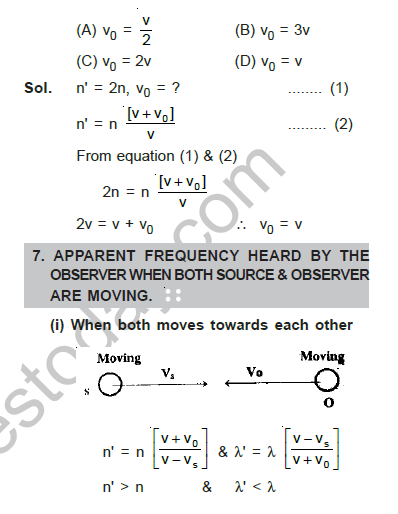
Solution: \( n'=2n \) and \( n'=n\left[\dfrac{v+v_0}{v}\right] \). Therefore \( 2n=n\,\dfrac{v+v_0}{v} \), \( 2v=v+v_0 \), so \( v_0=v \).
Answer: (D) \(v_0=v\)
7. Apparent frequency heard by the observer when both source and observer are moving
(i) When both move towards each other:\[ n'=n\left[\frac{v+v_0}{v-v_s}\right]\quad\&\quad \lambda'=\lambda\left[\frac{v-v_s}{v+v_0}\right];\qquad n'>n,\ \lambda'<\lambda \]
(ii) When both move away from each other:\[ n'=n\left[\frac{v-v_0}{v+v_s}\right]\quad\&\quad \lambda'=\lambda\left[\frac{v+v_s}{v-v_0}\right];\qquad n'<n,\ \lambda'>\lambda \]
(iii) When the source is approaching the receding observer:\[ n'=n\left[\frac{v-v_0}{v-v_s}\right]\quad\&\quad \lambda'=\lambda\left[\frac{v-v_s}{v-v_0}\right] \]
(iv) When the observer is approaching the receding source:\[ n'=n\left[\frac{v+v_0}{v+v_s}\right]\quad\&\quad \lambda'=\lambda\left[\frac{v+v_s}{v+v_0}\right] \]
Note:- If the medium is moving with velocity \(v_m\) in the direction of sound, then the velocity of sound becomes \( v+v_m \).
- If the medium is moving with velocity \(v_m\) in the direction opposite to that of sound, then the velocity of sound becomes \( v-v_m \).
- In all the above formulae \(v\) will have to be replaced by \( (v\pm v_m) \) according to the situation given.
If a sound source of frequency \(n\) approaches an observer with velocity \(v/4\) and the observer approaches the source with velocity \(v/5\), then the apparent frequency heard will be
- \(\dfrac58 n\)
- \(\dfrac85 n\)
- \(\dfrac75 n\)
- \(\dfrac57 n\)
Solution: \( v_s=\dfrac v4,\ v_0=\dfrac v5 \) (source and observer approaching each other).
\[ n'=n\,\frac{v+v_0}{v-v_s}=n\,\frac{v+\frac v5}{v-\frac v4}=n\left(\frac65\times\frac43\right)=\frac85\,n \]
Answer: (B) \( \dfrac85 n \)
A source and a detector move away from each other, each with a speed of 10 m/s with respect to the ground with no wind. If the detector detects a frequency of 1950 Hz of the sound coming from the source, what is the original frequency of the source? Speed of sound in air = 340 m/s.
- 2700 Hz
- 2007 Hz
- 2070 Hz
- 2170 Hz
Solution: If the original frequency of the source is \(\nu\), the apparent frequency heard by the observer is
\[ \nu'=\frac{v-v_0}{v+v_s}\,\nu\ \Rightarrow\ 1950=\frac{340-10}{340+10}\,\nu=\frac{33}{35}\,\nu \]
\[ \nu=\frac{35}{33}\times1950\approx2070\ \text{Hz} \]
Answer: (C) 2070 Hz. (The source's solution prints '350 − 10' in the numerator; it should be 340 − 10 = 330.)
8. Apparent change in frequency heard by the observer
(i) When the observer crosses a stationary source:\[ n'=n\left[\frac{v+v_0}{v}\right],\quad n''=n\left[\frac{v-v_0}{v}\right],\quad \Delta n=n'-n''=\frac{2nv_0}{v} \]
(ii) When a moving source crosses a stationary observer:\[ n'=\frac{nv}{v-v_s},\quad n''=\frac{nv}{v+v_s},\quad \Delta n=n'-n''=\frac{2nv_s/v}{1-\dfrac{v_s^2}{v^2}}\approx\frac{2nv_s}{v}\quad\left[\because \frac{v_s}{v}\ll1\right] \]
(The source prints \(v_0\) in place of \(v_s\) in this part and \(+\) in place of \(-\) in \(n''\) of part (i); these are corrected here.)
9. Doppler's effect in light
The velocity of light in free space is independent of the motion of the source or the observer and it is a universal constant, \( c=3\times10^8 \) m/s. Thus the Doppler effect in light depends only upon the relative motion of the light source and the observer, and it does not matter which one is moving.
(i) When a light source and an observer are approaching each other with a relative velocity \(v\), the apparent frequency of light is\[ \nu'=\nu\sqrt{\frac{c+v}{c-v}}\approx\nu\left(1+\frac vc\right)\ \ (v\ll c),\qquad \Delta\nu=+\nu\,\frac vc \]
(ii) When they are receding from each other:\[ \nu'=\nu\sqrt{\frac{c-v}{c+v}}\approx\nu\left(1-\frac vc\right),\qquad \Delta\nu=-\nu\,\frac vc \]
(In the source PDF the expression for the approaching case is missing, and the formulas \(\nu(1-v/c)\) and \(\Delta\nu=-\nu v/c\) are printed under the approaching case; they belong to the receding case, and are placed there.)
Case (a): when the light source is going away from the Earth: \( \nu'<\nu \), \( \Delta\nu=-\nu\dfrac vc \), and \( \Delta\lambda=+\lambda\dfrac vc \), i.e. \( \lambda'>\lambda \): the wavelength is increased and the spectral line shifts towards the red end of the spectrum. This is known as red shift.Case (b): when the light source is coming nearer to the Earth: \( \Delta\nu=+\nu\dfrac vc \), \( \nu'>\nu \), and \( \Delta\lambda=-\lambda\dfrac vc \), \( \lambda'<\lambda \). The wavelength appears to be decreasing, i.e. the spectral line in the electromagnetic spectrum gets displaced towards the violet end, hence it is known as violet shift.10. Difference between the Doppler effect in sound and light
| S.No. | Doppler effect in sound | Doppler effect in light |
|---|---|---|
| 1 | This effect depends upon whether the source is in motion or the observer is in motion. | This effect depends upon the relative motion between the source and the observer and not on whether the observer or the source is moving. |
| 2 | The velocity of the medium affects the apparent frequency. | The velocity of the medium does not contribute to this effect. |
| 3 | The ordinary law of addition of velocities is applicable. | The law of addition of velocities of relativistic mechanics is applicable. |
| 4 | The transverse Doppler effect is not applicable. | The transverse Doppler effect is applicable. |
11. Applications of the Doppler effect
- To determine the width of spectral lines (\(\Delta W\)).
- To determine the velocity of stars and galaxies.
- To determine the frequency of a tuning fork.
- To determine the speed of rotation of the Sun.
- In the discovery of Saturn's rings.
- In the discovery of twin (binary) stars.
- In E.C.G.
- In very high frequency unidirectional radio ranging (V.O.R.).
- In tracking of artificial satellites.
- In RADAR.
- In SONAR.
12. Points to remember
- The Doppler effect is valid for all types of waves because it is a universal property of waves.
- The Doppler effect in light is explained on the basis of Einstein's theory of relativity.
- Transverse Doppler effect. When the source is moving at right angles to the observer or the observer is moving at right angles to the source, the apparent change in the frequency of the light source is known as the transverse Doppler effect.
- The wavelength observed in front of a source is less and that observed behind the source is more.
- Pitch is that feeling which produces a sensation of sound being sharp or thick (shrill or flat).
- The Doppler effect of sound depends not only on the relative motion between the sound source and the observer, but also upon whether the source is moving or the observer is moving.
- The direction of sound is always taken from the source towards the observer.
- The Doppler effect in sound is used in estimating the velocity of an aeroplane in air.
- The Doppler effect in light can be used to estimate the speed of stars and galaxies.
- The velocity of a submarine moving under water can also be detected by observing the changes in frequency of the sound waves sent to the submarine and reflected by it.
- If the velocity of the source of sound is greater than that of sound (\(v_s>v\)), then the source will overtake the sound waves and under this condition the Doppler effect will not be observed.
- If the velocity of the observer is greater than the velocity of sound (\(v_0>v\)) and the observer is receding from the source, the wave will never reach the observer and consequently the Doppler effect will not be observed.
- The width of a spectral line can also be explained from the Doppler effect. This width is given by \( 2\Delta\lambda=2\,\dfrac vc\,\lambda \).
- When the source (S) and the observer (O) are approaching each other, then \( n'>n \) and \( \lambda'<\lambda \).
- When S and O are receding away from each other, then \( n'<n \) and \( \lambda'>\lambda \).
- When S and O are moving in the same direction with the same speed, then \( n'=n \) and \( \lambda'=\lambda \).
- \(\Delta\lambda\) depends upon: (a) the velocity of the source, (b) the velocity of the observer, (c) the frequency, (d) the wavelength.

Free study material for Physics
Physics Class 12 Exam Resources: Doppler Effect
Core Study Kit: Class 12 Physics Doppler Effect
Review targeted study resources for Doppler Effect tailored for Class 12 learners. Utilizing these structured notes and quick-revision tools ensures complete alignment with current CBSE evaluation standards.
NCERT-Aligned Solutions for Doppler Effect
Built using official NCERT guidelines for Class 12 Physics, these materials provide reliable academic support. Integrating past examination questions and step-by-step solutions helps students understand official CBSE grading criteria.
Next Steps in Your Exam Preparation
Maximize your grade potential by utilizing Class 12 Physics practice papers in tandem with these structured notes. All printable assignments and interactive mock tests on our platform are updated for the 2026 session and available free of charge.
FAQs
Our advanced study package for Doppler Effect includes detailed concepts, diagrams, Mind Maps, and explanation of complex topics to ensure Class 12 students learn as per syllabus for 2026 exams.
The Mind Maps provided for Doppler Effect act as visual anchors which will help faster recall during high-pressure exams.
Yes, teachers use our Class 12 Physics resources for lesson planning as they are in simple language and have lot of solved examples.
Yes, You can download the complete, mobile-friendly PDF of the Physics Doppler Effect advanced resources for free.
Yes, our subject matter experts have updated the Doppler Effect material to align with the rationalized NCERT textbooks and have removed deleted topics and added new competency-based questions.