

Official CBSE Study Materials for Class 12 Physics
Review targeted academic resources with the CBSE Class 12 Physics Simple Harmonic Motion Basic Problems. Built according to official CBSE standards for the 2026-27 term, these downloadable Class 12 Physics study materials support effective daily practice and deeper conceptual understanding for Simple Harmonic Motion.
Advanced Resources for Physics
View or download the dedicated CBSE Class 12 Physics Simple Harmonic Motion Basic Problems resource below. Engaging with these advanced study guides under focused conditions ensures continuous academic progress and mastery of the 2026-27 curriculum for Simple Harmonic Motion.
CBSE Class 12 Physics Simple Harmonic Motion Basic Problems. Please refer to the examination notes which you can use for preparing and revising for exams. These notes will help you to revise the concepts quickly and get good marks.
1. Consider a particle moving in simple harmonic motion according to the equation x = 2.0 cos (50 πt + tan–1 0.75) where x is in centimeter and t in second. The motion is started at t = 0.
(a) When does the particle come to rest for the first time?
(b) When does the acceleration have its maximum magnitude for the first time?
(c) When does the particle come to rest for the second time?
2. The equation of motion of a particle started at t = 0 is given by x = 5 sin (20 t + π/3) where x is in centimetre and t in second. When does the particle
(a) first come to rest
(b) first have zero acceleration
(c) first have maximum speed?
3. A particle having mass 10 g oscillates according to the equation x = (2.0) sin[(100)t + π/6] where x is in cm and t is in sec. Find
(a) the amplitude, the time period and the spring constant
(b) the position, the velocity and the acceleration at t = 0
4. A small block of mass m is kept on a bigger block of mass M which is attached to a vertical spring of spring constant k as shown in the figure. The system oscillates vertically.
(a) Find the resultant force on the smaller block when it is displaced through a distance x above its equilibrium position.
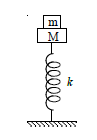
(b) Find the normal force on the smaller block at this position. When is this force smallest in magnitude?
(c) What can be the maximum amplitude with which the two blocks may oscillate together?
5. The block of mass m1 shown in figure is fastened to the spring and the block of mass m2 is placed against it
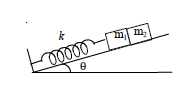
(a) Find the compression of the spring in the equilibrium position
(b) The blocks are pushed a further distance (2/k) (m1+ m2)g sin θ against the spring and released. Find the position where the two blocks separate.
(c) What is the common speed of blocks at the time of separation?
6. The spring shown in figure is unstretched when a man starts pulling the block. The mass of the block is M. If the man exerts a constant force F, find
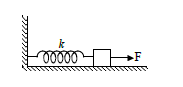
(a) the amplitude and the time period of the motion of the block,
(b) the energy stored in the spring when the block passes through the equilibrium position and
(c) the kinetic energy of the block at equilibrium position.
7. A particle of mass m is attached to three springs A, B and C of equal force constants k as shown in figure. If the particle is pushed slightly against the spring C and released, find the time period of oscillation.

8. The string, the spring and the pulley shown in figure are light. Find the time period of the mass m if it is displaced slightly from equilibrium position
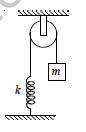
9. Solve the previous problem if the pulley has a moment of inertia I about its axis and the string does not slip over it.
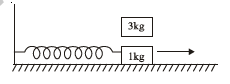
10. A 1 kg block is executing simple harmonic motion of amplitude 0.1 m on a smooth horizontal surface under the restoring force of a spring of spring constant 100 N/m. A block of mass 3 kg is gently placed on it at the instant it passes through the mean position. Assuming that the two blocks move together, find the frequency and the amplitude of the motion.
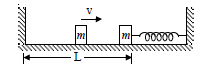
11. The left block in figure moves at a speed v towards the right block placed in equilibrium. All collisions to take place are elastic and the surfaces are frictionless. Show that the motions of the two blocks are periodic. Find the time period of these periodic motions. Neglect the widths of the blocks.
Please click on below link to download pdf file for CBSE Class 12 Physics Simple Harmonic Motion Basic Problems.
Free study material for Physics
Useful Resources and Notes for Class 12 Physics Simple Harmonic Motion
Comprehensive Study Resources for Simple Harmonic Motion
Explore essential learning tools for Class 12 Physics Simple Harmonic Motion. This curated collection features in-depth notes and targeted practice questions built around the active 2026 curriculum to streamline your daily revision.
Understanding Marking Schemes
Designed around the official curriculum, these study guides guarantee standard compliance. Reviewing step-by-step solutions clarifies complex sub-topics within Simple Harmonic Motion and demystifies standard marking schemes for Physics evaluations.
Complete Revision for Physics
For peak performance in upcoming evaluations, integrate official Physics sample papers directly into your study schedule. Follow up your revision by attempting online MCQ tests for Simple Harmonic Motion to refine calculation speed and precision.
FAQs
Our advanced study package for Simple Harmonic Motion includes detailed concepts, diagrams, Mind Maps, and explanation of complex topics to ensure Class 12 students learn as per syllabus for 2026 exams.
The Mind Maps provided for Simple Harmonic Motion act as visual anchors which will help faster recall during high-pressure exams.
Yes, teachers use our Class 12 Physics resources for lesson planning as they are in simple language and have lot of solved examples.
Yes, You can download the complete, mobile-friendly PDF of the Physics Simple Harmonic Motion advanced resources for free.
Yes, our subject matter experts have updated the Simple Harmonic Motion material to align with the rationalized NCERT textbooks and have removed deleted topics and added new competency-based questions.