

Advanced Study Material for Class 12 Physics: Simple Harmonic Motion
Access comprehensive study materials and useful resources for Simple Harmonic Motion using the CBSE Class 12 Physics Simple Harmonic Motion Exam Notes. Designed to align with the 2026-27 CBSE academic guidelines, these advanced resources help Class 12 Physics students reinforce core concepts beyond standard textbooks.
Practice Class 12 Physics Resources: Simple Harmonic Motion
Navigate directly to the advanced Physics study materials using the digital viewer below. Each resource pack includes detailed conceptual summaries and solved practice questions, allowing students to instantly reinforce their learning.
CBSE Class 12 Physics Simple Harmonic Motion Exam Notes. Please refer to the examination notes which you can use for preparing and revising for exams. These notes will help you to revise the concepts quickly and get good marks.
Class 12 Physics: Simple Harmonic Motion Exam Notes
PERIODIC AND OSCILLATORY MOTION
Periodic Motion: A motion which repeats itself after equal intervals of time is called periodic motion.Oscillatory Motion: A body is said to possess oscillatory or vibratory motion if it moves back and forth repeatedly about a mean position. For an oscillatory motion, a restoring force is required.SIMPLE HARMONIC MOTION
Simple Harmonic Motion is a periodic motion in which a body moves to and fro about its mean or equilibrium position such that its restoring force or its acceleration is directly proportional to the displacement from its mean position and is directed towards its mean position. It can be expressed mathematically as,
\[F = m\frac{d^2x}{dt^2} = -kx\]
where \(m\) is the mass on which a restoring force \(F\) acts to impart an acceleration \(\dfrac{d^2x}{dt^2}\) along the \(x\)-axis such that the restoring force \(F\) or acceleration is directly proportional to the displacement \(x\) along the \(x\)-axis and \(k\) is a constant. The negative sign shows that the restoring force or acceleration is directed towards the mean position.
The differential equation of a simple harmonic motion is given by,
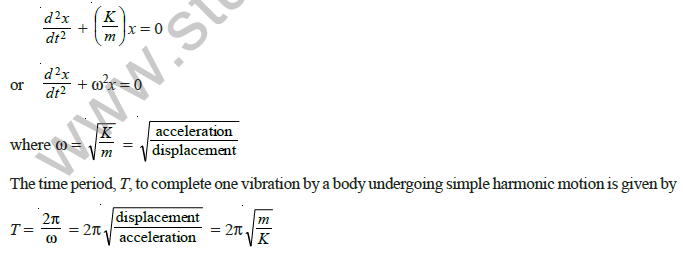
\[\frac{d^2x}{dt^2}+\left(\frac{k}{m}\right)x=0\]
or
\[\frac{d^2x}{dt^2}+\omega^2x=0\]
\[\text{where }\omega=\sqrt{\frac km}=\sqrt{\frac{\text{acceleration}}{\text{displacement}}}\]
The time period, \(T\), to complete one vibration by a body undergoing simple harmonic motion is given by,
\[T=\frac{2\pi}{\omega}=2\pi\sqrt{\frac{\text{displacement}}{\text{acceleration}}}=2\pi\sqrt{\frac mk}\]
REPRESENTATION OF SIMPLE HARMONIC MOTION
If a point mass \(m\) is moving with uniform speed along a circular path of radius \(a\), its projection on the diameter of the circle along the \(y\)-axis represents its simple harmonic motion.
\[y=a\sin\omega t\]
where \(\omega\) is the uniform angular velocity of the body of mass \(m\) along a circular path of radius \(a\) such that \(\omega t\) is the angle covered by the radius in time \(t\) from the initial position \(A\) at \(t=0\) to the position \(B\). As \(\angle AOB=\angle OBC=\omega t\), the foot of the perpendicular from \(B\) to the diameter \(YOY'\) gives the projection at the point \(C\) such that \(y=OC\) is the projection of this body on the diameter and represents the displacement of the body executing S.H.M. along the \(y\)-axis.
If the body does not start its motion from the point \(A\) but at a point \(A'\) so that \(\angle AOA'\) is the phase angle \(\phi\), then
\[y=a\sin(\omega t\pm\phi)\qquad \ldots\text{(i)}\]
where \(\phi\) is the phase angle, which may be positive or negative. The phase angle represents the fraction of the angle by which the motion of the body is out of step between the initial position of the body and the mean position of simple harmonic motion. The phase difference is the fraction of the angle \(2\pi\) or time period \(T\) of S.H.M. by which the body is out of step initially from the mean position of the body.
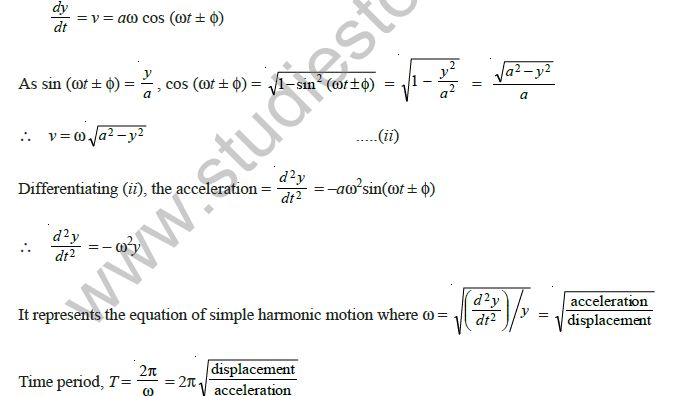
Differentiating equation (i),
\[\frac{dy}{dt}=v=a\omega\cos(\omega t\pm\phi)\]
As \(\sin(\omega t\pm\phi)=\dfrac ya\), \(\ \cos(\omega t\pm\phi)=\sqrt{1-\sin^2(\omega t\pm\phi)}=\sqrt{1-\dfrac{y^2}{a^2}}=\dfrac{\sqrt{a^2-y^2}}{a}\)
\[\therefore\ v=\omega\sqrt{a^2-y^2}\qquad \ldots\text{(ii)}\]
Differentiating (ii), the acceleration \(=\dfrac{d^2y}{dt^2}=-a\omega^2\sin(\omega t\pm\phi)\)
\[\therefore\ \frac{d^2y}{dt^2}=-\omega^2y\]
It represents the equation of simple harmonic motion, where \(\omega=\sqrt{\dfrac{d^2y/dt^2}{y}}=\sqrt{\dfrac{\text{acceleration}}{\text{displacement}}}\) (in magnitude).
\[\text{Time period, }T=\frac{2\pi}{\omega}=2\pi\sqrt{\frac{\text{displacement}}{\text{acceleration}}}\]
EXAMPLES OF SHM
There are two types of SHM’s:
- Linear simple harmonic motion
- Angular simple harmonic motion
LINEAR SIMPLE HARMONIC MOTION
If a particle executes SHM on a straight line, then it is said to be linear simple harmonic motion. In this case, to find out the time period, we find out the linear restoring force and hence linear acceleration.
i.e. \(F=ma\)
\[\Rightarrow\ -kx=ma,\ \text{where }k\text{ is a constant}\]
\[\Rightarrow\ a=-\frac kmx\qquad \ldots\text{(i)}\]
Also, we know that the equation of SHM is
\[a=-\omega^2x\qquad \ldots\text{(ii)}\]
Comparing (i) and (ii), we get \(\omega\) and hence the time period.
ANGULAR SIMPLE HARMONIC MOTION
When a particle executes S.H.M. on a curved path, then it is said to be angular SHM, as in a simple pendulum. In this case, to find out the time period, we find out the restoring torque and hence the angular acceleration.
i.e. \(\tau=-k\theta\), where \(k\) is a constant
\[\Rightarrow\ I\alpha=-k\theta,\ \text{where }I\text{ is the moment of inertia}\]
\[\Rightarrow\ \alpha=-\frac kI\theta\qquad \ldots\text{(i)}\]
Also, the equation of SHM for angular SHM is
\[\alpha=-\omega^2\theta\qquad \ldots\text{(ii)}\]
Comparing (i) and (ii), we get \(\omega\), hence the time period.
SIMPLE PENDULUM
It is an example of angular simple harmonic motion. Let us calculate its time period.
Let us suppose that a bob of mass \(m\) is executing SHM. The length of the pendulum is \(l\), which is the distance between the point of oscillation and the centre of mass of the bob. The restoring torque acting on the bob about the point \(O\) is
\[\tau=-mgl\theta\]
\[\Rightarrow\ I\alpha=-mgl\theta\]
\[\Rightarrow\ \alpha=-\frac{mgl}{I}\theta=-\frac{mgl}{ml^2}\theta,\ \text{where }\alpha\text{ is the angular acceleration}\]
\[\alpha=-\frac gl\theta\qquad \ldots\text{(i)}\]
The equation of SHM is
\[\alpha=-\omega^2\theta\qquad \ldots\text{(ii)}\]
Comparing (i) and (ii), we get
\[\omega^2=\frac gl\ \Rightarrow\ \omega=\sqrt{\frac gl}\ \Rightarrow\ \frac{2\pi}{T}=\sqrt{\frac gl}\ \Rightarrow\ T=2\pi\sqrt{\frac lg}\]
Notice that the period is independent of the mass of the suspended particle.
THE PHYSICAL PENDULUM
Any rigid body mounted so that it can swing in a vertical plane about some axis passing through it is called a physical pendulum.
A body of irregular shape is pivoted about a horizontal frictionless axis through \(P\) and displaced from the equilibrium position by an angle \(\theta\). (The equilibrium position is that in which the centre of mass \(C\) of the body lies vertically below \(P\).) The distance from the pivot to the centre of mass is \(d\). The moment of inertia of the body about an axis through the pivot is \(I\) and the mass of the body is \(M\).
The restoring torque about the point \(P\) is
\[\tau=-Mgd\sin\theta\]
If \(\theta\) is very small, \(\sin\theta\approx\theta\), so
\[\tau=-Mgd\theta\ \Rightarrow\ I\alpha=-Mgd\theta\ \Rightarrow\ \alpha=-\frac{Mgd}{I}\theta\qquad \ldots\text{(i)}\]
Comparing with the equation of SHM,
\[\omega^2=\frac{Mgd}{I}\ \Rightarrow\ \omega=\sqrt{\frac{Mgd}{I}}\ \Rightarrow\ \frac{2\pi}{T}=\sqrt{\frac{Mgd}{I}}\ \Rightarrow\ T=2\pi\sqrt{\frac{I}{Mgd}}\]
SPRING MASS SYSTEM
As shown in the figure, a mass \(m\) is attached to a massless spring. It is displaced from its mean position to a distance \(x\). The restoring force is given by
\[F=-kx\ \text{where }k\text{ is the force constant}\]
\[\Rightarrow\ ma=-kx\ \Rightarrow\ a=-\frac kmx\qquad \ldots\text{(i)}\]
Since \(a\propto-x\), the motion is SHM.
\[\Rightarrow\ \omega^2=\frac km\ \text{ or }\ \omega=\sqrt{\frac km}\ \Rightarrow\ T=2\pi\sqrt{\frac mk}\]
SERIES AND PARALLEL COMBINATION OF SPRINGS
Series combination of springs: If springs are connected in series, having force constants \(k_1,k_2,k_3\), then the equivalent force constant is\[\frac{1}{k_{eff}}=\frac1{k_1}+\frac1{k_2}+\frac1{k_3}+\ldots\]
Parallel combination of springs: If springs are connected in parallel, then the effective force constant is given by\[k_{eff}=k_1+k_2+k_3+\ldots\]
ENERGY OF A SIMPLE HARMONIC MOTION
When a body of point mass \(m\) undergoes simple harmonic motion, its kinetic energy at a time when its instantaneous velocity is \(v\) is given by,
\[\text{kinetic energy}=\tfrac12mv^2=\tfrac12m\omega^2(a^2-y^2)\]
\[\text{Its potential energy}=\tfrac12ky^2=\tfrac12m\omega^2y^2\]
\[\text{Total instantaneous energy}=\tfrac12m\omega^2(a^2-y^2)+\tfrac12m\omega^2y^2=\tfrac12m\omega^2a^2\]
The kinetic energy is maximum and the potential energy is minimum at the mean position in a simple harmonic motion, whereas the kinetic energy is minimum and the potential energy is maximum at the extreme position. The sum of instantaneous kinetic energy and potential energy is constant at all positions of the body.
GRAPH FOR ENERGY OF SHM
COMBINATION OF SHM
Case I: Same frequency and same directionLet the simple harmonic motions be
\[x_1=A_1\cos(\omega t+\delta_1)\ \&\ x_2=A_2\cos(\omega t+\delta_2)\]
The resultant displacement is \(x=x_1+x_2\)
\[\Rightarrow\ x=A_1(\cos\omega t\cos\delta_1-\sin\omega t\sin\delta_1)+A_2(\cos\omega t\cos\delta_2-\sin\omega t\sin\delta_2)\]
Let the resultant amplitude be \(A\), so \(x=A\cos(\omega t+\delta_R)\), where
\[A=\sqrt{A_1^2+A_2^2+2A_1A_2(\cos\delta_1\cos\delta_2+\sin\delta_1\sin\delta_2)}\]
\[=\sqrt{A_1^2+A_2^2+2A_1A_2\cos(\delta_1-\delta_2)}\]
If the phase difference \(\delta_1-\delta_2=0\), \(\ A_{max}=A_1+A_2\), and if \(\delta_1-\delta_2=\pi\), \(\ A_{min}=A_1-A_2\) (in magnitude).
Case II: Composition of two simple harmonic motions of the same frequency in mutually perpendicular directionsLet the two rectangular vibrations be represented by
\[x=a\sin(\omega t+\theta)\qquad \ldots\text{(i)}\]
\[y=b\sin\omega t\qquad \ldots\text{(ii)}\]
From equation (i),
\[\frac xa=\sin(\omega t+\theta)=\sin\omega t\cos\theta+\cos\omega t\sin\theta\qquad \ldots\text{(iii)}\]
Now, from (ii), \(\dfrac yb=\sin\omega t\), so \(\sqrt{1-\dfrac{y^2}{b^2}}=\cos\omega t\), or \(\dfrac{\sqrt{b^2-y^2}}{b}=\cos\omega t\).
Now, from equation (iii),
\[\frac xa=\frac yb\cos\theta+\sqrt{1-\frac{y^2}{b^2}}\sin\theta\ \Rightarrow\ \frac xa-\frac yb\cos\theta=\sqrt{1-\frac{y^2}{b^2}}\sin\theta\]
Squaring both sides, we get
\[\boxed{\frac{x^2}{a^2}+\frac{y^2}{b^2}-\frac{2xy}{ab}\cos\theta=\sin^2\theta}\]
Let us discuss a few particular cases.
Case I: \(\theta=0\)\[\frac{x^2}{a^2}+\frac{y^2}{b^2}-\frac{2xy}{ab}=0\ \Rightarrow\ \pm\left(\frac xa-\frac yb\right)=0\]
which represents a pair of coincident straight lines lying in the first and third quadrants. (For \(\theta=\pi\) the line lies in the second and fourth quadrants.)
Case II: \(\theta=\dfrac\pi2\)\(\sin\theta=1,\ \cos\theta=0\)
\[\therefore\ \frac{x^2}{a^2}+\frac{y^2}{b^2}=1\]
which represents an ellipse.
Case III: If \(\theta=\dfrac\pi4\),\[\frac{x^2}{a^2}+\frac{y^2}{b^2}-\frac{\sqrt2\,xy}{ab}=\frac12\]
which is an oblique ellipse.
The paths for varying phase difference \(\theta=0,\ \pi/4,\ \pi/2,\ 3\pi/4,\ \pi\) (periods \(\omega_1:\omega_2=1:1\)) are shown below.
θ = 0
θ = π/4
θ = π/2
θ = 3π/4
θ = π
Free study material for Physics
Free CBSE Study Guides: Class 12 Physics Simple Harmonic Motion
Comprehensive Study Resources for Simple Harmonic Motion
Explore essential learning tools for Class 12 Physics Simple Harmonic Motion. This curated collection features in-depth notes and targeted practice questions built around the active 2026 curriculum to streamline your daily revision.
Understanding Marking Schemes
Built using official NCERT guidelines for Class 12 Physics, these materials provide reliable academic support. Integrating past examination questions and step-by-step solutions helps students understand official CBSE grading criteria.
Complete Revision for Physics
For peak performance in upcoming evaluations, integrate official Physics sample papers directly into your study schedule. Follow up your revision by attempting online MCQ tests for Simple Harmonic Motion to refine calculation speed and precision.
FAQs
Our advanced study package for Simple Harmonic Motion includes detailed concepts, diagrams, Mind Maps, and explanation of complex topics to ensure Class 12 students learn as per syllabus for 2026 exams.
The Mind Maps provided for Simple Harmonic Motion act as visual anchors which will help faster recall during high-pressure exams.
Yes, teachers use our Class 12 Physics resources for lesson planning as they are in simple language and have lot of solved examples.
Yes, You can download the complete, mobile-friendly PDF of the Physics Simple Harmonic Motion advanced resources for free.
Yes, our subject matter experts have updated the Simple Harmonic Motion material to align with the rationalized NCERT textbooks and have removed deleted topics and added new competency-based questions.