

Official CBSE Study Materials for Class 12 Physics
Review targeted academic resources with the CBSE Class 12 Physics Solids and Fluids Exam Notes. Built according to official CBSE standards for the 2026-27 term, these downloadable Class 12 Physics study materials support effective daily practice and deeper conceptual understanding for Solids and Fluids.
Advanced Resources for Physics
View or download the dedicated CBSE Class 12 Physics Solids and Fluids Exam Notes resource below. Engaging with these advanced study guides under focused conditions ensures continuous academic progress and mastery of the 2026-27 curriculum for Solids and Fluids.
CBSE Class 12 Physics Solids and Fluids Exam Notes. Please refer to the examination notes which you can use for preparing and revising for exams. These notes will help you to revise the concepts quickly and get good marks.
ELASTIC PROPERTIES OF MATERIALS
When external forces are applied to a body which is fixed to a rigid support, there is a change in its length, volume or shape. When the external forces are removed, the body tends to regain its original shape and size. Such a property of a body by virtue of which a body tends to regain its original shape or size, when the external forces are removed, is called elasticity.
If a body completely regains its shape and size, it is called perfectly elastic. If it does not regain its shape and size completely, it is called inelastic material. Those materials which hardly regain their shape are called plastic material.
STRESS :
The restoring force per unit area is called the stress and is equal to the force applied per unit area. deforming force
Stress = Force/.area = .area
There are three types of stresses:
(i) If deforming force is applied along linear dimensions of the body, it is called longitudinal stress..
(ii) If a uniform stress acts normally to the whole volume of a body, it is called volume stress.
(iii) If the force is applied tangentially to one face of a rectangular body keeping the other face fixed, the stress is called tangential or shearing stress. Stress is measured in units of 1N/m2.1 N/m2 = 10 dynes/cm2.
STRAIN
The fractional or relative change in shape, size or dimensions of a body is called the strain.
Strain= Change in dimension/original dimension
There are three types of strains:
(i) Longitudinal strain : It is the ratio of the change in length, Δl , to the original length, l i.e. Δl/l .
(ii) Volume strain : It is the ratio of change in volume, ΔV, to the original volume V i.e. ΔV/V .
(iii) Shearing strain : The angular deformation, θ , in radians of a face of a rectangular body is called as the shearing strain.
If a tangential force F is used to displace upper face of a rectangular body through a small angle θ such that the upper face is displaced through distance Δx when l is height of the body, then shearing strain = θ≈tanθ= Δx/l
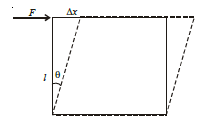
Strain is a ratio of two similar quantities and does not have any units.
HOOKE’S LAW
It states that for small deformations, stress is directly proprtional to strain within elastic limits and their ratio
is a constant called modules of elasticity.
Strain/ Stress =modulus of Elasticity =E

MODULI OF ELASTICITY
There are three moduli of elasticity:
(i) Young’s modulus, Y : It is the ratio of longitudinal stress to longitudinal strain. If a wire of length l and small cross-sectional area A is pulled longitudinally by a Force F or due to a mass M suspended from it, its length increases by Δl . The Young’s modulus, Y, of the material of such a body is given by:
Y=F/Al/ Δl/ l = Fl/AΔl= Mgl/πr2Δl
where r is the radius of wire.
(ii) Bulk Modulus, K : It is defined as the ratio of volume stress to the volume strain. If a body of volume v is subjected to a change in pressure ΔP applied uniformly to a body such that its volume decreases by Δv, then Bulk modulus, K = – ΔP v/ Δv where the negative sign shows that the volume decreases by Δv when the pressure is increased. The reciprocal of bulk modulus, 1/K, is called the compressibility of the material.
Please click on below link to download pdf file for CBSE Class 12 Physics Solids and Fluids Exam Notes.
Free study material for Physics
Useful Resources and Notes for Class 12 Physics Solids and Fluids
Essential Notes for Class 12 Physics
Review targeted study resources for Solids and Fluids tailored for Class 12 learners. Utilizing these structured notes and quick-revision tools ensures complete alignment with current CBSE evaluation standards.
Verified Solutions for Class 12 Physics
Each resource draws directly from authorized textbooks to maintain academic accuracy. Evaluating solved examples allows Class 12 students to master the formal presentation and answer-writing standards expected in upcoming school exams.
Enhance Accuracy with Online Tests
Maximize your grade potential by utilizing Class 12 Physics practice papers in tandem with these structured notes. All printable assignments and interactive mock tests on our platform are updated for the 2026 session and available free of charge.
FAQs
Our advanced study package for Solids and Fluids includes detailed concepts, diagrams, Mind Maps, and explanation of complex topics to ensure Class 12 students learn as per syllabus for 2026 exams.
The Mind Maps provided for Solids and Fluids act as visual anchors which will help faster recall during high-pressure exams.
Yes, teachers use our Class 12 Physics resources for lesson planning as they are in simple language and have lot of solved examples.
Yes, You can download the complete, mobile-friendly PDF of the Physics Solids and Fluids advanced resources for free.
Yes, our subject matter experts have updated the Solids and Fluids material to align with the rationalized NCERT textbooks and have removed deleted topics and added new competency-based questions.