

Official CBSE Study Materials for Class 12 Physics
Explore structured advanced study materials through the CBSE Class 12 Physics Electrostatic Solved Examples. Tailored for Class 12 learners, utilizing these Physics resources ensures thorough preparation and strengthens foundational knowledge before final CBSE evaluations.
Advanced Resources for Physics
Access the complete useful resource PDF for Class 12 Physics below. Regular practice with these targeted academic notes builds familiarity with complex topics and helps secure higher marks in final school evaluations.
CBSE Class 12 Physics Elecctrostatic Solved Examples. Please refer to the examination notes which you can use for preparing and revising for exams. These notes will help you to revise the concepts quickly and get good marks.
SOLVED EXAMPLES - ELECTROSTATICS
Class 12 Physics solved examples on electrostatics, covering Coulomb's law between point charges and charged balls, forces on a charged ring, dielectric slabs, pendulums in electric fields, forces on charges at the corners of squares and triangles, electric potential energy, potential and speed of particles, charged spheres and rings, and the motion of a dipole in a uniform field.
Ex.1: Two small balls having equal charges Q, are suspended from a hook with two insulating threads each of length L. This arrangement is carried in the space, where there is no gravitation. The tension in each string will be
(A) F = kQ² / 4L²
(B) 0
(C) kQ / 4L²
(D) kQ² / L²

[Figure: Two small balls A and B with equal charge Q placed on a straight line, a distance 2L apart. Each ball is attached to a thread of length L that is held along the same straight line, with the threads pointing away from each other, so that the angle between them is 180°. Forces F and tensions T act outwards along the line.]
Answer: (A) F = kQ² / 4L²
1. Each ball is pushed away from the other by the electrostatic force F between them.
2. Distance between the balls = 2L, so F = kQ² / (2L)² = kQ² / 4L².
3. In equilibrium, each thread tension balances this force, so T = F = kQ² / 4L².
4. Hence, the tension in each string is kQ² / 4L².
Teacher's Note:
a) In the absence of gravity, the only force on each ball is the Coulomb repulsion.
b) The threads lie in a straight line, so the angle between them is 180°.
c) The distance between the balls is 2L, not L; do not forget the factor of 2 when squaring.
Ex.2: A copper atom consists of copper nucleus surrounded by 29 electrons. The atomic weight of copper is 63.5 g/mole. Let us now take two pieces of copper each wieghing 10g. Let us transfer one electron from one piece to another for every 1000 atoms in that piece. What will be the coulomb force between the two pieces after the transfer of electron if they are 1cm. apart. [Avogadro number N = 6 × 10²³ /g. mole charge on an electron = -1.6 × 10⁻¹⁹ coulomb]
Answer:
1. 63.5 g of copper contains N = 6 × 10²³ atoms.
2. Number of copper atoms in 10 g = (6 × 1023 × 10) / 63.5.
3. One electron is transferred for every 1000 atoms, so the number of electrons transferred is n = (6 × 1023 × 10) / (63.5 × 1000) = 9.45 × 10¹⁹.
4. Magnitude of charge q = ne = (6 × 1023 × 10) / (63.5 × 1000) × 1.6 × 10-19 = 1920 / 127 C.
5. Separation between the pieces r = 1 cm = 10-2 m.
6. One piece is positively charged and the other negatively charged, so the force is attractive.
7. F = (1 / 4πε0) × q² / r² = 9 × 109 × (1920 / 127)² / (10-2)².
8. Hence, F = 2.057 × 10¹⁶ N.

Teacher's Note:
a) Convert the atomic weight into the number of atoms per gram before counting electrons.
b) Opposite charges attract, so the force is attractive.
c) Keep the distance in metres, here 10-2 m, before using the Coulomb formula.
d) Use the exact fraction 1920 / 127 for the charge to avoid rounding errors.
Ex.3: A thin conducting ring of radius r has an electric charge +Q. What would be the increase in the tension of wire, if a point charge +q is placed at the centre of the ring?
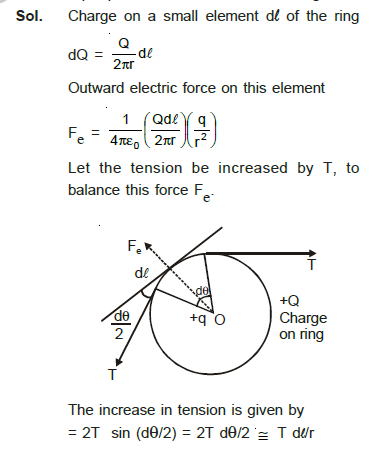
[Figure: A thin circular ring of radius r with charge +Q spread uniformly on it, and a point charge +q at its centre O. A small element dℓ of the ring subtends angle dθ at the centre. The outward electric force Fe on the element acts radially outwards, and the tension T in the wire acts along the tangent at each end of the element.]
Answer:
1. Charge on a small element dℓ of the ring: dQ = (Q / 2πr) dℓ.
2. Outward electric force on this element: Fe = (1 / 4πε0) × (Q dℓ / 2πr) × (q / r²).
3. Let the tension increase by T to balance Fe. The two tension components at the ends of the element give 2T sin(dθ / 2) ≈ T dθ.
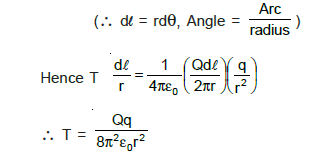
4. So T dθ = Fe, and with dℓ = r dθ, we get dθ = dℓ / r.
5. Hence, T = Fe × r / dℓ = (1 / 4πε0) × (Q / 2πr) × (q / r²) × r.
6. Simplifying, T = Qq / (8π²ε0r²).
Teacher's Note:
a) For small angles, sin(dθ / 2) is approximately dθ / 2.
b) Use the arc length dℓ = r dθ to change the angle into a length.
c) The increase in tension is produced only by the charge at the centre acting on the ring.
Ex.4: (a) Two similar point charges q1 and q2 are placed at a distance 'r' apart in air. If a dielectric slab of thickness 't' (< r) and dielectric constant 'K' is placed between the charges, calculate the coulomb force of repulsion (b). If the thickness of slab covers half the distance, between the charges, the coulomb repulsive force is reduced in the ratio 9 : 4, calculate the dielectric constant of slab.

Answer:
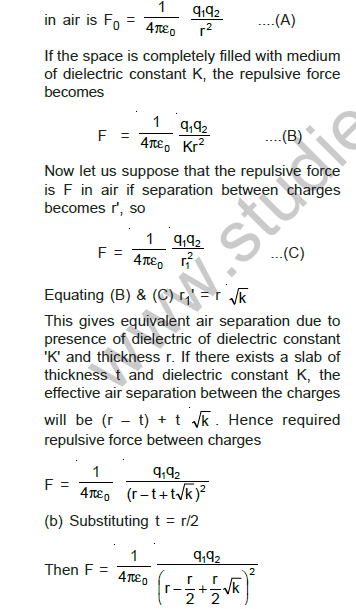
1. Force in air between the charges: F0 = (1 / 4πε0) × q1q2 / r².
2. If the whole space is filled with a medium of dielectric constant K, the force becomes F = (1 / 4πε0) × q1q2 / (K r²).
3. Let the air separation r' that gives the same force F in air satisfy r'² = Kr², so r' = r√K.
4. A slab of thickness t and dielectric constant K is equivalent to an air gap of thickness t√K, so the effective air separation is (r - t) + t√K.
5. (a) Hence, the repulsive force is F = (1 / 4πε0) × q1q2 / (r - t + t√K)².
6. (b) With t = r / 2, the effective separation is r/2 + (r/2)√K = (r/2)(1 + √K).
7. So F = (1 / 4πε0) × 4q1q2 / (r²(1 + √K)²), and Fair = (1 / 4πε0) × q1q2 / r².
8. Given Fair : F = 9 : 4, so F / Fair = 4 / (1 + √K)² = 4 / 9.
9. Hence, (1 + √K)² = 9, so √K = 2 and K = 4.
Teacher's Note:
a) This follows the equivalent air separation method of the textbook, with the slab thickness t scaled by √K.
b) Half the distance filled by the slab gives the factor (1 + √K) in the denominator.
c) A ratio of 9 : 4 means the force in air is larger by 9 / 4, so keep the ratio in the right order.
Ex.5: The bob of a pendulum carries an electric charge of 39.2 × 10⁻¹⁰ coulomb in an electric field of 20 × 103 v/m and it is at rest. The angle made by the pendulum with the vertical will be, if the mass of pendulum is 8 × 10⁻⁶ kg and g = 9.8 (A) 27° (B) 45° (C) 87° (D) 127°
[Figure: Pendulum bob of mass m hanging from a string at the top point S. The electric field E is horizontal. The free body diagram shows tension T along the string, the weight mg vertically downwards, and the electric force qE horizontally, with the string at angle θ to the vertical.]
Answer: (B) 45°
1. Horizontal balance: T sin θ = qE.
2. Vertical balance: T cos θ = mg.
3. Dividing: tan θ = qE / mg = (39.2 × 10-10 × 20 × 103) / (8 × 10-6 × 9.8).
4. Numerator = 784 × 10-7 and denominator = 78.4 × 10⁻⁶, so tan θ = 1.
5. Hence, θ = 45°, and the correct option is (B).
Teacher's Note:
a) Force balance in two perpendicular directions gives the angle directly.
b) Equal values of qE and mg always give a 45° angle.
c) Keep the powers of ten consistent before comparing the two sides.
Ex.6: A simple pendulum is oscillating between the plates of a capacitor as shown in the fig. If the bob and the capacitor both are charged, what will be the effect on the time-period of the pendulum?
[Figure: A simple pendulum with its bob oscillating between the plates of a capacitor. The string is attached at the top point S and the bob swings about the lowest point O.]
Answer:
1. Let the mass of the bob be m and the length of the thread be l. With the bob and capacitor uncharged, T = 2π√(l / g).
2. On charging the bob with +q and charging the capacitor, the electric force qE acts horizontally, so the equilibrium position shifts to O', where tan α = qE / mg.
3. The effective weight is mg' = √((mg)² + (qE)²), so the effective acceleration is g' = √(g² + (qE / m)²).
4. The new time period is T' = 2π√(l / g') = 2π√l / (g² + (qE / m)²)1/4.
5. Since g' is greater than g, T' is less than T.
6. Hence, the time period of the pendulum decreases.
Teacher's Note:
a) The pendulum swings about the new equilibrium position, so the effective acceleration is used.
b) A horizontal electric force adds to gravity as a vector, not as a simple sum.
c) A larger effective g always gives a shorter period.
Ex.7: A simple pendulum (length l, mass of the bob m) is suspended between the parallel plates of a capacitor as shown in the fig. What will be the effect on its time if it is (i) positively charged, (ii) negatively-charged? Assuming that the electric force on the bob is less than the gravitational force and the electric field E between the plates is uniform.
[Figure: A simple pendulum of length l with its bob of mass m hanging between the parallel plates of a capacitor, with a uniform field E between the plates. The electric force qE on the bob acts along the vertical.]
Answer:
1. When the bob and the capacitor are uncharged, T = 2π√(l / g).
2. The field between the plates is vertical, so the electric force qE on the bob acts along the vertical: in case (i) it adds to the weight, and in case (ii) it opposes the weight (qE < mg).
3. So the effective acceleration is g + qE / m in case (i) and g − qE / m in case (ii).
4. So the period in case (i) is T1 = 2π√(l / (g + qE / m)), and the period in case (ii) is T2 = 2π√(l / (g − qE / m)).
5. Comparing with T, note that T1 and T2 satisfy T1 < T in case (i) and T2 > T in case (ii).
6. Hence, in case (i) the time period decreases (T1 < T) and in case (ii) it increases (T2 > T).
Teacher's Note:
a) The electric force is vertical, so it simply adds to or subtracts from g.
b) The charge that makes the electric force oppose gravity reduces the effective g, so the period increases.
c) The condition qE < mg keeps g − qE / m positive.
Ex.8: A square of side 'a' has equal charge 'q' at its corners. The magnitude and direction of force at B will be- (A) (1 kq²) / (2 a²) (1 + 2√2), 45° (B) (1 k²q²) / (2 a²), 45° (C) 4kq² / a², 30° (D) none of these
[Figure: A square ABCD of side a with a charge q placed at each corner. A is at bottom left, B at bottom right, C at top right and D at top left.]
Answer: (A) (kq² / 2a²)(1 + 2√2) at 45°
1. Force on the charge at B due to the charge at A (adjacent, distance a) is F1 = kq² / a², directed along AB, away from A.
2. Force on the charge at B due to the charge at C (adjacent, distance a) is F2 = kq² / a², directed along CB, away from C.
3. Force on the charge at B due to the charge at D (diagonal, distance BD = √2 a) is F3 = kq² / (√2 a)² = kq² / 2a², along the diagonal DB.
4. F1 and F2 are at right angles, so their resultant is F12 = √2 kq² / a², along the bisector of the angle at B.
5. F12 and F3 act along the same line, so the total force F = F12 + F3 = √2 kq² / a² + kq² / 2a² = (kq² / 2a²)(1 + 2√2).
6. The resultant makes an angle β with F1 where tan β = F1 sin 90° / (F1 + F2 cos 90°) = 1, so β = 45°.
7. Hence, the force at B is (kq² / 2a²)(1 + 2√2) directed at 45°, and the correct option is (A).
Teacher's Note:
a) Forces from the two adjacent charges are at right angles, so add them with Pythagoras.
b) The diagonal charge is at distance √2 a, so its force is halved.
c) Always check the direction of each force, since all forces repel from the other charge.
d) Writing the total as a sum of two terms makes the option match easy.
Ex.9: Two identical charged spheres are suspended in air by strings of equal lengths and string make an angle of 30° with each other. When suspended in a liquid of density 0.8 gm cm-3, the angle remains the same. What is the dielectric constant of the liquid ? (Density of the material of the spheres = 1.6 gm cm-3)
[Figure: Two identical charged spheres hang from a common point on strings of equal length. Each string makes 15° with the vertical, so the angle between the strings is 30°. The distance between the spheres is r.]
Answer:
1. In air, each sphere is in equilibrium under its weight mg, the electric repulsion F = (1 / 4πε0) × q² / r², and the tension T.
2. Resolving: T cos 15° = mg and T sin 15° = F, so tan 15° = F / mg. ........(i)
3. In the liquid, the electric force becomes F / K, where K is the dielectric constant of the liquid.
4. The effective weight of each sphere in the liquid = mg (1 - 0.8 / 1.6) = mg / 2.
5. The angle is still 15° in the liquid, so tan 15° = (F / K) / (mg / 2) = 2F / (Kmg). ........(ii)
6. Equating (i) and (ii): F / mg = 2F / (Kmg), so K = 2.
Teacher's Note:
a) Each string makes 15° with the vertical, because the angle between the two strings is 30°.
b) The buoyant force reduces the effective weight to half, which is the key step.
c) The distance r cancels out, so the answer does not depend on it.
Ex.10: An electron falls a distance of 4 cm in a uniform electric field of magnitude 5 x 10⁴ N/C. The time taken by electron in falling will be (A) 2.99 × 10⁻⁷ s (B) 2.99 × 10⁻⁸ s (C) 2.99 × 10⁻⁹ s (D) 2.99 × 10⁻¹⁰ s
Answer: (C) 2.99 × 10⁻⁹ s
1. Acceleration of the electron: a = eE / m.
2. Distance fallen: y = ½at² = ½ (eE / m) t².
3. So t = √(2ym / eE).
4. Substituting y = 4 × 10⁻² m, m = 9.1 × 10⁻³¹ kg, e = 1.6 × 10⁻¹⁹ C and E = 5 × 10⁴ N/C: t = √(2 × 4 × 10-2 × 9.1 × 10-31 / (1.6 × 10-19 × 5 × 104)) ≈ 3 × 10⁻⁹ s.
5. Hence, the time taken is about 3 × 10⁻⁹ s, which matches option (C), 2.99 × 10⁻⁹ s.
Teacher's Note:
a) The electron is light, so its acceleration in the field is very large.
b) Use the mass of the electron, 9.1 × 10⁻³¹ kg, not the mass of a proton.
c) Check the units: the square root of metres per metre-per-second-squared gives seconds.
Ex.11: In the following fig. a unit positive charge moves along the path ABC in an electric field E. The potential difference between A & C will be (A) 0 (B) Er (C) Er/2 (D) Er/4
[Figure: Vertical parallel electric field lines pointing downwards, with arrows marked E. A is at the bottom, C is at the top left and B is at the top right. The path ABC goes from A diagonally up to B at 45°, then horizontally left to C. The vertical distance between A and C is r.]
Answer: (B) Er
1. Work done by a conservative electric field does not depend on the path taken.
2. Work done from A to C = q × VAC = q × E × r, where r is the vertical distance from A to C.
3. Since the unit positive charge has q = 1 C, VAC = E r.
4. Hence, the potential difference between A and C is Er.
Teacher's Note:
a) Potential difference depends only on the start and end points, not on the path.
b) Only the component of the displacement along the field, here r, contributes.
c) Use the unit charge to convert the work into potential difference.
Ex.12: Charge 2q, -q & -q lies at the vertices of a equilateral. The value of E and V at the centroid of the triangle will be- (A) E ≠ 0 and V ≠ 0 (B) E = 0 and V = 0 (C) E ≠ 0 and V = 0 (D) E = 0 and V ≠ 0
[Figure: Equilateral triangle with charge +2q at the top vertex and charge -q at each of the two bottom vertices. The centroid O lies inside the triangle, on the vertical line through the top vertex.]
Answer: (C) E ≠ 0 and V = 0
1. Potential is a scalar: V = k(2q / R - q / R - q / R) = 0, where R is the distance from the centroid to each vertex.
2. Electric field is a vector. The field from +2q at O points away from it, and has magnitude 2kq / R².
3. The fields from the two charges -q point towards them, and their horizontal components cancel. Their vertical components add to kq / R² in the same direction as the field from +2q.
4. Total field E = 2kq / R² + kq / R² = 3kq / R², which is not zero.
5. Hence, E ≠ 0 and V = 0, which is option (C).
Teacher's Note:
a) Add the electric fields as vectors, using their directions.
b) Add potentials as plain numbers, using the signs of the charges.
c) A zero potential does not mean the field is zero.
Ex.13: From the fig. given below, the potential energy of the system will be- (A) kq²/a (√2 - 4) (B) kq²/a (C) 0 (D) kq/a (√2 - 4)
[Figure: Square of side a with charges at its corners: +q at the top left (1), -q at the top right (2), -q at the bottom left (3) and +q at the bottom right (4). The side a is marked on the left side.]
Answer: (A) kq²/a (√2 - 4)
1. Label the corners 1 (top left), 2 (top right), 3 (bottom left) and 4 (bottom right). Potential energy U = U12 + U24 + U43 + U31 + U14 + U23, counting each pair once.
2. Each of the four sides joins a +q and a -q charge: U12 = k(+q)(-q) / a = -kq²/a.
3. Likewise U24, U43 and U31 are each -kq²/a, so the four sides give -4kq²/a.
4. The two diagonals have distance √2 a. U14 = k(+q)(+q) / (√2 a) = kq²/(√2 a) and U23 = k(-q)(-q) / (√2 a) = kq²/(√2 a).
5. Hence, U = -4kq²/a + 2kq²/(√2 a) = (kq²/a)(√2 - 4), which is option (A).
Teacher's Note:
a) Count every pair of charges exactly once.
b) The diagonal distance is √2 a, so its term has the factor 1 / √2.
c) Negative potential energy means the system is bound; work must be done to separate the charges.
Ex.14: Two particles A and B having masses equal and charges q and 4q. If these are accelerated from rest through same potential difference, then what will be the ratio in their speeds? (A) 4 : 1 (B) 1 : 4 (C) 2 : 1 (D) 1 : 2
Answer: (D) 1 : 2
1. Kinetic energy gained when accelerated through potential difference V: ½mv² = qV.
2. So v = √(2qV / m), which means v is proportional to √q for equal masses and equal V.
3. vA / vB = √(q / 4q) = √(1 / 4) = 1 / 2.
4. Hence, the ratio of speeds is 1 : 2, which is option (D).
Teacher's Note:
a) Energy gained equals charge times potential difference.
b) Speed depends on the square root of the charge when mass and voltage are the same.
c) Do not confuse the ratio of speeds with the ratio of kinetic energies, which is 1 : 4.
Ex.15: Two identical particles of mass m carry a charge Q each. Initially one is at rest on a smooth horizontal plane and the other is projected along the plane directly towards the first particle from a large distance, with the speed v. Find the closest distance of approach.
Answer:
1. The particles are identical, so both have mass m, and the external force on the system is zero.
2. By conservation of linear momentum: mv = mv1 + mv2, so v = v1 + v2.
3. By symmetry at the nearest approach, v1 = v2 = v / 2.
4. By conservation of energy: ½mv² = ½m(v / 2)² + ½m(v / 2)² + (1 / 4πε0) × Q² / d.
5. Simplifying: ¼mv² = (1 / 4πε0) × Q² / d.
6. Hence, d = (1 / 4πε0) × 4Q² / (mv²).
Teacher's Note:
a) Both particles move together at the nearest approach, each with v / 2.
b) Use conservation of momentum first, then energy.
c) The final kinetic energy is only half of the initial kinetic energy.
Ex.16: Sphere of radius 4 cm is suspended inside a hollow spherical conductor of radius 6 cms. The hollow sphere is charged upto 3 e.s.u and the outer surface is connected to earth. The potential difference between the spheres will be (A) 36 e.s.u. (B) 54 e.s.u. (C) 30 e.s.u. (D) 0.25 e.s.u.
Answer: (D) 0.25 e.s.u.
1. Let the inner sphere have radius r = 4 cm and the outer hollow sphere have radius R = 6 cm.
2. Potential difference between the spheres: V = Kq (1 / r - 1 / R).
3. Here K = 1 dyne cm² / stat coulomb² and q = 3 e.s.u.
4. V = 3 × (1 / 4 - 1 / 6) = 3 × (1 / 12) = 0.25 e.s.u.
5. Hence, the potential difference is 0.25 e.s.u., which is option (D).
Teacher's Note:
a) The outer surface being earthed does not change the charge on the inner shell.
b) Subtract the reciprocals of the radii, not the radii themselves.
c) Keep the radii in the same unit, centimetres, throughout.
Ex.17: A sphere of radius 5 cm has electric field 5 × 10⁶ V/m on its surface. What will be the force acting on a charge of 5 × 10⁻⁸ C placed at distance of 20cm from the centre of sphere- (A) 1.5 × 10⁻² N (B) 40 N (C) 4 N (D) 0 N
Answer: (A) 1.5 × 10⁻² N
1. Field at the surface of the sphere: Es = kq / R², with R = 0.05 m.
2. Field at distance r = 0.20 m outside the sphere: E0 = kq / r² = Es R² / r².
3. E0 = 5 × 106 × (0.05)² / (0.20)² = 5 × 10⁶ / 16 = 3.125 × 10⁵ V/m.
4. Force on the charge: F = qE0 = 5 × 10-8 × 3.125 × 105 = 1.5625 × 10⁻² N, which is about 1.5 × 10⁻² N.
5. Hence, the force is 1.5 × 10⁻² N, which is option (A).
Teacher's Note:
a) Outside a charged sphere, the field is the same as that of a point charge at its centre.
b) The printed value "r = 0.20 cm" in the working should read 0.20 m, which is 20 cm.
c) Convert every length into metres before using the field formula.
Ex.18: A thin stationary ring of radius 1m has a positive charge of 1 × 10⁻⁵ coulomb uniformly distributed over it. A particle of mass 0.9 gm and having a negative charge of 1 × 10⁻⁶ coulomb is placed on the axis at a distance of 1 cm from the centre of the ring. Show that the motion of the negatively-charged particle is approximately simple harmonic. Calculate the time-period of oscillation.
Answer:
1. Electric field on the axis of a ring of radius R at distance x from its centre: E = (1 / 4πε0) × qx / (R² + x²)3/2, where q is the charge on the ring.
2. For small x compared with R, x² is negligible in R² + x², so E = (1 / 4πε0) × qx / R³.
3. Force on the negative particle of charge q' is F = -q'E = -(1 / 4πε0) × qq' x / R³.
4. The force is proportional to -x and directed towards the centre, so the motion is simple harmonic.
5. Angular frequency ω = √((1 / 4πε0) × qq' / (mR³)) = √((9 × 109) × (1 × 10-5)(1 × 10⁻⁶) / ((0.9 × 10⁻³)(1)³)) = √100 = 10 rad/s.
6. Time period T = 2π / ω = 2π / 10 = π / 5 s, which is about 0.63 s.
Teacher's Note:
a) Simple harmonic motion needs a restoring force proportional to displacement.
b) Use the mass in kilograms, 0.9 × 10⁻³ kg, for the frequency.
c) Neglecting x² in the field expression is the approximation that gives simple harmonic motion.
Ex.19: A circular ring of radius R with uniform positive charge density 'λ' per unit length is located in the y-z plane with its centre at the origin O. A particle of mass m and positive charge q is projected from the point P(√3 R, 0, 0) on the positive x-axis directly towards O, with an initial speed v. Find the smallest (non-zero) value of speed v such that the particle does not return P.
[Figure: Three-dimensional set-up with the ring of radius R lying in the y-z plane and its centre at the origin O. The x-axis passes through O, and the point P is on the positive x-axis at distance √3 R from O. The particle moves from P along the x-axis towards O.]
Answer:
1. The electric field at the centre of the ring is zero by symmetry, so a particle at O experiences no force.
2. For the smallest speed, the particle must just reach O with zero speed. If it reaches O, it will not return to P.
3. Total charge of the ring Q = 2πRλ. Potential at O: VO = kQ / R.
4. Potential at P: VP = kQ / √((√3 R)² + R²) = kQ / (2R).
5. Energy conservation between P and O: ½mv² + qVP = 0 + qVO.
6. So ½mv² = qkQ (1 / R - 1 / 2R) = qkQ / 2R.
7. With kQ = (1 / 4πε0) × 2πRλ = Rλ / 2ε0, we get ½mv² = qλ / 4ε0.
8. Hence, v = \( \sqrt{\frac{\lambda q}{2\varepsilon_0 m}} \).
Teacher's Note:
a) The field at the centre of the ring is zero, but the potential there is not zero.
b) The particle is repelled by the ring, so it slows down while moving towards O.
c) The ring's total charge is 2πRλ, which is the key to the potential at O.
d) Any speed smaller than this value stops before O and returns to P.
Ex.20: The radii of internal and external spheres of concentric spherical air capacitor are 1 cm and 4 cm respectively. A potential difference of 3000 volts is applied between the spheres. What velocity will be imparted to an electron. when it approaches from a distance of r1 = 3 cm to r2 = 2cm as measured from the centre of spheres.
Answer:
1. Let a = 1 cm = 10-2 m and b = 4 cm = 4 × 10⁻² m. Potential difference between the spheres: Vab = (1 / 4πε0) × q (1 / a - 1 / b) = 3000 V.
2. Substituting: 3000 = 9 × 10⁹ × q × (100 - 25) = 6.75 × 10¹¹ q, so q = (4 / 9) × 10-8 C.
3. Potential at a distance r from the centre: V(r) = (1 / 4πε0) × q (1 / r - 1 / b).
4. At r1 = 3 cm: V1 = 40 × (100 / 3 - 25) = 40 × 25 / 3 = 333.3 V.
5. At r2 = 2 cm: V2 = 40 × (50 - 25) = 1000 V.
6. Gain in kinetic energy of the electron: K = e (V2 - V1) = 1.6 × 10-19 × 666.7 = (32 / 3) × 10-17 J.
7. Using ½mv² = (32 / 3) × 10-17 J with m = 9 × 10-31 kg, v2 = 2.37 × 10¹⁴ m²/s².
8. Hence, v = 1.54 × 10⁷ m/s.
Teacher's Note:
a) The electron moves to a smaller radius, where the potential is higher, so it gains energy.
b) The printed kinetic energy "(32 / 3) × 10-19 J" is wrong; the correct value is (32 / 3) × 10-17 J, which gives 1.54 × 10⁷ m/s.
c) Use the potential difference between the two radii, not the total potential difference of 3000 V.
Ex.21: A charge Q is distributed over two concentric hollow spheres of radii r and R (> r) such that the surface densities are equal. Find the potential at the common centre.
Answer:
1. Let the charges on the spheres of radii r and R be Qr and QR, so Q = Qr + QR.
2. Equal surface densities σ give Qr / (4πr²) = QR / (4πR²), so Qr / QR = r² / R².
3. Hence, QR = Q R² / (r² + R²) and Qr = Q r² / (r² + R²).
4. Potential at the centre due to the outer sphere: VR = kQR / R = kQR / (r² + R²).
5. Potential at the centre due to the inner sphere: Vr = kQr / r = kQr / (r² + R²).
6. Total potential: V = VR + Vr = kQ(R + r) / (r² + R²).
7. Hence, V = Q (R + r) / (4πε0 (r² + R²)).
Teacher's Note:
a) Equal surface density means the charge is proportional to the area, so the bigger sphere holds more charge.
b) The potential at the centre is the sum of the potentials of both spheres.
c) Check the special case r = R: the answer becomes Q / (4πε0R), the potential of a single sphere.
Ex.22: A point particle of mass M is attached to one end of a massless rigid non-conducting rod of length l. Another point particle of the same mass is attached to the other end of the rod. The two particles carry charges +q and -q respectively. This arrangement is held in a region of a uniform electric field E such that the rod makes angle θ (say of 5°) with the field direction. Find an expression for the minimum time needed for the rod to become parallel to the field after it is set free.
[Figure: A rod of length l with a mass M at each end, pivoted at its centre O. The end A carries charge -q and the end B carries charge +q. A uniform electric field E points to the right, and the rod makes angle θ with the field direction. The electric force qE acts on B along the field and -qE acts on A opposite to the field.]
Answer:
1. Moment of inertia of the system about O: I = M(l/2)² + M(l/2)² = Ml² / 2.
2. The electric forces qE and -qE on the two ends form a couple, and the torque is τ = qE × (l/2) sin θ × 2 = qE l sin θ.
3. The restoring torque is opposite to the displacement, and for small θ, sin θ ≈ θ, so Iα = -qE l θ.
4. Angular acceleration α = -(qE l / I) θ = -(2qE / Ml) θ, which is proportional to -θ, so the motion is angular simple harmonic motion.
5. Angular frequency ω² = 2qE / (Ml), so ω = √(2qE / (Ml)).
6. The rod moves from θ = 5° to the parallel position (θ = 0) in a quarter of a period, the shortest time for this motion.
7. Time t = T / 4 = (2π / ω) / 4 = π / (2ω) = (π / 2) × √(Ml / 2qE).
Teacher's Note:
a) The rod oscillates about the field direction, so the motion is angular simple harmonic motion.
b) Use the moment of inertia of two masses at distance l/2 from the centre, which gives Ml²/2.
c) The small-angle approximation sin θ ≈ θ is valid for θ = 5°, which is why the time is independent of the angle.
Note :- In the above problem, the angle between the 'threads will be 1800.' Because in the absence of gravity, the tension in the threads will be only due to columb-repulsion. Therefore the angle between the threads will be 1800.

Free study material for Physics
Useful Resources and Notes for Class 12 Physics Chapter 02 Electrostatic Potential and Capacitance
Core Study Kit: Class 12 Physics Chapter 02 Electrostatic Potential and Capacitance
Review targeted study resources for Chapter 02 Electrostatic Potential and Capacitance tailored for Class 12 learners. Utilizing these structured notes and quick-revision tools ensures complete alignment with current CBSE evaluation standards.
NCERT-Aligned Solutions for Chapter 02 Electrostatic Potential and Capacitance
Each resource draws directly from authorized textbooks to maintain academic accuracy. Evaluating solved examples allows Class 12 students to master the formal presentation and answer-writing standards expected in upcoming school exams.
Next Steps in Your Exam Preparation
Wrap up your chapter revision by testing your knowledge against standard objective question formats. Explore our full library of free, up-to-date sample papers and online assessments to secure top grades in your CBSE examinations.
FAQs
Our advanced study package for Chapter 02 Electrostatic Potential and Capacitance includes detailed concepts, diagrams, Mind Maps, and explanation of complex topics to ensure Class 12 students learn as per syllabus for 2026 exams.
The Mind Maps provided for Chapter 02 Electrostatic Potential and Capacitance act as visual anchors which will help faster recall during high-pressure exams.
Yes, teachers use our Class 12 Physics resources for lesson planning as they are in simple language and have lot of solved examples.
Yes, You can download the complete, mobile-friendly PDF of the Physics Chapter 02 Electrostatic Potential and Capacitance advanced resources for free.
Yes, our subject matter experts have updated the Chapter 02 Electrostatic Potential and Capacitance material to align with the rationalized NCERT textbooks and have removed deleted topics and added new competency-based questions.