

Class 12 Physics Study Guide: CBSE Class 12 Physics Electrostatics Advanced Problems
Review targeted academic resources with the CBSE Class 12 Physics Electrostatics Advanced Problems. Built according to official CBSE standards for the 2026-27 term, these downloadable Class 12 Physics study materials support effective daily practice and deeper conceptual understanding for Chapter 02 Electrostatic Potential and Capacitance.
Download Chapter 02 Electrostatic Potential and Capacitance Study Material PDF
Access the complete useful resource PDF for Class 12 Physics below. Regular practice with these targeted academic notes builds familiarity with complex topics and helps secure higher marks in final school evaluations.
CBSE Class 12 Physics Electrostatics Advanced Problems. Please refer to the examination notes which you can use for preparing and revising for exams. These notes will help you to revise the concepts quickly and get good marks.
1. Two identical positive point charges Q each are fixed at a distance 2a apart. A point charge q of mass m lies midway between the fixed charges. If a small displacement is given to this charge +q relative to a line joining the fixed charges, show that the charge executes S.H. M and find its time period T1. If a charge – q lying midway is given a small lateral displacement along the perpendicular bisector of line joining point charges +Q, show that it also executes S.H.M. and find the ratio of frequency of oscillation f1 of charge +q in the first case to that of frequency f2 of charge –q in the second case.
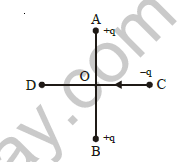
2. Two fixed, equal, and positive charges, each of magnitude 5 × 10⁻⁵ C, are located at points A and B separated by a distance of 6 m. An equal and opposite charge moves towards them along the line COD, the perpendicular bisector of AB. The moving charge, when it reaches the point C at a distance of 4 m from O, has a kinetic energy of 4 joules. Calculate the distance of the farthest point D which the negative charge will reach before returning towards C.
3. Two fixed charges –2Q and Q are located at the points with coordinates (–3a, 0) and (+3a, 0) respectively in the x-y plane.
(a) Show that all the points in the x-y plane where the electric potential due to the two charges is zero, lie on a circle. Find its radius and the location of its center.
(b) Give the expression for the potential V (x) at a general point on the x-axis and sketch the function V(x) on the whole x-axis.
(c) If a particle of charge +q starts from rest at the center of the circle, show by a short qualitative argument that the particle eventually crosses the circle. Find its speed when it does so.
4. Three concentric spherical metallic shells A, B and C of radii a, b and c (a < b < c) have surface charge densities σ, –σ and σ respectively.
(a) Find the potential for the three shells A, B and C.
(b) If the shells A and C are at the same potential, obtain the relation between the radii a, b and c.
5. Two small balls of mass m, carrying a charge q each, are connected by a nonconducting thread of length 2l. At a certain instant, the middle of the thread starts moving at a constant velocity v perpendicular to the initial direction of the thread. Determine the minimum distance d between the balls.
6. A thin fixed ring of radius 1 m has a positve charge 1 × 10⁻⁵ coulomb uniformly distriuted over it. A particle of mass 0.9 gm and having a negative charge of 1 × 10⁻⁶ coulomb is placed on the axis at a distance of 1 cm from the center of the ring. Show that the motion of the negatively charged particle is approximately simple harmonic. Calculate the time period of oscillations.
7. A ring of radius 0.1 m is made of a thin metallic wire of area of cross-section 10–6 m2. The ring has a uniform charge of π coulomb. Find the change in the radius ΔR of the ring when a charge of 10–8 coulomb is placed at the centre of the ring. Young’s modulus of the metal is 2 × 10¹¹ N/m2.
8. A ball of mass 10–2 kg and having charge +3.0 × 10⁻⁶ C is tied at one end of a 1 m long thread. The other end of the thread is fixed and a charge –3.0 × 10⁻⁶ C is placed at this end. The ball can move in a circular orbit of radius 1 m in the vertical plane. If the ball is initially at the bottom, find the minimum initial horizontal velocity of the ball so that it can complete the full circle. Take g = 10 ms–2.
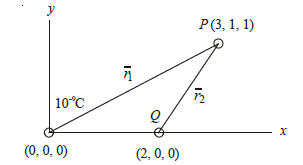
9. A charge 10–9 Coulomb is located at origin in free space and another charge Q is placed at Q(2, 0, 0). If the x component of the electric field at point P(3, 1, 1) is zero, find
(a) the value of Q (b) y component of electric
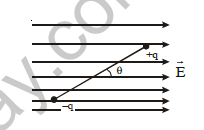
10. A point particle of mass M is attached to one end of a massless rigid non-conducting rod of length L. Another point particle of the same mass is attached to the other end of the rod. The two particles carry charges +q and –q respectively. This arrangement is held in a region of a uniform electric field E such that the rod makes a small angle θ with the field direction. Find the minimum time needed for the rod to become parallel to the field after it is set free.
11. The distance d between the parallel plates of a charged capacitor is 5 cm and the intensity of the field E = 300 V cm–1. A slab of dielectric constant K = 5 and 1 cm wide is inserted parallel to the plates.
(a) Find the potential difference before and after the slab is inserted.
(b) If the slab is replaced by a metallic plate so that the final potential difference remains unchanged, find the thickness of the plate.
12. Figure shows two identical parallel plate capacitors connected to a battery with the switch S closed. The switch is now opened and the free space between the plates of the capacitors is filled with a dielectric of dielectric constant equal to 3. Find the ratio of the total electrostatic energy stored in both capacitors before and after the introduction of the dielectric.
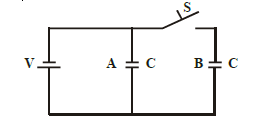
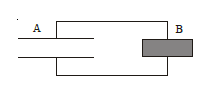
13. Two parallel plate capacitors A and B have the same separation d = 8.85 × 10⁻⁴ m between the plates.The plate areas of A and B are 0.04 m2 and 0.02 m2 respectively. A slab of dielectric constant (relative permittivity) K = 9 has dimensions such that it can exactly fill the space between the plates of capacitor
B.
(a) The dielectric slab is placed inside A as shown in figure. A is then charged to a potential difference of 110 V. Calculate the capacitance of A and the energy stored in it
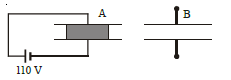
(b) The battery is disconnected and then the dielectric slab is removed from A. Find the work done by the external agency in removing the slab from A.
(c) The same dielectric slab is now placed inside B, filling it completely. The two capacitors A and B are then connected as shown in the figure. Calculate the energy stored in the system
Please click on below link to download pdf file forCBSE Class 12 Physics Electrostatics Advanced Problems.
Free study material for Physics
Free CBSE Study Guides: Class 12 Physics Chapter 02 Electrostatic Potential and Capacitance
Comprehensive Study Resources for Chapter 02 Electrostatic Potential and Capacitance
Access comprehensive study material for Chapter 02 Electrostatic Potential and Capacitance, including revision notes, concept maps, and high-probability questions. These resources are designed in alignment with the latest 2026 CBSE syllabus for Class 12 Physics to support effective exam preparation.
Understanding Marking Schemes
Built using official NCERT guidelines for Class 12 Physics, these materials provide reliable academic support. Integrating past examination questions and step-by-step solutions helps students understand official CBSE grading criteria.
Complete Revision for Physics
Wrap up your chapter revision by testing your knowledge against standard objective question formats. Explore our full library of free, up-to-date sample papers and online assessments to secure top grades in your CBSE examinations.
FAQs
Our advanced study package for Chapter 02 Electrostatic Potential and Capacitance includes detailed concepts, diagrams, Mind Maps, and explanation of complex topics to ensure Class 12 students learn as per syllabus for 2026 exams.
The Mind Maps provided for Chapter 02 Electrostatic Potential and Capacitance act as visual anchors which will help faster recall during high-pressure exams.
Yes, teachers use our Class 12 Physics resources for lesson planning as they are in simple language and have lot of solved examples.
Yes, You can download the complete, mobile-friendly PDF of the Physics Chapter 02 Electrostatic Potential and Capacitance advanced resources for free.
Yes, our subject matter experts have updated the Chapter 02 Electrostatic Potential and Capacitance material to align with the rationalized NCERT textbooks and have removed deleted topics and added new competency-based questions.