

Class 12 Physics Study Guide: CBSE Class 12 Physics Magnetism Solved Examples.
Review targeted academic resources with the CBSE Class 12 Physics Magnetism Solved Examples.. Built according to official CBSE standards for the 2026-27 term, these downloadable Class 12 Physics study materials support effective daily practice and deeper conceptual understanding for Chapter 05 Magnetism and Matter.
Download Chapter 05 Magnetism and Matter Study Material PDF
Navigate directly to the advanced Physics study materials using the digital viewer below. Each resource pack includes detailed conceptual summaries and solved practice questions, allowing students to instantly reinforce their learning.
This Class 12 Physics set of solved examples on Magnetism covers the force between magnetic poles, the magnetic field and induction of a pole, the couple and potential energy of a bar magnet, the neutral points near a current carrying cable, the magnetic moment of a coil, the Rowland ring, magnetic permeability and susceptibility, and the earth's magnetic field with bar magnets and current carrying conductors, each solved step by step.
SOLVED EXAMPLES: MAGNETISM
Ex.1 A north pole of strength 50 Am and south pole of strength 100 Am are separated by a distance of 10 cm in air. Find the force between them. Also find the force when the distance between them is doubled.

Answer: F = 50 × 10⁻³ N; on doubling the distance, F = 12.5 × 10⁻³ N.
1. Force between two poles in air: F = (μ₀/4π) × m₁m₂/r², with μ₀/4π = 10⁻⁷ in SI units.
2. F = 10⁻⁷ × 50 × 100 / (0.1)² = 10⁻⁷ × 5000 / 0.01 = 0.05 N, that is 50 × 10⁻³ N.
3. When the distance is doubled, F ∝ 1/r², so F₂ = F₁/4 = 50 × 10⁻³ / 4 = 12.5 × 10⁻³ N.
Teacher's Note:
a) Use r in metres: 10 cm must be converted to 0.1 m before squaring.
b) Common mistake: doubling the force instead of dividing it by four when the distance is doubled.
Ex.2 Calculate the strength of the magnetic field at a distance of 20 cm from a pole of strength 40 Am in air. Find the induction at the same point.
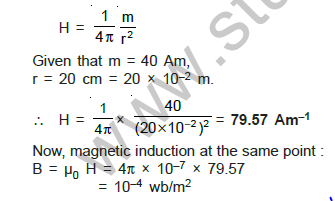
Answer: H = 79.57 A/m and B = 10⁻⁴ Wb/m².
1. Field strength of a pole: H = m/(4πr²) = 40 / (4π × (0.2)²).
2. H = 79.57 A/m.
3. Magnetic induction B = μ₀H = 4π × 10⁻⁷ × 79.57 = 10⁻⁴ Wb/m².
Teacher's Note:
a) Field strength is measured in A/m, while the induction is measured in Wb/m² or tesla.
b) The induction in air is numerically the field strength multiplied by μ₀.
Ex.3 A bar magnet of length 0.2 m and pole strength 5 Am is kept in a uniform magnetic induction field of strength 15 Wbm⁻² making an angle of 30° with the field. Find the couple acting on it.
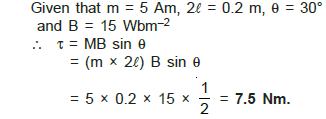
Answer: 7.5 N m.
1. Magnetic moment M = m × 2l = 5 × 0.2 = 1 Am².
2. Couple τ = MB sin θ = 1 × 15 × sin 30° = 1 × 15 × 1/2.
3. τ = 7.5 N m.
Teacher's Note:
a) Here 2l is the length of the magnet, so M is pole strength times length.
b) Common mistake: using the pole strength alone as the magnetic moment.
Ex.4 A short magnet of length 4 cm is kept at a distance of 20 cm to the east of a compass box such that is axis is perpendicular to the magnetic meridian. If the deflection produced is 45°, find the pole strength (H = 30 Am⁻¹)
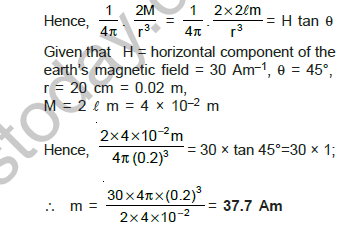
Answer: pole strength m ≈ 37.7 Am.
1. The compass lies on the axial line of the magnet, so the field of the magnet is B = (μ₀/4π) × 2M/r³.
2. Equating the magnet's field to the horizontal field of the earth: (1/4π) × 2M/r³ = H tan θ.
3. Here H = 30 A/m, θ = 45°, tan 45° = 1, r = 0.2 m and the length 2l = 4 cm, so M = m × 4 × 10⁻² m.
4. So M = 4π × (0.2)³ × 30 / 2 = 1.508 Am².
5. Pole strength m = M / (2l) = 1.508 / (4 × 10⁻²) ≈ 37.7 Am.
Teacher's Note:
a) For the axial position, the field of the magnet is along the axis and the compass needle deflects through the angle whose tangent is the ratio of the fields.
b) Common mistake: using the equatorial formula, which has 1/r³ with a factor of 1 instead of 2.
Ex.5 A bar magnet of magnetic moment 1.5 JT⁻¹ lies aligned with the direction of a uniform magnetic field of 0.22 T. (a) What is the amount of work required to turn the magnet so as to align its magnetic moment (i) normal to the field direction, (ii) opposite to the field direction? (b) What is the torque on the magnet in cases (i) and (ii)?
Answer: (a) 0.33 J and 0.66 J; (b) 0.33 N m and 0 N m.
1. Potential energy U = -MB cos θ. When aligned, θ = 0 and U₀ = -MB.
2. (i) Normal to the field, θ = 90°, U₉₀ = 0. Work W = U₉₀ - U₀ = MB = 1.5 × 0.22 = 0.33 J.
3. (ii) Opposite to the field, θ = 180°, U₁₈₀ = +MB. Work W = U₁₈₀ - U₀ = 2MB = 0.66 J.
4. (b) Torque in case (i): τ = MB sin 90° = 0.33 N m. Torque in case (ii): τ = MB sin 180° = 0 N m.
Teacher's Note:
a) Work done equals the change in potential energy of the magnet.
b) Common mistake: giving the torque as zero for case (i), which is the case of maximum torque.
Ex.6 A long straight horizontal cable carries a current of 2.5 A in the direction 10° south of west to 10° north of east. The magnetic meridian of the place happens to be 10° west of the geographic meridian. The earth's magnetic field at the location is 0.33 Gauss, and the angle of dip is zero. Locate the line of neutral points. (Ignore the thickness of the cable).

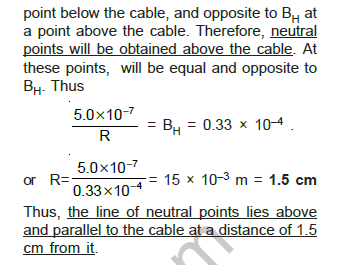
Answer: a line parallel to the cable at a distance of 1.5 cm from it.
1. The angle of dip is zero, so the horizontal component is B_H = B = 0.33 G = 0.33 × 10⁻⁴ T.
2. Field of the cable at distance R: B = μ₀I/(2πR) = 2 × 10⁻⁷ × 2.5 / R = 5 × 10⁻⁷ / R.
3. Neutral points lie where the cable's field equals B_H: 5 × 10⁻⁷ / R = 0.33 × 10⁻⁴.
4. R = 5 × 10⁻⁷ / (0.33 × 10⁻⁴) = 1.5 × 10⁻² m = 1.5 cm.
5. The line of neutral points is parallel to the cable at a distance of 1.5 cm, lying on the side where the cable's field opposes B_H (above the cable, as the printed solution shows).
Teacher's Note:
a) Neutral points are the places where the net field is zero, so the two fields must be equal and opposite.
b) Common mistake: giving the distance in metres without converting it to centimetres for the answer.
Ex.7 A 10 cm long bar magnet of magnetic moment 1.34 Am² is placed in the magnetic meridian with its south pole pointing geographical south. The neutral point is obtained at a distance of 15 cm from the centre of the magnet. Calculate the horizontal component of earth's magnetic field.
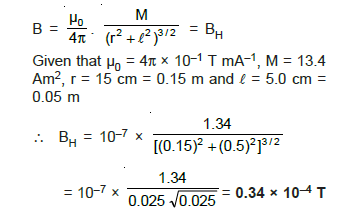
Answer: B_H = 0.34 × 10⁻⁴ T.
1. Since the south pole points geographic south, the neutral points lie on the equatorial line.
2. Field of the magnet at the equatorial point: B = (μ₀/4π) × M/(r² + l²)^(3/2).
3. Here M = 1.34 Am², r = 0.15 m and l = 0.05 m, so r² + l² = 0.0225 + 0.0025 = 0.025.
4. (0.025)^(3/2) = 3.95 × 10⁻³, so B = 10⁻⁷ × 1.34 / 3.95 × 10⁻³ = 3.4 × 10⁻⁵ T.
5. Hence the horizontal component of earth's field B_H = 0.34 × 10⁻⁴ T.
Teacher's Note:
a) The half length l is 5 cm, which is half of the 10 cm magnet.
b) Common mistake: using the full length of the magnet in place of its half length.
Ex.8 A circular coil of 16 turns and radius 10 cm carries a current of 0.75 A and rest with its plane normal to an external magnetic field of 5.0 × 10⁻² T. The coil is free to rotate about an axis in its plane perpendicular to the magnetic field. When the coil is slightly turned and released, it oscillates about its stable equilibrium position with a frequency of 2.0 s⁻¹. Compute the moment of inertia of the coil about its axis of rotation.
Answer: K ≈ 1.2 × 10⁻⁴ kg m².
1. Magnetic moment of the coil M = NIA = 16 × 0.75 × π × (0.1)² = 0.377 Am².
2. Period T = 2π√(K/MB), so the frequency ν = (1/2π)√(MB/K).
3. Therefore K = MB / (4π²ν²) = 0.377 × 5.0 × 10⁻² / (4π² × 4).
4. K = 1.2 × 10⁻⁴ kg m².
Teacher's Note:
a) Make sure the frequency is in hertz, not the angular frequency.
b) Common mistake: putting ν in place of 2πν when rearranging the formula.
Ex.9 A Rowland ring of mean radius 15 cm has 3500 turns of wire wound on a ferromagnetic core of relative permeability 800. What is the magnetic field B in the core for a magnetising current of 1.2 amp ?
Answer: B ≈ 4.48 T.
1. The ring behaves like a solenoid, so the number of turns per metre is n = N/(2πr).
2. n = 3500 / (2π × 0.15) = 3714 turns/m.
3. B = μ₀μ_r n I = 4π × 10⁻⁷ × 800 × 3714 × 1.2.
4. B = 4.48 T.
Teacher's Note:
a) The ring has no ends, so the field is confined to the core, which is why the solenoid formula is used.
b) Common mistake: using the radius instead of the circumference 2πr to find the turns per metre.
Ex.10 A magnetising field of 1600 Am⁻¹ produces a magnetic flux of 2.4 × 10⁻⁵ weber in a bar of iron of cross section 0.2 cm². Calculate the magnetic permeability and susceptibility of the bar.
Answer: μ = 7.5 × 10⁻⁴ T m A⁻¹ and χ_m ≈ 596.
1. Area A = 0.2 cm² = 0.2 × 10⁻⁴ m².
2. Magnetic induction B = φ/A = 2.4 × 10⁻⁵ / (0.2 × 10⁻⁴) = 1.2 Wb/m².
3. Permeability μ = B/H = 1.2 / 1600 = 7.5 × 10⁻⁴ T m A⁻¹.
4. Susceptibility χ_m = μ/μ₀ - 1 = 7.5 × 10⁻⁴ / (4π × 10⁻⁷) - 1 ≈ 596 - 1 = 595.8 ≈ 596.
Teacher's Note:
a) Convert the area from cm² to m² before dividing.
b) The printed solution gives 596.1; the more precise value is about 595.8, which rounds to 596.
Ex.11 A short bar magnet of magnetic moment 5.25 × 10⁻² JT⁻¹ is placed with its axis perpendicular to the earth's field direction. At what distance from the centre of the magnet on (i) its normal bisector, (ii) its axis, is the resultant field inclined at 45° with the earth's field? Magnitude of the earth's field at the place is given to be 0.42 G. Ignore the length of the magnet in comparison to the distance involved.
Answer: (i) 5 cm on the normal bisector; (ii) about 6.3 cm on the axis.
1. Earth's field B = 0.42 G = 0.42 × 10⁻⁴ T; M = 5.25 × 10⁻² Am².
2. (i) On the normal bisector, the magnet's field is B_eq = (μ₀/4π) M/r³. For the resultant to be at 45°, B_eq = B.
3. r³ = 10⁻⁷ × M / B = 10⁻⁷ × 5.25 × 10⁻² / (0.42 × 10⁻⁴) = 1.25 × 10⁻⁴, so r = 0.05 m = 5 cm.
4. (ii) On the axis, the magnet's field is B_axial = (μ₀/4π) 2M/r³. For 45°, B_axial = B.
5. r³ = 2 × 10⁻⁷ × M / B = 2.5 × 10⁻⁴, so r ≈ 0.063 m = 6.3 cm.
Figure (i): point P on the normal bisector
Figure (ii): point Q on the axis
Teacher's Note:
a) On the axis the field is twice the equatorial field for the same distance, which is why the axial distance is larger.
b) Common mistake: using the axial formula for the normal bisector.
Ex.12 A magnetic dipole is under the influence of two magnetic fields. The angle between the field directions is 60° and one of the fields has a magnitude of 1.2 × 10⁻² T. If the dipole comes to stable equilibrium at an angle of 15° with this field, what is the magnitude of other field ?
Answer: B₂ ≈ 4.4 × 10⁻³ T.
1. Angle of the dipole with the field B₁ is θ₁ = 15°, so with the second field B₂ it is θ₂ = 60° - 15° = 45°.
2. In equilibrium the torques from the two fields balance: MB₁ sin θ₁ = MB₂ sin θ₂.
3. B₂ = B₁ sin θ₁ / sin θ₂ = 1.2 × 10⁻² × sin 15° / sin 45° = 1.2 × 10⁻² × 0.2588 / 0.7071.
4. B₂ = 4.4 × 10⁻³ T.
Teacher's Note:
a) Torque balance is the key condition for equilibrium of a dipole in two fields.
b) Check that the two angles add up to the given angle between the fields.
Ex.13 A telephone cable at a place has four long, straight horizontal wires carrying a current of 1.0 A in the same direction east to west. The earth's magnetic field at the place is 0.39 Gauss, and the angle of dip is 35°. The magnetic declination is nearly zero. What are the resultant magnetic fields at points 4.0 cm below and above the cable ?
Answer: below the cable about 0.25 G (at about 62°); above the cable about 0.56 G (at about 23°).
1. Horizontal component B_H = 0.39 cos 35° = 0.32 G; vertical component B_V = 0.39 sin 35° = 0.22 G.
2. Field of the four wires at R = 4 cm: B′ = 4 × μ₀I/(2πR) = 4 × 2 × 10⁻⁷ × 1.0 / 0.04 = 2 × 10⁻⁵ T = 0.2 G.
3. Below the cable, B′ is opposite to B_H: R_H = 0.32 - 0.20 = 0.12 G, R_V = 0.22 G, so R = √(0.12² + 0.22²) ≈ 0.25 G at about 62° to the horizontal.
4. Above the cable, B′ is in the same direction as B_H: R_H = 0.32 + 0.20 = 0.52 G, R_V = 0.22 G, so R = √(0.52² + 0.22²) ≈ 0.56 G at about 23° to the horizontal.
Teacher's Note:
a) The printed solution labels the 0.52 G case as 'below' in one line, but the directions show it is above the cable.
b) Common mistake: adding the cable's field to B_H on both sides of the cable.
Ex.14 A 30 cm long bar magnet is placed in the magnetic meridian with its north pole pointing south. The neutral point is obtained at a distance of 40 cm from the centre of the magnet. Find the magnetic dipole moment and pole strength of the magnet. The horizontal component of earth's magnetic field is 0.34 Gauss.
Answer: M ≈ 8.0 Am² and pole strength m ≈ 26.7 Am.
1. The neutral points lie on the axial line, where the magnet's field equals B_H: (μ₀/4π) × 2Mr/(r² - l²)² = B_H.
2. Here r = 0.40 m, l = 0.15 m and B_H = 0.34 × 10⁻⁴ T.
3. M = 4π B_H (r² - l²)² / (μ₀ × 2r) = 10⁻⁷ × 4π × 0.34 × 10⁻⁴ × (0.1375)² / (2 × 0.40) ≈ 8.0 Am².
4. Pole strength m = M / (2l) = 8.0 / 0.30 = 26.7 Am.
Teacher's Note:
a) The length 2l is 30 cm, so the half length l is 15 cm.
b) Common mistake: dividing the magnetic moment by the full length of the magnet to get the pole strength.
Ex.15 A current-carrying planar loop suspended in a vertical plane normal to the magnetic meridian is in stable equilibrium. The horizontal component of the earth's field is 0.32 G. Another horizontal magnetic field of magnitude 0.48 G parallel to the plane of the loop is set up along magnetic west to east. Specify the new orientation of the loop when it comes to stable equilibrium. What happens if the current in the loop is reversed ?
Answer: the loop settles at about 33.7° west of north; reversing the current makes this position unstable, and the loop turns through 180° to a stable position.
1. The loop acts as a magnetic dipole of moment M normal to its plane. Initially M lies along the horizontal component B_H.
2. In the new equilibrium, M lies along the resultant of B_H and B: tan θ = B / B_H = 0.48 / 0.32 = 1.5.
3. θ = tan⁻¹ 1.5 ≈ 56.3° from the horizontal component B_H.
4. So the loop turns to 90° - 56.3° = 33.7° west of north in stable equilibrium.
5. If the current is reversed, this orientation becomes unstable, and a slight disturbance turns the loop by 180° to the new stable equilibrium.
Teacher's Note:
a) Stable equilibrium of a dipole occurs when the moment is aligned with the net field.
b) Common mistake: forgetting that reversing the current reverses the moment, which changes the stability.
Sol. The compass box will be on the axial line of the magnet,
Free study material for Physics
CBSE Class 12 Physics Study Material: Chapter 05 Magnetism and Matter
Essential Notes for Class 12 Physics
Review targeted study resources for Chapter 05 Magnetism and Matter tailored for Class 12 learners. Utilizing these structured notes and quick-revision tools ensures complete alignment with current CBSE evaluation standards.
Verified Solutions for Class 12 Physics
Built using official NCERT guidelines for Class 12 Physics, these materials provide reliable academic support. Integrating past examination questions and step-by-step solutions helps students understand official CBSE grading criteria.
Enhance Accuracy with Online Tests
Wrap up your chapter revision by testing your knowledge against standard objective question formats. Explore our full library of free, up-to-date sample papers and online assessments to secure top grades in your CBSE examinations.
FAQs
Our advanced study package for Chapter 05 Magnetism and Matter includes detailed concepts, diagrams, Mind Maps, and explanation of complex topics to ensure Class 12 students learn as per syllabus for 2026 exams.
The Mind Maps provided for Chapter 05 Magnetism and Matter act as visual anchors which will help faster recall during high-pressure exams.
Yes, teachers use our Class 12 Physics resources for lesson planning as they are in simple language and have lot of solved examples.
Yes, You can download the complete, mobile-friendly PDF of the Physics Chapter 05 Magnetism and Matter advanced resources for free.
Yes, our subject matter experts have updated the Chapter 05 Magnetism and Matter material to align with the rationalized NCERT textbooks and have removed deleted topics and added new competency-based questions.