

Official CBSE Study Materials for Class 12 Physics
Explore structured advanced study materials through the CBSE Class 12 Physics Optics Advanced Problems. Tailored for Class 12 learners, utilizing these Physics resources ensures thorough preparation and strengthens foundational knowledge before final CBSE evaluations.
Advanced Resources for Physics
Access the complete useful resource PDF for Class 12 Physics below. Regular practice with these targeted academic notes builds familiarity with complex topics and helps secure higher marks in final school evaluations.
CBSE Class 12 Physics Optics Advanced Problems. Please refer to the examination notes which you can use for preparing and revising for exams. These notes will help you to revise the concepts quickly and get good marks.
1. A 16 cm long pencil is placed at 45º angle with its centre 15.0 cm above the optic axis and 45.0 cm from a convex lens of focal length 20 cm as shown in figure. Assume that the diameter of the lens is large enough for the paraxial approximation to be valid :
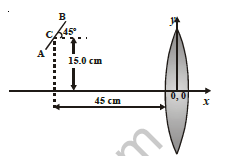
(a) where is the image of the pencil formed. (Give the location of the images of the points A, B and C w.r.t. coordinate system shown in the figure)
(b) what is the length of the image (the distance between the images of points A and B).
2. Two converging lenses of the same focal length f are separated by distance 2f. The axis of the second lens is inclined at angle θ = 60º with respect to the axis of the first lens. A parallel paraxial beam of light is incident from left side of the lens. Find the coordinates of the final image with respect to optical centre of firs lens as origin.
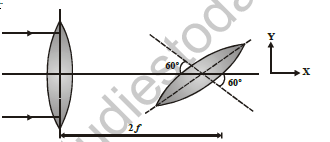
3. A double convex lens forms a real image of an object on a screen which is fixed. Now the lens is given a constat velocity v0 along its axis and away from the screen. For the purpose of forming the image always on the screen, the object is also required to be given appropriate velocity. Find the velocity of the object at the instant its size is n times the size of the image. (n < 1).
4. A ray of light is incident on the surface of a sphere of refractive index √7 /2 . Other half of the sphere is silvered. After refraction it is reflected and then refracted out of the sphere again such that the total deviation is minimum. Find :
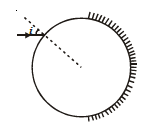
(a) the angle of incidence of the ray i
(b) total deviation of the ray,(sin 41º = √3/7) .
5. The refracting angle of prism is 60º. A ray of light passing through the prism undergoes a deviation of 30º. If the prism is rotated keeping the incident ray fixed through an angle 30º, the same deviation is again obtained. Calculate the refractive index of the prism.
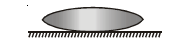
6. A thin biconvex lens of refractive index 3/2 is placed on a horizontal plane mirror as shown in the figure. The space between the lens and the mirror is then filled with water of refractive index 4/3. It is found that when a point object is placed 15 cm above the lens on its principal axis, the object coincides with its own image. On repeating with another liquid, the object and the image again coincide at a distance 25 cm from the lens. Calculate the refractive index of the liquid.
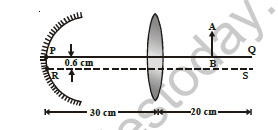
7. A convex lens of focal length 15 cm and a concave mirror of focal length 30 cm are kept with their optic axis PQ and RS parallel but separated in vertical direction by 0.6 cm as shown. The distance between the lens and mirror is 30 cm. An upright object AB of height 1.2 cm is placed on the optic axis PQ of the lens at a distance of 20 cm from the lens. If A′B′ is the image after refraction from the lens and the reflection from the mirror, find the distance of A′B′ from the pole of the mirror and obtain its magnification. Also locate positions of A′ and B′ with respect to the optic axis RS
8. The X-Y plane is the boundary between two transparent media. Medium-1 with z ≥ 0 has a refractive index √2 and medium-2 with z ≤ 0 has a refractive index √3 . A ray of light in medium-1 given by vector A = 6 √3 iˆ + 8 √3 ˆj –10 kˆ is incident on the plane of separation. Find the unit vector in the direction
of the refracted ray in medium-2
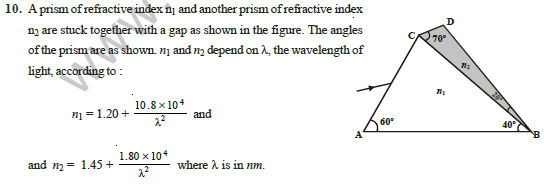
(a) Calculate the wavelength λ0 for which rays incident at any angle on the interface BC pass through without bending at that interface.
(b) For light of wavelength λ0, find the angle of incidence i on the face AC such that the deviation produced by the combination of prisms is minimum.
Please click on below link to download pdf file for CBSE Class 12 Physics Optics Advanced Problems.
Free study material for Physics
Free CBSE Study Guides: Class 12 Physics Chapter 09 Ray Optics and Optical Instruments
Core Study Kit: Class 12 Physics Chapter 09 Ray Optics and Optical Instruments
Explore essential learning tools for Class 12 Physics Chapter 09 Ray Optics and Optical Instruments. This curated collection features in-depth notes and targeted practice questions built around the active 2026 curriculum to streamline your daily revision.
NCERT-Aligned Solutions for Chapter 09 Ray Optics and Optical Instruments
Designed around the official curriculum, these study guides guarantee standard compliance. Reviewing step-by-step solutions clarifies complex sub-topics within Chapter 09 Ray Optics and Optical Instruments and demystifies standard marking schemes for Physics evaluations.
Next Steps in Your Exam Preparation
Maximize your grade potential by utilizing Class 12 Physics practice papers in tandem with these structured notes. All printable assignments and interactive mock tests on our platform are updated for the 2026 session and available free of charge.
FAQs
Our advanced study package for Chapter 09 Ray Optics and Optical Instruments includes detailed concepts, diagrams, Mind Maps, and explanation of complex topics to ensure Class 12 students learn as per syllabus for 2026 exams.
The Mind Maps provided for Chapter 09 Ray Optics and Optical Instruments act as visual anchors which will help faster recall during high-pressure exams.
Yes, teachers use our Class 12 Physics resources for lesson planning as they are in simple language and have lot of solved examples.
Yes, You can download the complete, mobile-friendly PDF of the Physics Chapter 09 Ray Optics and Optical Instruments advanced resources for free.
Yes, our subject matter experts have updated the Chapter 09 Ray Optics and Optical Instruments material to align with the rationalized NCERT textbooks and have removed deleted topics and added new competency-based questions.