

Advanced Study Material for Class 12 Physics: Chapter 09 Ray Optics and Optical Instruments
Review targeted academic resources with the CBSE Class 12 Physics Optical Instrument Theory and Examples. Built according to official CBSE standards for the 2026-27 term, these downloadable Class 12 Physics study materials support effective daily practice and deeper conceptual understanding for Chapter 09 Ray Optics and Optical Instruments.
Practice Class 12 Physics Resources: Chapter 09 Ray Optics and Optical Instruments
Navigate directly to the advanced Physics study materials using the digital viewer below. Each resource pack includes detailed conceptual summaries and solved practice questions, allowing students to instantly reinforce their learning.
CBSE Class 12 Physics Optical Instrument Theory and Examples. Please refer to the examination notes which you can use for preparing and revising for exams. These notes will help you to revise the concepts quickly and get good marks.
1. INTRODUCTION
1.1 Definition
Optical instruments are used primarily to assist the eye in viewing an object.
1.2 Types of Instruments
Depending upon the use , optical instruments can be categorised in the following way :

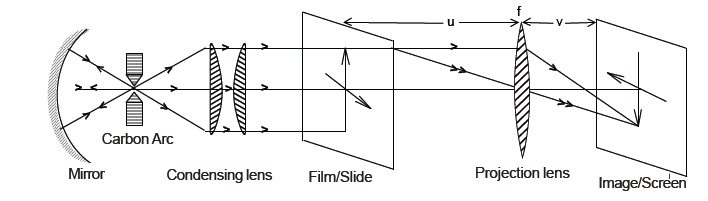
2. FILM OR SLIDE PROJECTOR
It projects real, inverted and magnified image of an object, when the object is placed between F & 2F and screen between 2F and ∞ .
2.1 Magnification :
If the sides of slide are a and b and magnification of projection lens is m , each side will become m times so that the area of image formed. Ai = ma x mb = m2 ab = m2A0
2.2 Intensity :
As area of image becomes m2 times that of object, the intensity of image will become 1/m2 times that of object, as
IA0 = Ii Ai = Ii m2 A0 Ii = ( I/ m2)
Ex.1 A slide projector lens has a focal length 10 cm. It throws an image of a 2cm x 2 cm slide on a screen 5 m from the lens. Find (a) the size of the picture on the screen and (b) the ratio of illumination of the slide and the picture on the screen.
Sol. (a) As here f = 10 cm and v = 5m = 500 cm
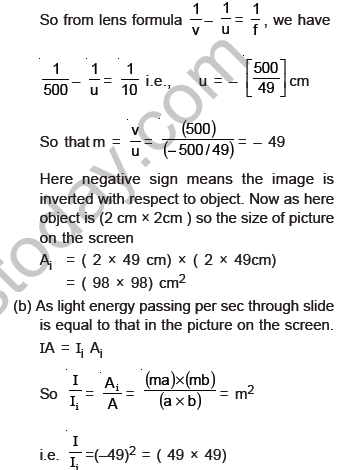
i.e. intensity in picture on the screen will be [1/(49x49)] times lesser than that on the slide. This is why in case of projector for observing image on a screen the source of light must be very powerful and the room dark.
3. CAMERA
Camera is of two types viz. pin hole camera and lens camera.
3.1 Pinhole Camera :
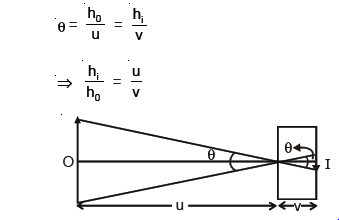
It is based on recti linear propagation of light and forms real, inverted image on the screen.
Note :
The image formed on the screen is neither a shadow ( as it is not dark) nor a true image ( as the rays do not intersect each other and can not be seen as an aerial image in absence of screen.
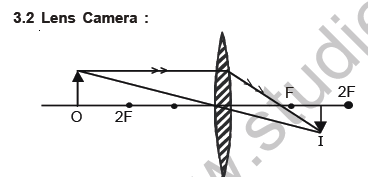
In it a converging lens whose aperture anddistance from the film can be adjusted is used. Usually object is real and between ∞ and 2F;so the image is real, inverted, diminished and between F and 2F.
(A) Exposure :
For a particular film, a definite amount of light energy must i.e. incident on the film for proper exposure. i.e., I x S x t = constant where, I = intensity of light, S = area of aperture of lens and t is the exposure time. i.e. ID2 t = constant where D = aperture
(B) f- number:
It is the ratio of focal length to the aperture of lens. i.e. f - no. = f/D
Camera
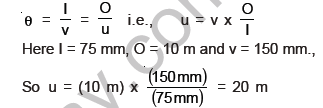
Ex.2 A pinhole camera with 75 mm high film is to be used to take a picture of a 10 m high tree. The film is 150 mm from the pinhole. How far should the camera be from the tree to include the full height of the tree?
Sol. In case of pinhole camera
4. MICROSCOPE
It is an optical instrument used to increase the visual angle of near objects which are too small to be seen by naked eye. Microscopes are of two types viz. simple microscope and compound microscope.
4.1 Simple Microscope :
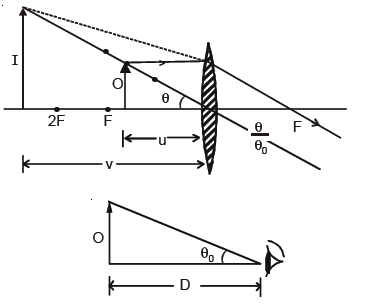
It is also known as magnifying glass or magnifier and consists of a convergent lens with object between its focus and optical centre and eye close to it. The image formed by it is erect, virtual, enlarged and on same side of lens between object and infinity.
Please click on below link to download pdf file for CBSE Class 12 Physics Optical Instrument Theory and Examples.
Free study material for Physics
Free CBSE Study Guides: Class 12 Physics Chapter 09 Ray Optics and Optical Instruments
Comprehensive Study Resources for Chapter 09 Ray Optics and Optical Instruments
Review targeted study resources for Chapter 09 Ray Optics and Optical Instruments tailored for Class 12 learners. Utilizing these structured notes and quick-revision tools ensures complete alignment with current CBSE evaluation standards.
Understanding Marking Schemes
Designed around the official curriculum, these study guides guarantee standard compliance. Reviewing step-by-step solutions clarifies complex sub-topics within Chapter 09 Ray Optics and Optical Instruments and demystifies standard marking schemes for Physics evaluations.
Complete Revision for Physics
Maximize your grade potential by utilizing Class 12 Physics practice papers in tandem with these structured notes. All printable assignments and interactive mock tests on our platform are updated for the 2026 session and available free of charge.
FAQs
Our advanced study package for Chapter 09 Ray Optics and Optical Instruments includes detailed concepts, diagrams, Mind Maps, and explanation of complex topics to ensure Class 12 students learn as per syllabus for 2026 exams.
The Mind Maps provided for Chapter 09 Ray Optics and Optical Instruments act as visual anchors which will help faster recall during high-pressure exams.
Yes, teachers use our Class 12 Physics resources for lesson planning as they are in simple language and have lot of solved examples.
Yes, You can download the complete, mobile-friendly PDF of the Physics Chapter 09 Ray Optics and Optical Instruments advanced resources for free.
Yes, our subject matter experts have updated the Chapter 09 Ray Optics and Optical Instruments material to align with the rationalized NCERT textbooks and have removed deleted topics and added new competency-based questions.