

Download CBSE Class 12 Physics Useful Resources
Access comprehensive study materials and useful resources for Chapter 06 Electromagnetic Induction using the CBSE Class 12 Physics Magnetic Effect of Current Theory and Examples. Designed to align with the 2026-27 CBSE academic guidelines, these advanced resources help Class 12 Physics students reinforce core concepts beyond standard textbooks.
Access CBSE Study Guides and Summaries
View or download the dedicated CBSE Class 12 Physics Magnetic Effect of Current Theory and Examples resource below. Engaging with these advanced study guides under focused conditions ensures continuous academic progress and mastery of the 2026-27 curriculum for Chapter 06 Electromagnetic Induction.
CBSE Class 12 Physics Magnetic Effect of Current Theory and Examples. Please refer to the examination notes which you can use for preparing and revising for exams. These notes will help you to revise the concepts quickly and get good marks.
1. OERSTED EXPERIMENT (1820)
(a) Oersted found that a magnetic field is established around a current carrying conductor.
(b) Magnetic field exists as long as there is current in the wire.
(c) It is concluded that moving charges produce magnetic field in the surrounding space.
(d) A moving charge produces magnetic as well as electric field, unlike a stationary charge which only produces electric field.
(e) The direction of magnetic field was found to be changed when direction of current was reversed.
2. MAGNETIC FIELD OR MAGNETIC INDUCTION OR INTENSITY OF MAGNETIC FIELD(→B )
(a) The field produced by flow of current or charge in a conductor is called magnetic field.
(b) This is a vector quantity.
(c) Unit : CGS – Gauss or Maxwell / cm2
MKS – Tesla or Weber / m2 or N/Amp-meter
1 Tesla = 1 weber / m2 = 104 Gauss
= 104 Maxwell / cm2
(d) Magnetic field is shown by magnetic lines of force.
3. MAGNETIC LINES OF FORCE
(a) These are the imaginary closed curves drawn in magnetic field, which represent the direction of the magnetic field.
(b) The tangent drawn at any point on a line of force shown the direction of magnetic field at that point.
3.1 Properties:
(i) The magnetic lines of force always starts from the north pole and following a curved path enter the south pole and reach back the north pole inside the magnet. Thus these are
closed curve. Fig (a) - Magnetic lines of force due to current carrying solenoid.
Note : Electric lines of force are not closed curves.
(ii) Two lines of force never intersect each other.
(iii) Larger the number of lines of force at a given point, stronger is the magnetic field at the point.
Note : At poles there are maximum number of lines of force.
4. BIOT - SAVERT LAW
(i) Biot - Savart - a French scientist in 1820 gave a law to study the magnetic field generated by an infinitesimal element of a current carrying conductor at a point P.
(ii) Let the infinitesimal element be of length 'dl' and magnetic field at P be dB, then
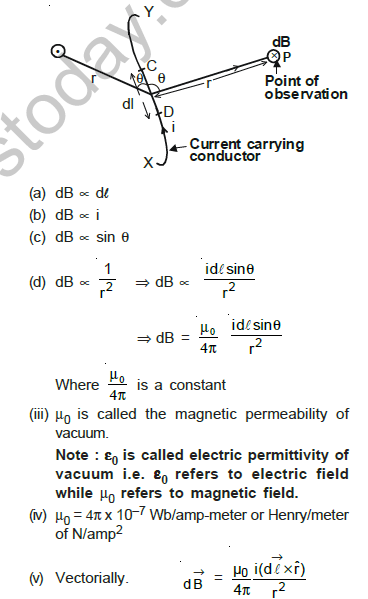
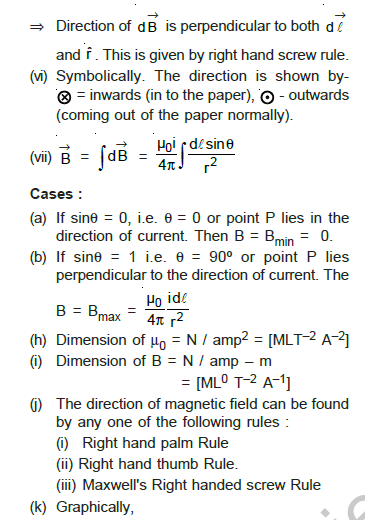
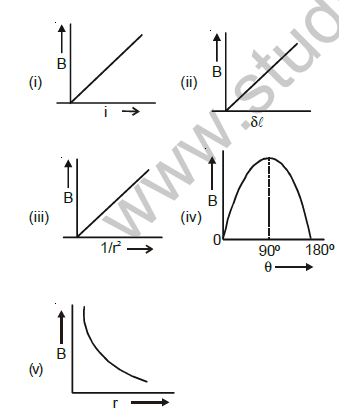
(l) Direction of magnetic field : The direction of magnetic field is determined with the help of the following simple laws :
(i) Maxwell’s cork screw rule : According to this law if a right handed cork screw is rotated in such a way that it moves forward in the direction of current in the conductor, then the direction of the rotation of the screw will show the direction of lines of force. [fig . (a)]
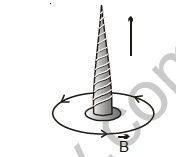
(ii) Right hand palm rule : According to this rule if a current carrying conductor is held in the right hand such that the thumb of the hand represents the direction of current flow, then the direction of folding fingers will represent the direction of magnetic lines of force. [Fig. (b)]

(iii) Right hand palm rule of circular currents : According to this rule if the direction of current in circular conducting coil is in the direction of folding fingers of right hand, then the
direction of magnetic field will be in the direction of stretched thumb. [Fig. (c)]
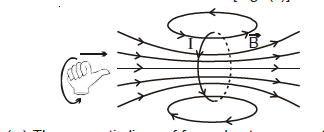
(m) The magnetic lines of force due to a current carrying element are in the form of concentric circles with their centres at the element.
Note : Biot - Savart law in terms of current density j
Please click on below link to download pdf file for CBSE Class 12 Physics Magnetic Effect of Current Theory and Examples.
Free study material for Physics
Physics Class 12 Exam Resources: Chapter 06 Electromagnetic Induction
Essential Notes for Class 12 Physics
Access comprehensive study material for Chapter 06 Electromagnetic Induction, including revision notes, concept maps, and high-probability questions. These resources are designed in alignment with the latest 2026 CBSE syllabus for Class 12 Physics to support effective exam preparation.
Verified Solutions for Class 12 Physics
Built using official NCERT guidelines for Class 12 Physics, these materials provide reliable academic support. Integrating past examination questions and step-by-step solutions helps students understand official CBSE grading criteria.
Enhance Accuracy with Online Tests
For peak performance in upcoming evaluations, integrate official Physics sample papers directly into your study schedule. Follow up your revision by attempting online MCQ tests for Chapter 06 Electromagnetic Induction to refine calculation speed and precision.
FAQs
Our advanced study package for Chapter 06 Electromagnetic Induction includes detailed concepts, diagrams, Mind Maps, and explanation of complex topics to ensure Class 12 students learn as per syllabus for 2026 exams.
The Mind Maps provided for Chapter 06 Electromagnetic Induction act as visual anchors which will help faster recall during high-pressure exams.
Yes, teachers use our Class 12 Physics resources for lesson planning as they are in simple language and have lot of solved examples.
Yes, You can download the complete, mobile-friendly PDF of the Physics Chapter 06 Electromagnetic Induction advanced resources for free.
Yes, our subject matter experts have updated the Chapter 06 Electromagnetic Induction material to align with the rationalized NCERT textbooks and have removed deleted topics and added new competency-based questions.