

Advanced Study Material for Class 12 Physics: Chapter 02 Electrostatic Potential and Capacitance
Review targeted academic resources with the CBSE Class 12 Physics Electrostatics Exam Notes. Built according to official CBSE standards for the 2026-27 term, these downloadable Class 12 Physics study materials support effective daily practice and deeper conceptual understanding for Chapter 02 Electrostatic Potential and Capacitance.
Practice Class 12 Physics Resources: Chapter 02 Electrostatic Potential and Capacitance
Navigate directly to the advanced Physics study materials using the digital viewer below. Each resource pack includes detailed conceptual summaries and solved practice questions, allowing students to instantly reinforce their learning.
Coulomb’s Law
The force of attraction or repulsion between two stationary point charges in vacuum or free space is directly proportional to the product of charges and inversely proportional to the square of distance between these charges.
If q1 and q2 are the magnitudes of two point charges separated by a distance r, the force F due to interaction is given by:


If a force on a point charge q1 is exerted by a large body with charge q, the force dF is found by dividing charge q into infinitesimally small charge dq located at a distance r from q1 as :

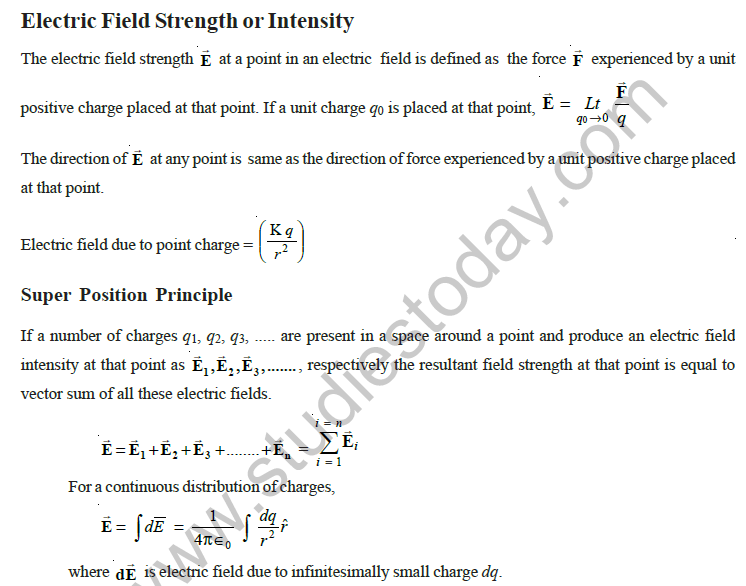

Question. Three positive charges of equal value q are placed at the vertices of an equilateral triangle. The resulting lines of force should be sketched as in:

Answer : C
Question. A metallic sphere is placed in a uniform electric field. The lines of force follow the path (s) shown in the figure as:
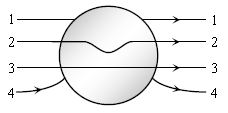
a. 1
b. 2
c. 3
d. 4
Answer : D
Question. In x-y co-ordinate system if potential at a point P(x, y) is given by V = axy ; where a is a constant, if r is the distance of point P from origin then electric field at P is proportional to:
a. r
b. r–1
c. r–2
d. r2
Answer : A
Question. The electric potential V at any point x, y, z (all in metres) in space is given by V = 4x2 volt. The electric field at the point (1m, 0, 2m) in volt/metre is:
a. 8 along negative X-axis
b. 8 along positive X-axis
c. 16 along negative X-axis
d. 16 along positive Z-axis
Answer : A
Question. The electric potential V is given as a function of distance x (metre) by V = (5x2 + 10x – 9) volt. Value of electric field at x = 1m is
a. – 20 V/m
b. 6 V/m
c. 11 V/m
d. – 23 V/m
Answer : A
Question. A uniform electric field having a magnitude E0 and direction along the positive X-axis exists. If the electric potential V, is zero at X = 0, then, its value at X = + x will be:
a. V(x) = + xE0
b. V(x) = – xE0
c. V(x) = x2E0
d. V(x) = – x2E0
Answer : B
Question. If the potential function is given by V = 4x + 3y, then the magnitude of electric field intensity at the point (2, 1) will be:
a. 11
b. 5
c. 7
d. 1
Answer : B
Question. A charge q is placed at the centre of the line joining two equal charges Q. The system of the three charges will be in equilibrium. If q is equal to:
a. − (Q/2)
b. − (Q/4)
c. + (Q/4)
d. − Q/2
Answer : B
Question. The lines of force of the electric field due to two charges q and Q are sketched in the figure. State if:
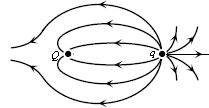
a. Q is positive and │Q│ > │q│
b. Q is negative and │Q > │q│
c. q is positive and │Q│ < │q│
d. q is negative and │Q│ < │q│
Answer : C
Question. A charged water drop of radii 0.1μm is under equilibrium in some electric field. The charge on the drop is equivalent to electronic charge. The intensity of electric field is:
a. 1.61 N / C
b. 25.2 N / C
c. 262 N / C
d. 1610 N / C
Answer : C
Question. Two similar charges of +Q as shown in figure are placed at points A and B. – q charge is placed at point C midway between A and B. – q charge will oscillate if:
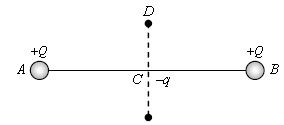
a. It is moved towards A
b. It is moved towards B
c. It is moved along CD
d. Distance between A and B is reduced
Answer : C
Question. Two point charges (+Q) and (– 2Q) are fixed on the X- axis at positions a and 2a from origin respectively. At what position on the axis, the resultant electric field is zero:
a. Only x = √2 a
b. Only x = − √2 a
c. Both x = ± √2 a
d. x = 3a/2 only
Answer : B
Question. The electric field, at a distance of 20 cm from the centre of a dielectric sphere of radius 10 cm is 100 V/m. The ‘E’ at 3 cm distance from the centre of sphere is:
a. 100 V/m
b. 125 V/m
c. 120 V/m
d. Zero
Answer : C
Question. Two point charges +4q and +q are placed at a distance L apart. A third charge Q is so placed that all the three charges are in equilibrium. Then location and magnitude of third charge will be:
a. At a distance L/3 from +4q charge,4q/9
b. At a distance L/3 from +4q charge- 4q/9
c. At a distance L/3 from +4q charge, - 4q/9
d. At a distance 2L/3 from +q charge, + 4q/9
Answer : C
Question. A drop of 6 10−6 kg water carries 6 10−6 C charge. What electric field should be applied to balance it’s weight: (assume g = 10 m/sec2)
a. 10 V /m, Upward
b. 10 V /m, Downward
c. 0.1 V/m Downward
d. 0.1V /m, Upward
Answer : A
Question. A charge (–q) and another charge (+Q) are kept at two points A and B respectively. Keeping the charge (+Q) fixed at B, the charge (–q) at A is moved to another point C such that ABC forms an equilateral triangle of side l. The network done in moving the charge (–q) is:
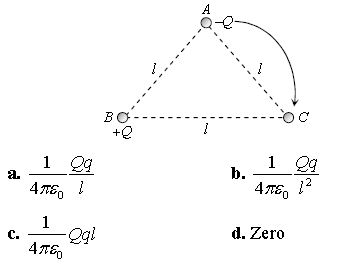
Answer : D
Please click on below link to download pdf file for CBSE Class 12 Physics Electrostatics Exam Notes.
Free study material for Physics
Physics Class 12 Exam Resources: Chapter 02 Electrostatic Potential and Capacitance
Comprehensive Study Resources for Chapter 02 Electrostatic Potential and Capacitance
Explore essential learning tools for Class 12 Physics Chapter 02 Electrostatic Potential and Capacitance. This curated collection features in-depth notes and targeted practice questions built around the active 2026 curriculum to streamline your daily revision.
Understanding Marking Schemes
Each resource draws directly from authorized textbooks to maintain academic accuracy. Evaluating solved examples allows Class 12 students to master the formal presentation and answer-writing standards expected in upcoming school exams.
Complete Revision for Physics
Wrap up your chapter revision by testing your knowledge against standard objective question formats. Explore our full library of free, up-to-date sample papers and online assessments to secure top grades in your CBSE examinations.
FAQs
Our advanced study package for Chapter 02 Electrostatic Potential and Capacitance includes detailed concepts, diagrams, Mind Maps, and explanation of complex topics to ensure Class 12 students learn as per syllabus for 2026 exams.
The Mind Maps provided for Chapter 02 Electrostatic Potential and Capacitance act as visual anchors which will help faster recall during high-pressure exams.
Yes, teachers use our Class 12 Physics resources for lesson planning as they are in simple language and have lot of solved examples.
Yes, You can download the complete, mobile-friendly PDF of the Physics Chapter 02 Electrostatic Potential and Capacitance advanced resources for free.
Yes, our subject matter experts have updated the Chapter 02 Electrostatic Potential and Capacitance material to align with the rationalized NCERT textbooks and have removed deleted topics and added new competency-based questions.