

Download CBSE Class 12 Physics Useful Resources
Review targeted academic resources with the CBSE Class 12 Physics Radiation Solved Examples. Built according to official CBSE standards for the 2026-27 term, these downloadable Class 12 Physics study materials support effective daily practice and deeper conceptual understanding for Radiation.
Access CBSE Study Guides and Summaries
View or download the dedicated CBSE Class 12 Physics Radiation Solved Examples resource below. Engaging with these advanced study guides under focused conditions ensures continuous academic progress and mastery of the 2026-27 curriculum for Radiation.
This Class 12 Physics set of solved examples on Radiation covers Fraunhofer lines, black body radiation, Wien's displacement law, Stefan's law, emission and absorption by blackened surfaces, Newton's law of cooling, heat conduction through a slab and the radiation from the Sun, with each multiple choice question worked out step by step.
SOLVED EXAMPLES: RADIATION
Ex.1 In a solar spectrum dark lines (fraunhofer lines) are obtained due to
(A) absorption
(B) reflection
(C) emission
(D) transmission
Answer: (A) absorption
1. Fraunhofer lines are dark lines in the solar spectrum.
2. They are obtained because certain characteristic radiations are absorbed by the atoms of the cooler gases in the outer atmosphere of the Sun.
3. Hence the correct answer is (A).
Teacher's Note:
a) Dark lines mean absorption, while bright lines mean emission.
b) Common mistake: confusing dark Fraunhofer lines with emission lines.
Ex.2 Fraunhofer lines are explained by
(A) Provosts theory of heat exchanges
(B) Newton's law of cooling
(C) Stefan's law
(D) Kirchoft's law
Answer: (D) Kirchhoff's law
1. Fraunhofer lines are explained on the basis of Kirchhoff's law.
2. Hence the correct answer is (D).
Teacher's Note:
a) Kirchhoff's law states that a body which absorbs a radiation also emits the same radiation at the same temperature.
b) Remember that Kirchhoff's law links the absorption and emission of radiation.
Ex.3 The nature of radiation emitted by a black body depends only on -
(A) the shape of a body
(B) the nature of a body
(C) the temperature of a body
(D) the medium
Answer: (C) the temperature of a body
1. The radiation emitted by a black body depends only upon its temperature.
2. Hence the correct answer is (C).
Teacher's Note:
a) A black body is an ideal absorber and emitter, so its material and shape do not matter.
b) Common mistake: thinking that the colour or material of the body changes the spectrum.
Ex.4 Two identical balls of wax are attached on the outer surface of two tin sheets. The inner surface of P is coated with lamp black and that of Q is polished. If a source of heat is placed between P and Q then which ball will melt first
(A) Q ball
(B) P ball
(C) both simultaneously
(D) nothing can be predated
Answer: (B) P ball
1. The inner surface of P is coated with lamp black, which is a good absorber of heat.
2. The inner surface of Q is polished, which is a poor absorber and a good reflector.
3. Hence the P ball receives more heat and melts first, and the correct answer is (B).
Teacher's Note:
a) Black or dull surfaces are good absorbers and good emitters of heat.
b) Polished surfaces reflect most of the heat, so they absorb very little.
Ex.5 Energy spectrum of radiations emitted by a black body is
(A) line spectrum
(B) continuous spectrum
(C) bond spectrum
(D) line and continuous spectrum
Answer: (B) continuous spectrum
1. A black body emits radiation of all wavelengths.
2. The energy spectrum of its radiation is therefore continuous.
3. Hence the correct answer is (B).
Teacher's Note:
a) A line spectrum comes from excited atoms, not from a black body.
b) Common mistake: choosing the line spectrum because it is seen in atomic emission.
Ex.6 If the rate of emission of radiation from a body is equal to the rate of absorbing, then the temperature of the body will be -
(A) less than the temperature of the surrounding
(B) greater then the temperature of the surrounding
(C) equal to the temperature of the surrounding
(D) nothing can be said
Answer: (C) equal to the temperature of the surrounding
1. When the rate of emission equals the rate of absorption, the body is in thermal equilibrium.
2. In thermal equilibrium the body and its surrounding have the same temperature.
3. Hence the correct answer is (C).
Teacher's Note:
a) Thermal equilibrium means no net heat flow between the body and its surroundings.
b) A body hotter than its surroundings would emit more than it absorbs.
Ex.7 For the analysis of spectral energy of thermal radiations emitted by a body the prism used made of
(A) quartz
(B) crown glass
(C) flint glass
(D) rock salt
Answer: (D) rock salt
1. A prism of rock salt is used because it does not absorb thermal radiation.
2. All the other materials absorb thermal radiation, so the spectrum is not obtained.
3. Hence the correct answer is (D).
Teacher's Note:
a) Thermal radiation lies largely in the infrared region, where glass and quartz absorb strongly.
b) Rock salt is transparent to infrared radiation, which is why it is used.
Ex.8 If the temperature of a body is increased by 50%, then the increase in the amount of radiation emitted by it will be :
(A) 500%
(B) 400%
(C) 200%
(D) 100%
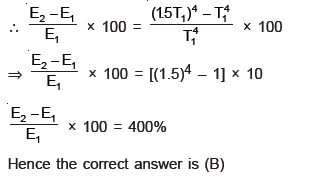
Answer: (B) 400%
1. Stefan's law gives the energy radiated as E ∝ T⁴.
2. Let the initial temperature be T₁ and the final temperature be T₂ = 1.5 T₁.
3. Percentage increase = (E₂ - E₁)/E₁ × 100 = [(1.5)⁴ - 1] × 100.
4. = (5.0625 - 1) × 100 ≈ 406%, which is closest to 400%.
5. Hence the correct answer is (B).
Teacher's Note:
a) Because of the fourth power, a 50% rise in temperature gives a rise of about 400% in the radiation.
b) Common mistake: taking the increase in radiation to be proportional to the temperature increase, which gives only 50%.
Ex.9 A blackened platinum wire of length 5cm and perimeter 0.02cm is maintained at atemperature of 300K. Then at what rate the wire is losing its energy?
(A) 4.62 W
(B) 0.462W
(C) 46.2W
(D) 4620W
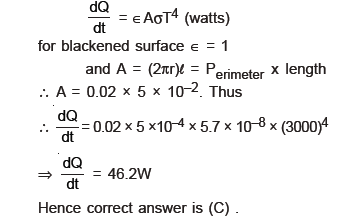
Answer: (C) 46.2 W
1. The rate of radiation heat loss is dQ/dt = εAσT⁴ (watts). For a blackened surface ε = 1 and A = (2πr)l = perimeter × length, so A = 0.02 × 5 × 10⁻².
2. dQ/dt = 0.02 × 5 × 10⁻⁴ × 5.7 × 10⁻⁸ × (3000)⁴
3. dQ/dt = 46.2 W
4. Hence correct answer is (C).
Teacher's Note:
a) For a blackened surface the emissivity is 1, so the surface radiates as a black body.
b) Use absolute temperature in Stefan's law and keep all lengths in the same unit system.
Ex.10 A blackened sphere of radius 10cm at a temperature 227ºC is placed in a chamber with blackened wall, maintained at 27ºC. Calculate the rate of loss of heat ?
(A) 9.224 cal/s
(B) .9224 cal/s
(C) 922.4 cal/s
(D) 92.24 cal/s
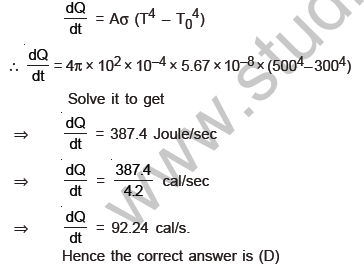
Answer: (D) 92.24 cal/s
1. Temperatures in kelvin: T = 227 + 273 = 500 K and T₀ = 27 + 273 = 300 K.
2. Surface area A = 4πr² = 4π × (0.1 m)² = 0.1257 m².
3. dQ/dt = Aσ(T⁴ - T₀⁴) = 0.1257 × 5.67 × 10⁻⁸ × (500⁴ - 300⁴) ≈ 387.4 J/s.
4. Converting: dQ/dt = 387.4 / 4.2 = 92.24 cal/s.
Teacher's Note:
a) Use absolute temperatures in Stefan's law, never the Celsius values.
b) Common mistake: forgetting to subtract the radiation absorbed from the chamber, which gives the net loss.
Ex.11 A blackened metal disc is held normal to the sun's rays, Both of its surfaces are exposed to atmosphere if the distance of earth from sun is 216 times the radius of sun and the temperature of sun is 6000K, the temperature of the disc in steady state will be -
(A) 80ºC
(B) 70ºC
(C) 60ºC
(D) 50ºC
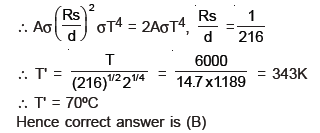
Answer: (B) 70ºC
1. In the steady state, heat absorbed from the sun equals the heat radiated from both faces of the disc.
2. Heat absorbed: (R/d)² σT⁴ × area, where d = 216R, so (R/d)² = 1/216².
3. Heat radiated from both sides: 2 × area × σT′⁴.
4. So T′⁴ = T⁴ / (2 × 216²), giving T′ = 6000 / (216^(1/2) × 2^(1/4)) = 6000 / 17.48 ≈ 343 K.
5. T′ = 343 - 273 = 70ºC. Hence the correct answer is (B).
Teacher's Note:
a) The disc radiates from both faces but receives heat only on one face.
b) Common mistake: using the distance ratio without squaring it, which gives an incorrect temperature.
Ex.12 In the above problem, if the heat capacity (thermal capacity) of the sphere is 1000 cal/ºC then what is the rate of cooling of the sphere ?
(A) 55ºC/min
(B) 55ºC/min
(C) 550ºC/min
(D) 5.5ºC/min
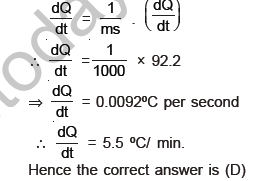
Answer: (D) 5.5ºC/min
1. Heat capacity of the sphere ms = 1000 cal/ºC.
2. Rate of loss of heat from the previous problem dQ/dt = 92.24 cal/s.
3. Rate of cooling dT/dt = (1/ms) × dQ/dt = 92.24 / 1000 = 0.0922 ºC per second.
4. Converting to minutes: 0.0922 × 60 ≈ 5.5 ºC per minute.
5. Hence the correct answer is (D).
Teacher's Note:
a) The printed working shows 0.0092 ºC per second at one step, which is a slip; 92.24/1000 is 0.0922 ºC per second.
b) Two options in the printed question are identical; the value 5.5 ºC/min is the only one that matches.
Ex.13 A slab of stone of area 3600 sq cm. and thickens 10cm is exposed on the lower surface to steam at 100ºC, block of ice is melted in one hour. The thermal conductivity of stone is (in cal/cm-ºC) given (latent heat of ice = 80 cal/gm)
(A) 0.003
(B) 0.03
(C) 0.3
(D) none of these
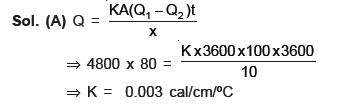
Answer: (A) 0.003
1. Heat conducted: Q = KA(θ₁ - θ₂)t / x.
2. Heat used to melt the ice = mass × latent heat = 4800 g × 80 cal/g = 384000 cal (the mass of 4800 g is taken from the original solution, as it is not printed in the question).
3. Here A = 3600 cm², θ₁ - θ₂ = 100 - 0 = 100ºC, t = 3600 s and x = 10 cm.
4. 4800 × 80 = K × 3600 × 100 × 3600 / 10, so K = 0.003 cal/cm/ºC. Hence the correct answer is (A).
Teacher's Note:
a) The mass of ice is needed for the calculation but is not printed in the question; state it clearly in class.
b) Always convert the time to seconds when the answer is in cal/cm/s/ºC, and check the units of each term.
Ex.14 Behaving like a black body sun emits maximum radiation at wavelength 0.48μm. The mean radius of the sun is 6.96 x 10⁸m. Stefan's constant is 5.67 × 10⁻⁸ wm⁻²k⁻⁴ and Wien's constant is 0.293 cm-k. The loss of mass per second by the emission of radiation from sun is -
(A) 5.32 × 10⁹ kg/s
(B) 6.24 × 10¹⁰ kg/s
(C) 8.65 × 10¹² kg/s
(D) 2.46 × 10¹⁴ kg/s
Answer: (A) 5.32 × 10⁹ kg/s
1. Wien's law: T = b/λm = 0.293 × 10⁻² m K / (0.48 × 10⁻⁶ m) = 6104 K.
2. Energy emitted per second: E = 4πR²σT⁴ = 4π(6.96 × 10⁸)² × 5.67 × 10⁻⁸ × (6104)⁴ ≈ 4.79 × 10²⁶ J/s.
3. Loss of mass per second: m = E/c² = 4.79 × 10²⁶ / (9 × 10¹⁶) = 5.32 × 10⁹ kg/s.
4. Hence the correct answer is (A).
Teacher's Note:
a) The printed working writes the energy as 49.285 × 10²⁵ J, which is a scaling slip; the value is 4.79 × 10²⁶ J.
b) Use the Wien constant in metre-kelvin units to avoid an error of 100 in the temperature.
Ex.15 If the E_λ-λ curve for a black body at temperature T is as shown in the figure, then curve at temperature 2T will be
[Figure: Left: graph of E_λ against λ for a black body at temperature T, a single smooth peak at moderate wavelength labelled T. Options: four graphs of E_λ against λ each labelled 2T. Graph (A) has a tall peak at a moderate wavelength; graph (B) has a steep rise to a peak at a short wavelength and a long tail; graph (C) has a tall, narrow peak at a short wavelength and a falling tail; graph (D) has a low, broad peak at a long wavelength.]
(A) graph A
(B) graph B
(C) graph C
(D) graph D
Answer: (C) graph C (peak higher and shifted to shorter wavelength)
1. The total energy of a black body varies as E_m ∝ T⁵ at the peak, so doubling T increases the peak height.
2. By Wien's displacement law, λm ∝ 1/T, so the peak shifts towards shorter wavelengths when T is doubled.
3. Hence the correct curve is the one with a higher peak at a shorter wavelength, which is (C). Hence the correct answer is (C).
Teacher's Note:
a) Wien's displacement law and the Stefan law both appear in this question.
b) Common mistake: picking the graph with the peak at a longer wavelength, which corresponds to a lower temperature.
Ex.16 Which part of E_λ-λ graph represents wien's -
(A) OA part
(B) BC part
(C) DE part
(D) FG part
Answer: (A) OA part
1. Wien's law is valid only in the short wavelength region of the spectrum.
2. The part OA of the curve lies in this short wavelength region, so it represents Wien's law.
3. Hence the correct answer is (A).
Teacher's Note:
a) Wien's law fails at long wavelengths, where the Rayleigh-Jeans law applies.
b) The peak at B is where Wien's displacement law gives the peak wavelength.
Ex.17 50g of water and an equal volume of alcohol (relative density 0.8) are placed one after the other in the same calorimeter. They are found to cool from 60ºC to 50ºC is 2 minutes and 1 minute respectively if the water equivalent of the calorimeter is 2g then what is the specific heat of the alcohol?
(A) 0.6 cal/gºC
(B) 6.0 cal/gºC
(C) 60 cal/gºC
(D) 600 cal/gºC
Answer: (A) 0.6 cal/gºC
1. Mass of water m_w = 50 g, and the mass of alcohol m_a = 50 × 0.8 = 40 g (equal volume, relative density 0.8).
2. Water equivalent of the calorimeter W = 2 g; specific heat of water = 1 cal/gºC.
3. S_alco = (1/m_alco) { (t_alco/t_w) [m_w + W] − W }.
4. S_alco = (1/40) { (1/2) [50 + 2] − 2 } = 24/40.
5. S_a = 24 / 40 = 0.6 cal/gºC. Hence the correct answer is (A).
Teacher's Note:
a) Equal volume means the mass of alcohol is not 50 g but 40 g.
b) Common mistake: forgetting to add the water equivalent of the calorimeter to both masses.
Sol.(B) in the steady state the heat received from sun will be equal to heat radiated out. Heat received from sun will be on one side only and it will radiate from both sides.
Free study material for Physics
Physics Class 12 Exam Resources: Radiation
Comprehensive Study Resources for Radiation
Access comprehensive study material for Radiation, including revision notes, concept maps, and high-probability questions. These resources are designed in alignment with the latest 2026 CBSE syllabus for Class 12 Physics to support effective exam preparation.
Understanding Marking Schemes
Built using official NCERT guidelines for Class 12 Physics, these materials provide reliable academic support. Integrating past examination questions and step-by-step solutions helps students understand official CBSE grading criteria.
Complete Revision for Physics
For peak performance in upcoming evaluations, integrate official Physics sample papers directly into your study schedule. Follow up your revision by attempting online MCQ tests for Radiation to refine calculation speed and precision.
FAQs
Our advanced study package for Radiation includes detailed concepts, diagrams, Mind Maps, and explanation of complex topics to ensure Class 12 students learn as per syllabus for 2026 exams.
The Mind Maps provided for Radiation act as visual anchors which will help faster recall during high-pressure exams.
Yes, teachers use our Class 12 Physics resources for lesson planning as they are in simple language and have lot of solved examples.
Yes, You can download the complete, mobile-friendly PDF of the Physics Radiation advanced resources for free.
Yes, our subject matter experts have updated the Radiation material to align with the rationalized NCERT textbooks and have removed deleted topics and added new competency-based questions.