

Download CBSE Class 12 Physics Useful Resources
Access comprehensive study materials and useful resources for Chapter 09 Ray Optics and Optical Instruments using the CBSE Class 12 Physics Optics Solved Examples. Designed to align with the 2026-27 CBSE academic guidelines, these advanced resources help Class 12 Physics students reinforce core concepts beyond standard textbooks.
Access CBSE Study Guides and Summaries
Navigate directly to the advanced Physics study materials using the digital viewer below. Each resource pack includes detailed conceptual summaries and solved practice questions, allowing students to instantly reinforce their learning.
CBSE Class 12 Physics Optics Solved Examples. Please refer to the examination notes which you can use for preparing and revising for exams. These notes will help you to revise the concepts quickly and get good marks.
SOLVED EXAMPLES
Ex.1 A person looking through the telescope T just sees the point A on the rim at the bottom of a cylindrical vessel when the vessel is empty. When the vessel is completely filled with a liquid of refractive index 1.5, he observes a mark at the centre B, of the bottom, without moving the telescope or the vessel. What is the height of the vessel if the diameter of its cross-section is 10 cm. ?

Sol.:
1. The vessel is filled with liquid of refractive index μ when the ray from B reaches the telescope.
2. μ sin i = 1.0 × sin r ....(i)
3. Here, angle r = angle ADC and angle i = angle BDC.
4. sin i = \( \frac{R}{\sqrt{R^2 + h^2}} \) and sin r = \( \frac{2R}{\sqrt{h^2 + (2R)^2}} \), where h is the height of the liquid and R is the radius of the cylinder.
5. Substituting in equation (i): μ × \( \frac{R}{\sqrt{R^2 + h^2}} \) = \( \frac{2R}{\sqrt{h^2 + (2R)^2}} \)
6. μ = \( \frac{2\sqrt{R^2 + h^2}}{\sqrt{h^2 + (2R)^2}} \)
7. Squaring: 4R²(μ² - 1) = h²(4 - μ²)
8. h = 2R \( \sqrt{\frac{\mu^2 - 1}{4 - \mu^2}} \)
9. h = 10 \( \sqrt{\frac{(1.5)^2 - 1}{4 - (1.5)^2}} \) = 10 \( \sqrt{\frac{5}{7}} \) = 8.45 cm
Teacher's Note:
a) The ray from B bends at the liquid surface, so both angles must be measured at the point D on the rim.
b) Use the diameter 10 cm, so the radius R is 5 cm and 2R is 10 cm.
c) Squaring removes the square roots, but check the sign of each term before you simplify.
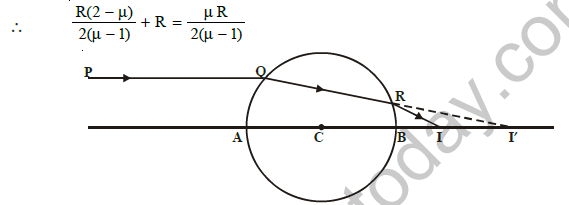
Ex.2 A parallel beam of light rays is incident on a transparent sphere of radius R and index of refraction μ in the direction of one of the diameters. At what distance from the centre of the sphere will the rays be focussed? Assume that μ less than 2.
Sol.:
1. For refraction at the first surface: μ1 = 1, μ2 = μ, u = -∞, v = ?, r = +R
2. \( \frac{\mu}{v} - \frac{1}{-\infty} = \frac{\mu - 1}{R} \), so v = \( \frac{\mu R}{\mu - 1} \)
3. For refraction at the second surface, I' is the object. Here μ1 = μ (light goes from the sphere to air) and μ2 = 1.
4. u = BI' = \( \frac{\mu R}{\mu - 1} - 2R \) = \( \frac{R(2 - \mu)}{\mu - 1} \) (positive, since light travels from left to right)
5. v = ?, r = -R
6. \( \frac{1}{v} - \frac{\mu(\mu - 1)}{R(2 - \mu)} = \frac{1 - \mu}{-R} \), so v = \( \frac{R(2 - \mu)}{2(\mu - 1)} \)
7. Distance of the focal point from the centre = v + R = \( \frac{R(2 - \mu)}{2(\mu - 1)} + R \) = \( \frac{\mu R}{2(\mu - 1)} \)
Teacher's Note:
a) Find the image formed by the first surface and use it as the object for the second surface.
b) Careful with the sign of the radius: the second surface is concave towards the incident light, so r = -R.
c) The final answer is measured from the centre, so add R to the distance from the second surface.
Ex.3 A hollow sphere of glass of refractive index μ has a small mark on its interior surface which is observed from a point outside the sphere on the side opposite the centre. The inner cavity in concentric with the external surface and the thickness of the glass is uniform and equal to the radius of the inner surface. Prove that the mark will appear nearer than it really is by a distance \( \frac{(\mu - 1)R}{(3\mu - 1)} \) where R is the radius of the inner surface.
Sol.:
1. For the refraction at the outer surface I: μ1 = 1, μ2 = μ, u = -2R, v = ?, r = -R
2. \( \frac{\mu}{v} - \frac{1}{-2R} = \frac{\mu - 1}{-R} \), so v = \( -\frac{2\mu R}{2\mu - 1} \)
3. I' is the object for the second surface. Here μ1 = μ and μ2 = 1.
4. u = -BI' = -\( \left( \frac{2\mu R}{2\mu - 1} + R \right) \) = -\( \frac{(4\mu - 1)R}{(2\mu - 1)} \)
5. v = ?, r = -2R
6. \( \frac{1}{v} - \frac{\mu(2\mu - 1)}{-(4\mu - 1)R} = \frac{1 - \mu}{-2R} \), so v = \( -\frac{2(4\mu - 1)R}{(3\mu - 1)} \)
7. Actual distance of O from B = 3R
8. Distance of the image I from B = \( \frac{2(4\mu - 1)R}{(3\mu - 1)} \)
9. Distance by which the mark appears nearer = 3R - \( \frac{2(4\mu - 1)R}{(3\mu - 1)} \) = \( \frac{(\mu - 1)R}{(3\mu - 1)} \)
10. Hence proved. This shows that the image I lies between I' and C.
Teacher's Note:
a) Solve the two refractions one after the other, using the image of the first surface as the object for the second.
b) Keep the signs consistent: distances on the side of incident light are negative.
c) The final shift simplifies neatly; check that the algebra leaves (mu - 1) in the numerator.
Ex.4 A parallel beam of light travelling in water (μ = 4/3) is refracted by a spherical air bubble of radius 2 mm situated in water. Assuming the light rays to be paraxial
(a) Find the position of the image due to refraction at the first surface and the position of final image.
(b) Draw a ray diagram showing the positions of both the images.
Sol.:
1. (a) For refraction at a single spherical surface: \( \frac{\mu_2}{v} - \frac{\mu_1}{u} = \frac{\mu_2 - \mu_1}{R} \)
2. Let P1 be the pole at the first surface and P2 the pole at the second surface.
3. At P1: μ1 = 4/3, μ2 = 1, R = +0.2 cm, u1 = ∞
4. \( \frac{1}{v_1} - \frac{4/3}{\infty} = \frac{1 - 4/3}{+0.2} \), so v1 = -0.6 cm
5. The first surface forms a virtual image I1 at 0.6 cm to the left of P1.
6. This image acts as the object for the second surface. At P2: μ1 = 1, μ2 = 4/3, R = -0.2 cm, u2 = -(0.6 + 0.4) = -1.0 cm
7. \( \frac{4/3}{v_2} - \frac{1}{-1.0} = \frac{4/3 - 1}{-0.2} \), so v2 = -0.5 cm
8. The final image I2 is formed 0.5 cm to the left of P2, that is 0.5 - 0.4 = 0.1 cm to the left of the first surface.
9. (b) The ray diagram is shown below.
Teacher's Note:
a) An air bubble in water acts as a diverging surface, so the first image is virtual.
b) Measure the distance of the second surface from the first image, which is 0.6 + 0.4 = 1.0 cm.
c) The final image is virtual, 0.1 cm to the left of the first surface, on the same side as the object.
Ex.5 An object O is placed at a distance of 15 cm from a convex lens A of focal length 10 cm and its image I1, is formed on a screen on the other side of the lens. A concave lens B is now placed midway between A and I1 and the screen is moved back 10 cm to receive a clear image I2. Find
(a) the focal length of the concave lens and
(b) linear magnification of final image.
Sol.:
1. For refraction through the convex lens A: u1 = OP = -15 cm, f = +10 cm, v1 = PI1
2. Using \( \frac{1}{v_1} = \frac{1}{f} + \frac{1}{u} = \frac{1}{10} + \frac{1}{-15} = \frac{3 - 2}{30} = \frac{1}{30} \)
3. v1 = 30 cm. The image I1 acts as a virtual object for lens B.
4. For lens B: u2 = QI1 = PI1 - 15 = 30 - 15 = +15 cm and v2 = 15 + 10 = +25 cm
5. \( \frac{1}{f} = \frac{1}{v_2} - \frac{1}{u_2} = \frac{1}{25} - \frac{1}{15} = \frac{3 - 5}{75} = -\frac{2}{75} \)
6. f = -\( \frac{75}{2} \) = -37.5 cm
7. (a) The focal length of the concave lens is -37.5 cm. The negative sign shows that it is a concave lens.
8. (b) Linear magnification = \( \frac{v_1}{u_1} \times \frac{v_2}{u_2} = \frac{30}{-15} \times \frac{25}{15} = -\frac{10}{3} = -3.33 \)
9. The negative sign shows that the final image is inverted.
Teacher's Note:
a) Use the first image as a virtual object for the second lens, so the distance is measured from lens B.
b) Watch the sign of u2: the object for lens B lies on the far side, so u2 is positive.
c) Magnification is the product of the two magnifications, one for each lens.
Ex.6 The radius of curvature of the convex face of plano-convex lens is 12 cm and its μ = 1.5.
(a) Find the focal length of the lens.
The plane surface of the lens is now silvered.
(b) At what distance from the lens will parallel rays incident on the convex surface converge ?
(c) Sketch the ray diagram to locate the image, when a point object is placed on the axis 20 cm from the lens.
(d) Calculate the image distance when the object is placed as in (c).
Sol.:
1. (a) The focal length f of a lens of refractive index μ is given by \( \frac{1}{f} = (\mu - 1)\left( \frac{1}{R_1} - \frac{1}{R_2} \right) \)
2. For a plano-convex lens: R1 = ∞, R2 = -12 cm, μ = 1.5
3. \( \frac{1}{f} = (1.5 - 1)\left( \frac{1}{12} \right) \), so f = 24 cm.
4. (b) The focal length of the plane silvered surface, f_m, is infinity. When the plane surface is silvered, the focal length F of the lens is given by \( \frac{1}{F} = \frac{1}{f} + \frac{1}{f_m} + \frac{1}{f} = \frac{2}{f} + \frac{1}{\infty} \)
5. F = \( \frac{f}{2} = \frac{24}{2} = 12 \) cm.
6. Such a lens behaves like a concave mirror of focal length 12 cm. The parallel rays converge at 12 cm from the silvered surface.
7. (c) The ray diagram shows the image formed by this lens when the object is placed at 20 cm from the lens. The light is incident from right to left.
8. (d) For a lens: \( \frac{1}{v} + \frac{1}{u} = \frac{1}{F} \), with F = 12 cm, u = +20 cm and v = ?
9. \( \frac{1}{v} = \frac{1}{12} - \frac{1}{20} = \frac{1}{30} \), so v = 30 cm.
10. A real image is formed.
Teacher's Note:
a) A plano-convex lens has one flat surface, so its R1 is infinity.
b) Silvering the plane face turns the lens and mirror into one combined system with power 2/f plus the mirror power.
c) The object lies between F and 2F, so the image is real, inverted and enlarged, and it lies beyond 2F.
d) Use the lens formula with the sign convention of the object distance taken as positive.
Ex.7 The convex surface of a thin concavo-convex lens of glass of refractive index 1.5 has a radius of curvature 20 cm. The concave surface has a radius of curvature 60 cm. The convex side is silvered and placed at horizontal surface as shown in the figure.
(a) Where should a pin be placed on the optic axis such that its image is formed at the same place ?
(b) If the concave part is filled with water of refractive index 4/3, find the distance through which the pin should be moved so that the image of the pin again coincides with pin.
Sol.:
1. (a) The refraction takes place at the first surface, reflection at the silvered lower surface, and refraction again at the first surface. The focal lengths are f_g, f_m and f_g respectively.
2. \( \frac{1}{F} = \frac{1}{f_g} + \frac{1}{f_m} + \frac{1}{f_g} = \frac{2}{f_g} + \frac{1}{f_m} \) ....(i)
3. f_m = R_2/2 = 20/2 = 10 cm.
4. \( \frac{1}{f_g} = (\mu - 1)\left( \frac{1}{R_1} - \frac{1}{R_2} \right) = (1.5 - 1)\left( \frac{1}{20} - \frac{1}{60} \right) \), so f_g = 60 cm.
5. Substituting in equation (i): \( \frac{1}{F} = \frac{2}{60} + \frac{1}{10} = \frac{8}{60} = \frac{2}{15} \), so F = 7.5 cm.
6. For the image to be formed at the same point as the object, u = 2F = 2 × 7.5 = 15 cm.
7. The pin should be placed at 15 cm from the lens on the optic axis.
8. (b) If f_w is the focal length of the water lens, the focal length F' of the combination is given by \( \frac{1}{F'} = \frac{2}{f_w} + \frac{2}{f_g} + \frac{1}{f_m} \) ....(ii)
9. \( \frac{1}{f_w} = (\mu_w - 1)\left( \frac{1}{R_1} - \frac{1}{R_2} \right) = \left( \frac{4}{3} - 1 \right)\left( \frac{1}{60} \right) = \frac{1}{180} \), so f_w = 180 cm.
10. Substituting in equation (ii): \( \frac{1}{F'} = \frac{2}{180} + \frac{2}{60} + \frac{1}{10} = \frac{13}{90} \), so F' = \( \frac{90}{13} \) cm.
11. u' = 2F' = \( \frac{2 \times 90}{13} = \frac{180}{13} \) cm.
12. Displacement of the pin = u - u' = 15 - \( \frac{180}{13} \) = \( \frac{15}{13} \) = 1.15 cm.
Teacher's Note:
a) A silvered lens behaves as a mirror of focal length F, so the object must be placed at 2F for coincidence.
b) The water lens adds its own power, so it must be included as an extra term in the combination.
c) The printed displacement of 1.14 cm is a rounding slip; 15/13 is 1.15 cm.
Ex.8 A slab of glass 20 cm thick and of refractive index 1.5 is placed in front of a plane mirror and a pin is placed in front of it in the air at a distance of 40 cm from the mirror. Find the position of the image.
Sol.:
1. The slab shifts the object by (t - t/μ). Hence the object O is shifted to O' by 20 - \( \frac{20}{1.5} \) = \( \frac{20}{3} \) cm.
2. O' serves as the object for the plane mirror. Object distance for the mirror = MO' = 40 - \( \frac{20}{3} \) = \( \frac{100}{3} \) cm.
3. For a plane mirror, object distance = image distance, so MI' = MO' = \( \frac{100}{3} \) cm.
4. Now I' serves as the object for the slab again. I' is shifted towards the mirror to I'' by 20 - \( \frac{20}{1.5} \) = \( \frac{20}{3} \) cm.
5. Distance of the final image I'' from the mirror = \( \frac{100}{3} - \frac{20}{3} = \frac{80}{3} \) cm = 26.7 cm.
Teacher's Note:
a) The slab shifts the apparent position by t(1 - 1/μ), and this shift must be applied twice.
b) The plane mirror forms an image as far behind it as the object is in front.
c) The second slab shift moves the image towards the mirror, so subtract it.
Ex.9 A rectangular glass block of thickness 10 cm and refractive index 1.5 is placed over a small coin. A beaker is filled with water of refractive index 4/3 to a height of 10 cm and is placed over the block.
(a) Find the apparent position of the object when it is viewed from normal incidence.
(b) Draw a neat ray diagram.
(c) If the eye is slowly moved away from the normal, at a certain position the object is found to disappear due to total internal reflection. At which surface does this happen and why?
Sol.:
1. (a) For the first surface (glass to water): μ1 = 1.5, μ2 = 4/3, u = -10 cm, R = ∞, v1 = ?
2. \( \frac{4/3}{v_1} - \frac{1.5}{-10} = \frac{4/3 - 1.5}{\infty} \), so v1 = -\( \frac{80}{9} \) cm.
3. I' serves as the object for the second surface (water to air): μ1 = 4/3, μ2 = 1, R = ∞
4. u = -BI' = -(BA + AI') = -\( \left( 10 + \frac{80}{9} \right) \) = -\( \frac{170}{9} \) cm
5. \( \frac{1}{v_2} - \frac{4/3}{-170/9} = 0 \), so v2 = -14.2 cm.
6. The apparent position of the object is 14.2 cm below the top surface of the water.
7. (c) Critical angle for the glass-water interface: sin C = \( \frac{\mu_w}{\mu_g} = \frac{4/3}{3/2} = \frac{8}{9} \), so C = 62.7°.
8. Critical angle for the water-air interface: sin C = \( \frac{1}{\mu_w} = \frac{3}{4} \), so C = 48.6°.
9. The critical angle at the water-air surface is smaller, so total internal reflection takes place first at the water-air interface.
Teacher's Note:
a) The coin is seen through two refractions, one at each surface of the water.
b) Use the distance BI' measured from the top water surface, not from the glass.
c) The printed value 48° is a rounding of 48.6°.
d) Total internal reflection happens at the surface with the smaller critical angle, which is the water-air surface.
Ex.10 An achromatic lens of focal length 100 cm is to be made from crown and flint glass lenses. Find the focal length of each lens. It is given that for crown glass, μv = 1.5245, μr = 1.5155 and for flint glass, μ'v = 1.659 and μ'r = 1.641.
Sol.:
1. Mean refractive index of crown glass: μ = \( \frac{\mu_v + \mu_r}{2} = \frac{1.5245 + 1.5155}{2} = 1.52 \)
2. Mean refractive index of flint glass: μ' = \( \frac{\mu'_v + \mu'_r}{2} = \frac{1.659 + 1.641}{2} = 1.65 \)
3. Dispersive power of crown glass: ω = \( \frac{\mu_v - \mu_r}{\mu - 1} = \frac{0.009}{0.52} = \frac{9}{520} \)
4. Dispersive power of flint glass: ω' = \( \frac{\mu'_v - \mu'_r}{\mu' - 1} = \frac{0.018}{0.65} = \frac{9}{325} \)
5. For an achromatic combination: \( \frac{f_c}{f_f} = -\frac{\omega}{\omega'} = -\frac{9}{520} \times \frac{325}{9} = -\frac{5}{8} \)
6. So f_f = -\( \frac{8}{5} f_c \), and \( \frac{1}{F} = \frac{1}{f_c} + \frac{1}{f_f} = \frac{1}{f_c} - \frac{5}{8 f_c} = \frac{3}{8 f_c} \)
7. With F = 100 cm: \( \frac{1}{100} = \frac{3}{8 f_c} \), so f_c = \( \frac{3}{8} \times 100 \) = 37.5 cm.
8. f_f = -\( \frac{8}{5} \) × 37.5 = -60 cm.
9. The achromatic doublet requires a convex lens of focal length 37.5 cm made of crown glass, and a concave lens of focal length 60 cm made of flint glass.
Teacher's Note:
a) Dispersive power is the difference of the two refractive indices divided by the mean minus one.
b) The flint lens must be concave, because its focal length is negative.
c) The crown lens is the convex one, so keep the signs of the two focal lengths opposite.
Ex.11 A beam of light consisting of two wavelengths 6500 Å and 5200 Å is used to obtain interference fringes in a Young's double slit experiment.
(a) Find the distance of the third bright fringe on the screen from central maxima for 6500 Å wavelength.
(b) What is the least distance from the central maxima where the bright fringes due to both the wavelengths coincide ? The distance between slits is 2 mm and distance between slits and screen is 120 cm.
Sol.:
1. d = 2 × 10^-3 m, D = 120 cm = 1.2 m, λ1 = 6500 Å = 6.5 × 10^-7 m, λ2 = 5200 Å = 5.2 × 10^-7 m
2. (a) For the third bright fringe, n1 = 3: x1 = \( \frac{n_1 \lambda_1 D}{d} = \frac{3 \times 6.5 \times 10^{-7} \times 1.2}{2 \times 10^{-3}} \)
3. x1 = 1.17 × 10^-3 m = 1.17 mm.
4. (b) Bright fringes coincide when n1 λ1 = n2 λ2, so \( \frac{n_1}{n_2} = \frac{\lambda_2}{\lambda_1} = \frac{5200}{6500} = \frac{4}{5} \)
5. The least values are n1 = 4 and n2 = 5.
6. Distance of the coinciding fringes: x = \( \frac{n_1 \lambda_1 D}{d} = \frac{4 \times 6500 \times 10^{-10} \times 1.2}{2 \times 10^{-3}} \) = 1.56 mm
Teacher's Note:
a) Convert all lengths to metres before substituting.
b) For coincidence, the fringe orders are in the inverse ratio of the wavelengths.
c) The least coinciding fringe has the smallest integers that satisfy n1 λ1 = n2 λ2.
Ex.12 A double slit apparatus is immersed in a liquid of refractive index 1.33. It has a slit separation of 1.0 mm and the distance between the plane of slits and screen is 1.33 m. The slits are illuminated by a parallel beam of light whose wavelength is 6300 Å. One of the slits is covered by a thin glass sheet of refractive index 1.53.
(a) find the fringe width.
(b) find the smallest thickness of the sheet required to bring the adjacent minima at the position of earlier central maxima.
Sol.:
1. (a) If the double slit apparatus is immersed in a liquid of refractive index μm, the fringe width is β' = \( \frac{\lambda D}{\mu_m d} \)
2. λ = 6300 Å = 6.3 × 10^-7 m, D = 1.33 m, μm = 1.33, d = 10^-3 m
3. β' = \( \frac{1.33 \times 6300 \times 10^{-10}}{1.33 \times 10^{-3}} \) = 6.3 × 10^-4 m = 0.63 mm.
4. (b) If t is the minimum thickness of the sheet of refractive index μg with respect to the medium, the shift of the fringes = \( \frac{D}{d}({}^m\mu_g - 1)t \)
5. The shift required to bring adjacent minima on the axis = \( \frac{\beta'}{2} = \frac{D\lambda}{2 \mu_m d} \)
6. Equating: \( \frac{D}{d}\left( \frac{\mu_g}{\mu_m} - 1 \right) t = \frac{D\lambda}{2 \mu_m d} \), so t = \( \frac{\lambda}{2(\mu_g - \mu_m)} \)
7. t = \( \frac{6300 \times 10^{-10}}{2(1.53 - 1.33)} \) = 1.575 × 10^-6 m = 1.575 μm.
Teacher's Note:
a) In a liquid, the wavelength is effectively reduced, so the fringe width is divided by the refractive index of the liquid.
b) The glass sheet is measured relative to the liquid, so use μg divided by μm.
c) The thickness is the smallest value that shifts the pattern by exactly half a fringe width.
Ex.13 A monochromatic beam of λ = 5000 Å is incident on two narrow slits separated by a distance of 7.5 × 10^-4 m to produce interference pattern on a screen placed at a distance of 1.5 m from the slits in Young's double slit experiment. A thin uniform glass plate of μ = 1.5 and of 2.5 × 10^-6 m thickness is placed normal to the beam between one of the slits and the screen.
(a) Find the lateral shift of the central maxima
(b) If the intensity at the central maxima is I0, find the intensity at this point after the glass plate is introduced.
(c) If the glass plate is removed and the slits are also illuminated by an additional light of 4000 Å, find the least distance from the central maxima where the bright fringes from both the wavelengths will coincide.
Sol.:
1. (a) D = 1.5 m, d = 7.5 × 10^-4 m, μ = 1.5, t = 2.5 × 10^-6 m
2. Lateral shift of central maxima = \( \frac{D}{d}(\mu - 1)t = \frac{1.5 \times 0.5 \times 2.5 \times 10^{-6}}{7.5 \times 10^{-4}} \) = 2.5 × 10^-3 m = 2.5 mm.
3. (b) Path difference caused by the sheet at O: x = (μ - 1)t = (1.5 - 1) × 2.5 × 10^-6 = 1.25 × 10^-6 m
4. Corresponding phase difference: φ = \( \frac{2\pi x}{\lambda} = \frac{2\pi \times 1.25 \times 10^{-6}}{5000 \times 10^{-10}} = 5\pi \)
5. If a1 = a2 = a, then A² = a² + a² + 2a² cos(5π) = 2a² - 2a² = 0
6. Since A² = 0, there will be a minimum at O, so the intensity at this point is zero.
7. (c) Let the n1-th maximum of λ1 = 5000 Å coincide with the n2-th maximum of λ2 = 4000 Å.
8. \( \frac{n_1}{n_2} = \frac{\lambda_2}{\lambda_1} = \frac{4000}{5000} = \frac{4}{5} \), so the least values are n1 = 4 and n2 = 5.
9. x = \( \frac{4 \times 5000 \times 10^{-10} \times 1.5}{7.5 \times 10^{-4}} \) = 4 × 10^-3 m = 4 mm.
Teacher's Note:
a) A glass plate in one path shifts the whole pattern towards the side with the plate.
b) Phase difference of 5π means the two waves cancel exactly, so the point is dark.
c) For coincidence of two wavelengths, the least orders have the ratio of the inverse wavelengths.
Ex.14 In an interference arrangement similar to Young's double slit experiment, slits S1 and S2 are illuminated with coherent microwave sources each of frequency 1 MHz. The sources are synchronized to have zero phase difference. The slits are separated by a distance d = 150 m. The intensity I0 is measured as a function of θ with respect to the axial line passing through the middle point of the slits. If I0 is maximum intensity, calculate I(θ) for
(a) θ = 0 (b) θ = 30º and (c) θ = 90º.
Sol.:
1. Wavelength of microwaves: λ = \( \frac{c}{f} = \frac{3 \times 10^{8}}{10^{6}} \) = 300 m
2. Path difference for a point P: Δx = d sin θ (for small θ, tan θ ≈ sin θ)
3. Phase difference: φ = \( \frac{2\pi}{\lambda}(\Delta x) = \frac{2\pi}{\lambda}(d \sin\theta) = \frac{2\pi}{300} \times 150 \sin\theta = \pi \sin\theta \)
4. Resultant intensity: I = I1 + I2 + 2√(I1 I2) cos φ. As I1 = I2, I = 2I1[1 + cos(π sin θ)] = 4I1 cos²(\( \frac{\pi \sin\theta}{2} \))
5. Maximum intensity I0 = 4I1, so I(θ) = I0 cos²(\( \frac{\pi \sin\theta}{2} \))
6. (a) For θ = 0: I = I0 cos(0) = I0.
7. (b) For θ = 30°: I = I0 cos²(\( \frac{\pi}{4} \)) = \( \frac{I_0}{2} \).
8. (c) For θ = 90°: I = I0 cos²(\( \frac{\pi}{2} \)) = 0.
Teacher's Note:
a) Microwaves of frequency 1 MHz have a wavelength of 300 m, far larger than the slit spacing.
b) Phase difference is π sin θ, so write the answer in terms of sin θ.
c) At 90° the two waves are exactly out of phase at the point, so the intensity is zero.
Ex.15 In a modified Young's double slit experiment, a monochromatic uniform and parallel beam of light of wavelength 6000 Å and intensity \( \frac{10}{\pi} \) W/m² is incident normally on two circular apertures A and B of radii 0.001 m and 0.002 m respectively. A perfectly transparent film of thickness 2000 Å and refractive index 1.5 for wavelength 6000 Å is placed in front of the aperture A. Calculate the power in watts received at the focal spot F of the lens. The lens is symmetrically placed with respect to the aperture. Assume that 10% of the power received by each aperture goes in the original direction and is brought to the focal spot.
Sol.:
1. Power incident on an aperture: P = I a, where a is the area of the aperture.
2. Power received at A: P_A = \( \frac{10}{\pi} \times \pi \times (0.001)^2 = 10^{-5} \) W
3. Power received at B: P_B = \( \frac{10}{\pi} \times \pi \times (0.002)^2 = 4 \times 10^{-5} \) W
4. Only 10% of the power goes in the original direction, so P'_A = \( \frac{10}{100} \times 10^{-5} = 10^{-6} \) W and P'_B = \( \frac{10}{100} \times 4 \times 10^{-5} = 4 \times 10^{-6} \) W
5. Path difference due to the film: Δx = (μ - 1)t
6. Phase difference produced: φ = \( \frac{2\pi}{\lambda}(\mu - 1)t = \frac{2\pi}{6000 \times 10^{-10}} \times 0.5 \times 2000 \times 10^{-10} = \frac{\pi}{3} \)
7. The resultant power at the focal spot: P = P'_A + P'_B + 2\( \sqrt{P'_A P'_B} \) cos φ
8. P = 10^-6 + 4 × 10^-6 + 2 × \( \sqrt{1 \times 4 \times 10^{-12}} \) × cos(\( \frac{\pi}{3} \)) = 10^-6 + 4 × 10^-6 + 2 × 2 × 10^-6 × \( \frac{1}{2} \)
9. P = 7 × 10^-6 W
Teacher's Note:
a) Power through an aperture is intensity multiplied by its area, so the radius must be squared.
b) Only the 10% that travels in the original direction takes part in the interference at the focus.
c) The cross term is 2√(P'A P'B) cos φ, and it must be included with its sign.
I′ serves as object for the second surface. Now μ1 = μ (since light is going from sphere to air) and μ2= μ
u= BI'= +( μR/ μ-1 -2R) = R(2- μ)/ μ-1
(It is the positive because light is travelling from left to right and the distance is also from left to right.)

Free study material for Physics
Free CBSE Study Guides: Class 12 Physics Chapter 09 Ray Optics and Optical Instruments
Quick Revision Material for Chapter 09 Ray Optics and Optical Instruments
Access comprehensive study material for Chapter 09 Ray Optics and Optical Instruments, including revision notes, concept maps, and high-probability questions. These resources are designed in alignment with the latest 2026 CBSE syllabus for Class 12 Physics to support effective exam preparation.
Expert Notes and Solved Exam Questions
Built using official NCERT guidelines for Class 12 Physics, these materials provide reliable academic support. Integrating past examination questions and step-by-step solutions helps students understand official CBSE grading criteria.
Additional Study Resources for Class 12
Maximize your grade potential by utilizing Class 12 Physics practice papers in tandem with these structured notes. All printable assignments and interactive mock tests on our platform are updated for the 2026 session and available free of charge.
FAQs
Our advanced study package for Chapter 09 Ray Optics and Optical Instruments includes detailed concepts, diagrams, Mind Maps, and explanation of complex topics to ensure Class 12 students learn as per syllabus for 2026 exams.
The Mind Maps provided for Chapter 09 Ray Optics and Optical Instruments act as visual anchors which will help faster recall during high-pressure exams.
Yes, teachers use our Class 12 Physics resources for lesson planning as they are in simple language and have lot of solved examples.
Yes, You can download the complete, mobile-friendly PDF of the Physics Chapter 09 Ray Optics and Optical Instruments advanced resources for free.
Yes, our subject matter experts have updated the Chapter 09 Ray Optics and Optical Instruments material to align with the rationalized NCERT textbooks and have removed deleted topics and added new competency-based questions.