

Download CBSE Class 12 Physics Useful Resources
Explore structured advanced study materials through the CBSE Class 12 Physics Electrostatics Subjective Problems. Tailored for Class 12 learners, utilizing these Physics resources ensures thorough preparation and strengthens foundational knowledge before final CBSE evaluations.
Access CBSE Study Guides and Summaries
Navigate directly to the advanced Physics study materials using the digital viewer below. Each resource pack includes detailed conceptual summaries and solved practice questions, allowing students to instantly reinforce their learning.
CBSE Class 12 Physics Electrostatics Subjective Problems. Please refer to the examination notes which you can use for preparing and revising for exams. These notes will help you to revise the concepts quickly and get good marks.
1. Two equal point charges +q are separated by a distance 2a. A point test charge is located in a plane which is normal to the line joining these charges and midway between them. Find radius r of the circle of symmetry in this plane for which the force on the test charge has a maximum value.
2. Three charge q, 2q and 8q are to be placed on 9 cm long straight line. Find the position where the charges should be placed such that the potential energy of this system is minimum. Find the electric field at the position of charge q due to the other two charges.
3. A charge 2.0 μC is placed at the corner A of a square ABCD of side 0.1 m. A charge –1.0 μC is located at the centre of the square. Find the work done in carrying a charge of 0.3 μC from the corner C to B of the square.
4. An infinite number of charges, each equal to q Coulomb, are placed along the x-axis at x = 1, 2, 4, 8......... and so on where x is in metres. Find the potential and the electric field at the point x = 0 due to this set of charges. Find the potential and electric field in the above set if the consecutive charges have opposite sign.
5. Four charges +q, +q, –q and –q are placed respectively at the corners A, B, C and D of a square with side a, arranged in the given order. Calculate the electric potential and intensity at O, the center of the square. If E and F are the mid-points of sides BC and CD, respectively, what will be the work done in carrying a charge e from O to E and from O to F?
6. A charge of 4 × 10⁻⁹ coulmb is uniformly distributed over the surface of a ring shaped conductor of radius 0.3 m. Calculate the intensity and direction of the electric field at a point on the axis of the ring at a distance of 0.4 m from the plane of the conductor. Find the intensity at the centre of ring.
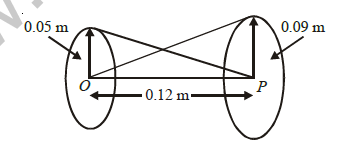
7. Two circular loops of radii 0.05 m and 0.09 m respectively are placed vertically such that their axes coincide and their centres are 0.12 m apart. A charge of one micro-coulomb is spread uniformly on each loop. Find the potential difference between the centres of loops.
8. A simple pendulum consists of a small sphere of mass m suspended by a thread of length l. The sphere carries a positive charge q. The pendulum is placed in a uniform electric field of strength E directed vertically upwards. With what period will the pendulum oscillate, if the electrostatic force acting on the sphere is less than the gravitational force ? (Assume that the oscillations are small).
9. A particle of mass 40 mg and carrying a charge of 5 × 10⁻⁹ C is moving directly towards a fixed positive point charge of magnitude 10–8C. When it is at a distance of 10 cm from the fixed point charge, it has a velocity of 50 cm/second. Find the distance from the fixed point charge where the particle will momentarily come to rest.
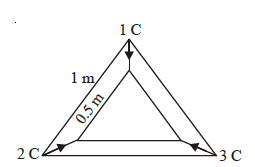
10. Three point charges 1C, 2C and 3C are placed at the corners of an equilateral triangle of side 1 m. If these charges were to be shifted to the corners of a smaller equilateral triangle of side 0.5 m as shown in figure, find the work done to move these charges.
11. A pendulum bob of mass 80 mg and carrying a charge of 2 × 10⁻⁸ coulombs, is at rest in a horizontal, uniform electric field of 20,000 volt/m. Find the tension in the pendulum and the angle it makes with vertical.
12. A particle having mass 9 × 10–31 kg and negative charge of 1.6 × 10⁻¹⁹ coulomb is projected horizontally with a velocity of 105 m/sec into a region between two infinite, horizontal parallel plates of metal. The distance between the plates is 0.3 cm, and the particle enters 0.1 cm below the top plate. The top and the bottom plates are connected, respectively, to the positive and negative terminals of a 30-volts battery. Find the components of the velocity of the particle just before it hits one of the plates.
13. Two parallel plate capacitors of capacity C and 2C are connected in parallel and charged to a potential difference V. The battery is then disconnected and the space between the plates of the capacitor C is completely filled with a material of dielectric constant K. Find the final potential difference across the capacitors.
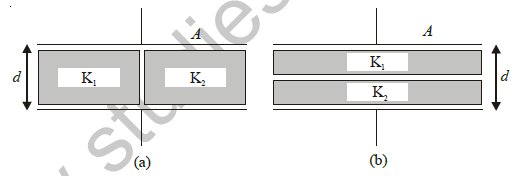
14. Two dielectric slabs of dielectric constant K1 and K2 have been filled equally in between the plates of two similar parallel plate capacitors of area A and separation d as shown in figure. Find the capacitance in each case (a) and (b). Also find the ratio of capacitance of (a) and (b) if the values of K1 and K2 are 2 and 3 respectively.
15. Two different capacitors C1 and C2 are connected in parallel such that the energy of the combination is 0.25 J when the difference of potentials between their terminals is 10 volts. When these condensers are connected in series, the energy is 0.05 J, when the same potential difference is applied. Find C1 and C2
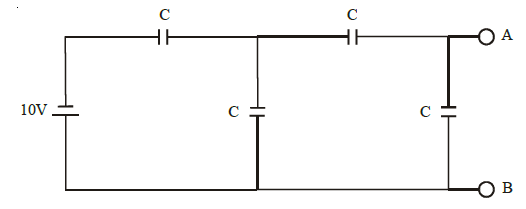
16. Find the potential difference between points A and B of the circuit as shown in the figure. The e.m.f. of the battery is 10 volts and each capacitance C is of 8μF.
Please click on below link to download pdf file for CBSE Class 12 Physics Electrostatics Subjective Problems.
Free study material for Physics
Free CBSE Study Guides: Class 12 Physics Chapter 02 Electrostatic Potential and Capacitance
Quick Revision Material for Chapter 02 Electrostatic Potential and Capacitance
Explore essential learning tools for Class 12 Physics Chapter 02 Electrostatic Potential and Capacitance. This curated collection features in-depth notes and targeted practice questions built around the active 2026 curriculum to streamline your daily revision.
Expert Notes and Solved Exam Questions
Designed around the official curriculum, these study guides guarantee standard compliance. Reviewing step-by-step solutions clarifies complex sub-topics within Chapter 02 Electrostatic Potential and Capacitance and demystifies standard marking schemes for Physics evaluations.
Additional Study Resources for Class 12
Maximize your grade potential by utilizing Class 12 Physics practice papers in tandem with these structured notes. All printable assignments and interactive mock tests on our platform are updated for the 2026 session and available free of charge.
FAQs
Our advanced study package for Chapter 02 Electrostatic Potential and Capacitance includes detailed concepts, diagrams, Mind Maps, and explanation of complex topics to ensure Class 12 students learn as per syllabus for 2026 exams.
The Mind Maps provided for Chapter 02 Electrostatic Potential and Capacitance act as visual anchors which will help faster recall during high-pressure exams.
Yes, teachers use our Class 12 Physics resources for lesson planning as they are in simple language and have lot of solved examples.
Yes, You can download the complete, mobile-friendly PDF of the Physics Chapter 02 Electrostatic Potential and Capacitance advanced resources for free.
Yes, our subject matter experts have updated the Chapter 02 Electrostatic Potential and Capacitance material to align with the rationalized NCERT textbooks and have removed deleted topics and added new competency-based questions.