

Class 12 Physics Study Guide: CBSE Class 12 Physics Electrostatics Theory and Examples
Access comprehensive study materials and useful resources for Chapter 02 Electrostatic Potential and Capacitance using the CBSE Class 12 Physics Electrostatics Theory and Examples. Designed to align with the 2026-27 CBSE academic guidelines, these advanced resources help Class 12 Physics students reinforce core concepts beyond standard textbooks.
Download Chapter 02 Electrostatic Potential and Capacitance Study Material PDF
View or download the dedicated CBSE Class 12 Physics Electrostatics Theory and Examples resource below. Engaging with these advanced study guides under focused conditions ensures continuous academic progress and mastery of the 2026-27 curriculum for Chapter 02 Electrostatic Potential and Capacitance.
CBSE Class 12 Physics Electrostatics Theory and Examples. Please refer to the examination notes which you can use for preparing and revising for exams. These notes will help you to revise the concepts quickly and get good marks.
Electrostatics , deals with the study of charges in rest. These stationary charges occurs due to friction of two insulating bodies, therefore it is often called frictional electricity
1. FUNDAMENTAL FORCE OF THE NATURE
(i) Behind every process occurring in the nature, there is one or the other force acting.
(ii) Different forces are divided in FOUR parts based on their nature
(A) Gravitational force
(B) Electro-magnetic force
(C) Nuclear force
(D) Weak force

Important points :
(i) Gravitational force is the weakest while nuclear force is the strongest force of the nature
(ii) Nuclear force does not depend upon charge. It acts equally between proton-proton, proton neutron and neutron-neutron.
(iii) There are weak forces acting in β- degradiation in radio-activity.
(iv) A stationary charge produces electric filed while a moving charge produce electric as well as magnetic field.
(v) Moving charge produce electric field as well as magnetic field but does not radiate energy while uniform acceleration.
(vi) Accelerated charge produce electrid field as well as magnetic field and radiate energy.
2. CHARGE
Property of a substance by virtue of which it can repel or attract another charged substance.
Charges are of two types.
(a) Positive charge : Lesser number of electrons than number of protons.
(b) Negative charge : More number of electrons than number of protons
Importants Points : Only , electron is responsible for a substance to be charged and not the proton.
2.1 Properties of Charge :
(i) Like charges repel while unlike charges attract each other.
(ii) Charge is quantized in nature i.e. The magnitude of charge possessed by different objects is always an integral multiple of charge of electron (or proton) i.e. q = ± ne
where n = 1 , 2 , 3 ........
(iii) The minimum possible charge that can exist in nature is the charge of electron which has a magnitude of e = 1.60 207x10-19 coulomb.This is also known as quantum of charge or fundamental charge.
(iv) In an isolated system the algebraic sum of total charge remains constant. This is the law of'Conservation of charge'.
Note : The fact that electric charge is an integral multiple of electronic charge was experimentally proved by Milliken. Unit of charge → 1 coulomb = 3 × 10⁹ e.s.u.= 1/10 e.m.u.,in cgs → e.s.u. (state coulomb)
Charge
Ex.1 Two spheres of the same metal (in all respects) are taken. One is given a positive charge of Q coulomb. and other is given the same but negative charge. Which sphere will have a higher mass.
Sol. Negatively charged sphere will have a higher mass. This is due to increase in number of electron to make it negatively charged.
Ex.2 Which of the following charge is not possible:
(A) 1.6 × 10⁻¹⁸c (B) 1.6 × 10⁻¹⁹ c (C) 1.6 × 10⁻²⁰ c (D) None of these
Sol. (C) 1.6 × 10⁻²⁰ c, because this is 1/10 of electronic charge and hence not an integral multiple.
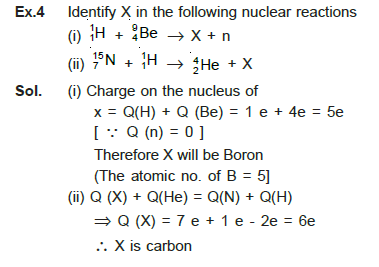
Ex.3 How many electron are present in 1 coulomb charge.
Sol. ∴ q = ne
q = 1c
e = 1.6 × 10⁻¹⁹ c
n = ?
n = q/e = 6.25 × 10¹⁸ electrons.
3. COULOMB'S LAW
The force of attraction or repulsion between two stationary point charges is directly proportional to the product of charges and inversely proportional to the square of distance betweenthem.This force acts along the line joining the two. If q1 & q2 are charges in consideration r, the distance between them and F, the force acting between them
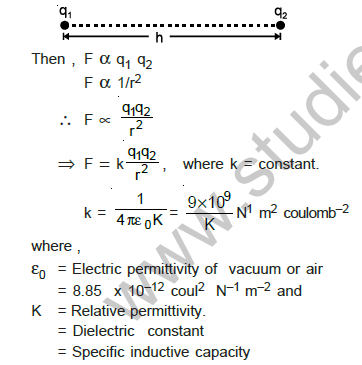
[Newton's law for particles is analogous to coulomb's law for rest charges. The difference is that Newton's law gives attraction force while coulomb's law gives attraction as well as repulsion force]
Note:
(i) Coulomb's law is applicable to point charges only. But it can be applied for distributed charges also
(ii) This law is valid only for stationary charges and cannot be applied for moving charges.
(iii) This law is valid only if the distance between two charges is not less than 10–15 m.
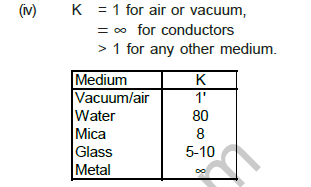
Note : Be aware of k and K K is dielectric constant and k electrostatic constant k =1/ 4πε 0 K
Direction
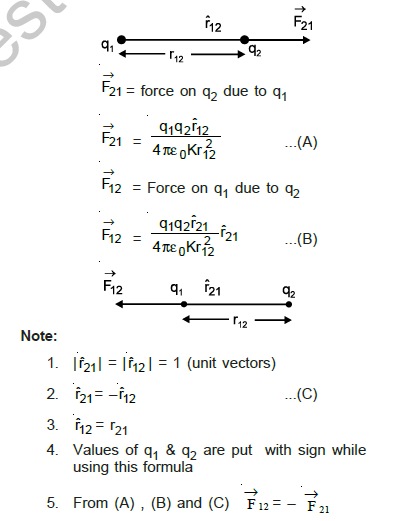
Direction of the force acting between two charges depends upon their nature and it is along the line joining two charges.
Please click on below link to download pdf file for CBSE Class 12 Physics Electrostatics Theory and Examples.
Free study material for Physics
Free CBSE Study Guides: Class 12 Physics Chapter 02 Electrostatic Potential and Capacitance
Quick Revision Material for Chapter 02 Electrostatic Potential and Capacitance
Explore essential learning tools for Class 12 Physics Chapter 02 Electrostatic Potential and Capacitance. This curated collection features in-depth notes and targeted practice questions built around the active 2026 curriculum to streamline your daily revision.
Expert Notes and Solved Exam Questions
Each resource draws directly from authorized textbooks to maintain academic accuracy. Evaluating solved examples allows Class 12 students to master the formal presentation and answer-writing standards expected in upcoming school exams.
Additional Study Resources for Class 12
Wrap up your chapter revision by testing your knowledge against standard objective question formats. Explore our full library of free, up-to-date sample papers and online assessments to secure top grades in your CBSE examinations.
FAQs
Our advanced study package for Chapter 02 Electrostatic Potential and Capacitance includes detailed concepts, diagrams, Mind Maps, and explanation of complex topics to ensure Class 12 students learn as per syllabus for 2026 exams.
The Mind Maps provided for Chapter 02 Electrostatic Potential and Capacitance act as visual anchors which will help faster recall during high-pressure exams.
Yes, teachers use our Class 12 Physics resources for lesson planning as they are in simple language and have lot of solved examples.
Yes, You can download the complete, mobile-friendly PDF of the Physics Chapter 02 Electrostatic Potential and Capacitance advanced resources for free.
Yes, our subject matter experts have updated the Chapter 02 Electrostatic Potential and Capacitance material to align with the rationalized NCERT textbooks and have removed deleted topics and added new competency-based questions.