

Download CBSE Class 12 Physics Useful Resources
Review targeted academic resources with the CBSE Class 12 Physics Current Electricity chapter notes and important questions. Built according to official CBSE standards for the 2026-27 term, these downloadable Class 12 Physics study materials support effective daily practice and deeper conceptual understanding for Chapter 03 Current Electricity.
Access CBSE Study Guides and Summaries
Access the complete useful resource PDF for Class 12 Physics below. Regular practice with these targeted academic notes builds familiarity with complex topics and helps secure higher marks in final school evaluations.
CBSE Class 12 Physics Current Electricity chapter notes and important questions. There are many more useful educational material which the students can download in pdf format and use them for studies. Study material like concept maps, important and sure shot question banks, quick to learn flash cards, flow charts, mind maps, teacher notes, important formulas, past examinations question bank, important concepts taught by teachers. Students can download these useful educational material free and use them to get better marks in examinations. Also refer to other worksheets for the same chapter and other subjects too. Use them for better understanding of the subjects.
CURRENT ELECTRICITY
GIST
* Current carriers – The charge particles which flow in a definite direction constitutes the electric current are called current carriers. E.g.: Electrons in conductors, Ions in electrolytes, Electrons and holes in semiconductors.
* Electric current is defined as the amount of charge flowing through any cross section of the conductor in unit time. I = Q/t.
* Ohm’s law: Current through a conductor is proportional to the potential difference across the ends of the conductor provided the physical conditions such as temperature, pressure etc. Remain constant. V α I i.e. V = IR, Where R is the resistance of the conductor. Resistance R is the ratio of V & I
* Resistance is the opposition offered by the conductor to the flow of current.
* Resistance R = ρl/A where ρ is the resistivity of the material of the conductor- length and A area of cross section of the conductor. If l is increased n times, new resistance becomes If n2R. A is increased n times, new resistance becomes 1/nnR
* Resistivity ρ = m/ne τ, Where m, n, e are mass, number density and charge of electron respectively, τ-relaxation time of electrons. ρ is independent of geometric dimensions.
* Relaxation time is the average time interval between two successive collisions
* Conductance of the material G =1/R and conductivity
* Drift velocity is the average velocity of all electrons in the conductor under the influence of applied electric field. Drift velocity
* Effect of temperature on resistance: Resistance of a conductor increase with the increase of temperature of
* conductor RT = Ro (1 + a T ) , where α is the temperature coefficient of resistance of T the conductor. α is slightly positive for metal and conductor, negative for semiconductors and insulators and nearly zero for alloys like tungsten, eureka, constantan.
* Cells: E.M.F of a cell is defined as the potential difference between its terminals in an open circuit. Terminal potential difference of a cell is defined as the p.d between its ends in a closed circuit.
* Internal resistance r of a cell is defined as the opposition offered by the electrolyte of cell to the flow of current . r=(E/V-1) where R is external resistances.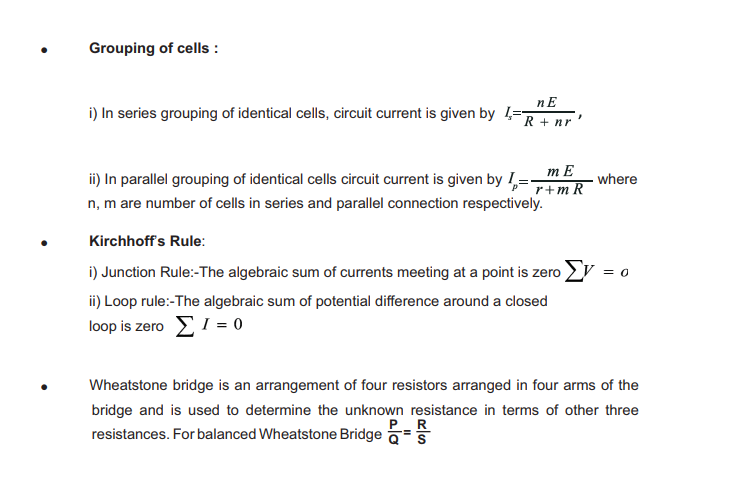
* Potentiometer is considered as an ideal voltmeter of infinite resistance.
* Principle of potentiometer: The potential drop across any portion of the uniform wire is proportional to the length of that portion of the wire provided steady current is maintained in it i.e. v α l
* Potentiometer is used to (i) compare the e.m.f.s of two cells (ii) determine the internal resistance of a cell and (iii) measure small potential differences.
* Expression for comparison of e.m.f of two cells by using potentiometer ε1/ε2=l1/l2 where ε1 , ε2 of two cells.
* Expression for the determination of internal resistance of a cell I is given by(l1-l1/l1)R Where I is the balancing length of potentiometer wire corresponding to e.m.f of the cell, 1
I that of terminal potential difference of the cell when a resistance R is connected in 2 series with the cell whose internal resistance is to be determined
* Expression for determination of potential difference Where L is the length of the potentiometer wire, l is balancing length, r is the resistance of potentiometer wire, R is the resistance included in the primary circuit.
* Joule’s law of heating states that the amount of heat produced in a conductor is proportional to (i) square of the current flowing through the conductor,(ii) resistance of the conductor and (iii) time for which the current is passed. Heat produced is given by the relation H=I2Rt
Please click the link below to download CBSE Class 12 Physics Current Electricity chapter notes and important questions.
Free study material for Physics
Useful Resources and Notes for Class 12 Physics Chapter 03 Current Electricity
Core Study Kit: Class 12 Physics Chapter 03 Current Electricity
Access comprehensive study material for Chapter 03 Current Electricity, including revision notes, concept maps, and high-probability questions. These resources are designed in alignment with the latest 2026 CBSE syllabus for Class 12 Physics to support effective exam preparation.
NCERT-Aligned Solutions for Chapter 03 Current Electricity
Built using official NCERT guidelines for Class 12 Physics, these materials provide reliable academic support. Integrating past examination questions and step-by-step solutions helps students understand official CBSE grading criteria.
Next Steps in Your Exam Preparation
For peak performance in upcoming evaluations, integrate official Physics sample papers directly into your study schedule. Follow up your revision by attempting online MCQ tests for Chapter 03 Current Electricity to refine calculation speed and precision.
FAQs
Our advanced study package for Chapter 03 Current Electricity includes detailed concepts, diagrams, Mind Maps, and explanation of complex topics to ensure Class 12 students learn as per syllabus for 2026 exams.
The Mind Maps provided for Chapter 03 Current Electricity act as visual anchors which will help faster recall during high-pressure exams.
Yes, teachers use our Class 12 Physics resources for lesson planning as they are in simple language and have lot of solved examples.
Yes, You can download the complete, mobile-friendly PDF of the Physics Chapter 03 Current Electricity advanced resources for free.
Yes, our subject matter experts have updated the Chapter 03 Current Electricity material to align with the rationalized NCERT textbooks and have removed deleted topics and added new competency-based questions.