

Official CBSE Study Materials for Class 12 Physics
Explore structured advanced study materials through the CBSE Class 12 Physics Magnetism Theory and Examples. Tailored for Class 12 learners, utilizing these Physics resources ensures thorough preparation and strengthens foundational knowledge before final CBSE evaluations.
Advanced Resources for Physics
View or download the dedicated CBSE Class 12 Physics Magnetism Theory and Examples resource below. Engaging with these advanced study guides under focused conditions ensures continuous academic progress and mastery of the 2026-27 curriculum for Chapter 05 Magnetism and Matter.
CBSE Class 12 Physics Magnetism Theory and Examples. Please refer to the examination notes which you can use for preparing and revising for exams. These notes will help you to revise the concepts quickly and get good marks.
1. INTRODUCTION
In nature, first time iron ore was found which had a property to attack small pieces of iron, nickel and cobalt etc. And this property of attracting small pieces of material such as iron, nickel and cobalt etc. by a piece of material is called magnetism. There are two types of magnets. One which are found in nature are called natural magnets. These are of distorted shape. Second which are artificially manufactured are called artificial magnets. These are of defined shape and size i.e. bar magnets.
2. BASIC PROPERTIES OF MAGNETS
1. A magnet attracts magnetic substances such as nickel, cobalt, iron etc.
2. When a magnet is suspended with the help of unspum thread, its two end, which are called poles come to rest in north south direction.
3. Poles exists always in pair and having equal strength i.e. magnetic monopoles do not exist.
4. Like poles repel each other and unlike poles attract each other.
5. North and south pole of magnet are a little inwards from geometrical end. The magnetic length of magnet is about 0.84 times the geometrical length.
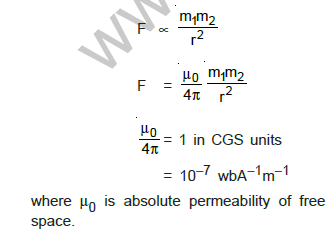
6. The force of attraction or repulsion between two magnetic poles is directly proportional to product of pole strengths (m1, m2) and inversely proportional to square of distance (r) between their centres
3. MAGNETIC DIPOLE AND It’s MOMENT
It has two unlike poles of equal strength separated by a definite small distance. Unit of pole strength is ampere meter or Newton/ Tesla. Magnetic dipole moment (Mr) is defined as the product of pole strength denoted by m and distance between the two poles, called magnetic length, represented by 2 l

It is a vector quantity and its direction is from south to north pole. Its unit is ampere meter2 or Joule/Tesla
4. MAGNETIC FIELD
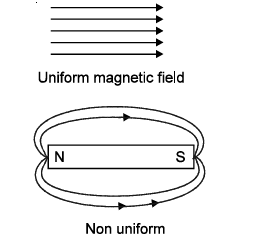
It is the space around magnet or a current carrying conductor, in which magnetic effects can be felt. Magnetic field strength at a point is defined as the force experience by a unit positive charge moving with unit velocity in the direction perpendicular to magnetic field. When the magnitude and direction of magnetic field in a region is same throughout, field is uniform magnetic field. i.e. Earth’s magnetic field. Otherwise field is called non uniform field i.e. magnetic field of a bar magnet.
5.MAGNETIC LINE OF FORCES AND THEIR PROPERTIES
As electric field lines of forces we also have imaginary magnetic field lines to represent magnetic field in any region. These are closed lines when electric field lines are open lines.
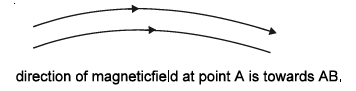
To draw magnetic lines we use a magnetic dipole i.e. small compose needle. The direction of magnetic field at a point is same as direction of tangent at the point.
PROPERTIES
1. No two magnetic lines can cut each other.
2. These are closed lines whose direction outside magnet is from north to south pole and inside from south to north pole.
3. Tangent at a point of magnetic line give direction of field at that point.
4. Crowding of magnetic lines of force represent stronger magnetic field.
5. There is always tension in magnetic field line and repulsion between two lines.
Magnetic Line of Forces
Ex.1 The main difference between electriclines of force and magnetic lines of force is
(A)Electric lines of force are closed curves whereas magnetic lines of force are open curves.
(B)Electric lines of force are open curves whereas magnetic lines of force are closed curves.
(C)Magnetic lines of force cut each other whereas electric lines of force do not cut.
(D)Electric lines of force cut each other whereas magnetic lines of force do not cut.
Sol. The magnetic lines of force are in the form of closed curves whereas electric lines of force are open curves. Hence the correct answer will be (B).
6. MAGNETIC FIELD STRENGTH DUE TO BAR MAGNET
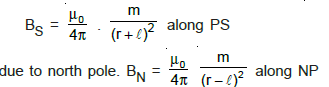
(i) End-on position : In this position point lies on the axis of magnet. Magnetic field strength due to south pole
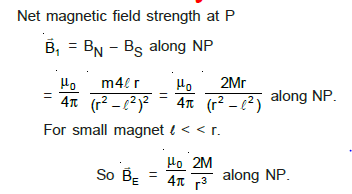
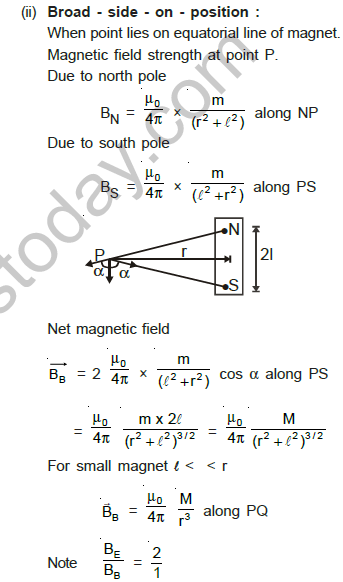
Magnetic Field
Ex.2 A bar magnet with its poles 25 cm apart and of pole strength 24.0 A-m rests with its centre on a frictionless pivot. A force F is applied on the magnet at a distance of 12 cm from the pivot. So that it is held in equilibrium at an angle of 30º with respect to a magnetic field of induction 0.25 T. The value of force F is
(A) 65.62 N (B) 2.56 N (C) 6.52 (D) 6.25 N
Please click on below link to download pdf file for CBSE Class 12 Physics Magnetism Theory and Examples.
Free study material for Physics
CBSE Class 12 Physics Study Material: Chapter 05 Magnetism and Matter
Comprehensive Study Resources for Chapter 05 Magnetism and Matter
Explore essential learning tools for Class 12 Physics Chapter 05 Magnetism and Matter. This curated collection features in-depth notes and targeted practice questions built around the active 2026 curriculum to streamline your daily revision.
Understanding Marking Schemes
Designed around the official curriculum, these study guides guarantee standard compliance. Reviewing step-by-step solutions clarifies complex sub-topics within Chapter 05 Magnetism and Matter and demystifies standard marking schemes for Physics evaluations.
Complete Revision for Physics
Wrap up your chapter revision by testing your knowledge against standard objective question formats. Explore our full library of free, up-to-date sample papers and online assessments to secure top grades in your CBSE examinations.
FAQs
Our advanced study package for Chapter 05 Magnetism and Matter includes detailed concepts, diagrams, Mind Maps, and explanation of complex topics to ensure Class 12 students learn as per syllabus for 2026 exams.
The Mind Maps provided for Chapter 05 Magnetism and Matter act as visual anchors which will help faster recall during high-pressure exams.
Yes, teachers use our Class 12 Physics resources for lesson planning as they are in simple language and have lot of solved examples.
Yes, You can download the complete, mobile-friendly PDF of the Physics Chapter 05 Magnetism and Matter advanced resources for free.
Yes, our subject matter experts have updated the Chapter 05 Magnetism and Matter material to align with the rationalized NCERT textbooks and have removed deleted topics and added new competency-based questions.