

Advanced Study Material for Class 12 Physics: All Chapters
Review targeted academic resources with the CBSE Class 12 Physics All Chapters Important Questions. Built according to official CBSE standards for the 2026-27 term, these downloadable Class 12 Physics study materials support effective daily practice and deeper conceptual understanding for All Chapters.
Practice Class 12 Physics Resources: All Chapters
Access the complete useful resource PDF for Class 12 Physics below. Regular practice with these targeted academic notes builds familiarity with complex topics and helps secure higher marks in final school evaluations.
CBSE Class 12 Physics All Chapters Important Questions. There are many more useful educational material which the students can download in pdf format and use them for studies. Study material like concept maps, important and sure shot question banks, quick to learn flash cards, flow charts, mind maps, teacher notes, important formulas, past examinations question bank, important concepts taught by teachers. Students can download these useful educational material free and use them to get better marks in examinations. Also refer to other worksheets for the same chapter and other subjects too. Use them for better understanding of the subjects.
PHYSICS WORKSHEETS (CLASS XII) - IMPORTANT QUESTIONS
PHYSICS WORKSHEETS (CLASS XII) - IMPORTANT QUESTIONS
MAGNETIC EFFECT OF CURRENT AND MAGNETISM
State Biot–Savart law, giving the mathematical expression for it.
Answer: The magnetic field \(d\vec B\) at a point due to a small current element \(I\,d\vec l\) is directly proportional to the current \(I\), the length \(dl\) of the element and \(\sin\theta\) (where \(\theta\) is the angle between \(d\vec l\) and the line joining the element to the point), and inversely proportional to the square of the distance \(r\):
\[d\vec B=\frac{\mu_0}{4\pi}\,\frac{I\,d\vec l\times\vec r}{r^{3}}\]
Write the expression for the Lorentz magnetic force on a particle of charge \(q\) moving with velocity \(\vec v\) in a magnetic field \(\vec B\).
Answer: \(\vec F=q(\vec v\times\vec B)\)
Using the concept of force between two infinitely long parallel current-carrying conductors, define one ampere current.
Answer: One ampere is that steady current which, when passed in each of two infinitely long, straight, parallel conductors placed 1 m apart in vacuum, causes each conductor to experience a force of \(2\times10^{-7}\ \text{N}\) per metre of its length.
Write the expression for the magnetic moment \(\vec M\) of a planar square loop of side \(l\) carrying a steady current \(I\), in vector form.
Answer: \(\vec M=I\vec A=I\,l^{2}\,\hat n\), where \(\hat n\) is the unit vector normal to the plane of the loop (direction given by the right-hand rule).
State the underlying principle of the cyclotron.
Answer: When a charged particle moves perpendicular to a uniform magnetic field it travels in a circle. In a cyclotron the particle is accelerated by an alternating electric field applied across the gap between the two dees; when the frequency of this field equals the cyclotron frequency of the particle, the particle gains energy every time it crosses the gap and spirals outward.
The permeability of a magnetic material is 0.9983. Name the type of magnetic material it represents.
Answer: Diamagnetic substance (its relative permeability is slightly less than 1).
At what place on the surface of the earth is the angle of dip 90°?
Answer: At the magnetic poles (north and south magnetic poles).
The horizontal component of the earth’s magnetic field at a place is \(B\) and the angle of dip is 60°. What is the vertical component of the earth’s magnetic field at the equator?
Answer: Zero. At the equator the angle of dip is 0°, so the vertical component \(B_V=B_H\tan\delta\) is zero.
The susceptibility of a magnetic material is \(-2.6\times10^{-5}\). Identify the type of material.
Answer: Diamagnetic (susceptibility is small and negative).
Mention the two characteristic properties of the material suitable for making the core of a transformer.
Answer: Low coercivity and low retentivity (and high permeability).
What are permanent magnets? Give one example.
Answer: Substances which retain their ferromagnetic properties for a long period of time at room temperature are called permanent magnets. Example: Alnico, cobalt steel.
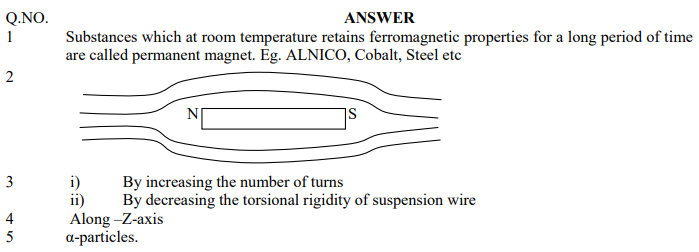
Draw diagrammatically the behaviour of magnetic field lines in the presence of a diamagnetic substance.
Answer: The field lines are repelled (expelled) from the diamagnetic substance, so fewer lines pass through it.
Give two factors by which the voltage sensitivity of a moving coil galvanometer can be increased.
Answer: (i) By increasing the number of turns of the coil. (ii) By decreasing the torsion constant (torsional rigidity) of the suspension wire.
An electron is moving along the X-axis in a uniform magnetic field directed along the +Y axis. What is the direction of the force acting on it?
Answer: Along the \(-Z\) axis. (Force on the electron \(=-e(\vec v\times\vec B)\); \(\hat x\times\hat y=\hat z\), and the negative charge reverses it.)
Which of the following will have the minimum frequency of revolution when projected with the same velocity \(v\) perpendicular to the magnetic field: (i) α-particle, (ii) β-particle?
Answer: α-particle. The frequency of revolution is \(f=\dfrac{qB}{2\pi m}\), which is proportional to \(q/m\), and \(q/m\) is smallest for the α-particle.
ELECTROMAGNETIC INDUCTION AND ALTERNATING CURRENT
Define self-inductance.
Answer: The phenomenon of induction of an e.m.f. in a coil due to a change of current (and hence of magnetic flux) in the same coil is called self-induction.
Define mutual inductance.
Answer: The phenomenon of induction of an e.m.f. in a coil due to a change of magnetic flux linked with it caused by a change of current in a neighbouring coil is called mutual induction.
What is the unit of self-inductance and mutual inductance?
Answer: Henry (equal to weber per ampere).
Define magnetic flux.
Answer: The magnetic flux through a surface is the total number of magnetic field lines crossing the surface normally; \(\Phi=\vec B\cdot\vec A\).
What is the unit of magnetic flux?
Answer: Weber (Wb).
Define eddy currents.
Answer: The currents induced in the body of a conductor when the magnetic flux linked with the conductor changes are called eddy currents.
Write two applications of eddy currents.
Answer: (i) Electromagnetic damping. (ii) Induction furnace.
Plot a graph of inductive reactance versus frequency of an a.c. in an LCR series circuit.
Answer: \(X_L=2\pi fL\), so the graph is a straight line through the origin.
Plot a graph of capacitive reactance versus frequency of an a.c. in an LCR series circuit.
Answer: \(X_C=\dfrac{1}{2\pi fC}\), so the graph is a rectangular hyperbola: \(X_C\) falls as \(f\) increases.
Define wattless current.
Answer: The component of current that does not contribute to the power consumed (the component differing in phase by 90° from the voltage) is called wattless current.
The power factor of an a.c. circuit is 0.5. What is the phase difference between the voltage and the current?
Answer: \(\cos\phi=0.5\), so \(\phi=60^\circ\).
An alternating voltage given by \(V=70\sin100\pi t\) is connected across a pure resistor of 25 Ω. Find the frequency of the source.
Answer: \(\omega=100\pi\) rad s−1, so \(f=\omega/2\pi=50\ \text{Hz}\).
How are eddy currents reduced in a metallic core?
Answer: By laminating the core, i.e. making the core of thin sheets of metal insulated from one another.
Give the relation between the r.m.s. and peak value of an alternating current.
Answer: \(I_{rms}=\dfrac{I_0}{\sqrt2}\)
The instantaneous value of an e.m.f. is \(e=300\sin314t\). What is the r.m.s. value of the e.m.f.?
Answer: \(E_{rms}=\dfrac{300}{\sqrt2}\approx212.1\ \text{V}\).
ELECTROMAGNETIC WAVES
Which part of the electromagnetic spectrum has the largest penetrating power?
Answer: Gamma rays.
Name the physical quantity which remains the same for microwaves of wavelength 1 mm and UV radiation of 1600 Å in vacuum.
Answer: Speed (\(3\times10^8\ \text{m s}^{-1}\)).
To which part of the electromagnetic spectrum does a wave of frequency \(5\times10^{11}\ \text{Hz}\) belong?
Answer: Microwaves.
How are infrared waves produced?
Answer: By the vibrations of atoms and molecules.
Write one important use of visible light.
Answer: It is essential for photosynthesis in plants (and for vision).
A plane electromagnetic wave travels in vacuum along the z-direction. What can you say about the directions of the electric and magnetic field vectors?
Answer: They are perpendicular to the z-direction and to each other; for example, \(\vec E\) along the x-axis and \(\vec B\) along the y-axis.
Why are infrared waves referred to as heat waves?
Answer: Because they cause a heating effect when absorbed by substances (water molecules and most materials readily absorb them).
How are radio waves produced?
Answer: By the accelerated motion of charges in conducting wires (oscillating electric circuits).
Arrange the following electromagnetic radiations in ascending order of their frequencies: microwave, radio wave, X-rays, gamma rays.
Answer: Radio wave, microwave, X-rays, gamma rays.
What are the directions of the electric and magnetic field vectors relative to each other and relative to the direction of propagation of an electromagnetic wave?
Answer: \(\vec E\), \(\vec B\) and the direction of propagation are mutually perpendicular.
Name the characteristic of electromagnetic waves that remains constant in the electromagnetic spectrum as one moves from the radio-wave region towards the UV region.
Answer: The speed in vacuum (\(c\)) remains the same.
Write an expression for the speed of e.m. waves in free space.
Answer: \(c=\dfrac{1}{\sqrt{\mu_0\varepsilon_0}}\)
Name the electromagnetic radiation having a wavelength range from 1 mm to 700 nm.
Answer: Infrared radiation.
For an electromagnetic wave, write the relationship between the amplitudes of the electric and magnetic fields in free space.
Answer: \(\dfrac{E_0}{B_0}=c\)
Identify the electromagnetic radiation of each wavelength given below and write one application of each: (a) 1 mm, (b) \(10^{-3}\) nm.
Answer: (a) 1 mm: microwaves (at the boundary with infrared); use: radar and microwave ovens. (b) \(10^{-3}\) nm: gamma rays; use: radiotherapy (treatment of cancer).
OPTICS
Total Internal Reflection
Write Snell’s law.
Answer: \(\dfrac{\sin i}{\sin r}=\mu\) (a constant for the given pair of media).
What is the angle of refraction when the angle of incidence equals the critical angle?
Answer: 90°.
Write the relation between the critical angle and the refractive index.
Answer: \(\sin i_c=\dfrac{1}{\mu}\), where \(\mu\) is the refractive index of the denser medium with respect to the rarer medium.
Can total internal reflection be obtained when light travels from a rarer medium to a denser medium?
Answer: No.
Name the property of light used to explain the formation of a mirage.
Answer: Total internal reflection.
Name the principle used in the propagation of waves through an optical fibre.
Answer: Total internal reflection.
Show with a diagram how light can be bent by 90° with the help of a totally reflecting prism.
Answer: A ray falls normally on one face of a right-angled isosceles prism, strikes the hypotenuse at 45° (greater than the critical angle of glass, about 42°), is totally reflected and leaves normally through the other face, turned through 90°.
Draw a diagram showing the path of light when it is bent by 180° by a totally reflecting prism.
Answer: The ray enters the hypotenuse face normally, is totally reflected at each of the two equal faces (incidence 45° each time) and emerges normally from the hypotenuse, parallel to the incident ray but reversed in direction.
What is the cause of the glittering of a diamond?
Answer: Total internal reflection (the critical angle of diamond is very small, about 24°).
If the angle of incidence is ______ than the critical angle, we can observe total internal reflection.
Answer: Greater.
When light travels from a medium of refractive index \(\sqrt2\) to vacuum, what is the critical angle for the pair of media?
Answer: \(\sin i_c=1/\sqrt2\), so \(i_c=45^\circ\).
The refractive index of diamond is 2.4. What is the critical angle for it if light travels from diamond to vacuum?
Answer: \(i_c=\sin^{-1}\!\left(\dfrac{1}{2.4}\right)\) (about 24.6°).
How does the critical angle change when a totally reflecting prism is dipped in water?
Answer: It increases (since the refractive index of glass relative to water is smaller).
Write two conditions for observing total internal reflection.
Answer: (i) Light must travel from a denser medium to a rarer medium. (ii) The angle of incidence must be greater than the critical angle (\(i>i_c\)).
How does total internal reflection differ from ordinary (partial) internal reflection?
Answer: In ordinary internal reflection, when light strikes a boundary part of it is reflected and part is refracted. In total internal reflection (\(i>i_c\), denser to rarer medium) the whole of the light is reflected and none is refracted.
Optical Instruments
Name the device used to observe magnified images of microscopic objects.
Answer: Microscope.
Name the device used to observe distinct images of distant objects.
Answer: Telescope.
In construction, how does a compound microscope differ from a simple microscope?
Answer: A compound microscope has two convex lenses (objective and eyepiece), whereas a simple microscope has a single convex lens.
How does the objective differ from the eyepiece in a telescope?
Answer: The objective has a greater focal length and a greater aperture than the eyepiece.
How does the objective differ from the eyepiece in a microscope?
Answer: The objective has a smaller focal length and a smaller aperture than the eyepiece.
Write the expression for the angular magnification of a compound microscope.
Answer: \(m=\dfrac{L}{f_o}\left(1+\dfrac{D}{f_e}\right)\), where \(L\) is the tube length, \(f_o\) and \(f_e\) are the focal lengths of the objective and eyepiece, and \(D=25\) cm.
Write the expression for the angular magnification of a simple microscope.
Answer: \(m=1+\dfrac{D}{f}\) (when the final image is at the least distance of distinct vision).
Write the expression for the angular magnification of a telescope (normal adjustment).
Answer: \(m=\dfrac{f_o}{f_e}\)
The focal lengths of the lenses used in a microscope are small. Why?
Answer: To increase the magnification.
Why is the focal length of the objective greater than that of the eyepiece in a telescope?
Answer: To increase the magnification (\(m=f_o/f_e\)).
A child of class V is unable to read from the blackboard from his seat. What is the possible defect of vision?
Answer: Shortsightedness (myopia).
A child suffering from shortsightedness can read objects clearly only up to a maximum distance of 2 m. What should be the power of the lens used to see objects at infinity?
Answer: The lens must form the image of an object at infinity at 2 m, so \(f=-2\ \text{m}\) and \(P=\dfrac1f=-0.5\ \text{D}\) (a concave lens).
Draw the diagram for the formation of an image by a telescope in normal adjustment.
Answer: The objective forms a real image of the distant object at its focal plane; the eyepiece is placed so that this image is at its focus, giving the final image at infinity. (The standard ray diagram is to be drawn.)
Write two advantages of a reflecting-type telescope over a refracting-type telescope.
Answer: (i) It is free from chromatic aberration. (ii) It is free from spherical aberration (when a parabolic mirror is used); a large mirror is also easier to support and make than a large lens.
Why do we prefer to form the image at the least distance of distinct vision in a microscope rather than at infinity?
Answer: Because the magnification is higher.
Refraction and Dispersion of Light through a Prism
Define the angle of deviation.
Answer: The angle between the incident ray and the emergent ray.
What happens to the angle of deviation as the angle of incidence increases?
Answer: It first decreases, reaches a minimum value and then increases.
The angle of deviation which is minimum is called ______.
Answer: The angle of minimum deviation.
Which colour of light bends the least in dispersion?
Answer: Red.
What is dispersion of light?
Answer: The splitting of white light into its component colours when it passes through a prism.
What is the cause of dispersion?
Answer: The refractive index of the prism is different for different colours (wavelengths), so each colour is deviated by a different angle.
Under what condition is the refracted ray inside the prism parallel to the base of the prism?
Answer: At the position of minimum deviation.
Write the relation between the angle of minimum deviation, the refractive index and the angle of the prism for a small-angle prism.
Answer: \(\delta_m=(\mu-1)A\)
When the angle of minimum deviation increases, what happens to the refractive index of the prism?
Answer: It increases.
Write the relation between the angle of the prism, the angle of deviation, the angle of incidence and the angle of emergence.
Answer: \(\delta=i+e-A\)
What optical phenomena are involved in a rainbow?
Answer: Refraction, internal reflection, total internal reflection and dispersion.
When a prism is put inside water, what happens to its angle of minimum deviation?
Answer: The refractive index of the prism relative to water becomes smaller, so the angle of minimum deviation decreases.
If the angle of incidence is 45°, what is the angle of emergence in the minimum-deviation position?
Answer: 45° (at minimum deviation \(i=e\)).
For an equilateral prism the angle of minimum deviation is 30°. What is the refractive index of the prism?
Answer: \(\mu=\dfrac{\sin\frac{A+\delta_m}{2}}{\sin\frac A2}=\dfrac{\sin45^\circ}{\sin30^\circ}=\sqrt2\).
How does the refractive index of a material depend on the wavelength of the incident light?
Answer: The refractive index decreases as the wavelength increases.
Interference of Light (Young’s Double Slit Experiment)
What is interference of light?
Answer: When two coherent light waves moving in the same direction superpose, the energy is redistributed in space, giving alternate regions of maximum and minimum intensity. This phenomenon is called interference of light.
In Young’s double slit experiment, write the expression for the fringe width.
Answer: \(\beta=\dfrac{\lambda D}{d}\)
What is the path difference between the two waves for a bright fringe in Young’s double slit experiment?
Answer: An integral multiple of the wavelength: \(\Delta x=n\lambda\) (\(n=0,1,2,\dots\)).
What is a coherent source of light?
Answer: Sources that emit waves of the same frequency with a constant phase difference between them.
Write the expression for the position of a bright fringe in Young’s double slit experiment.
Answer: \(x_n=\dfrac{n\lambda D}{d}\)
In Young’s double slit experiment, what happens to the fringe width if the distance between the two slits is doubled?
Answer: It is halved (\(\beta\propto1/d\)).
What happens to the angular width of the fringes if the distance between the slits and the screen is increased?
Answer: No change (the angular width \(\lambda/d\) is independent of \(D\)).
What happens to the fringe width if red light is replaced by blue light?
Answer: It decreases (blue has a shorter wavelength).
When two waves of intensities \(I_1\) and \(I_2\) with a phase difference \(\phi\) superpose, what is the resultant intensity?
Answer: \(I=I_1+I_2+2\sqrt{I_1I_2}\,\cos\phi\)
In Young’s double slit experiment the fringe width is 20 mm for light of wavelength 500 nm. What will be the fringe width for wavelength 250 nm?
Answer: \(\beta\propto\lambda\), so \(\beta'=20\times\dfrac{250}{500}=10\ \text{mm}\).
What happens to the interference fringes if red light is replaced by white light?
Answer: The central fringe is white; on either side there are coloured fringes, and after a few fringes the colours overlap and no clear fringes are seen.
The ratio of the intensities at minima to maxima in Young’s double slit experiment is 9 : 25. Find the ratio of the widths of the two slits.
Answer: \(\dfrac{I_{min}}{I_{max}}=\left(\dfrac{a_1-a_2}{a_1+a_2}\right)^2=\dfrac{9}{25}\Rightarrow\dfrac{a_1-a_2}{a_1+a_2}=\dfrac35\Rightarrow\dfrac{a_1}{a_2}=4\). Slit width is proportional to intensity, i.e. to \(a^2\), so \(w_1:w_2=16:1\).
What happens to the fringe width if the width of the slits is increased?
Answer: The fringe width remains the same (\(\beta=\lambda D/d\) does not depend on slit width); however, the fringes become less sharp if the slits are made too wide.
In Young’s double slit experiment the fringe width is 20 mm when the distance between the slits is 2 mm. What is the fringe width when the slit separation is 4 mm?
Answer: \(\beta\propto1/d\), so \(\beta'=20\times\dfrac24=10\ \text{mm}\).
How does the intensity of the bright fringes change from the first-order to the third-order fringe?
Answer: In the ideal Young’s experiment all the bright fringes have the same intensity (\(I_{max}=4I_0\)); the intensity does not change from the first to the third order.
DUAL NATURE OF MATTER AND RADIATION
Define work function.
Answer: The minimum energy required by an electron to come out from the surface of a metal is called the work function of the metal.
What are the three types of electron emission?
Answer: Thermionic emission, photoelectric emission and field emission.
What is the S.I. unit of work function?
Answer: Joule (it is often expressed in electron volt).
Define one electron volt.
Answer: One electron volt is the energy gained or lost by an electron in passing through a potential difference of one volt (\(1\ \text{eV}=1.6\times10^{-19}\ \text{J}\)).
Define stopping potential.
Answer: The minimum negative (retarding) potential given to the anode (collector) for which the photoelectric current becomes zero.
Which of the two photons is more energetic, violet light or red light?
Answer: Violet light.
Yellow light can eject photoelectrons from a photosensitive surface while orange light cannot. Will blue light and red light eject electrons from the same surface?
Answer: Blue light will eject electrons: \(E\propto1/\lambda\) and blue light has a shorter wavelength (greater energy) than yellow. Red light will not: its wavelength is longer (energy less) than that of orange, which already cannot eject electrons.
Draw the graph between the energy of a photon and its frequency.
Answer: \(E=hf\), so the graph is a straight line through the origin.
What will be the change in the energy of a photon when its wavelength is made double?
Answer: The energy becomes half (\(E\propto1/\lambda\)).
What will be the change in the energy of a photon when its frequency is made half?
Answer: The energy becomes half (\(E\propto f\)).
Define threshold frequency.
Answer: The minimum frequency of the incident radiation below which there is no photoelectric emission from the metal.
Draw a graph between the stopping potential and the frequency of the incident radiation.
Answer: The graph is a straight line that meets the frequency axis at the threshold frequency \(f_0\) (slope \(h/e\)).
What is the nature of the graph between the stopping potential and the frequency of the incident radiation?
Answer: A straight line which intersects the frequency axis (at \(f_0\)).
The momentum of a particle is made double. What is the change in its de Broglie wavelength?
Answer: \(\lambda=h/p\), so the wavelength becomes half.
Draw a graph between the photocurrent and the intensity of the incident light at constant frequency.
Answer: The photocurrent is directly proportional to the intensity, so the graph is a straight line through the origin.
ATOMS AND NUCLEI
Write the unit for the activity of a radioactive nucleus.
Answer: Becquerel (Bq) in S.I.; also the curie (Ci), where \(1\ \text{Ci}=3.7\times10^{10}\ \text{Bq}\).
Which has the higher ionising power, an α-particle or a β-particle?
Answer: The α-particle.
On which factor does the stability of a nucleus depend?
Answer: On the binding energy per nucleon: the higher the binding energy per nucleon, the more stable the nucleus.
A radioactive sample has a half-life of 20 years. If its original mass is 1 g, find the mass left after 40 years.
Answer: 40 years is two half-lives, so the mass left \(=1\times\left(\tfrac12\right)^2=\tfrac14\ \text{g}\).
What is the energy of an electron in the first Bohr orbit?
Answer: \(-13.6\ \text{eV}\).
How many neutrons does a deuterium nucleus have?
Answer: One.
Complete the nuclear reaction: \({}^4_2\text{He}+{}^9_4\text{Be}\rightarrow{}^1_0\text{n}+\ \_\_\_\_\)
Answer: \({}^{12}_{6}\text{C}\)
Compare the radii of two nuclei with mass numbers 1 and 27.
Answer: \(R\propto A^{1/3}\), so \(R_1:R_2=1:3\).
α-decay of a nucleus of mass number 238 releases a daughter nucleus. What is its mass number?
Answer: 234.
Write a relation between the mean life of a nucleus and its decay constant.
Answer: \(\tau=\dfrac1\lambda\)
Lighter nuclei have low binding energy per nucleon. What does it suggest?
Answer: Lighter nuclei can fuse (unite) to form a heavier nucleus with greater binding energy per nucleon, i.e. nuclear fusion is possible.
During β− decay the atomic number of the daughter nucleus increases by 1. How?
Answer: A neutron in the nucleus changes into a proton and an electron (and an antineutrino): \(n\rightarrow p+e^-+\bar\nu\). The electron is emitted and the extra proton increases the atomic number by one.
When a γ-ray photon is emitted, what is the effect on the mass number and atomic number of the parent nucleus?
Answer: No change in either.
Obtain the ratio of the nuclear radii of \({}^{216}X\) and \({}^{64}Y\).
Answer: \(\dfrac{R_X}{R_Y}=\left(\dfrac{216}{64}\right)^{1/3}=\dfrac{6}{4}=3:2\).
Why are neutrons considered ideal projectiles for nuclear reactions?
Answer: Being electrically neutral, they are not repelled by the nucleus, so they can be used as projectiles to hit a target nucleus and bring about nuclear reactions.
SEMICONDUCTOR DEVICES
p-n Junction Diode
What is a junction diode?
Answer: A p-n junction consists of wafers of p-type and n-type semiconductors fused together or grown on each other; it is called a junction diode.
When is a junction diode said to be forward biased?
Answer: When the p-region is maintained at a higher potential than the n-region.
When is a junction diode said to be reverse biased?
Answer: When the p-region is maintained at a lower potential than the n-region.
What type of charge carriers are there in a p-type semiconductor?
Answer: Holes (majority carriers).
Doping of silicon with arsenic leads to which type of semiconductor?
Answer: n-type semiconductor.
Draw the circuit diagram of a p-n junction diode in forward bias.
Answer: The p-side is connected to the positive terminal and the n-side to the negative terminal of the battery.
Draw the V–I graph for a p-n junction diode in forward bias.
Answer: The current is very small until the applied voltage exceeds the knee (threshold) voltage and then rises rapidly.
Name the type of biasing of a p-n junction diode in which the junction offers very high resistance.
Answer: Reverse bias.
Name one device in which a p-n junction diode is used.
Answer: Rectifier.
How does the depletion layer change when a p-n junction is forward biased?
Answer: Its width decreases.
Write the order of the thickness of the depletion layer in a p-n junction.
Answer: About one micrometre (\(10^{-6}\ \text{m}\)).
Name two factors on which the electrical conductivity of a pure semiconductor at a given temperature depends.
Answer: (i) The width of the forbidden gap (\(E_g\)). (ii) The intrinsic charge-carrier concentration (\(n_i\)).
Name the device which is used as a voltage regulator.
Answer: Zener diode.
Which process causes the depletion region in a p-n junction?
Answer: Diffusion of electrons and holes across the junction.
What element other than As and Sb can be used as an impurity with germanium to form an n-type semiconductor?
Answer: Phosphorus, which is a pentavalent atom.
Why is silicon preferred over germanium for making semiconductor devices?
Answer: The energy gap of germanium is 0.7 eV whereas that of silicon is 1.1 eV; silicon has a larger band gap, so its devices work well at higher temperatures with much lower leakage current.
Under what condition does a p-n junction diode work as an open switch?
Answer: When it is reverse biased.
Draw the V–I characteristic curve of a p-n junction diode.
Answer: Forward bias: the current is negligible below the knee voltage and then rises rapidly. Reverse bias: a very small reverse (leakage) current flows, nearly constant, until the breakdown voltage is reached, after which the current rises sharply.
How can a diode be made forward and reverse biased?
Answer: Forward bias: the p-type side is connected to the positive terminal and the n-type side to the negative terminal of the battery. Reverse bias: the p-type side is connected to the negative terminal and the n-type side to the positive terminal.
Differentiate between n-type and p-type semiconductors on the basis of doping and energy-band diagram.
Answer:
- n-type: pure Si/Ge is doped with a pentavalent impurity (As, P, Sb) which donates extra electrons. Electrons are the majority carriers. A donor energy level lies just below the bottom of the conduction band.
- p-type: pure Si/Ge is doped with a trivalent impurity (B, Al, In) which creates holes. Holes are the majority carriers. An acceptor energy level lies just above the top of the valence band.
From the diagram shown below, identify whether the diode is forward or reverse biased.
Answer: Forward biased: the p-side (anode) is at 0 V and the n-side (cathode) is at −10 V through the resistor, so the anode is at the higher potential.
Draw the input and output waveforms of a full-wave rectifier.
Answer: The input is an alternating voltage; in the full-wave rectifier both half-cycles are conducted (D1 in one half-cycle, D2 in the other), so the output across the load has the same direction in each half-cycle and is a pulsating d.c. of twice the input frequency.
In the following diagrams, state which of the diodes are forward biased and which are reverse biased.
Answer: The diode in figure (b) is forward biased; those in (a) and (c) are reverse biased.
Zener Diode
What is a Zener diode?
Answer: A junction diode specially designed to operate in the reverse breakdown region without getting damaged is called a Zener diode.
Why is it called a Zener diode?
Answer: It is named after C. Zener, who explained the Zener (field-emission) breakdown.
What is the symbol of a Zener diode?
Answer: The symbol is that of a diode with the bar (cathode) bent at both ends.
What is the important use of a Zener diode?
Answer: It is used as a voltage regulator (voltage stabiliser).
What is the difference between a p-n junction diode and a Zener diode?
Answer: In a Zener diode both the p and n sides are heavily doped, and it is always used in reverse bias (in the breakdown region); an ordinary p-n junction diode is lightly doped and is damaged in the breakdown region.
Why is a Zener diode considered a special-purpose semiconductor diode?
Answer: Because of its special use as a voltage regulator in the reverse breakdown region.
The output of an unregulated d.c. power supply is to be regulated. Name the device used for this purpose.
Answer: Zener diode.
What is the difference between avalanche breakdown and Zener breakdown?
Answer: Avalanche breakdown occurs in lightly doped diodes (wide depletion layer, at higher reverse voltage) by multiplication of carriers through collisions. Zener breakdown occurs in heavily doped diodes (very thin depletion layer, at low reverse voltage) when the strong electric field pulls electrons directly out of the covalent bonds.
Name the device in which a Zener diode is used.
Answer: Voltage regulator (stabiliser).
Logic Gates
What is a logic gate?
Answer: A logic gate is a digital circuit that follows a certain logical relationship between the input and output voltages.
Give the symbol and Boolean expression for the AND gate.
Answer: Boolean expression: \(Y=A\cdot B\).
Which gates are known as the building blocks of digital circuits?
Answer: NAND and NOR gates.
Name the fundamental gates.
Answer: OR, AND and NOT gates.
Write down the truth table of the NOR gate.
Answer:
| A | B | Y |
|---|---|---|
| 0 | 0 | 1 |
| 1 | 0 | 0 |
| 0 | 1 | 0 |
| 1 | 1 | 0 |
Find the truth table for the circuit whose output is \(Y=A+AB\).
Answer:
| A | B | Y = A + AB |
|---|---|---|
| 0 | 0 | 0 |
| 1 | 0 | 1 |
| 0 | 1 | 0 |
| 1 | 1 | 1 |
Why is the NAND gate known as a building block of digital circuits?
Answer: Because all three fundamental gates (OR, AND, NOT) can be obtained by the repeated use of NAND gates.
Draw the logic symbol of the NAND gate and write down its truth table.
Answer:
| A | B | Y |
|---|---|---|
| 0 | 0 | 1 |
| 0 | 1 | 1 |
| 1 | 0 | 1 |
| 1 | 1 | 0 |
Write the symbol and truth table of an AND gate.
Answer:
| A | B | Y |
|---|---|---|
| 0 | 0 | 0 |
| 0 | 1 | 0 |
| 1 | 0 | 0 |
| 1 | 1 | 1 |
Write the logic symbol and truth table of the OR gate.
Answer:
| A | B | Y |
|---|---|---|
| 0 | 0 | 0 |
| 1 | 0 | 1 |
| 0 | 1 | 1 |
| 1 | 1 | 1 |
Name the gate obtained from the combination of gates shown in the figure (an OR gate followed by a NOT gate).
Answer: NOR gate.
Identify the logic gate represented by the circuit shown (two NAND gates, the output of the first joined to both inputs of the second).
Answer: AND gate. The second NAND gate has both inputs joined, so it acts as a NOT gate; NAND followed by NOT gives AND.
The figure shows the input waveforms (A, B) and the output waveform (Y) of a gate. Identify the gate.
Answer: NAND gate. The output Y is 0 only when both A and B are 1 (intervals 0–1 and 4–5) and is 1 otherwise.
The output of an OR gate is connected to both the inputs of a NAND gate. Draw the logic circuit of this combination of gates and name the resulting gate.
Answer: Both inputs of the NAND gate are joined to form a single input, so it behaves like a NOT gate. An OR gate followed by a NOT gate is a NOR gate, so the combination acts as a NOR gate.
Transistor
Write the symbol of an n-p-n junction transistor.
Answer:
What is a junction transistor?
Answer: A junction transistor is a three-terminal solid-state device obtained by growing a thin layer of one type of semiconductor between two thick layers of the other type.
Is a transistor a temperature-controlled or a current-controlled device?
Answer: Current-controlled device.
What kind of biasing is used in the input and output circuits of a transistor (amplifier)?
Answer: The input (base–emitter) circuit is forward biased and the output (base–collector) circuit is reverse biased.
In an n-p-n transistor, what are the current carriers inside and outside the transistor circuit?
Answer: Inside the transistor the carriers are electrons (majority carriers in the emitter and collector) and holes (in the base); in the external circuit the current carriers are electrons only.
What is the phase difference between the input and output voltages in a common-emitter transistor amplifier?
Answer: 180°.
Why is the common-emitter amplifier preferred over the common-base amplifier?
Answer: Because of its large current gain and higher power gain.
When is a common-base amplifier used instead of a common-emitter amplifier?
Answer: When voltage amplification is required without any phase change of the signal voltage.
Why is the base region of a transistor made very thin and lightly doped?
Answer: To reduce the recombination of electrons and holes in the base so that most of the majority carriers from the emitter reach the collector.
Mention the region in which the transistor is used as a switch and the region in which it is used as an amplifier.
Answer: Switch: ON in the saturation region and OFF in the cut-off region. Amplifier: active region.
Draw the transfer characteristic curve of a base-biased common-emitter transistor.
Answer: The output voltage \(V_o\) is high (cut-off region) at low \(V_i\), falls almost linearly in the active region, and becomes low and constant in the saturation region. The transistor is used as an amplifier in the active region.
Write the relationship between the base current, collector current and emitter current.
Answer: \(I_E=I_B+I_C\)
Which has the higher resistance, the input circuit or the output circuit of a transistor?
Answer: The output circuit.
Under what condition can an amplifier be converted into an oscillator?
Answer: When positive feedback is provided.
What is the relationship among power gain, current gain and voltage gain?
Answer: Power gain = voltage gain × current gain.
COMMUNICATION SYSTEMS
What is the function of a transducer in a communication system?
Answer: It converts one form of energy into another form (e.g. sound into electrical signals).
To which part of the electromagnetic spectrum does a wave of frequency \(5\times10^{19}\ \text{Hz}\) belong? Mention one use of these waves.
Answer: X-rays / γ-rays; used for photography of the internal parts of the body or for treatment of cancer.
Write the full form of GPS.
Answer: Global Positioning System.
What does http stand for?
Answer: Hyper Text Transfer Protocol.
What is 3G?
Answer: Third-generation high-speed digital cellular telephony.
What is the function of a repeater in a communication system?
Answer: It picks up the signal, amplifies it and retransmits it (it repeats the signal).
To which part of the electromagnetic spectrum does a wave of frequency \(5\times10^{11}\ \text{Hz}\) belong? Mention one use of these waves.
Answer: Microwaves; used in radar and microwave ovens.
Write the full form of FAX.
Answer: Facsimile.
What does ICT stand for?
Answer: Information and Communication Technology.
What is CDMA?
Answer: Code Division Multiple Access, a technique used in mobile telephony.
What is the function of a transponder in a communication system?
Answer: It receives the signal from the earth and retransmits it with a different frequency.
To which part of the electromagnetic spectrum does a wave of frequency \(5\times10^{16}\ \text{Hz}\) belong? Mention one use of these waves.
Answer: Ultraviolet; used for purification of water and sterilising medical equipment.
Write the full form of MODEM.
Answer: Modulator and Demodulator.
What does www stand for?
Answer: World Wide Web.
Explain the word “MAGIC” related to mobile telephony.
Answer: M – Mobile multimedia; A – Any time, anywhere; G – Global mobility support; I – Integrated wireless solution; C – Customised personal services.
1. WORK SHEET FOR LEVEL-A
Q.NO. WORK SHEET 1-A
Q.NO. ANSWER
1 Diamagnetic substance
2 At south pole and north pole
3 Net magnetic field in vertical direction at the equator is zero.
4 Diamagnetic
1. WORK SHEET FOR LEVEL-C
Q.NO. WORK SHEET 1-C
NAME OF THE CHAPTER : MAGNETIC EFFECT OF CURRENT AND MAGNETISM
NAME OF THE TOPIC : MAGNETISM
Chapter-E.M.I and A.C
Worksheet1A
5 weber
Worksheet1B Chapter-E.M.I and A.C
3 Plot agraph of inductive reactance vs. frequency of LCR series circuit.
Free study material for Physics
CBSE Class 12 Physics Study Material: All Chapters
Quick Revision Material for All Chapters
Review targeted study resources for All Chapters tailored for Class 12 learners. Utilizing these structured notes and quick-revision tools ensures complete alignment with current CBSE evaluation standards.
Expert Notes and Solved Exam Questions
Built using official NCERT guidelines for Class 12 Physics, these materials provide reliable academic support. Integrating past examination questions and step-by-step solutions helps students understand official CBSE grading criteria.
Additional Study Resources for Class 12
Maximize your grade potential by utilizing Class 12 Physics practice papers in tandem with these structured notes. All printable assignments and interactive mock tests on our platform are updated for the 2026 session and available free of charge.
FAQs
Our advanced study package for All Chapters includes detailed concepts, diagrams, Mind Maps, and explanation of complex topics to ensure Class 12 students learn as per syllabus for 2026 exams.
The Mind Maps provided for All Chapters act as visual anchors which will help faster recall during high-pressure exams.
Yes, teachers use our Class 12 Physics resources for lesson planning as they are in simple language and have lot of solved examples.
Yes, You can download the complete, mobile-friendly PDF of the Physics All Chapters advanced resources for free.
Yes, our subject matter experts have updated the All Chapters material to align with the rationalized NCERT textbooks and have removed deleted topics and added new competency-based questions.