

Advanced Study Material for Class 12 Physics: Refraction at Curved Surface
Access comprehensive study materials and useful resources for Refraction at Curved Surface using the CBSE Class 12 Physics Refraction at Curved Surface Theory and Examples. Designed to align with the 2026-27 CBSE academic guidelines, these advanced resources help Class 12 Physics students reinforce core concepts beyond standard textbooks.
Practice Class 12 Physics Resources: Refraction at Curved Surface
View or download the dedicated CBSE Class 12 Physics Refraction at Curved Surface Theory and Examples resource below. Engaging with these advanced study guides under focused conditions ensures continuous academic progress and mastery of the 2026-27 curriculum for Refraction at Curved Surface.
CBSE Class 12 Physics Refraction at Curved Surface Theory and Examples. Please refer to the examination notes which you can use for preparing and revising for exams. These notes will help you to revise the concepts quickly and get good marks.
1. LAW OF REFRACTION AT SPHERICAL SURFACE
When light passes from a medium of refractive index μ1 to a medium of refractive index μ2 by a spherical surface of radius of curvature R then the relation between object distance u and image distance v is given by
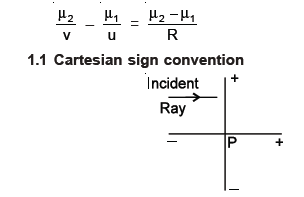
(1) All distances are measured from the pole (P).
(2) Distances measured in the direction of incident rays are taken as positive.
(3) Distances above the principal axis are taken as positive.
(4) Angles measured from the normal in the anticlockwise sense are positive.
DERIVATION
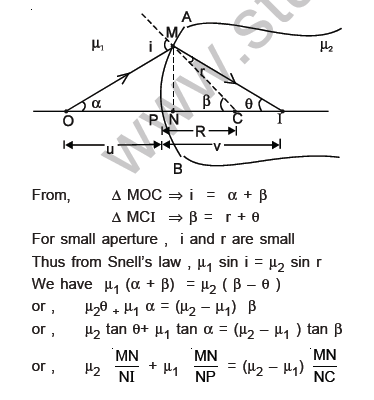
Suppose AB is the spherical surface which saparates the two medium of refractive index μ1 and μ2 .O and Ι is the position of object and image in medium of R.Ι. μ1 and μ2 repectively
or ,
μ2/v– μ1/u = μ2 − μ1/ R
[For small aperture P & N are the same point]
1.2 Terms related to refraction at spherical surfaces
(A) centre of curvature (C) It is the centre of sphere of which the surface is a part.
(B) Radius of curvature (R) It is the radius of the sphere of which the surface is a part.
(C) Pole (P) It is the geometrical centre of the spherical refracting surface .
(D) Principal Axis It is the straight line joining the centre of curvature to the pole.
(E) Focus (F) When a narrow beam of rays of light, parallel to the principal axis and close to it (known as paraxial rays) is incident on a refracting spherical boundary , the refracted beam is found to converge or appear to diverge [depending upon the nature of the boundary (concave/canvex) and the refractive index of two media] from a point on the principal axis .This point is called focus.
Note :
(1) It is not always necessary that for convex boundary the parallel rays always converge. Similarly for concave boundary the incident parallel ray may converge or diverge depending upon the refractive index of two media,
(2) Laws of refraction are valid for spherical surface .
(3) Pole, centre of curvature, Radius of curvature, Principal axis etc. are defined as spherical mirror except for the focus.
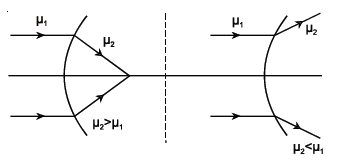

Laws of refraction at curved surface
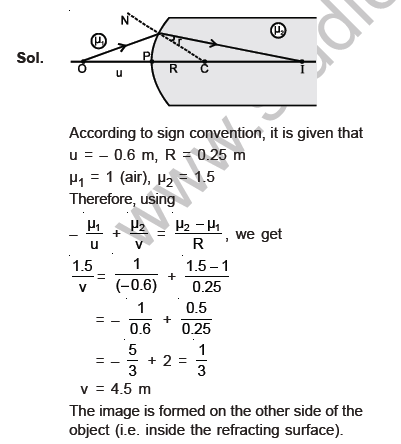
Ex.1 A small point object is placed at O, at a distance of 0.60 metre in air from a convex spherical surface of refractive index 1.5. If the radius of the curvature is 25 cm, then what is the position of the image on the principal axis ?
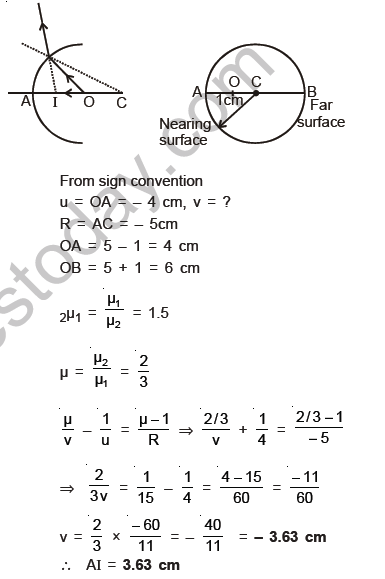
Ex.2 The radius of a glass ball is 5 cm. There is an air bubble at 1cm from the centre of the ball, refractive index of glass is 1.5 then find
position of image (i) viewed from surface near the bubble, (ii) viewed from surface farther from the bubble.
Sol. (i) On viewing from the closer surface A (near to object) : The final image is formed at Ι.

Please click on below link to download pdf file for CBSE Class 12 Physics Refraction at Curved Surface Theory and Examples.
Free study material for Physics
Free CBSE Study Guides: Class 12 Physics Refraction at Curved Surface
Comprehensive Study Resources for Refraction at Curved Surface
Access comprehensive study material for Refraction at Curved Surface, including revision notes, concept maps, and high-probability questions. These resources are designed in alignment with the latest 2026 CBSE syllabus for Class 12 Physics to support effective exam preparation.
Understanding Marking Schemes
Designed around the official curriculum, these study guides guarantee standard compliance. Reviewing step-by-step solutions clarifies complex sub-topics within Refraction at Curved Surface and demystifies standard marking schemes for Physics evaluations.
Complete Revision for Physics
Wrap up your chapter revision by testing your knowledge against standard objective question formats. Explore our full library of free, up-to-date sample papers and online assessments to secure top grades in your CBSE examinations.
FAQs
Our advanced study package for Refraction at Curved Surface includes detailed concepts, diagrams, Mind Maps, and explanation of complex topics to ensure Class 12 students learn as per syllabus for 2026 exams.
The Mind Maps provided for Refraction at Curved Surface act as visual anchors which will help faster recall during high-pressure exams.
Yes, teachers use our Class 12 Physics resources for lesson planning as they are in simple language and have lot of solved examples.
Yes, You can download the complete, mobile-friendly PDF of the Physics Refraction at Curved Surface advanced resources for free.
Yes, our subject matter experts have updated the Refraction at Curved Surface material to align with the rationalized NCERT textbooks and have removed deleted topics and added new competency-based questions.