

Download CBSE Class 12 Physics Useful Resources
Review targeted academic resources with the CBSE Class 12 Physics Heat and Thermodynamics Objective Questions. Built according to official CBSE standards for the 2026-27 term, these downloadable Class 12 Physics study materials support effective daily practice and deeper conceptual understanding for Heat and Thermodynamics.
Access CBSE Study Guides and Summaries
Navigate directly to the advanced Physics study materials using the digital viewer below. Each resource pack includes detailed conceptual summaries and solved practice questions, allowing students to instantly reinforce their learning.
CBSE Class 12 Physics Heat and Thermodynamics Objective Questions. Please refer to the examination notes which you can use for preparing and revising for exams. These notes will help you to revise the concepts quickly and get good marks.
Choose the correct option(s):
1. Two identical rectangular strips, one of copper and the other of steel, are rivetted together to form a bimetallic strip. On heating this strip, it will (αcopper > αsteel)
(a) remain straight (b) bend with copper on the convex side
(c) bend with steel on the convex side (d) get twisted
2. If I is the moment of inertia of solid body, the change in I corresponding to a small change in temperature ΔT is
(a) αI ΔT (b) 1/2 αI ΔT (c) 2 αI ΔT (d) 3 αI ΔT
3. The length of the steel rod which would have the same difference in length with a copper rod of length 16 cm at all temperature (αcopper = 18 × 10–6 K–1, αsteel = 12 × 10–6 K–1) is
(a) 20 cm (b) 18 cm (c) 24 cm (d) 30 cm
4. The density of a solid at 0°C and 500°C is in the ratio 1.027 : 1. The coefficient of linear expansion of the solid is
(a) 20 × 10–6 K–1 (b) 12 × 10–6 K–1 (c) 18 × 10–6 K–1 (d) 24 × 10–6 K–1
5. At 4°C, 98% of the volume of a body is immersed in water. The temperature at which the entire body gets immersed in water (γω = 3.3 × 10⁻⁴ K–1) is (neglect the expansion of the body)
(a) 40.8° C (b) 64.6° C (c) 60.0°C (d) 58.8°C
6. If α is the coefficient of linear expansion, the change in the period t of a physical pendulum with a temperature change of ΔT is
(a) 1/2 αtΔT (b) 1/4 αtΔT (c) 3/4 αtΔT (d) 1/3 αtΔT
7. Which one of the following expressions (notations having their usual meanings) does not represent ideal gas behaviour?
(a) p = ρrT (b) pV = (m/M)RT (c) pV =(m/M)rT (d) p = nkT
8. The volume V versus temperature T graphs for a certain amount of a perfect gas at two pressures p1 and p2 are shown in the figure here.
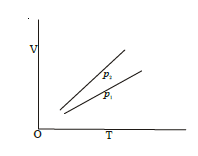
(a) p1 < p2 (b) p1 = p2 (c) p1 > p2 (d) It cannot be ascertained.
9. The molar heat capacity of an ideal gas at constant volume is given by
(a) γ−Ρ/ γ-1 (b) R/ γ-1 (c) γR (d) (γ – 1)R
10. The work done by a gas in an adiabatic process is
(a) P1V1-p2V2/γ-1 (b) P2V2-p1V1/γ-1 (c) R(T1-T2)/ γ-1 (d) nR(T2-T1)/ γ-1
11. An ideal gas is compressed isothermally. The compression agent does 36 joules of work. The amount of heat that flows out from the gas is
(a) zero (b) +36 J (c) – 36 J (d) infinite
12. In an isobaric (constant pressure) process
(a) Δ Q : Δ U = 1 : 1 (b) Δ Q : Δ U = 1 : γ = 1 (c) Δ Q : Δ U = γ – 1 : 1 (d) Δ Q : Δ U = γ : 1
13. In an isobaric process
(a) Δ Q : Δ W = 1 : 1 (b) Δ Q : Δ W = γ : γ – 1 (c) Δ Q : Δ W = γ – 1 : γ (d) Δ Q : Δ W = γ : 1
14. The internal energy of a mole of air (γ = 7/5) in a room of volume V = 40 m³ at 1 atmospheric pressure (= 105 N m–2) is
(a) 105 J (b) 104 J (c) 107 J (d) 108 J
15. In an isobaric process
(a) the heat added is γ −1/γtimes the work done by the gas (b) the work done is zero
(c) the heat added is (γ –1) times the work done (d) the heat added has no relation with the work done
16. For an adiabatic compression, the quantity PV
(a) increases (b) decreases
(c) remains constant (d) may either increase or decrease
17. Q calories of heat is required to raise the temperature of 1 mole of a monoatomic gas from 20°C to 30°C. The amount of heat required to raise the temperature of diatomic gas from 20° C to 25° C is
(a) Q (b) 3Q/2 (c) 5Q/3 (d) 7Q/3
18. The heat capacity of an ideal gas in a polytropic process is C = CV + 0 .1 R. The value of the polytropic exponent is
(a) 11 (b) 10 (c) – 10 (d) –9
19. An ideal gas expands according to the law pV² = constant. The molar heat capacity C is
(a) CV + R (b) CV – R (c) CV + 2R (d) CV – 3R
20. If W1 is the work done in compressing an ideal gas from a given initial state through a certain volume isothermally and W2 is the work done in compressing the same gas from the same initial state through the same volume adiabatically, then
(a) W1 = W2 (b) W1 < W2 (c) W1 > W2 (d) W1 = 2 W2
Please click on below link to download pdf file for CBSE Class 12 Physics Heat and Thermodynamics Objective Questions
Free study material for Physics
Useful Resources and Notes for Class 12 Physics Heat and Thermodynamics
Core Study Kit: Class 12 Physics Heat and Thermodynamics
Review targeted study resources for Heat and Thermodynamics tailored for Class 12 learners. Utilizing these structured notes and quick-revision tools ensures complete alignment with current CBSE evaluation standards.
NCERT-Aligned Solutions for Heat and Thermodynamics
Designed around the official curriculum, these study guides guarantee standard compliance. Reviewing step-by-step solutions clarifies complex sub-topics within Heat and Thermodynamics and demystifies standard marking schemes for Physics evaluations.
Next Steps in Your Exam Preparation
Maximize your grade potential by utilizing Class 12 Physics practice papers in tandem with these structured notes. All printable assignments and interactive mock tests on our platform are updated for the 2026 session and available free of charge.
FAQs
Our advanced study package for Heat and Thermodynamics includes detailed concepts, diagrams, Mind Maps, and explanation of complex topics to ensure Class 12 students learn as per syllabus for 2026 exams.
The Mind Maps provided for Heat and Thermodynamics act as visual anchors which will help faster recall during high-pressure exams.
Yes, teachers use our Class 12 Physics resources for lesson planning as they are in simple language and have lot of solved examples.
Yes, You can download the complete, mobile-friendly PDF of the Physics Heat and Thermodynamics advanced resources for free.
Yes, our subject matter experts have updated the Heat and Thermodynamics material to align with the rationalized NCERT textbooks and have removed deleted topics and added new competency-based questions.