

Class 12 Physics Study Guide: CBSE Class 12 Physics Refraction at Plane Surface Theory and Examples
Access comprehensive study materials and useful resources for Refraction at Plane Surface using the CBSE Class 12 Physics Refraction at Plane Surface Theory and Examples. Designed to align with the 2026-27 CBSE academic guidelines, these advanced resources help Class 12 Physics students reinforce core concepts beyond standard textbooks.
Download Refraction at Plane Surface Study Material PDF
Access the complete useful resource PDF for Class 12 Physics below. Regular practice with these targeted academic notes builds familiarity with complex topics and helps secure higher marks in final school evaluations.
CBSE Class 12 Physics Refraction at Plane Surface Theory and Examples. Please refer to the examination notes which you can use for preparing and revising for exams. These notes will help you to revise the concepts quickly and get good marks.
1. INTRODUCTION
The phenomenon of change in path of light as it goes from one medium to another is called refraction. Refraction phenomenon can be categories, depending upon the type of separating surface which can be further subdivided depending upon the shape of the medium as follows
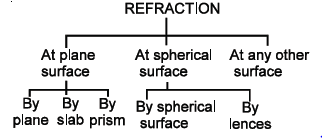
Let us study the refraction phenomenon for individual cases :
2. ABSOLUTE REFRACTIVE INDEX
The refractive index (μ) of a medium is defined as the ratio of the speed of light in vacuum (c) to the speed of light in the medium (v), i.e., μ = c/v
Note:
1. It is a scalar quantity without any unit or dimension.
2. If ε0 and μ0 are electric permittivity and magnetic permeability of vacuum while ε and μ are that of a given medium then

3. For vacuum, μ = 1 as v = c
4. Absolute refractive index of any medium is greater than one.
5. Refractive index of a medium also depends on the wavelength of light used. As per Cauchy’s formula
μ = A + B/λ2 + ..... longer the wavelength smaller is the refractive index.
3. RELATIVE REFRACTIVE INDEX
The relative refractive index of two media is equal to the ratio of their absolute refractive indices.
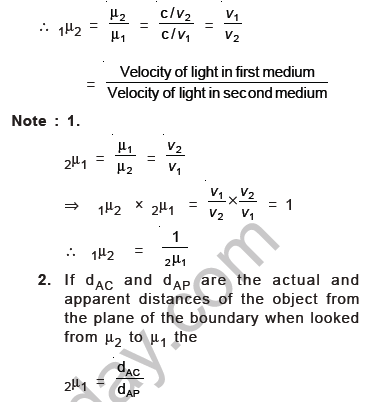
4. LAWS OF REFRACTION
(a) Frequency (and hence colour) and phase do not change (while wavelength and velocity changes)
(b) Incident ray, refracted ray, and normal always lie in the same plane.
(c) SNELL’S LAW :
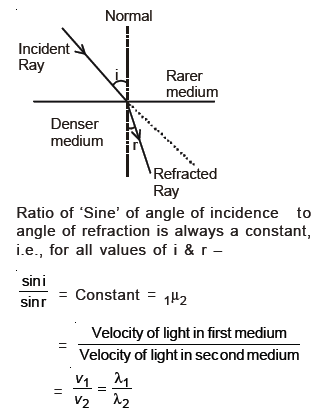
5. APPLICATION OF SNELL’S LAW
(a) When light passes from rarer to denser medium it bends toward the normal. Using Snell’s law
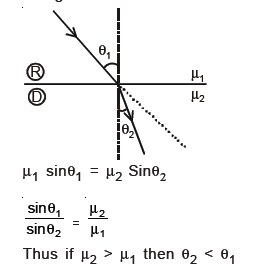
(b) When light passes from denser to rarer medium it bends away from the normal. From Snell’s law.

(c) When light propagates through a series of layers of different medium, then according to Snell’s law

(d) CONDITIONS OF NO REFRACTION :
(A) If light is incident normally on a boundary i.e., ∠ i = 0º, Then from Snell’s law, μ1 sin 0 = μ2 sin r, ⇒ sin r = 0 i.e. ∠ r = 0 i.e., light passes undeviated from the boundary. (So boundary will be invisible)
(B) If the refractive indices of two media are equal i.e., if,μ1 = μ2 = μ, Then from Snell’s law μ sin i = μ sin r ⇒∠ i = ∠ r i.e., ray passes undeviated from the boundary with ∠ i = ∠ r ≠ 0 and boundary will not be visible. This is also why a transparent solid is invisible in a liquid if μS = μL
(e) RELATION BETWEEN OBJECT AND IMAGE DISTANCE :
An object O placed in first medium (refractive index μ1) is viewed from the second medium (refractive index μ2). Then the image distance dAP and the object distance dAC are related as
dAP =(μ2/μ1)dAC
Please click on below link to download pdf file for CBSE Class 12 Physics Refraction at Plane Surface Theory and Examples.
Free study material for Physics
Physics Class 12 Exam Resources: Refraction at Plane Surface
Comprehensive Study Resources for Refraction at Plane Surface
Access comprehensive study material for Refraction at Plane Surface, including revision notes, concept maps, and high-probability questions. These resources are designed in alignment with the latest 2026 CBSE syllabus for Class 12 Physics to support effective exam preparation.
Understanding Marking Schemes
Designed around the official curriculum, these study guides guarantee standard compliance. Reviewing step-by-step solutions clarifies complex sub-topics within Refraction at Plane Surface and demystifies standard marking schemes for Physics evaluations.
Complete Revision for Physics
Maximize your grade potential by utilizing Class 12 Physics practice papers in tandem with these structured notes. All printable assignments and interactive mock tests on our platform are updated for the 2026 session and available free of charge.
FAQs
Our advanced study package for Refraction at Plane Surface includes detailed concepts, diagrams, Mind Maps, and explanation of complex topics to ensure Class 12 students learn as per syllabus for 2026 exams.
The Mind Maps provided for Refraction at Plane Surface act as visual anchors which will help faster recall during high-pressure exams.
Yes, teachers use our Class 12 Physics resources for lesson planning as they are in simple language and have lot of solved examples.
Yes, You can download the complete, mobile-friendly PDF of the Physics Refraction at Plane Surface advanced resources for free.
Yes, our subject matter experts have updated the Refraction at Plane Surface material to align with the rationalized NCERT textbooks and have removed deleted topics and added new competency-based questions.