

Class 12 Physics Study Guide: CBSE Class 12 Physics Optics Exam Notes
Explore structured advanced study materials through the CBSE Class 12 Physics Optics Exam Notes. Tailored for Class 12 learners, utilizing these Physics resources ensures thorough preparation and strengthens foundational knowledge before final CBSE evaluations.
Download Chapter 09 Ray Optics and Optical Instruments Study Material PDF
Access the complete useful resource PDF for Class 12 Physics below. Regular practice with these targeted academic notes builds familiarity with complex topics and helps secure higher marks in final school evaluations.
CBSE Class 12 Physics Optics Exam Notes. Please refer to the examination notes which you can use for preparing and revising for exams. These notes will help you to revise the concepts quickly and get good marks.
Laws of Reflection :
1. The incident ray, the reflected ray and the normal at the point of incidence lie in the same plane.
2. The angle of incidence is equal to the angle of reflection, i.e., incident ray and reflected ray form same angle with normal at point of incidence.
Characteristics of Images formed by Plane mirror :
1. The image of a real object formed by reflection from a plane mirror is virtual, erect and is laterally inverted.
2. Object and image are on opposite side of mirror but their distances from mirror is same.
3. The size of the image is equal to the size of the object.
4. If the plane mirror is rotated through a certain angle, the reflected ray for any fixed incident ray is rotated through double the angle. If the mirror is moved through a certain distance towards or away from the object, the image moves through double the distance respectively.
5. When two plane mirrors are inclined at an angle θ and an object is placed between these mirrors, then multiple number of images, n, are formed due to successive reflections as follows :
(i) If [360/θ] is even number of images, n=[360/θ]-1
(ii) If [360/θ] is odd and the object lies unsymmetrically, n=[360/θ]
(iii) If object is placed at angle bisector of two mirror, the no of images reduces by one in both the case (i) and (ii).
(iv) If the two mirrors are parallel to each other, an infinite number of images will be formed of diminishing intensity due to absorption of light in multiple reflections.
6. Velocity of object w.r.t. mirror = – velocity of image w.r.t. mirror.
Spherical Mirrors
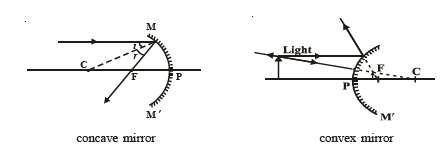
A spherical mirror is a smooth reflecting surface which forms a part of a spherical surface. If reflection takes place from the inner reflecting surface, the mirror is called a concave mirror. If the reflection takes place from the outer surface, it is called a convex mirror. The reflection of light from a concave or convex mirror is shown in the figure.
Parameters associated with mirror
Pole or vertex is the geometrical centre of reflecting surface. Centre of curvature C is the centre of the sphere of which the mirror forms a part. Radius of curvature R is equal to the distance between the pole P and centre of curvature of the mirror and is the radius of the sphere of which the mirror is a part. Principal axis is the line CP which passes through pole P and centre of curvature C. If a ray of light is incident from an object at infinity so that the beam of light is parallel to the principal axis, the image is formed at principal focus F after reflection. Focal length, f, is the distance between pole P and focus F along principal axis. When a beam of light is incident parallel to principal axis, the reflected rays converge to a point F for concave mirror and appear to diverge from a point for convex mirror after reflection. Aperture of a spherical mirror is the effective diameter MM′ of light reflecting area of the mirror. For a mirror of small aperture, the focal length is equal to half the radius of curvature.
Sign Convention :
The following sign convention based on coordinate geometry is convenient to adopt :
1. The rays of light are considered to travel from left to right direction.
2. All the distances are measured from the pole and the distances in the direction of light towards the right of the pole are taken as positive. The distances measured in the opposite direction of light to the left of pole are taken as negative.
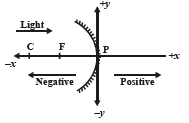
3. The transverse distances above principal axis are taken as positive and the distances below the principal axis are taken as negative. If the condition (1) in sign convention is followed, this sign convention follows right hand Cartesian coordinate system.
Rules for Image Formation :
These rules are used for locating the image of an object by considering the reflection of the following three rays based on laws of reflection :
1. A ray incident parallel to the principal axis will pass through the principal focus after reflection in the case of a concave mirror and will appear to pass through the focus in the case of convex mirror.
2. A ray which passes through the principal focus of a concave mirror, or which appears to go towards the principal focus of a convex mirror, goes parallel to the principal axis after reflection.
Please click on below link to download pdf file for CBSE Class 12 Physics Optics Exam Notes.
Free study material for Physics
Physics Class 12 Exam Resources: Chapter 09 Ray Optics and Optical Instruments
Core Study Kit: Class 12 Physics Chapter 09 Ray Optics and Optical Instruments
Explore essential learning tools for Class 12 Physics Chapter 09 Ray Optics and Optical Instruments. This curated collection features in-depth notes and targeted practice questions built around the active 2026 curriculum to streamline your daily revision.
NCERT-Aligned Solutions for Chapter 09 Ray Optics and Optical Instruments
Designed around the official curriculum, these study guides guarantee standard compliance. Reviewing step-by-step solutions clarifies complex sub-topics within Chapter 09 Ray Optics and Optical Instruments and demystifies standard marking schemes for Physics evaluations.
Next Steps in Your Exam Preparation
Wrap up your chapter revision by testing your knowledge against standard objective question formats. Explore our full library of free, up-to-date sample papers and online assessments to secure top grades in your CBSE examinations.
FAQs
Our advanced study package for Chapter 09 Ray Optics and Optical Instruments includes detailed concepts, diagrams, Mind Maps, and explanation of complex topics to ensure Class 12 students learn as per syllabus for 2026 exams.
The Mind Maps provided for Chapter 09 Ray Optics and Optical Instruments act as visual anchors which will help faster recall during high-pressure exams.
Yes, teachers use our Class 12 Physics resources for lesson planning as they are in simple language and have lot of solved examples.
Yes, You can download the complete, mobile-friendly PDF of the Physics Chapter 09 Ray Optics and Optical Instruments advanced resources for free.
Yes, our subject matter experts have updated the Chapter 09 Ray Optics and Optical Instruments material to align with the rationalized NCERT textbooks and have removed deleted topics and added new competency-based questions.