

Official CBSE Study Materials for Class 12 Physics
Access comprehensive study materials and useful resources for Simple Harmonic Motion using the CBSE Class 12 Physics Simple Harmonic Motion Solved Examples. Designed to align with the 2026-27 CBSE academic guidelines, these advanced resources help Class 12 Physics students reinforce core concepts beyond standard textbooks.
Advanced Resources for Physics
Navigate directly to the advanced Physics study materials using the digital viewer below. Each resource pack includes detailed conceptual summaries and solved practice questions, allowing students to instantly reinforce their learning.
CBSE Class 12 Physics Simple Harmonic Motion Solved Examples. Please refer to the examination notes which you can use for preparing and revising for exams. These notes will help you to revise the concepts quickly and get good marks.
Simple Harmonic Motion: Solved Examples
Example: Find the time period of small oscillations in a horizontal plane performed by a ball of mass 40 g fixed at the middle of a horizontally stretched string 1.0 m in length. The tension of the string is assumed to be constant and equal to 10 N.

Solution: Consider a ball of mass \(m\) placed at the middle of a string of length \(l\) and tension \(T\). The component of tension \(T\) towards the mean position is \(T\cos\theta\). The force acting on the ball is \(2T\cos\theta\).
\[\therefore\ ma=-\frac{2Tx}{\sqrt{l^2/4+x^2}}\qquad\left(\because\ \text{the force is }T\text{ and }\cos\theta=\frac{x}{\sqrt{l^2/4+x^2}}\right)\]
As \(x\) is small, \(x^2\) can be neglected in the denominator.
\[\therefore\ a=-\frac{2Tx}{m(l/2)}=-\left(\frac{4T}{ml}\right)x=-\omega^2x\]
The acceleration is directly proportional to the negative of the displacement \(x\) and is directed towards the mean position. Hence the motion is S.H.M.
\[T=\frac{2\pi}{\omega}=\frac{2\pi}{\sqrt{4T/ml}}=\pi\sqrt{\frac{ml}{T}}\]
Substituting the given values, we get
\[T=3.14\times\sqrt{\frac{(4\times10^{-2})(1.0)}{10}}=0.2\text{ s}\]
Example: If a tunnel is dug through the earth from one side to the other side along a diameter, show that the motion of a particle dropped into the tunnel is simple harmonic motion. Find the time period. Neglect all the frictional forces and assume that the earth has a uniform density. \(G=6.67\times10^{-11}\text{ N m}^2\text{ kg}^{-2}\); density of earth \(=5.51\times10^{3}\text{ kg m}^{-3}\)
Solution: Consider a tunnel dug along the diameter of the earth. A particle of mass \(m\) is placed at a distance \(y\) from the centre of the earth. There will be a gravitational attraction of the earth experienced by this particle due to the mass of matter contained in a sphere of radius \(y\). Force acting on the particle at distance \(y\) from the centre
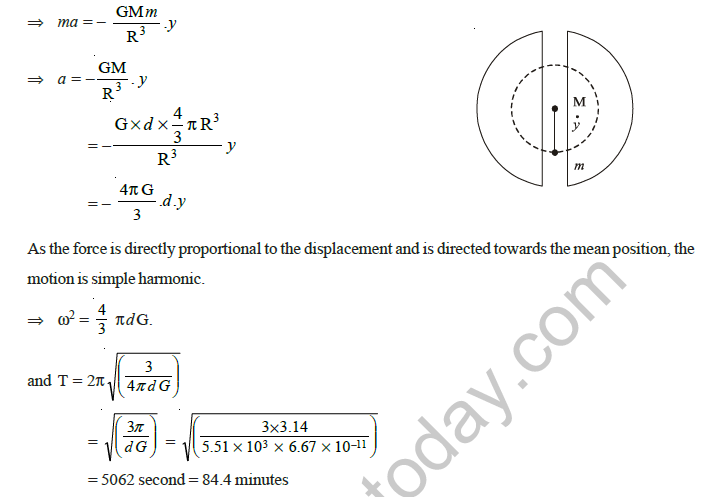
\[F=\frac{GMm}{R^3}\,y\]
\[\Rightarrow\ ma=-\frac{GMm}{R^3}\,y\ \Rightarrow\ a=-\frac{GM}{R^3}\,y=-\frac{G\times d\times\frac43\pi R^3}{R^3}\,y=-\frac{4\pi G}{3}\,d\,y\]
As the force is directly proportional to the displacement and is directed towards the mean position, the motion is simple harmonic.
\[\Rightarrow\ \omega^2=\frac43\pi dG\]
\[\text{and }T=2\pi\sqrt{\frac{3}{4\pi dG}}=\sqrt{\frac{3\pi}{dG}}=\sqrt{\frac{3\times3.14}{5.51\times10^3\times6.67\times10^{-11}}}=5062\text{ s}=84.4\text{ minutes}\]
Example: Two light springs of force constants \(k_1\) and \(k_2\) and a block of mass \(m\) are in one line AB on a smooth horizontal table such that one end of each spring is fixed on rigid supports and the other end is free as shown in the figure.
The distance CD between the free ends of the springs is 60 cm. If the block moves along AB with a velocity 120 cm/s in between the springs, calculate the period of oscillation of the block. (\(k_1=1.8\text{ N/m},\ k_2=3.2\text{ N/m},\ m=200\text{ g}\)). Initially the block is midway between C and D.
Solution: If initially the block is midway between C and D, the time period \(T\) is equal to the sum of the time to travel 30 cm to the right, the time in contact with spring \(k_2\), the time to travel 60 cm to the left, the time in contact with spring \(k_1\) and the time to travel 30 cm to the right.
\[\therefore\ T=\frac{30}{120}+\frac12\left[2\pi\sqrt{\frac m{k_2}}\right]+\frac{60}{120}+\frac12\left[2\pi\sqrt{\frac m{k_1}}\right]+\frac{30}{120}\]
\[=0.25+\pi\sqrt{\frac{0.2}{3.2}}+0.5+\pi\sqrt{\frac{0.2}{1.8}}+0.25=0.25+\frac\pi4+0.5+\frac\pi3+0.25=2.83\text{ s}\]
Example: Two identical balls A and B, each of mass 0.1 kg, are attached to two identical massless springs. The spring–mass system is constrained to move inside a rigid smooth pipe bent in the form of a circle as shown in the figure. The pipe is fixed in a horizontal plane. The centres of the balls can move in a circle of radius 0.06 m. Each spring has a natural length \(0.06\pi\text{ m}\) and spring constant 0.1 N/m. Initially both the balls are displaced by angle \(\pi/6\) radian with respect to the diameter PQ of the circle and released from rest.
- Calculate the frequency of oscillation of ball B.
- Find the speed of the ball A when A and B are at the two ends of diameter PQ.
- What is the total energy of the system?
Solution: (a) Restoring force on A or B \(=k\Delta x+k\Delta x=2k\Delta x\),
Solution: (a) Restoring force on A or B \(=k\Delta x+k\Delta x=2k\Delta x\), where \(\Delta x\) is the compression in the spring at one end. Effective force constant \(=2k\).
. Effective force constant \(=2k\).\[\text{Frequency }\nu=\frac1{2\pi}\sqrt{\frac{2k}{\mu}}\quad\text{where }\mu\text{ is the reduced mass of the system: }\mu=\frac{m\cdot m}{m+m}=\frac m2\]
\[\nu=\frac1{2\pi}\sqrt{\frac{2k}{m/2}}=\frac1{2\pi}\sqrt{\frac{0.4}{0.1}}=\frac1{2\pi}\times2=\frac1{3.14}\text{ Hz}\]
(b) P and Q are the equilibrium positions. Balls A and B at P and Q have only kinetic energy, and it is equal to the potential energy at the extreme positions.
\[\text{P.E. at extreme positions}=\frac12k(2\Delta x)^2+\frac12k(2\Delta x)^2=4k(\Delta x)^2,\qquad\Delta x=R\times\frac\pi6\]
\[\Rightarrow\ \text{P.E.}=\frac{4\pi^2kR^2}{36}=\frac{\pi^2kR^2}{9}=\frac{(3.14)^2\times0.1\times(0.06)^2}{9}\approx3.94\times10^{-4}\text{ J}\]
When the balls A and B are at points P and Q respectively, \(KE_A+KE_B=\text{P.E.}\), i.e., \(2KE_A=\text{P.E.}\):
\[2\times\frac12mv^2=3.94\times10^{-4}\ \Rightarrow\ v=\left(\frac{3.94}{0.1}\right)^{1/2}\times10^{-2}=6.28\times10^{-2}=0.0628\text{ m s}^{-1}\]
(c) The total potential and kinetic energy of the system is equal to the total potential energy at the extreme position, \(=3.94\times10^{-4}\text{ J}\).
Example: Two non-viscous, incompressible and immiscible liquids of density \(\rho\) and \(1.5\rho\) are poured into two limbs of a circular tube of radius \(R\) and small cross-section kept fixed in a vertical plane as shown in the figure. Each liquid occupies one fourth of the circumference of the tube.
- Find the angle that the radius vector to the interface makes with the vertical in the equilibrium position.
- If the whole liquid is given a small displacement from its equilibrium position, show that the resulting oscillations are simple harmonic. Find the time period of these oscillations.
Solution: (a) Density of liquid column BC \(=1.5\rho\); density of liquid column CD \(=\rho\).
Pressure at A due to liquid column BA:
\[p_{AB}=AF\times1.5\rho g=(AO-OF)\,1.5\rho g=(R-R\sin\theta)\,1.5\rho g\]
Pressure at A due to liquid column AD:
\[p_{AD}=AE\times1.5\rho g+EG\,\rho g=(AO-OE)\,1.5\rho g+(EO+OG)\,\rho g=(R-R\cos\theta)\,1.5\rho g+R(\cos\theta+\sin\theta)\,\rho g\]
In equilibrium \(p_{AB}=p_{AD}\):
\[R(1-\sin\theta)\,1.5\rho g=R(1-\cos\theta)\,1.5\rho g+R(\cos\theta+\sin\theta)\,\rho g\]
\[1.5-1.5\sin\theta=1.5-1.5\cos\theta+\cos\theta+\sin\theta\ \Rightarrow\ -2.5\sin\theta=-0.5\cos\theta\]
\[\tan\theta=\frac{0.5}{2.5}=\frac15,\quad\text{or}\quad\theta=\tan^{-1}\left(\frac15\right)\]
(b) If \(a\) is the area of cross-section, the length of each column \(=\dfrac{2\pi R}{4}=\dfrac{\pi R}{2}\).
\[\text{Volume of each column}=\frac{\pi Ra}{2},\quad\text{mass of column }BC=\frac{\pi Ra}{2}\times1.5\rho,\quad\text{mass of column }CD=\frac{\pi Ra}{2}\times\rho\]
\[\text{M.I. of whole liquid about }O=\left(\frac{\pi Ra\rho}{2}\right)(1.5+1)R^2\ \text{ or }\ I=\frac{2.5\pi R^3a\rho}{2}\]
Let \(y\) be a small displacement towards left and \(\theta\) be the angular displacement, \(\theta=\dfrac yR\) or \(y=R\theta\). Angular acceleration \(=\dfrac{d^2\theta}{dt^2}\). Torque about A \(=I\dfrac{d^2\theta}{dt^2}=\dfrac{2.5\pi R^3a\rho}{2}\left(\dfrac{d^2\theta}{dt^2}\right)\).
, so \(\varphi=y/R\). If the liquid is displaced by \(\varphi\), a length \(y=R\varphi\) of the tube changes its contents at each of the three boundaries B, C and D. The change in the moment of the weight about \(O\) is\[Restoring torque due to displaced liquid,\[\tau_{rest}=-[ay\times1.5\rho g+ay\rho g]\times R\cos\theta=-2.5\,ay\rho g\times R\cos\theta\]
+(x_D-x_C)\big],\quad x_B=-R\cos\theta,\ x_C=R\sin\theta,\ x_D=R\cos\theta\]\[\[\tau_{rest}=-2.5\,a\rho gR^2\cos\theta\cdot\theta\]
[\(R\cos\theta\) is the perpendicular distance of the gravitational force from the axis of rotation]
\,\varphi\]Equating, \[\left(\frac{2.5\pi R^3a\rho}{2}\right)\frac{d^2\theta}{dt^2}=-(2.5\,a\rho gR^2\cos\theta)\,\theta\]
\[\frac{d^2\theta}{dt^2}=-\left(\frac{2g\cos\theta}{\pi R}\right)\theta=-\omega^2\theta\]
and \(\sin\theta=\tfrac1{\sqrt{26}}\), so \(2.5\cos\theta+0.5\sin\theta=\tfrac{13}{\sqrt{26}}=\tfrac{\sqrt{26}}{2}\). Equating \(I\dfrac{d^2\varphi}{dt^2}\) to the restoring torque:\[\frac{2.5\pi R^3a\rho}{2}\frac{d^2\varphi}{dt^2}=-\left(a\rho gR^2\frac{\sqrt{26}}{2}\right)\varphi\ \Rightarrow\ \frac{d^2\varphi}{dt^2}=-\left(\frac{\sqrt{26}\,g}{2.5\,\pi R}\right)\varphi=-\omega^2\varphi\]
As \(\omega^2\) is a constant, the angular acceleration is proportional to the angular displacement and is directed towards the mean position, so the liquid undergoes S.H.M.
\[\[T=\frac{2\pi}{\omega}=2\pi\times\sqrt{\frac{\pi R}{2g\cos\theta}}\]
As \(\tan\theta=\dfrac15\), \(\cos\theta=\dfrac5{\sqrt{26}}\), \[T=2\pi\sqrt{\frac{\pi R}{2\times g\times\frac5{\sqrt{26}}}}=2(\pi)^{3/2}\sqrt{\frac{R}{\left(\frac{10g}{\sqrt{26}}\right)}}\]
\approx2\pi\sqrt{1.54\,\frac Rg}\]as \(2.5\,a\rho gR^2\cos\theta\,\varphi\) (using the same lever arm \(R\cos\theta\) at all three boundaries), which gives \(T=2\pi\sqrt{\pi R\sqrt{26}/(10g)}\). The lever arms at B, C and D are different (as shown above), so the term \(0.5\sin\theta\) must be added; the corrected period is about 3% smaller. The equilibrium angle \(\tan^{-1}(1/5)\) is unaffected.
Example: A thin rod of length \(L\) and area of cross-section \(S\) is pivoted at its lowest point P inside a stationary, homogeneous and non-viscous liquid as shown in the figure. The rod is free to rotate in a vertical plane about a horizontal axis passing through P. The density \(d_1\) of the material of the rod is smaller than the density \(d_2\) of the liquid. The rod is displaced by a small angle \(\theta\) from its equilibrium position and then released. Show that the motion of the rod is simple harmonic and determine its angular frequency in terms of the given parameters.
Solution: Consider the rod displaced through an angle \(\theta\). The different forces on the rod are shown in the figure.
\[\text{Weight of the rod (downward)}=SLd_1g=mg,\qquad\text{buoyant force (upward)}=SLd_2g\]
\[\text{Net thrust on the rod, upward: }F=SL(d_2-d_1)g\]
\[\text{Restoring torque }\tau=F\times\frac L2\sin\theta=SL(d_2-d_1)g\,\frac L2\sin\theta\approx SL(d_2-d_1)g\,\frac L2\,\theta\quad(\text{for small }\theta,\ \sin\theta\approx\theta)\]
If \(\theta\) is in the clockwise direction, then \(\tau\) will be in the anticlockwise direction.
\[\therefore\ \tau=-\frac12SL^2(d_2-d_1)g\,\theta\]
\[\tau=I\alpha=\left(\frac{ML^2}{3}\right)\frac{d^2\theta}{dt^2}=\left(\frac{SLd_1\times L^2}{3}\right)\frac{d^2\theta}{dt^2}\]
\[\therefore\ \frac{d^2\theta}{dt^2}=-\frac{3}{SL^3d_1}\times\frac12SL^2(d_2-d_1)g\,\theta\quad\text{or}\quad\frac{d^2\theta}{dt^2}+\frac{3g}{2L}\left(\frac{d_2-d_1}{d_1}\right)\theta=0\]
so the motion is S.H.M.; comparing with the differential equation of S.H.M. \(\dfrac{d^2\theta}{dt^2}+\omega^2\theta=0\):
\[\omega=\sqrt{\frac{3g}{2L}\left(\frac{d_2-d_1}{d_1}\right)}\]
\[\text{Time period }T=\frac{2\pi}{\omega}=2\pi\sqrt{\frac{2Ld_1}{3g(d_2-d_1)}}\]

Free study material for Physics
Free CBSE Study Guides: Class 12 Physics Simple Harmonic Motion
Comprehensive Study Resources for Simple Harmonic Motion
Access comprehensive study material for Simple Harmonic Motion, including revision notes, concept maps, and high-probability questions. These resources are designed in alignment with the latest 2026 CBSE syllabus for Class 12 Physics to support effective exam preparation.
Understanding Marking Schemes
Built using official NCERT guidelines for Class 12 Physics, these materials provide reliable academic support. Integrating past examination questions and step-by-step solutions helps students understand official CBSE grading criteria.
Complete Revision for Physics
Maximize your grade potential by utilizing Class 12 Physics practice papers in tandem with these structured notes. All printable assignments and interactive mock tests on our platform are updated for the 2026 session and available free of charge.
FAQs
Our advanced study package for Simple Harmonic Motion includes detailed concepts, diagrams, Mind Maps, and explanation of complex topics to ensure Class 12 students learn as per syllabus for 2026 exams.
The Mind Maps provided for Simple Harmonic Motion act as visual anchors which will help faster recall during high-pressure exams.
Yes, teachers use our Class 12 Physics resources for lesson planning as they are in simple language and have lot of solved examples.
Yes, You can download the complete, mobile-friendly PDF of the Physics Simple Harmonic Motion advanced resources for free.
Yes, our subject matter experts have updated the Simple Harmonic Motion material to align with the rationalized NCERT textbooks and have removed deleted topics and added new competency-based questions.