

Download CBSE Class 12 Physics Useful Resources
Access comprehensive study materials and useful resources for Solids and Fluids using the CBSE Class 12 Physics Solids and Fluids Advanced Problems. Designed to align with the 2026-27 CBSE academic guidelines, these advanced resources help Class 12 Physics students reinforce core concepts beyond standard textbooks.
Access CBSE Study Guides and Summaries
Access the complete useful resource PDF for Class 12 Physics below. Regular practice with these targeted academic notes builds familiarity with complex topics and helps secure higher marks in final school evaluations.
CBSE Class 12 Physics Solids and Fluids Advanced Problems. Please refer to the examination notes which you can use for preparing and revising for exams. These notes will help you to revise the concepts quickly and get good marks.
1. A sphere of radius 0.1 m and mass 8π kg is attached to the lower end of a steel wire of length 5.0 m and diameter 10–3 m. The wire is suspended from 5.22 m high ceiling of a room. When the sphere is made to swing as a simple pendulum, it just grazes the floor at its lowest point. Claculate the velocity of the sphere at its lowest point. Young’s modulus for steel is 1.994 × 10¹¹ Nm–2.
2. A load of 981 Newton is suspended from a steel wire of radius 1 mm. Find the maximum angle through which the wire with its load can be deflected so that it does not break when the load passes through the position of equilibrium. Breaking stress is equal to 7.85 × 10⁸ Nm–2.
3. A uniform heavy rod of weight W, cross-sectional area A and length L is hanging from a fixed support. Young’s modulus of the material of the rod is Y. Neglect the lateral contraction. Find the elongation of the rod.
4. A block of weight 10 N is fastened to one end of a wire of cross-sectional area 3 mm² and is rotated in a vertical circle of radius 20 cm. The speed of the block at the bottom of the circle is 2 m/s. Find the elongation of the wire when the block is at the bottom of the circle. Young’s modulus of the material of the wire = 2 × 10¹¹ N/m².
5. Two rods of different metals, having the same area of cross-section A, are placed end to end between two massive walls as shown in figure. The first rod has a length L1, coefficient of linear expansion α1 and Young’s modulus Y1. The corresponding quantities for second rod are L2, α2 and Y2. The temperature of both the rods is now raised by T degrees.

(a) Find the force with which the rods act on each other at the higher temperature in terms of the given quantities.
(b) Also find the lengths of the rods at the higher temperature. Assume that there is no change in the cross-sectional area of the rods and the rods do not bend. There is no deformation of walls.
6. Two rods of equal cross-sections, one of copper and the other of steel, are joined to form a composite rod of length 2.0 m. At 20°C the length of the copper rod is 0.5 m. When the temperature is raised to 120°C the length of the composite rod increases to 2.002 m. If the composite rod is fixed between two rigid walls and is, thus, not allowed to expand, it is found that the lengths of the two component rods also do not change with the increase in temperature. Calculate the Young’s modulus and the coefficient of linear expansion of steel. Given YCu = 1.3 × 10¹³ N/m² and αCu = 1.6 × 10⁻⁵/°C.
7. A rod AD consisting of three segments AB, BC and CD joined together is hanging vertically from a fixed support at A. The length of the segments are respectively 0.1 m, 0.2 m and 0.15 m. The crosssection of the rod is 10–4 m². A weight of 10 kg is hung from D. Calculate the displacements of points B, C and D if YAB = 2.5 × 10¹⁰ N/m², YBC= 4 × 10¹⁰ N/m² and YCD = 1 × 10¹⁰ N/m². (Neglect the weight of the rod.)
8. A rod of length 6 m has a mass of 12 kg. If it is hinged at one end at a distance of 3 m below a water surface, find
(a) the weight which must be attached to the end of the rod so that 5 m of the rod is submerged,
(b) the magnitude and direction of the force exerted by the hinge on the rod. The specific gravity of the material of the rod is 0.5.
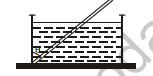
9. A wooden plank of length 1 m and uniform area of cross-section is hinged at one end to the bottom of a tank as shown in the figure. The tank is filled with water upto a height of 0.5 m. Find the angle θ that the plank makes with the vertical in the equilibrium position. Exclude the case θ = 0.
10. A tube, bent at right angles, is lowered into a water stream as shown in the figure. The velocity of the stream is 2.5 ms–1. The closed upper end of the tube is located at a height 12 cm from the surface of the liquid. Find the height upto which the water jet will rise.

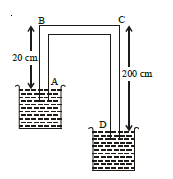
11. The figure shows a siphon in action. The liquid flowing through the siphon has a density of 1.5 gm/cc. Calculate the pressure difference between
(a) Points A and D,(b) Points B and C.
12. Water stands at a depth H in a tank, whose side walls are vertical. A hole is made on one of the walls at a depth h below the water surface. Find at what distance from the foot of the wall does the emerging stream of water strike the floor and for what value of h this range is maximum ?
Please click on below link to download pdf file for CBSE Class 12 Physics Solids and Fluids Advanced Problems.
Free study material for Physics
Physics Class 12 Exam Resources: Solids and Fluids
Comprehensive Study Resources for Solids and Fluids
Explore essential learning tools for Class 12 Physics Solids and Fluids. This curated collection features in-depth notes and targeted practice questions built around the active 2026 curriculum to streamline your daily revision.
Understanding Marking Schemes
Designed around the official curriculum, these study guides guarantee standard compliance. Reviewing step-by-step solutions clarifies complex sub-topics within Solids and Fluids and demystifies standard marking schemes for Physics evaluations.
Complete Revision for Physics
Wrap up your chapter revision by testing your knowledge against standard objective question formats. Explore our full library of free, up-to-date sample papers and online assessments to secure top grades in your CBSE examinations.
FAQs
Our advanced study package for Solids and Fluids includes detailed concepts, diagrams, Mind Maps, and explanation of complex topics to ensure Class 12 students learn as per syllabus for 2026 exams.
The Mind Maps provided for Solids and Fluids act as visual anchors which will help faster recall during high-pressure exams.
Yes, teachers use our Class 12 Physics resources for lesson planning as they are in simple language and have lot of solved examples.
Yes, You can download the complete, mobile-friendly PDF of the Physics Solids and Fluids advanced resources for free.
Yes, our subject matter experts have updated the Solids and Fluids material to align with the rationalized NCERT textbooks and have removed deleted topics and added new competency-based questions.